The Making of Surplus Strips Part 2 – The Quilt Top and Basting

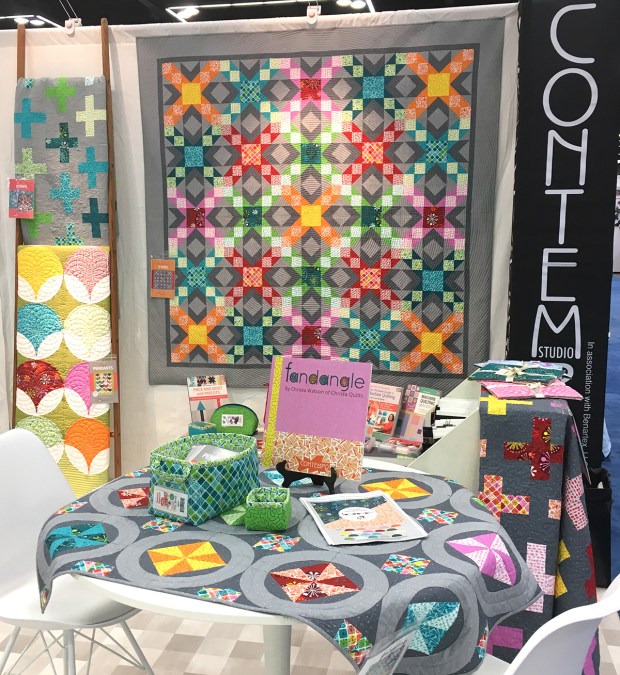
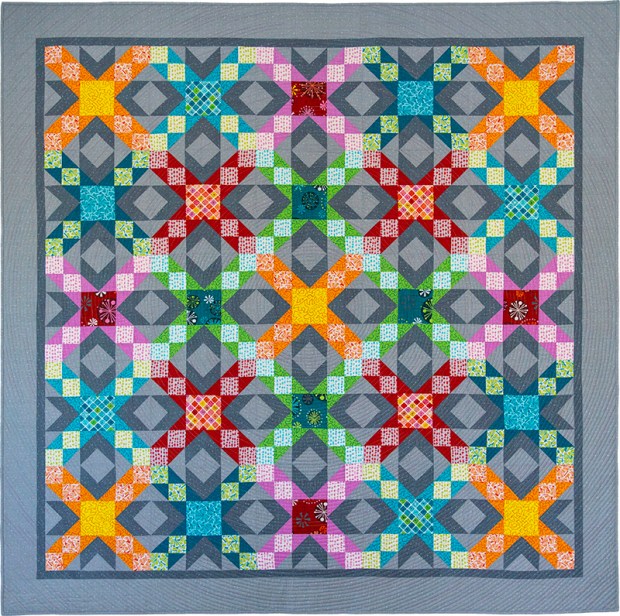
As I prepare for International Quilt Market, which is an industry trade show held this spring in Portland, Oregon (May 18-20), I’m sewing like a madwoman, finishing up samples to promote my new quilt patterns and Fandangle fabric line. I’m currently working on two versions of my Surplus Strips Quilt Pattern – in warm and cool colors. Click here to read my previous post about making the blocks.

Color Arrangement

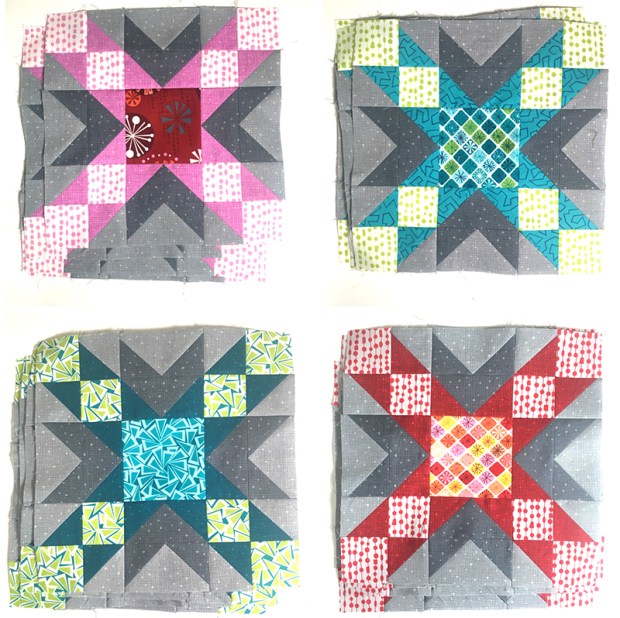
Surplus Strips Blocks in Cool Fandangle

Arranging tiny blocks was much faster than using my design wall!

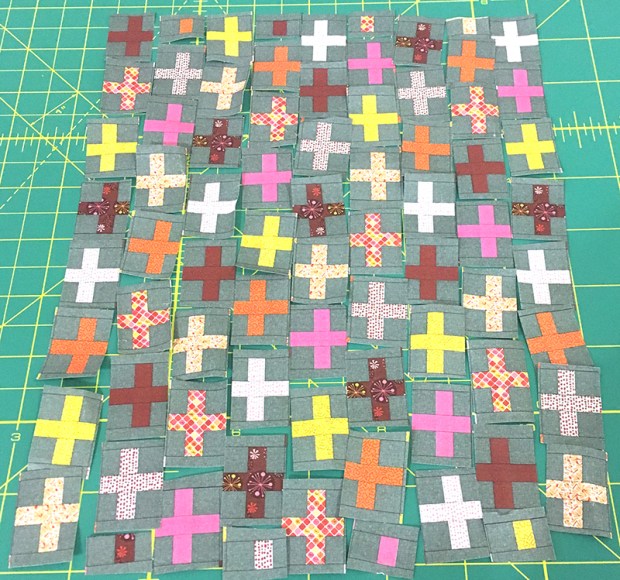
Although I designed both colorways in EQ8, I didn’t finalize the exact color placement for each block. Instead, I did something very low tech. I printed out a version of the quilt with the same number of blocks that I made and then cut out all of the tiny paper blocks to arrange on my work table. It actually went a lot faster than putting up the blocks on my design wall and arranging them there.

Surplus Strips Paper Blocks - Warm Fandangle

I like being able to rearrange the blocks until I’m happy with their color placement.
These paper blocks are only about 1″ wide!

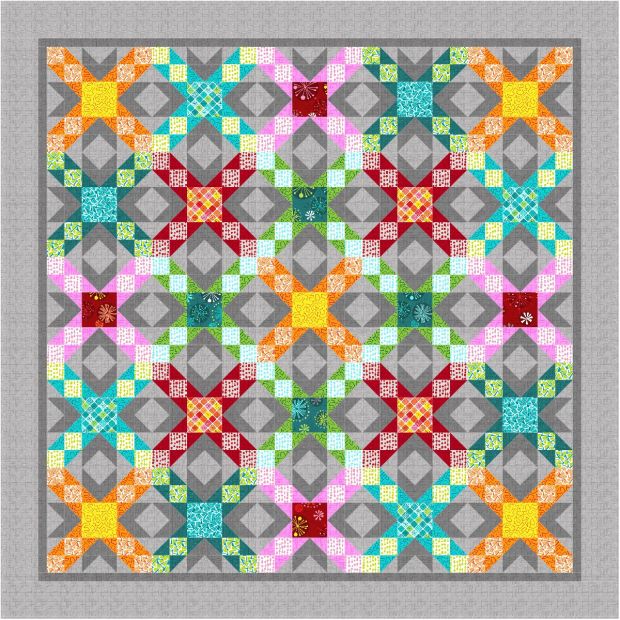
Once I was happy with the color arrangement, I printed out the final layout in color, and organized the blocks on my work table by color. In other words, the printed out layout served as a “virtual” design wall that takes up a lot less space!

Surplus Strips Blocks Fandangle Warm Colorway

I printed out the layout in EQ8 which serves as my “virtual” design wall.

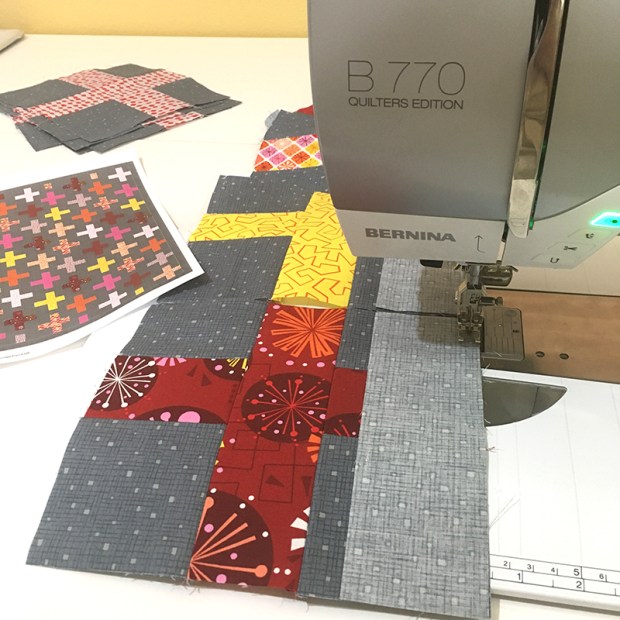
It was super fast to sew the blocks into rows using my printed out layout as a guideline. This quilt goes together in vertical columns, rather than horizontal rows, so I just had to make sure I kept everything in the correct orientation as I sewed.

Surplus Strips blocks Fandangle Fabric warm colorway

I sewed the blocks and sashing in order according to my printed out layout.

Pressing Seams Open

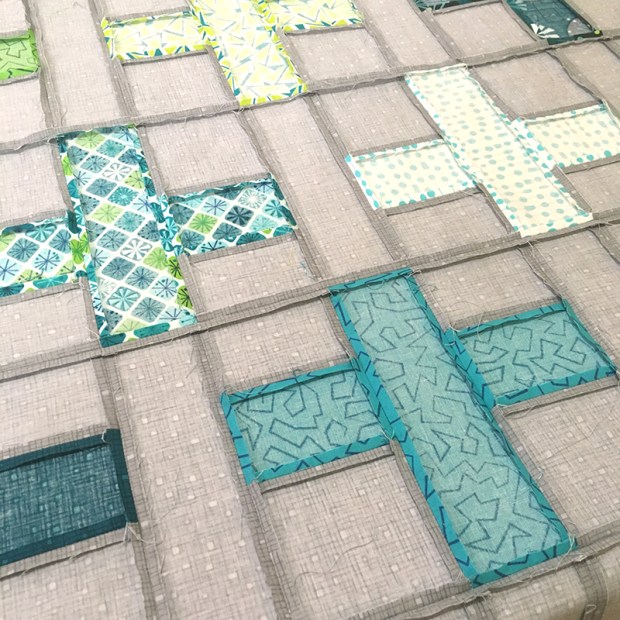
I used this process for both the warm and cool colorway, and it went super fast! Pressing all of my seams open really helped the quilt top lie flat when I gave it a final press. It also made it soooo much easier to line up the seams accurately! Because there’s no nesting, it’s important to pin generously while joining the blocks and rows. But I actually get better results and perfect seam joins when I press seams open & use pins, so it’s worth it to take the extra time.

Seams Pressed Open - Cool Colorway, Fandangle Fabric, Surplus Strips Quilt

Seams pressed open ensures a nice flat top, with no lumps and bumps!

When pressing seams open, be sure to use a shorter stitch length (like 2 instead of 2.5) to secure the seams. A shorter stitch also makes it less likely that you’ll see thread poking through the seams, too!

Bonus Measuring Tip

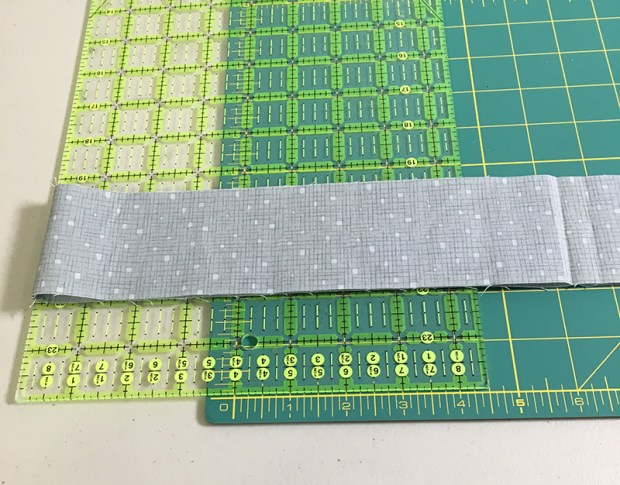
Measuring long borders

Use a ruler to extend the cutting length on your mat for long borders: place the folded end on the ruler, and cut on the mat. If I needed more length, I’d rotate the ruler longways.

Here’s a bonus tip when working with borders that are longer than your mat. When cutting, I fold the border fabric in half and use an “extend a ruler” – my phrase for extending the cutting length by using a ruler, lined up at the edge of the mat. I’ll use as many extra inches as needed to get a nice precise measurement when cutting. Just divide the needed length in half and count over that many inches on the extension ruler and mat.

More Pressing

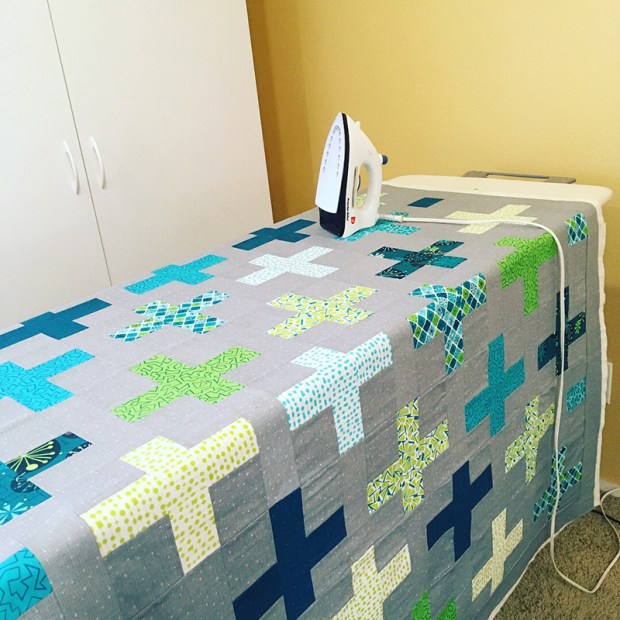
Press the quilt on both sides

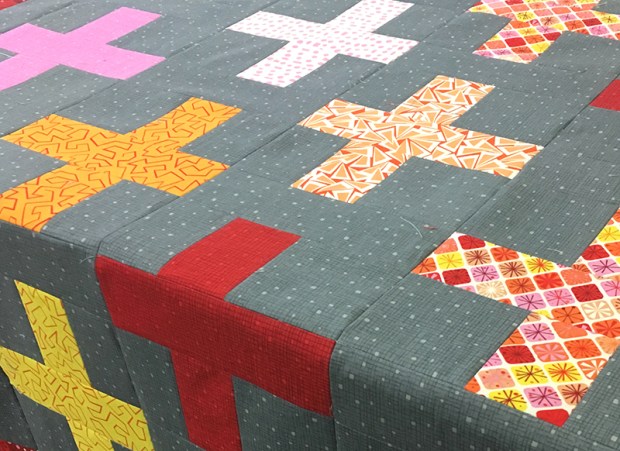
Speaking of pressing, once the quilt top is finished, I give it a final press on the front, too. It seems to make the quilt nice, flat and crisp, so it’s ready to baste! Whenever I press anything on my quilt, I always use a dry iron. I don’t like steam because it can burn your fingers and distort the fabric. Also, if the iron leaks or spits, you can get a nasty mess! If I need a bit of water for an unruly seam, I’ll just use a spray bottle filled with water instead.

Virtual Home and Studio Tour

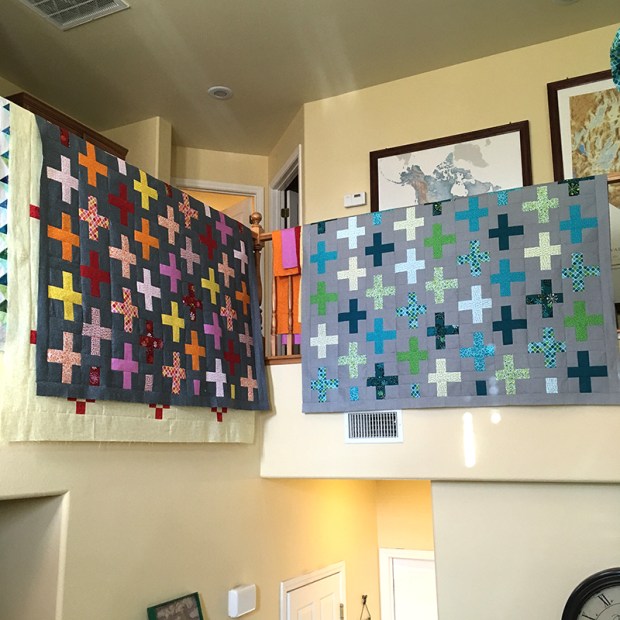
Surplus Strips Quilt Tops Warm and Cool

Look closely and you can see 2 quilt tops waiting underneath the warm colorway. Plus there’s some yardage of Fandangle peeking out underneath the cool colorway.

When my quilt top(s) are finished and pressed, I hang them over the stair railing on the upper floor of my home so they don’t get wrinkled. Upstairs is my husband’s office, my daughter’s room, our bedroom and my sewing loft. Downstairs is my son’s room, work area for The Precut Store, living room, dining area, and kitchen. It’s a comfy home and we use every square foot!!

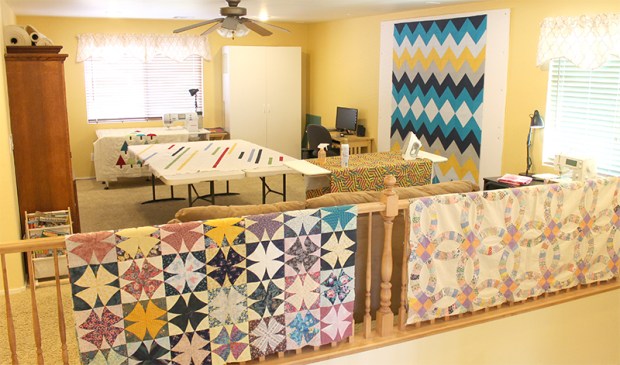
Here’s an image of my studio space, across from the stair railing where I hang my quilts in progress. This picture was taken back in 2014 for a magazine profile. It’s pretty much still the same!

Christa's Sewing Room

Image of my sewing studio 2014 – with 3 quilt tops that are still unfinished LOL!!

Our backyard is just off the kitchen downstairs, and is where I keep a plastic table set up on the patio for spray basting. I don’t spend nearly enough time in my yard as I do my sewing room, so it needs a little work, LOL!!

Spray Basting

Basting Outside

Click here for my spray basting tutorial using a design wall.
Click here for my spray basting tutorial using a table.

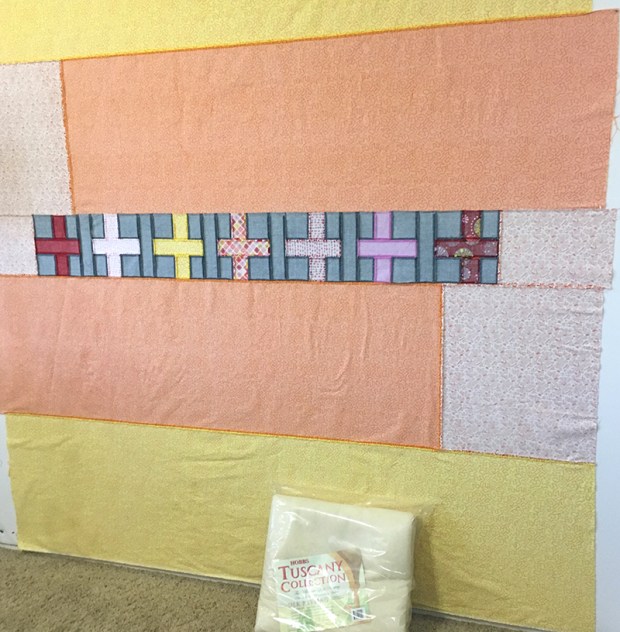
Once the backing and top are sprayed outside, I then bring them inside and assemble them on my design wall indoors.

Surplus Strips Batting

Take a picture of the batting with the quilt, and take note of what you like/don’t like.
I’m using Hobbs cotton batting for the cool colorway.

To keep track of which batting I use, I take a picture of the batting with the quilt top so I can remember. For these quilts, I used Hobbs cotton for the cool colorway and Hobbs silk for the warm. I used those particular battings because they are what I had on hand and didn’t have time to order anything else, LOL!!

But I love using natural fiber battings like cotton, wool, or silk because they cling to the quilt, provide good stitch definition, and allow the quilt to breathe and hang well.

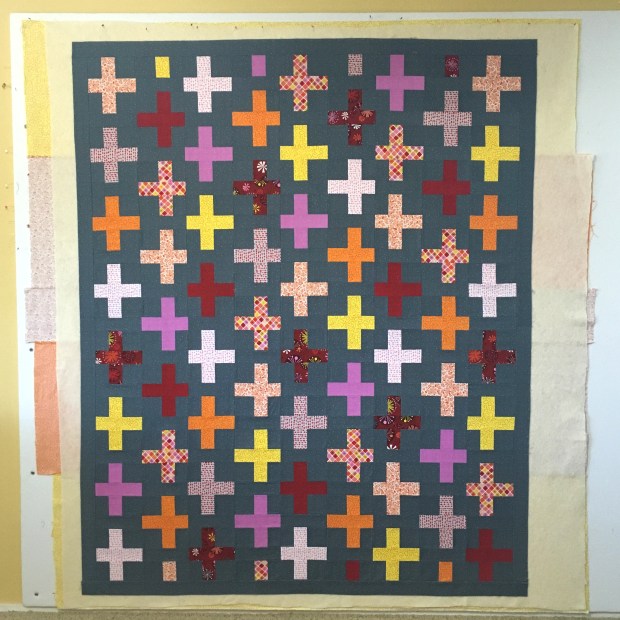
Surplus Strips Warm Colorway backing

I’m using Hobbs Silk batting for the warm colorway.

Although the quilt pattern calls for all of one fabric for the backing, I had fun and made some bonus blocks with some of the leftover strips. Because I only have a limited amount of Fandangle yardage right now, I got creative with my piecing and used three different warm prints instead.

Surplus Strips Warm basting

Click here for a tutorial on how I made my design wall – back in 2013.

I like to make sure I have several inches of extra batting and backing beyond the quilt top. That way I don’t have to line things up perfectly, and the extra will get cut off when it’s time to bind.

Once it’s basted, I’ll trim down the backing and batting so that there’s only 1-2 inches sticking out. This prevents them from flipping backwards under the quilt, causing you to accidentally stitch through them while quilting. Please tell me I’m not the only one who’s done that!!

Pressing the Quilt After Basting

Notice how closely I trimmed the layers, with only about an inch or two of batting/backing sticking out beyond the quilt top. This prevents quilting the quilt to itself!

The final step is to press the quilt – yet again!! After it’s basted, I’ll press the quilt, first on the back, and then again on the front. This helps set the glue so the layers don’t shift. But more importantly, it allows me to work out any creases or bubbles on either side of the quilt. One the quilt is nice and flat, it’s sooo much easier to machine quilt!

Surplus Strips Quilt Pattern by Christa WatsonClick here to preorder the Surplus Strips quilt pattern – print version.
Click here to preorder Fandangle fabric bundles + background.

I hope you are enjoying seeing my progress as I make these quilts. Once they’re finished and photographed, I’ll release the patterns in both PDF and print. For now, you can pre-order the print version over at Shop.ChristaQuilts.com along with fabric to make them. (FYI the Fandangle 1/2 yard bundle + 5 yards of gray will be enough to make either quilt top.)

Now it’s time to quilt them – so stay tuned for part 3!!

The Making of Surplus Strips Part 1 – the Blocks

I sure have enjoyed documenting more of my real-time progress as I create quilts to help promote my patterns, books and fabric. It’s so much more enjoyable to write about my process as I go, rather than trying to recapture the excitement months later!

Surplus Strips Quilt Pattern by Christa Watson

Click here to pre-order my Surplus Strips Quilt Pattern.

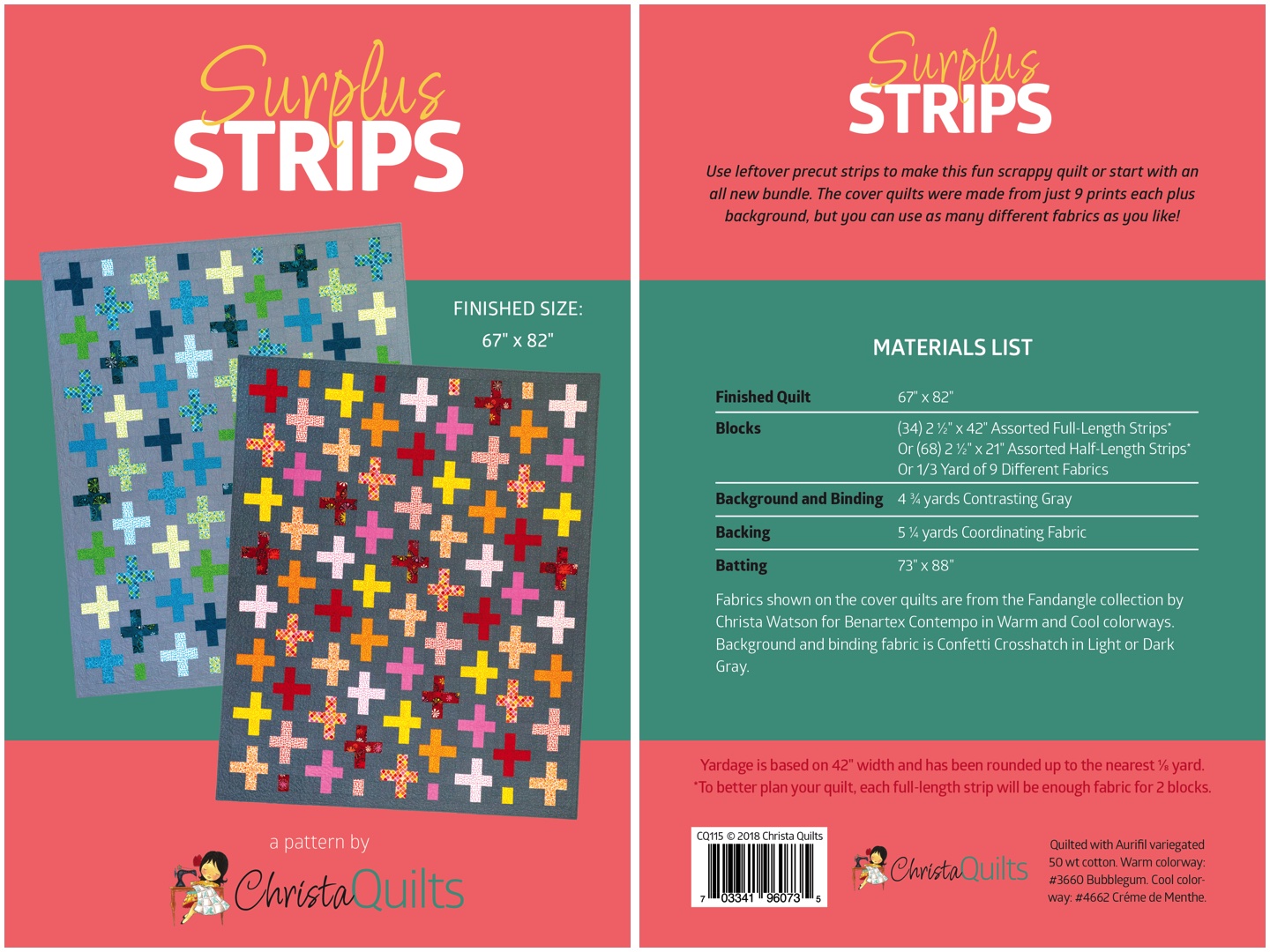
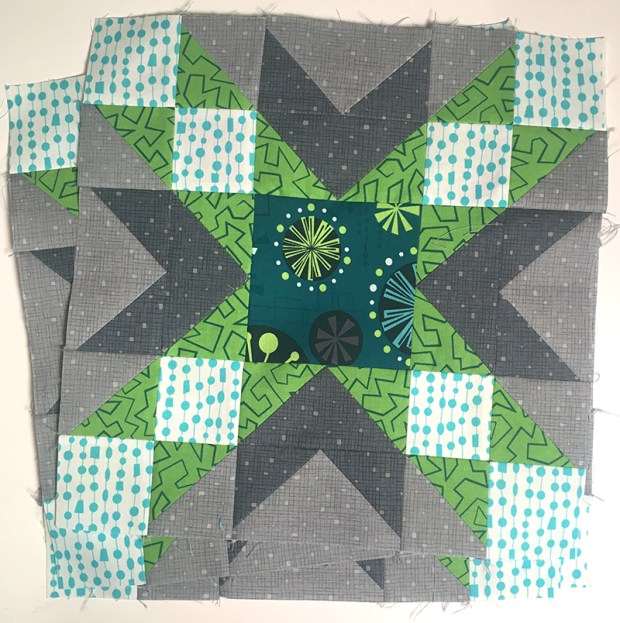
I’m currently making two versions of Surplus Strips – both in warm and cool colorways of my newest fabric line, Fandangle, which will be shown at Spring Quilt Market in Portland, Oregon, May 18-20. The pattern cover art above is shown using my digitally created images from EQ8 as a placeholder until the quilts are finished and photographed.

Once that’s done, I’ll send it off to the printer and release a PDF pattern, too. For now, you are welcome to preorder the print version which will ship on or before June 1, 2018.

Fandangle Fabrics Cool Colorway

Fandangle Fabric in the Cool Colorway

Although my timeline is tight, I’m still going through the regular process I use to create a well-made quilt. I like to prewash and starch all of my fabrics for two reasons: (1) it gets rid of the excess dye so there’s no chance of bleeding or ruining the quilt and (2) the starch makes the fabric stiffer so there’s less stretch while piecing.

My number 1 starching tip is to spray starch on one side of the fabric, then flip it over and iron the other side. Then repeat – starch the side you just ironed, flip it over again and press from the other side. The prevents the iron from burning the starch so you don’t get flakes! Starching and pressing both sides makes the fabric more crisp so it’s easier to work with. Also – I just use cheap starch from the grocery store and I’ve never had a problem with it.

Fandangle Fabrics Warm Colorway

Fandangle Fabric in the Warm Colorway

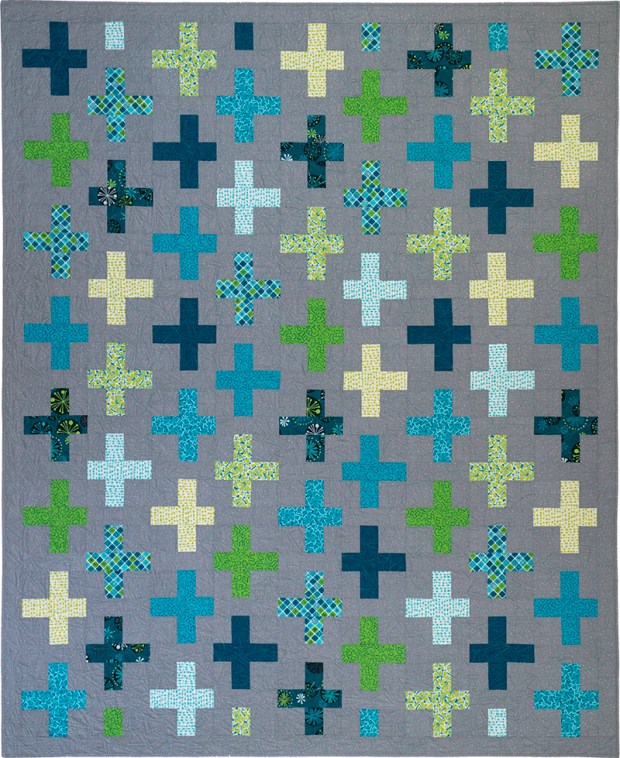
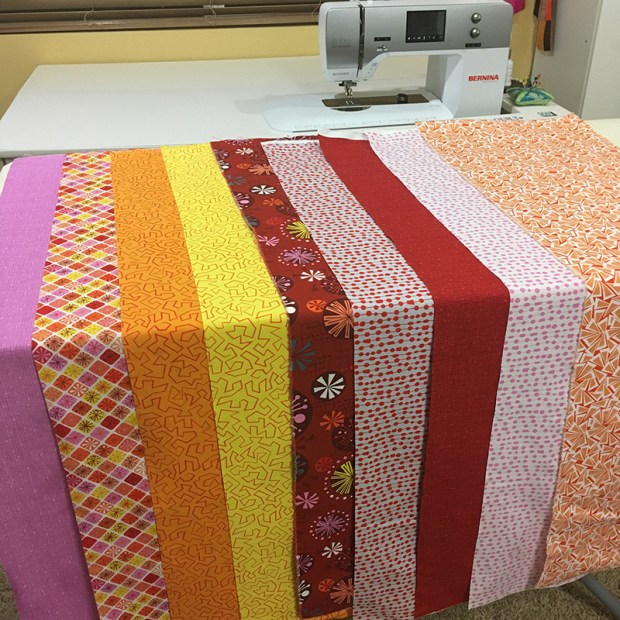
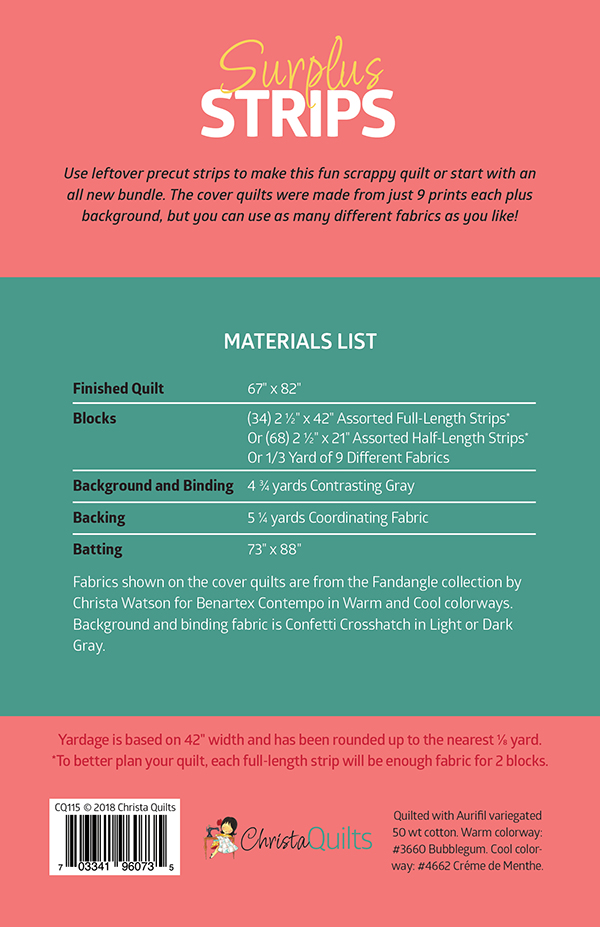
My Surplus Strips pattern is written for either precut 2 1/2″ strips or yardage. You can go super scrappy with a single jellyroll + background, or do a color blocked quilt like I’m doing. For yardage, It takes about 1/3 yard of 9 different fabrics plus 4 3/4 yards background + binding.

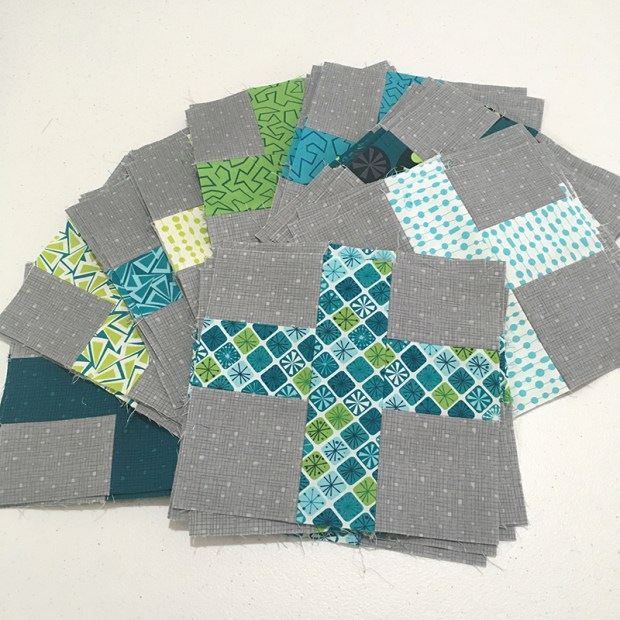
Surplus Strips Quilt Warm Colorway of Fandangle

I like stacking my pieces so they look pretty!

I paired up the darker gray confetti crosshatch print with the warm colorway of Fandangle, and the lighter gray with the cool colorway. If you are interested in using the same fabrics as me, you can preorder 1/2 yard bundles of Fandangle + 5 yards of either gray and you’ll be set, with a little leftover fabric.

Seams Pressed Open

Pressing seams open ensures flat blocks, and a flat quilt top.

I started cutting out the fabrics for both quilts while I was away on my last teaching trip. When I returned home, I finished cutting all of the pieces for the warm colorway and made all of the blocks in about two days. I used a shorter stitch length for piecing (1.8 instead of the default 2.0) and pressed all of my seams open (with a dry iron, no steam). This will allow the blocks to lie flat for domestic machine quilting.

Surplus Strips Quilt Block Warm Colorway of Fandangle

Surplus Strips Blocks in the Warm Colorway of Fandangle

After piecing the blocks in the warm colorway, I jumped into making the blocks in the cool colorway. I like making two quilts at a time, so I can assembly line the process as much as possible.

Surplus Strips Fandangle Fabric Cool

Units are cut and stacked and ready to sew!

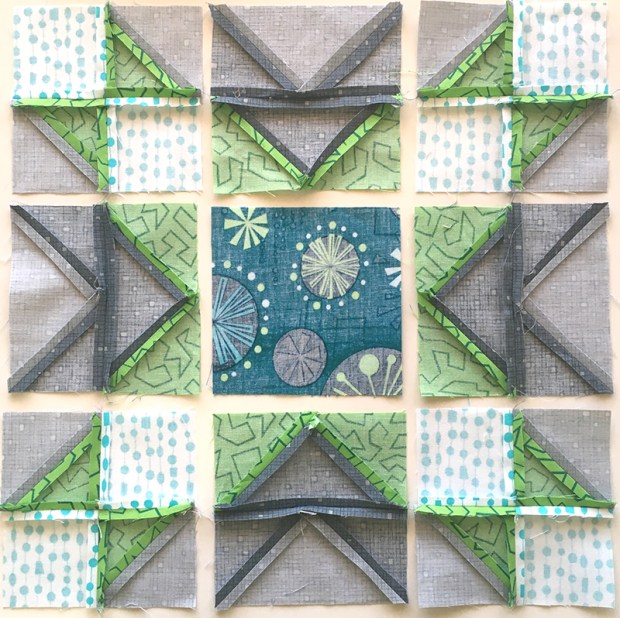
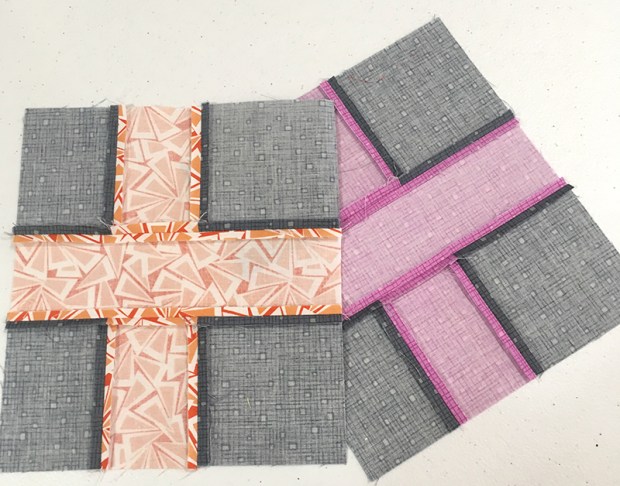
Here are a couple more piecing tips that make the blocks go together smoothly and stay square: when sewing, I pieced with the gray units on top to ensure that I switched sewing directions each time I joined the units. When you join two seams in opposite directions, it helps prevent block distortion. It’s not a huge deal on smaller units, but if you are sewing long strips together, it can be more noticeable.

Lining up block seams

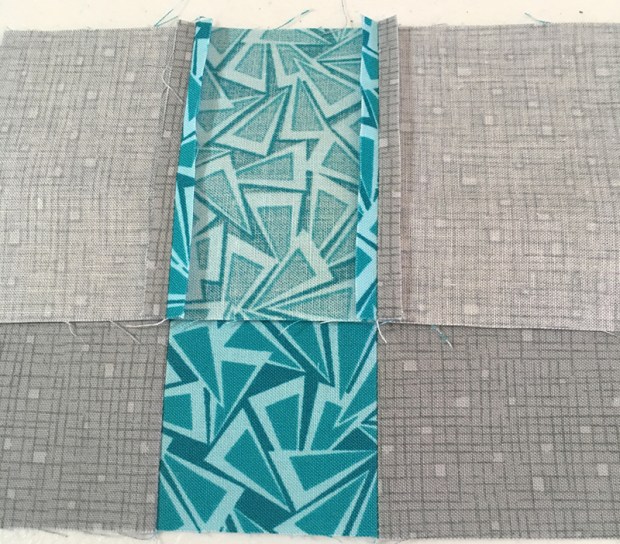
Step 1 for proper alignment – match up the fabric seams.

Also, in order to get the top and bottom of each plus block to line up correctly, I placed the top unit right sides together on top of the partially sewn block to see exactly where things needed to line up to keep the seams in alignment. The pressed open seams really help me see this part.

Aligning units for quilt blocks

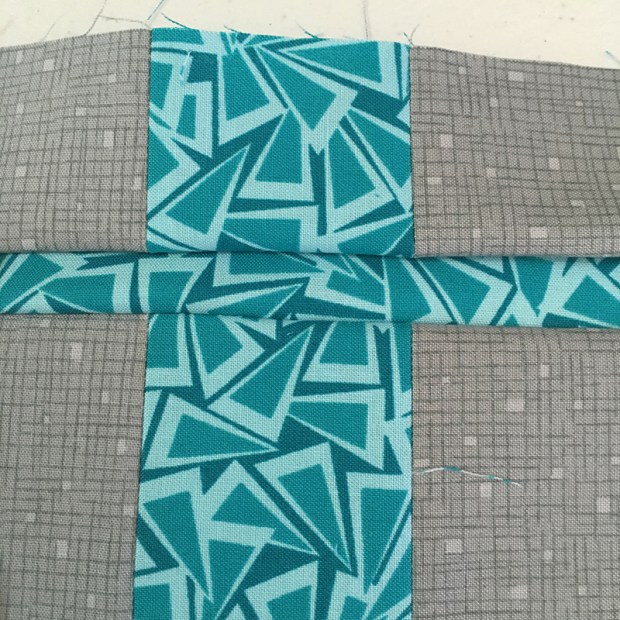
Step 2 for proper alignment – fold back to make sure lines are straight.

Then, I folded it back up partially to make sure it’s in the proper position before sewing. I didn’t actually need to use any pins because the blocks were small enough and I used my fingers to keep the edges lined up at all times.

Surplus Strips Blocks Fandangle Fabric cool colorway

Click here to preorder bundles of Fandangle fabric by colorway + background fabric.
Click here to preorder the Surplus Strips quilt Pattern.

The blocks went together even faster this time around and I love the color distribution! Now it’s time to sew the blocks together and finish up the quilt top. I’ll make both tops and then have a little basting party to make that chore a little less painful, lol!! I’ll be using my spray basting method that you can read about here (wall basting) or here (table basting).

Stay tuned for the next update!

Quilt Las Vegas 2018 and Lots of Gorgeous Modern Quilts

My local quilt guild, Desert Quilters of Nevada. recently held their 28th annual show of Quilt Las Vegas. I’ve been entering off and on over the years since the early 2000’s and it’s still exciting to participate after all these years.

DQN Quilted banner by Karen Garth

Desert Quilters of Nevada quilted banner made by past president Karen Garth

The competition is always fierce, and the judging is always performed by a certified judge. Even after all these years of entering this show, it’s still thrilling whenever one of my quilts wins a ribbon and I love the feedback provided by the judge.

Below are my entries from the show along with the judge’s comments, plus several more that caught my eye. I’m so happy to see that more and more members are making modern quilts, and especially that more are being accepted into non-modern categories. Enjoy the virtual show!

Diamond in the Rough by Christa Watson

Diamond in the Rough, made in 2016. 2nd place, Modern category.
Originally patterned in QuiltCon magazine 2017, it hung in QuiltCon last year and also received an honorable mention in the modern category at UQSM quilt show in 2017.

Judge’s comments for Diamond in the Rough

  • Repetition of shape unifies design while variations provide interest.
  • Very graphic presentation.
  • Very good piecing.
  • Quilting designs are well-chosen for their areas.
  • Good machine quilting technique.
  • Slight imbalance in tension noted with red thread. Continue to strive for accurate retracing.
  • Bit of red in binding was a good choice.
  • Binding is good.

Positive Direction Quilt by Christa Watson

Positive Direction, made in 2016. 2nd place, Holiday category.
Originally patterned in one size in Modern Quilts Unlimited magazine.
Updated pattern now includes 4 sizes, available as print pattern or PDF download.

Judge’s comments for Positive Direction

  • Good interplay between quilt top design and quilting design.
  • Very good accuracy in piecing.
  • Good machine quilting technique.
  • Strive for more accuracy in retracing bubbles.
  • Binding is well done.

Scrap Happy by Christa Watson

Scrap Happy, made in 2017. 2nd place, Pieced – One Person category
Cover quilt + patterned in American Patchwork and Quilting magazine, October 2017.
I recently gifted this quilt to my son to take with him to college.

Scrap Happy Machine Quilting Detail

Machine Quilting Detail on Scrap Happy

Judge’s comments for Scrap Happy

  • Good definition between figure and ground.
  • Good machine piecing.
  • Colors are well balanced across quilt top.
  • Quilting designs further enhance definition between figure and ground.
  • Continue to strive for consistent stitch length in machine quilting.
  • Pieced binding enhances scrappy feel. Corners should be square.

I always mention to my students when teaching machine quilting not to stress too much about consistent stitch length when making their quilts. Yes, judges notice my “imperfections” in my quilts, but they still like them enough to award them ribbons, and I love making them without stressing about creating perfect stitches!

Other Gorgeous Quilts

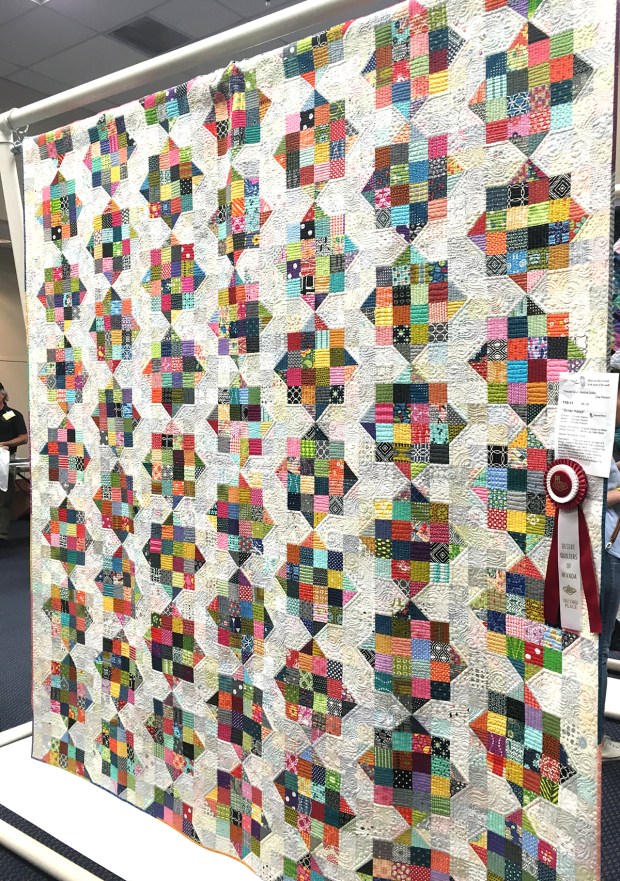
Autumn Path quilt by Vicki Ruebel

Autumn Leaf by Vicki Ruebel of Orchid Owl Quilts
1st Place Pieced – One Person category and best machine quilting.

Vicki is a great friend and amazing quilter. We encourage each to other enter lots of quilt shows and I don’t even mind that she usually beats me every time, LOL!!

I love our friendly competition because it always pushes me to be a better quilter. Incidentally, her quilt was also patterned in the same issue of American Patchwork and quilting that has Scrap Happy on the cover. There’s even a bonus article on how she quilted it!
The Big Pickle by Vicki Ruebel

The Big Pickle, also by Vicki Ruebel. 1st Place, Modern

Yep, this one beat mine in the modern category, but isn’t it fabulous? This quilt nabs an award at each show it is entered, and deservedly so!

Corn Flowers by Cory Allender

Corn Flowers by Cory Allender and her Instagram quilting bee.
2nd place, collaboration/group quilt.
Design source: Blossom Heart Quilts Beehive

I love the quilting on this quilt. Cory is an amazing award winning longarm quilter and she’s nailed both the modern and traditional aesthetic.

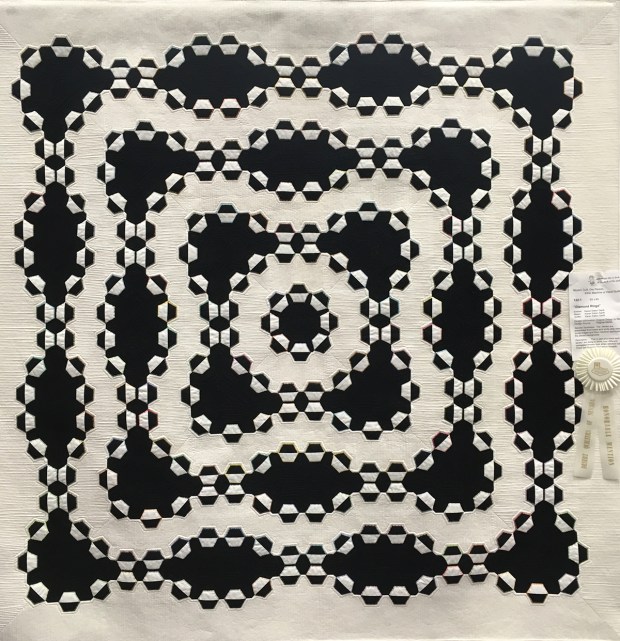
Diamond Rings by Karen Garth

Diamond Rings by Karen Garth, Honorable Mention Modern Category
Original design and made by Karen

Karen, the past president who made the DQN banner at the top of this post always creates such stunning, dynamic work. I have a thing for black and white and this design really makes my heart sing!

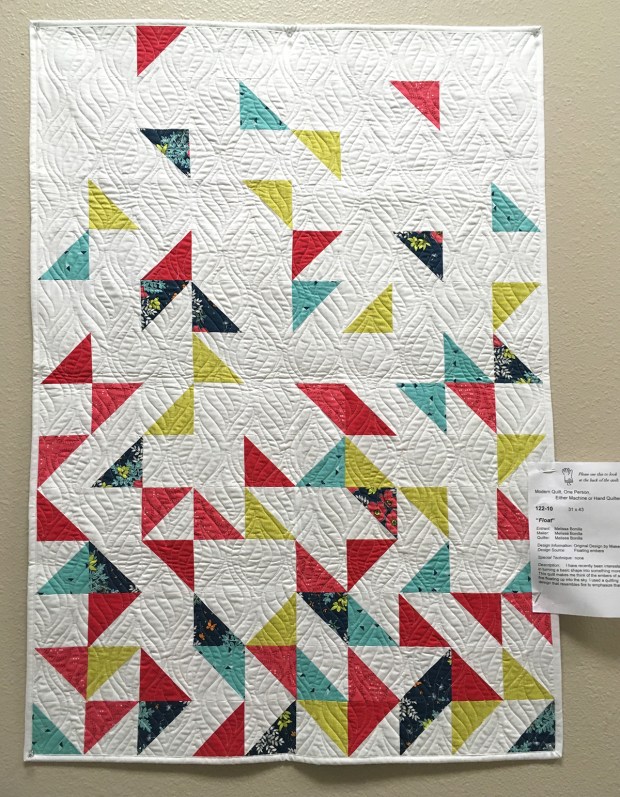
Float by Melissa Bonilla

Float by Melissa Bonilla – Modern Category
inspired by Floating Embers

Every time I attend quilt shows, I wish I could bring my own ribbons! If so, I would have put one on Melissa’s quilt above. I may actually have to do that at a show someday. Hmmm, maybe I can create my own “Christa’s Choice” ribbon!!!

Modern Logs Quilt

Super Star Bingo by Lynda Blair – quilted by Cory Allender – Modern

I walked by this quilt and was stunned by the gorgeous colors and fabric placement. I was thinking “why do I love this quilt?” and on closer inspection realized the maker had used my Modern Logs quilt pattern to make it, LOL!! She even gave me credit in her artist’s statement as the design source.

Super Star Bingo Text

I’m totally happy when people make quilts from my patterns and enter them into shows, and I especially love it when they give credit to the designer. 🙂

Quilt Show Quilts

Bertha (left) by Melissa Curley – Third Place Modern
Theresa’s Crayon Box (right) by Theresa C – Third place, small pieced

I took this picture from the show which illustrates what I love about quilting and the quilting community. From minimalist modern designs to blinged and bedazzled art pieces – there’s truly something for everyone when it comes to quilting!

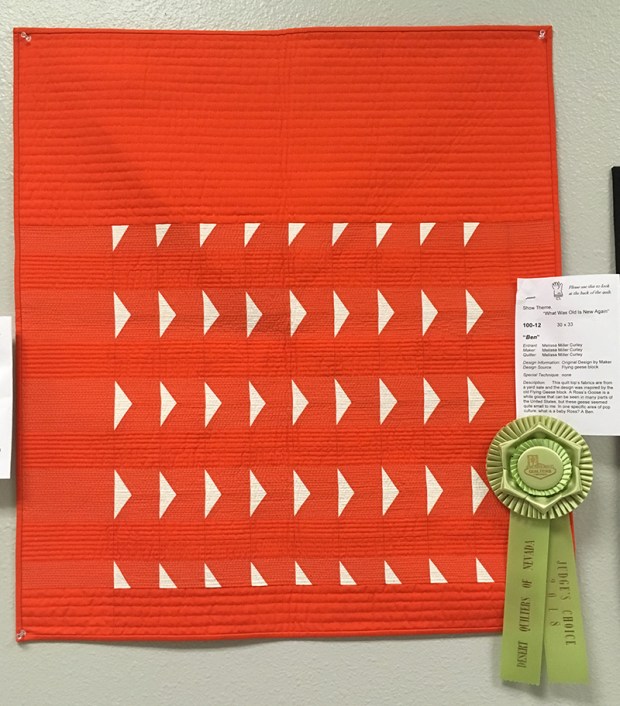
Ben Modern Quilt by Melissa Curley

Ben by Melissa Curley –  Judge’s Choice – Show Theme Category

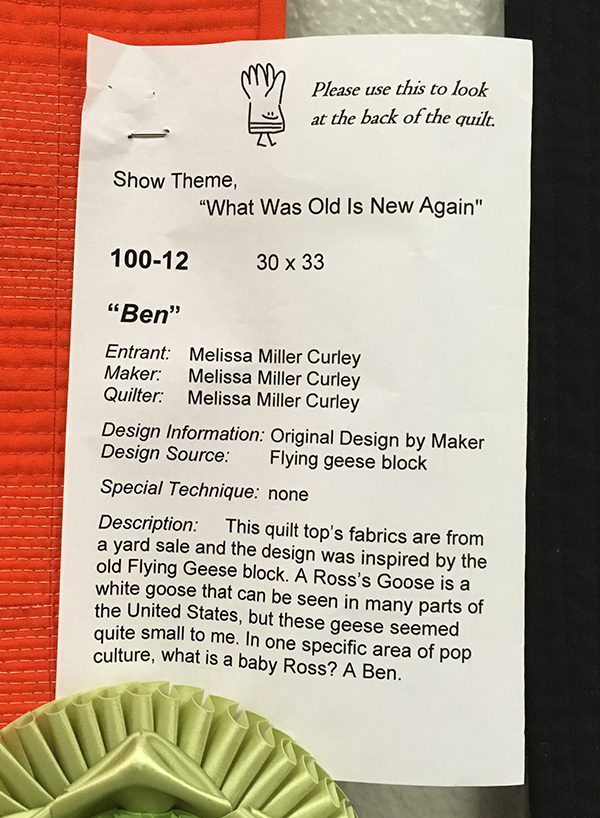
Here’s another fabulous piece by Melissa Curley. I’m a fan of everything she makes and her sense of design and color are spot on! I think it’s kinda cool that she gives all of her quilts first names. Read her artist statement below, explaining the fun pop culture reference.

Artists Statement at Quilt Show

I hope you’ve enjoyed the virtual show and remember – entering quilts into shows isn’t really about the competition. It’s about sharing your work with a larger audience and inspiring others to make quilts they’d only dream about!!

Make a Quilt from Start to Finish: Register for my Week-long Workshop this June!

This June 3-8 I have the great pleasure of returning to John. C. Campbell Folkschool in Brasstown, NC to teach my popular start-to-finish quilting class: Modern Quilting 101. This is the only in-person class I teach that guides you through every step of the quilt making process from cutting to binding.

John Campbell Folk School

Registration Open Now

Click here to register for my class : Modern Quilting 101 – Stepping Stones.
Class dates are June 3-8, 2018

Class sizes are extremely limited. With only 12 students per instructor, you get plenty of hands on help and special attention from me. Whether this is your first quilt, or your 40th, you’ll have a fantastic time and will finish a complete quilt by the end of the week!

Stepping Stones quilt pattern by Christa Watson of Christa Quilts

Click here to purchase a print copy of Stepping Stones quilt pattern.
Click here to purchase a downloadable PDF copy of Stepping Stones quilt pattern.

Each year at the Folkschool, I’ve focused on a different pattern. This summer’s group will be making my Stepping Stones quilt pattern seen here. The best part about being the teacher is getting to see the beautiful quilts my students make. Although they are all working through the same pattern, they turn out so unique, based on the fabrics and quilting each person chooses.

Stepping Stones Quilt Pattern by Christa Watson of Christa Quilts

I quilted a simple geometric free-motion design for my quilt. I’ll teach several options in class!

This is the most intense but satisfying class I teach. Think of it as an intimate week-long retreat with me where I’ll share all of my secrets and guide you every step of the way! Students have several housing options and I have to say, the food they serve is the best southern cooking I’ve had. Seriously, you could come JUST for the food!!

Quilt Photography

Jason putting his photography skills to use on a photo shoot in the desert near our home.

Jason came with me last year and took a photography class while I taught quilting. He now does all of the photography for my quilt patterns and he learned so many valuable skills while he was there. He’s excited to return for another photography class while I teach again this summer.

The kids are flying back east with us, too and they’ll get to visit with nearby family, while we’re there so it will be a fun trip for all of us!

Folkschool Fiber Studio

This is the fiber studio where our classes take place. There’s tons of room for everyone!

The previous time I taught (in 2016), students made my Charming Chevrons quilt pattern. They were able to make the quilt in different sizes, according to their needs, and they all turned out beautifully! By the end of the week, we were all BQF’s (best quilting friends) and it’s been so great seeing their continued quilting success!

Charming Chevrons class

Click here to read more about the previous group’s  class!

Click here to purchase Charming Chevrons Quilt Pattern.

In 2015, Students made quilts using my Modern Logs Quilt Pattern. This was my first time teaching at the Folkschool, and it’s such a magical experience that it was easy to say yes when they asked me to return.

Modern Logs class at John C. Campbell Folkschool

Click here to read more about the class of 2015.

Click here to purchase Modern Logs Quilt Pattern.

I can’t wait to return this summer and I hope you’ll join me. At last check, there were a few spaces left, but I’m sure they will go fast. So don’t delay, register soon so you can get your travel plans in place.

Students arrive on Sunday and class instruction runs Monday-through Friday with an end of the week show and share by all students Friday afternoon. Compared to other similar events, the prices they charge at the Folkschool for this week-long experience are quite a bargain because it’s a not-for profit institution interested in preserving the folk-art tradtion and educating others in a non-competitive environment.

Machine Quilting Boxes on Stepping Stones

I hope to see you in my workshop this summer!

Important Folk School Links:

Save

Save

Save

Save

Save

Save

Save

My Newest Craftsy Class – Startup Project: Starry Path Quilt

It’s here – it’s here! The launch of my third Craftsy class – whoo whoo! Just after I made the sneak peak announcement earlier this week, the class went live! So today I’d like to introduce you to Startup Project: Starry Path Quilt.

craftsy Class Starry Path Quilt

Click here to preview my class Startup Project: Starry Path Quilt

In this nearly 3 hour long class, I teach how to make this stunning quilt I designed featuring two different types of star blocks and three different types of triangles.

It was created as a followup class to my comprehensive start-to-finish class, Startup Library: Quilting. But of course, anyone can enroll and make this stunning quilt:

Starry Path Quilt by Christa Watson

Click here to get the Starry Path Quilt Kit, while supplies last

The class comes with the complete pattern to make the Starry Path Quilt above, and there’s even an optional kit. I chose to make it from basic blenders in a cool color scheme of lime, green aqua, blue and turquoise. I paired it up with a solid gray background for maximum impact. I’m really pleased with how well the design turned out and I loved taking my time to be as accurate as possible.

And, because you all know I loooove machine quilting, I threw in a bonus lesson on how to quilt elongated swirls. Isn’t it just fully of yummy texture??

Swirls quilting on Starry Path Quilt by Christa Watson

The class materials include step-by-step drawing lessons showing how to form the basic swirl design, plus a page for you to print off and practice drawing your own quilting plan. (It’s a nod to the technique I first introduced in my machine quilting class, The Quilter’s Path.)

The exclusive Starry Path pattern is easy to follow along as you watch the class, and I’ve sprinkled in as many helpful hints as I can to ensure your success with this quilt!

Starry Path Quilt with Christa Watson on Craftsy

I can’t help fondling my quilts, LOL!!
In Startup Project: Starry Path Quilt, I share my best tips and tricks for accurate cutting and piecing so that you can get stunning results, every time. My top tips for piecing any quilt?? Slow down when you are sewing, maintain an accurate 1/4″ seam and use lots of pins to get those intersections to line up precisely.

Starry Path Quilt in Progress

The best thing about my Craftsy classes is that unlike my live classes, you actually get to watch me sew and quilt. That way you can and see where I place my hands, and how I manipulate the fabric. With the magic of filming to speed things up, it’s actually fun to watch!

Starry Path Class Overview

Here’s a breakdown of what’s covered in each section and length of each lesson. The total class runs for just under 3 hours, and if you’ve ever heard me speak, you know that I can cover a lot of info in a short amount of time. So you really get more “bang” for your buck with my classes!!

Boundless Fabric from Craftsy
1. Getting Started (32 min)
Meet Christa and go over everything you’ll need for your project, the Starry Path quilt. Then she shares tips for cutting both yardage and fat quarters. Plus, see how to check and correct your seam allowance early on. This way, your blocks will be the correct size.
Sawtooth Star Block Piecing
2. Sawtooth Star Block (39 min)
Piece the classic flying geese unit four at a time! Christa shows you how to mark, sew, press and cut, and add simple squares to create the Sawtooth Star block. She helps you chain piece a few blocks at a time to speed up your stitching, and shows you how to use webbing to keep your blocks together as you go.

Christa Starry Path Quilt

3. Garden Path Block (30 min)
Learn how to cut and sew with the popular Tri-Recs specialty ruler that you can use in many other quilts. Find out how to properly cut and line up the pieces, add simple four-patches and solid units for a beautiful block, and save time by chain-piecing it.
Garden Path Block
4. Pieced Border (30 Min)
Follow along as Christa guides you to create the colorful pieced border that surrounds the Starry Path Quilt. See how to pair half-square triangles to form this hourglass unit, also known as the quarter-square triangle. Then batch-assemble the border strips.

Christa Sewing

5. Quilt Top Assembly (23 Min)
Now you’re ready to put your quilt blocks together! Here, discover a technique called webbing that will keep your blocks in order as you assemble the inner quilt top into rows. From there, sew the rows together, then add the solid and pieced borders.
Machine Quilting Swirls with Christa Watson
6. Machine Quilting Swirls (20 Min)
Wrap up class by finishing your basted Starry Path quilt with an all-over free-motion design. Christa discusses thread choices, then shares the benefits of making small samples to practice your designs. Afterwards, get her tips on maneuvering this quilt on your home machine as you add the final touches.

Starry Path Quilt by Christa Watson

I had so much fun making this quilt and I’m sure you will too! The best part about enrolling in my class is that you have my help and support 24/7. Got a question about the class or want to share your progress? Use the interactive class platform to share with me and fellow students. It’s like a virtual classroom with me at your side!!

Click here to enroll in Startup Project: Starry Path Quilt

Click here to get the Starry Path Quilt Kit

Elongated Swirls quilting by Christa Watson

I can’t wait to “see” you in class!

Join Craftsy Unlimited for All You Can Watch Classes (Including Mine!)

You guys – I’m so excited! It’s almost time for the launch of my brand new Craftsy class!! But before it goes “live” I invite you to join Craftsy’s new subscription service “Craftsy Unlimited.”

craftsy unlimited

Click here to start a free trial of Craftsy Unlimited and watch all my classes for free!!

How is this different from regular Craftsy – you say?? Rather than paying a one time fee to own the class, Craftsy Unlimited is a monthly streaming service, similar to Netflix, Hulu, etc. but on your computer. With Craftsy Unlimited, you don’t own the class, but you have access to the entire library and class materials of thousands of classes 24/7 as long as you are a member.

The coolest thing is that you can actually combine both services if you want to – join Craftsy Unlimited to check out classes you may be interested in, but aren’t quite ready to commit to a purchase. Later, you can permanently purchase any classes you know you’ll want to keep forever.

Starry Path Quilt Blocks

Sneak peek of my brand new class, coming really soon!!

For instructors, we get compensated slightly differently for either model, but Craftsy Unlimited is a great way to support your favorite teachers. The more you watch our classes on Craftsy Unlimited, the more we get paid!! So even if you own my other classes already, you can view them in Craftsy Unlimited and it’s sort of like giving me a little bonus each time you watch. 🙂

Speaking of which, if you decide to join Craftsy Unlimited, be sure to check out my current classes:

The Quilter's Path by Christa Watson

The Quilter’s Path is like taking one of my in-person workshops. I teach you how to make a quilting plan and give you tons of ideas for both walking foot quilting and free-motion designs. Plus, you get to see how I actually “scrunch and smoosh” a real quilt under the machine. But the best part is you can pause, rewind, and watch your favorite parts over and over again!

Startup Library Craftsy Class by Christa Watson

Startup Library Quilting is great for beginners who want to learn to make a quilt from start to finish. I cover all the basics – choosing fabrics, reading a quilt pattern, rotary cutting, piecing, basting, machine quilting – walking foot & free-motion –  AND binding! It’s the whole shebang right from the comfort of your home!!

Craftsy Quilting Class taught by Christa Watson

Screen shot from my newest class, coming soon!!

Click here to start a free trial of Craftsy Unlimited and watch all my classes for free!!

In the new class, I focus a lot on accurate cutting and piecing, plus there’s a bit of machine quilting at the end. So watch for the new reveal soon!

Improv Squares Finish with Machine Quilting Details

Now that I’ve been blogging again on a regular basis, I’ve realized I haven’t shared about some quilts I made from Modern Marks. And since I’ll soon be starting on quilts from my next line of fabric, I want to make sure I’ve documented my recent finishes!

Improv Squares by Christa Watson, made from Modern Marks

I recently shared a spray basting tutorial for Improv Squares, but here are some beauty shots of the finished quilt, taken in the desert behind our home in Las Vegas.

The inspiration for Improv Squares was a broken wooden fence that I drove by several years ago. I snapped a picture of the fence and kept it in my phone for a long time, until I was ready to do something with it.

Improv Squares Inspiration

The holes in the fence made an interesting pattern that I though would be fun to do something with. I also wanted to further explore the concept of “Structured Improv” – a technique I’ve been playing around with for several years now.

Improv Squares by Christa Watson

The improv part is that you sew a bunch of fabric together randomly. The structured part is that all of the block units are a similar shape  – rectangles. All of the blocks finish the same size so they can be placed randomly in the design, yet no two are the same.

Machine Quilting Tips

Aurifil Vareigated thread

When I’m working with busy prints and I want the fabric to be the star of the show, I’ll try to choose a thread that blends in. Because Modern Marks is so colorful and I wanted to use all of the prints in this quilt, I chose a variegated thread that would add fun layer of texture to the busy prints

My favorite variegated thread is 50 weight Aurifil #3817 Marrakech. It’s fun to see the color changes while I’m quilting, and I love quirkiness that it gives the quilt! It also seems to match any rainbow-colored quilt I make!

Machine Quilting Jagged Stipple

Because I was in a hurry to get this quilt finished, I quilted an allover/edge to edge design on a rather large scale. The quilting is still very dense, but by quilting larger shapes, I was able to cover more area very quickly.

I used one of my favorite designs – a  geometric, jagged stipple rather than a smooth curvy stipple. I was able to complete the quilting on this throw size quilt in an afternoon, rather than several days whenever I do more intricate custom quilting.

Jagged stipple quilting

I love this texture so much, it inspired one of the fabric prints in my second fabric line!
More about that later…….stay tuned!!

Incidentally, whenever I teach machine quilting, I always have the students practice quilting both angular shapes, and curved designs. Some people find it easier to quilt one vesus another, so it’s a good exercise to try and see which type of design you prefer!

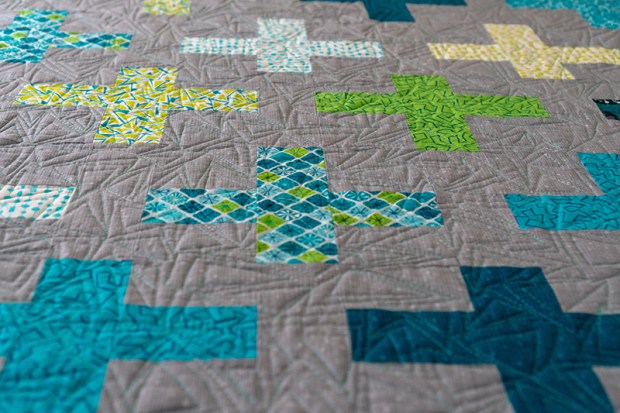
As you can see in the detail picture below, the jagged motif gives some interesting texture to the quilt, without overpowering the overall design.

Allover jagged stipple

Improv squares is now available as a pattern, either as a printed version, or a PDF download.
If you make one, I’d love to see it! After all, the fun of designing quilts for others to make is seeing the variety!

Improv Squares quilt

Share your progress wtih me on social media with the hashtage #improvsquaresquilt. You can also share images of any projects you make from my books, patterns or fabric in my ChristaQuilts Facebook group.

Click here to get the Imrpov Squares Quilt Pattern – printed version shipped to you.

Click here to get  the Improv Squares Quilt Pattern – instant PDF download.

Improv Squares Quilt Pattern using Modern Marks Fabric

Improv Squares STATS:

  • Finished Size: 66″ x 80″
  • Fabric: Modern Marks by Christa Watson for Benartex
  • Batting: Hobbs 100% Cotton
  • Thread: Aurifil 50 weight cotton #3817 Marrakech
  • Machine Quilting Design: Jagged Stipple
  • Completed: October, 2017

Improv Squares quilt

My Pattern Writing Process and Sneak Peeks of Upcoming Quilt Patterns

In an effort to share more of what I’m working on in real time – and to answer to the question – how do I get it all done?? – I’m excited to let you know what I’ve been working on the last few weeks. I’m currently writing and editing the next round of quilt patterns that will be released along with my next fabric line, and I couldn’t be more excited!!

Pattern Writing in Process

I’ve been posing the question to my friends and social media followers, asking if they’d like me to share real time updates, or wait until everything is polished and ready for purchase. I got a resounding “share now!” as the answer which made me sooo happy! I have a hard time suppressing my excitement for what I’m currently working on and I feel like I can be more genuine when I’m sharing in real time.

I also just got word that my fabric samples should arrive some time in the next week or two so I can actually start sewing the designs you see above. I’m also excited to collaborate with my friend Heather Black on one of them because she has the most amazing design sense!!

Pearl Pendants by Heather Black and Christa Watson

Pearl Pendants pattern coming soon – click here to preorder.

So here’s a bit of my pattern writing process for those that are curious. First, I design the patterns in EQ8, using digital swatches of the fabrics I plan to use. Next, I write the instructions while I’m waiting for the fabrics to arrive.

While editing the patterns, I use digital images as placeholders for the pattern covers until the quilts are made and can be photographed. Then it’s very easy to swap out the digital images with the photography, without altering the pattern layout. I send the rough draft of the pattern to my graphic designer to lay out and make everything look pretty, and then a technical editor checks all the math to make sure I haven’t missed anything.

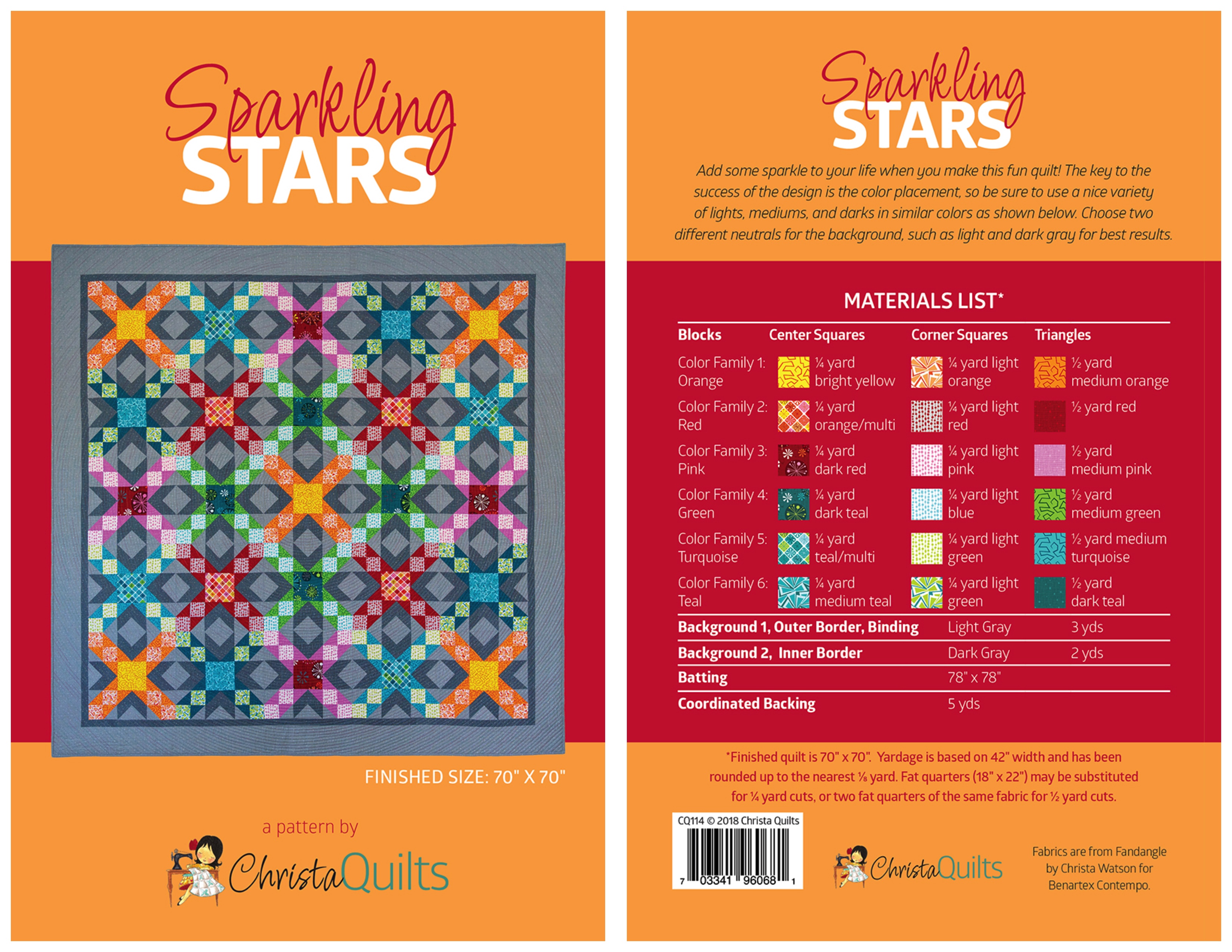
Sparkling Stars front Cover

Sparkling Stars pattern coming soon – click here to preorder.

Once the fabric arrives, I make the quilts following my own instructions so that I can pattern test and see if there are any steps I missed. While I’m making the quilts, digital images of the covers are sent off to the distributors (companies who sell patterns on a mass-scale to quilt shops) so they can get them in their system in time for shops to pre-order.

Once the quilts are finished, they are photographed and cover images swapped out with the real ones, and I do once last round of editing to make sure everything looks right. Then patterns are sent off to the printer for physical copies, and PDF downloads are uploaded to my Craftsy shop for sale.

Surplus Strips Quilt Pattern by Christa Watson

Surplus Strips pattern coming soon – click here to preorder.

As you can imagine, the timing is critical to make sure everything happens in the right order. My process is probably a bit different than pattern designers who aren’t working with a specific fabric line. But I like the challenge of making all the parts fit together.

You can see sneak peeks of the fabric line in the quilt pattern covers above, but I’ll be happy to tell you more about the fabric when my samples arrive in the next few weeks. Quilt shops will be able to order it later this spring, usually around quilt market in May – and I’ll be there in person showing off these quilts and more “in the cloth.” Then the fabric will arrive in shops around mid summer – sometime in June or July. I can’t wait!!

Spray Basting Tutorial – Using a Table

Recently I shared a tutorial on spray basting using a design wall. Today’s tutorial shows how to modify the spray basting process using a table instead. Note that my pictures are all taken outside but once the quilt layers have been sprayed outdoors,  you can assemble the quilt inside using any size table.

Improv Squares Quilt Using Modern Marks

Step 1 – Spray the back side of the backing and quilt top

Be sure to spray the layers outside, or in a well ventilated area. If you have sensitivity to chemicals, I recommend wearing a dust mask. I use 505 basting spray and a large sheet to protect the surface I’m spraying on.

I’m using a lightweight folding plastic table, so it’s easy to move. I just store it out of the way in the garage when I’m not using it.

Spray Basting

The table you are using doesn’t have to be bigger than the quilt. When I’m spraying, I cover the center section of the quilt first, and then the sides. For this step, you don’t even need a table; you can lay out a sheet or dropcloth on the ground or wherever you have room.

I used a small park near my home so that I’d have plenty of room, and also nice scenery for photography!

Hold the can an arm’s length away and spray evenly and generously. Make sure to get good coverage on the quilt. To ensure the can is spraying consistently and doesn’t get clogged, spray a few squirts on your dropcloth before applying it to the quilt.

Spray Baste

Although I pressed the top and backing separately before I began, you can see some fold lines on both layers. But not to worry – this gets pressed out at the end. If you spray the top and backing separately, it uses less spray than spraying the batting, and it’s easier to manage.

Once both layers have been sprayed, you can fold them up and bring them inside to finish the assembly process (or stay outside and set the layers aside like I’m showing here.) The layers will be sticky, but not stuck, and you don’t have to assemble them right away – the adhesive doesn’t dry out.

Remove the drop cloth or sheet from the table and then lay out the backing wrong side up.

Spray Baste

Step 2 – Add the batting

I like to fold the batting in half long ways so that I can put the fold line roughly in the center of the backing. You can see in the picture below that it’s not exactly even and that’s ok. As long as the batting and backing are bigger than the quilt top, you’ll have some wiggle room so that you don’t have to line things up perfectly.

In fact, my batting is actually a little longer than the backing so it’s easy enough to trim away the excess. Working on a table is great because it won’t hurt your back like the floor can.

Spray Baste

Open up the batting so you have coverage on all sides. Even if the sides hang down to the ground – that’s okay. The excess will get trimmed away.

Spend time smoothing out the backing. You can lift and reposition it if needed. Work out any wrinkles or bubbles, using your hands and a long acrylic ruler.

I’m using Hobbs cotton batting for this quilt. I like natural fiber battings because they cling to the fabric and they aren’t slippery. (Polyester has a tendency to slip while you are shoving the quilt through the machine which can cause puckers.)

Spray Baste

Once you smooth out the center section, adjust the layers so that you can smooth out the sides, too. Take your time here to really get it nice and flat. Smoothing out the layers also smashes them together so that they stick together better and don’t shift.

You can also iron your batting before you baste to get it nice and flat. I use a spray bottle and a dry iron. With cotton batting, you can put the iron directly on the batting. With more delicate battings like wool, you can cover the area you press with a piece of fabric. Be sure to use a dry iron so that it doesn’t shrink up the batting.

Spray Baste

Step 3 – Add the Quilt Top

Add the top in the same way that you added the batting – get it roughly in the center and make sure there’s coverage all the way around the edges. You can see it’s still a bit wrinkly from handling and moving it around. That’s okay – you’ll iron it again at the end.

Spray Baste

Trim away the excess batting and backing so you’ll have less bulk to deal with. If you have a super large quilt that touches the ground, you can always place two tables side by side to give you more room to work.

I use specialty batting scissors – they cut through the layers like butter, and trimming goes super fast! I only leave about an inch or two on all sides when I trim. That way it’s less likely that I’ll flip the quilt under itself and accidentally quilt through the extra layers!!

Spray Baste

Step 4 – Smooth Out the Layers

Smoothing out each layer as you add it is such a critical step. When your quilt sandwich is flat and smooth, it makes the machine quilting process so much easier! The reason I love using basting spray is that every inch of the quilt is stuck to every other inch. This prevents shifting of the quilt and greatly reduces the chances that you’ll get a tuck or pucker while quilting.

Spray Baste

Use the long ruler again to smooth out the center of the quilt. You can also use it to help line up the pieced seams and nudge things back into place if needed. It’s almost like pre-blocking the quilt before you quilt it.

Spray Baste

Once you’ve smoothed out the center, you can work on the edges. Roll up the excess so that it doesn’t drag on the ground as you shift the quilt around.

It usually takes me a good 20 minutes to smooth out each layer of the quilt, but it’s time well spent!

Spray Baste

Step 5 – Press the Basted Quilt on Both Sides

The secret to good spray basting is to press the quilt once it’s layered. The heat of the iron sets the glue and it smooshes the quilt together so it’s nice and flat. I press the back side first, working out any excess bubbles or wrinkles. Then I flip it over and press the front.

I use a big board which fits on top of my ironing board, giving me more room to work.

Spray Baste

I’ve developed this basting method over the last few years and I can honestly say it makes a huge difference in how my quilts turn out. Just remember, you are putting a lot of wear and tear on the quilt when you scrunch and smoosh it through the opening of your machine. But with this method, nothing shifts and it’s easy to just focus on one area of the quilt at a time.

Feel free to pin and share this tutorial with your friends. My goal is to get more people quilting their own quilts while enjoying the process from start to finish!

Your Chance to win a Rainbow Taffy Quilt Kit + Machine Quilting Tips

April Update!! My Quilt Won the Championship!!
Thanks for all your Votes!!

I know it’s a little silly to get all excited about a fun promotional contest, but it really means a lot to me that so many of you have picked Rainbow Taffy as your favorite free pattern from Benartex so far. Today is the last round of voting to determine the final fan favorite, and one lucky voter will take home a kit of the winning quilt! Will it be Rainbow Taffy?? See below for details:

Benartex March Madness Voting

Final matchup: Rainbow Taffy from Modern Marks versus Violette from Gloaming

Click here to cast your vote for Rainbow Taffy on Benartex’ blog: Sew In Love with Fabric.
Click here to vote a second time in their Sew Interesting Facebook group.

You can also vote over on their Instagram account @benartex_fabrics.

Well, it all comes down to today and the final matchup between my pattern and my friend Shelley Cavanna’s. I met Shelley last fall when her booth was near mine in the Contempo section of Benartex at Quilt Market. She, too was debuting her first line of fabric and we got to know each other as we chatted on the floor for 3 days. So I will be happy no matter which of us wins!

Shelley Cavanna and Christa Watson at Benartex

Half the fun of attending quilt market is getting to meet new designer friends!!

Rainbow Taffy Quilting Tips

Here’s a tip for choosing thread: if you want your quilting to blend in, choose a thin, 50 weight thread in a color that is slightly lighter than the prints in the quilt. I chose a lime green Aurifil which actually acted as a neutral. It didn’t stand out too much on the white fabric and it added bit of sparkle to this colorful quilt!

Lime Green Aurifil Thread

Here’s another tip: the more quilting you add, the more the quilting design recedes into the background and becomes a textural element, rather than a focal point point motif. And rather than thinking you are quilting your quilt to death, you are really quilting the life into it by adding an extra layer of design!

Boxes quilting Detail

I quilted Rainbow Taffy using one of my favorite modern free motion motifs, “Boxes.”

In fact, I love this design so much, I included it as one of the prints in the line, seen in orange below. I thought it would be so “meta” to quilt boxes on boxes, LOL!!

Boxes print from Modern Marks

Here’s my tip for quilting an allover, or edge-to-edge design: start on one side of the quilt, and meander your way around the quilt, block by block. Allover designs are perfect for quilting a quilt in a hurry, since you don’t really have to worry about quilting different designs in different areas of the quilt.

Scrunch and Smoosh

I work my way from right to left across the quilt, rotating in the middle when it gets bulky.
To deal with the bulk – scrunch and smoosh it out of the way as you go.

Allover designs are also fantastic to hide any less than perfect seams. If they don’t match up perfectly, you can obscure this fact by adding a layer of texture right on top of the quilt.

Also, if there’s any fullness in your quilt, or it doesn’t lay quite flat, dense allover quilting can draw up some of that excess, and you can use your fingers to smooth out and problem areas while you quilt – just be careful that they don’t get in the way of the needle!

Machine Quilting Texture

See how that lime green thread blends in?? I love it!!

If you happen to run out of thread while you are quilting, you can just back up about 1/2 an inch and quilt a little bit on top of your previous quilting. Stitching on top will help secure the threads, and on a buys quilt, it’s hardly noticeable.

Rainbow Taffy by Christa Watson

One other tip – try not to play “bobbin chicken!” If you have a low bobbin indicator on your machine, try to stitch off the end of the quilt and put in a fresh bobbin. If you are quilting with cotton thread, you can always use that bit of leftover thread when piecing your next scrappy quilt!

Vote For Your Chance to Win a Rainbow Taffy Quilt Kit

Rainbow Taffy Quilt by Christa Watson. Made from Modern Marks.

To wrap up March Madness, Benartex is generously offering one lucky voter a chance to win a kit of the winning quilt! Voting closes Monday, April 2 at Noon EDT.

So head over to the Benartex blog now to cast your vote. The winner will be selected at random. You can also submit a bonus vote in their Facebook Group and Instagram @benartex_fabrics.

I sure loved making this quilt and I know you will, too. Click here to get the free pattern.
Good luck and thanks for playing!!