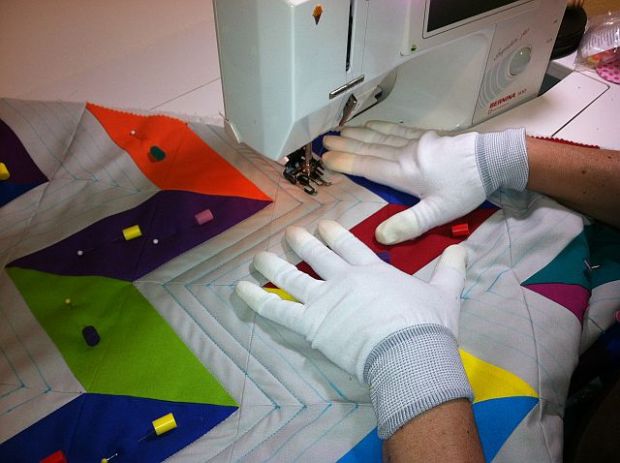
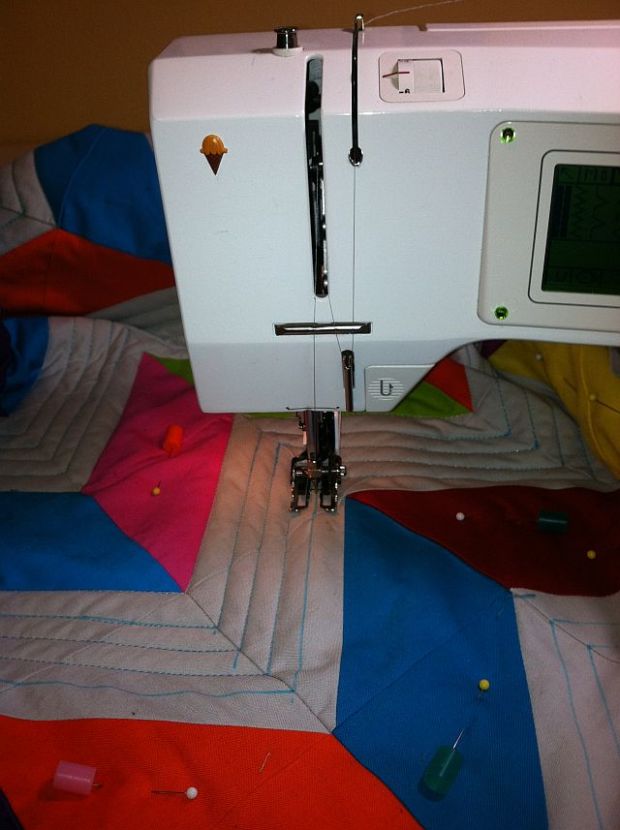
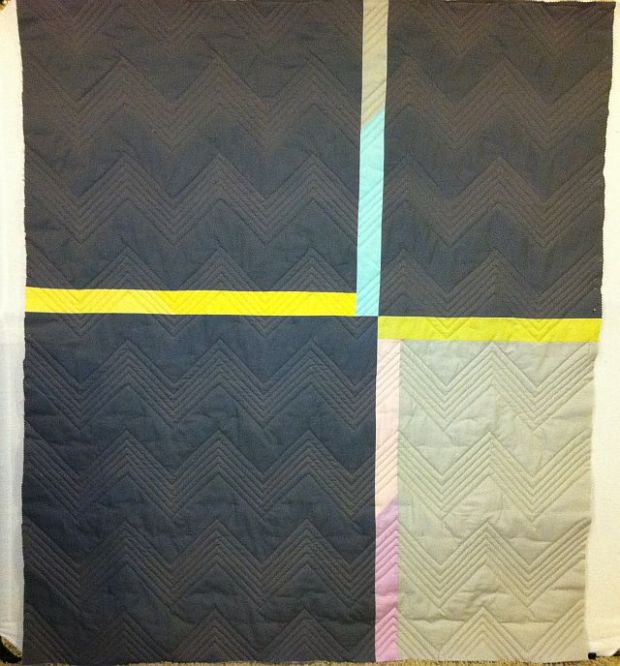
Christa’s Quilt Along 3.6 – Marking and Basting the Chevrons

Grid MarkingAlthough basting a quilt is my least favorite “chore” of the whole quilting process, it’s a necessary step so I can get to my most favorite part which is the machine quilting. I always have better results if I take the time to properly mark and baste my quilt.

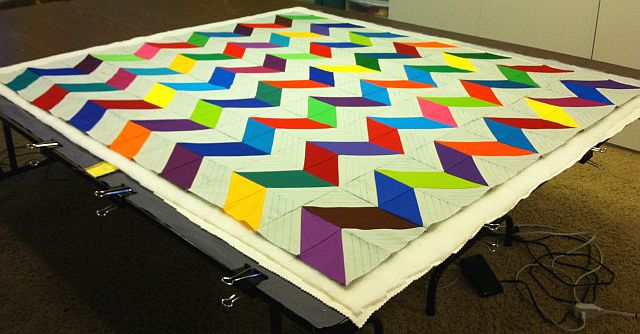
It took me a total of 2.5 hours to mark the top and prepare my quilt for machine quilting.

This doesn’t include the time it took to sew my quilt backing which took an additional 1.5 hours.

I wrote a separate pieced quilt backing tutorial where I could show off my “back art”.

Step 1 – Marking The Quilt Top (1 Hour, 15 Minutes)

If I know the design I’m going to quilt ahead of time, I will mark my lines before I baste, using a water-soluble blue marking pen. (Test ahead of time to be sure your marks will come out and that your fabrics are color-safe.)

June Tailor Grid Marker

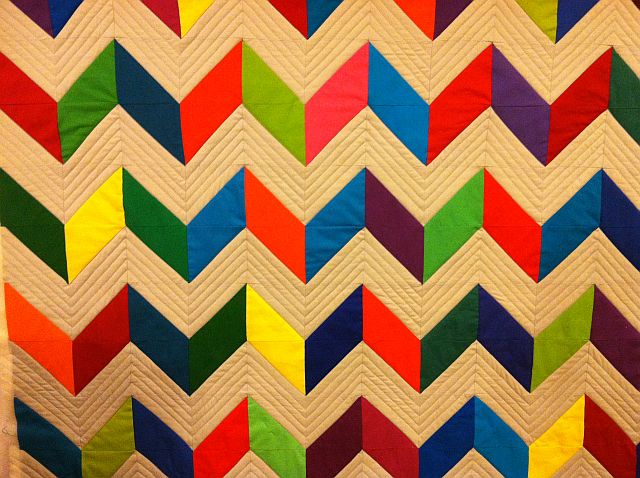
For my Charming Chevrons, I chose to mark a set of grid lines following the outline of the chevrons. I used a June Tailor grid marker to speed up the process. I drew my lines so that they were about 1/2″ apart. I marked the top at my dining table while watching a movie with the family!

Step 1 – Preparing to Baste (30 Minutes)

Be sure your backing is at least 3″-4″ larger than your quilt top on all sides. (Professional long-armers need even more space than this but since I know you will all be quilting your own quilts, you can get away with less space if you are careful with your layout!)

Roll of Batting

Roll out your batting if cut from a roll, and cut it a couple of inches bigger than your quilt top. If you are using a packaged batting, be sure to unfold it and air it out a day or two before you begin to remove as many wrinkles as possible.

Be sure you have a nice big area for basting. You can use the floor, your kitchen table, a couple of utility tables, or even some tables thrown together at your local library or quilt shop.

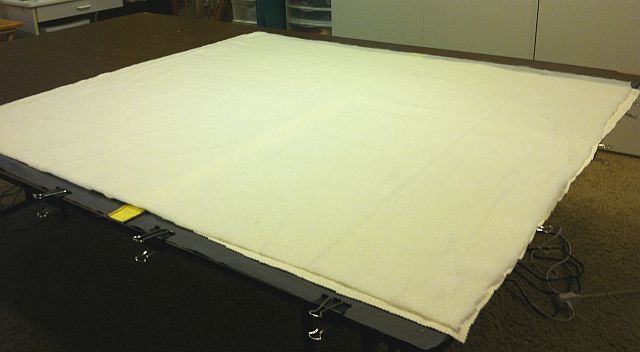
Give your backing a final pressing before laying it out. Remove any excess threads and smooth it out a flat as you can onto your basting surface. Clamp or tape down all sides of your quilt backing. I use binder clips on two sides of the quilt where the backing meets the edge of the table. I tape down the other two sides.

Layer 1 Quilt Backing

Layer 1 – Quilt Backing

Spread out your batting onto your quilt backing. Again, smooth it out so there are no wrinkles and puckers. You don’t need to clamp down the batting. For my quilt I am experimenting with a double batting. I laid down a layer of Warm-N-Natural Cotton, then a layer of Wool on top of that. I’ll let you know how I like it when it comes to quilting!

Layer 2 Quilt Batting

Layer 2 – Quilt Batting

Finally, spread out your quilt top as smoothly as possible. Since I use two tables to baste, I use the center between the tables as my reference point for where the middle is. This helps me keep the quilt top straight.

Layer 3 Quilt Top

Layer 3 – Quilt Top

Step 3 – Pin Basting (45 Minutes)

Pinmoors for Quilt BastingI mention this every time I get to this step of the quilting process, but I really love Pinmoors for basting!

They go into the batting quickly and come out super easy when machine quilting.

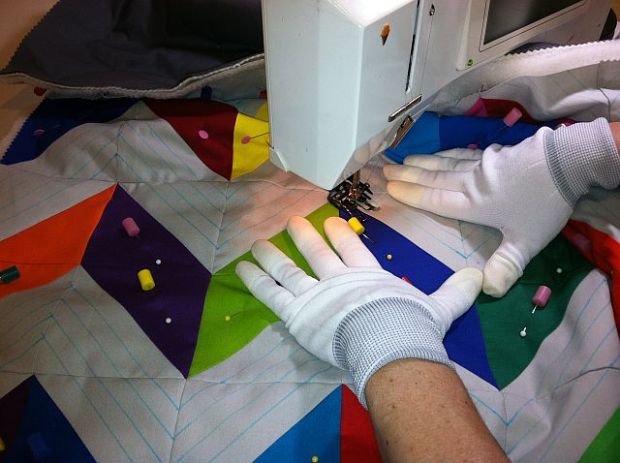
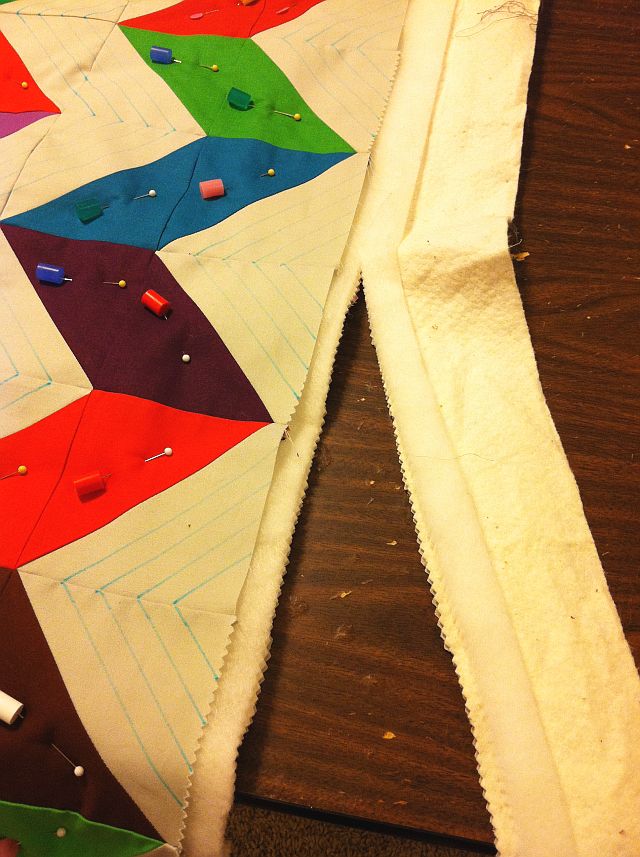
You get 50 per pack and it took just over 3 packs (168 to be exact) to baste my Chevrons quilt. I put one pin and Pinmoor anchor in each colored triangle and that was enough for this size quilt.

Because my batting was a little thicker, the longer flower pins worked great for getting through all the layers.

Trim the Excess

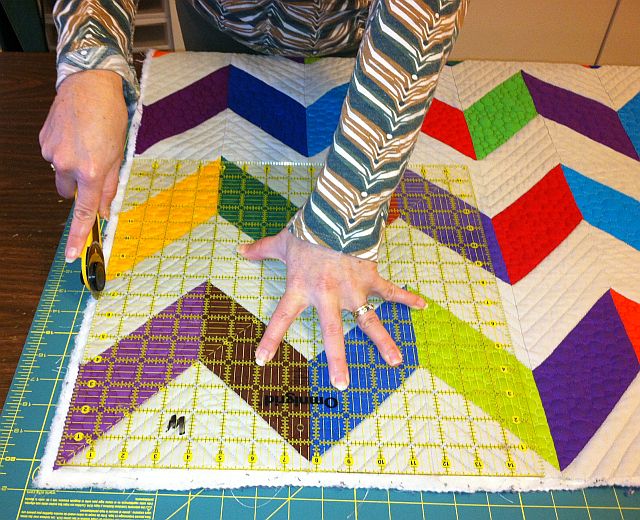
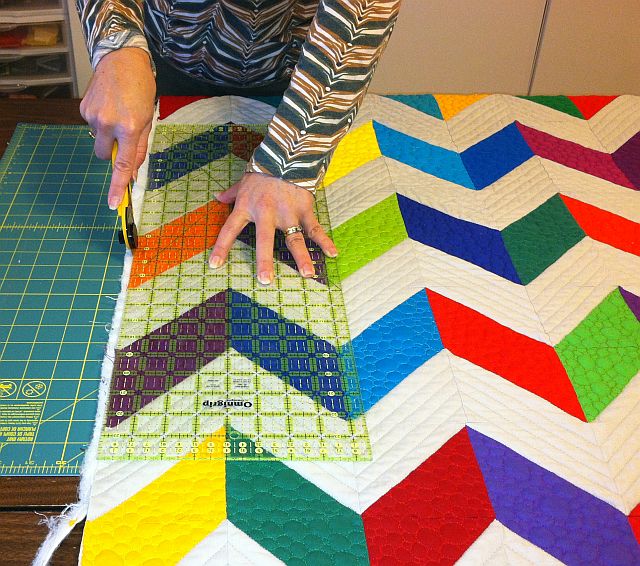
The last step before I begin quilting is to trim up the extra couple of inches around the quilt.

I don’t cut off all the excess, but I do trim it up pretty close so I have less bulk going under the arm of the machine.

I am super excited to quilt this puppy!

Be sure to email me pictures of your progress – it’s so fun to see all the variety!


Quilt Along Schedule (Links are active once each step has been completed.)

Charming Chevrons Followup #3

It’s so fun to see how everyone’s Charming Chevrons quilts are turning out. Keep emailing me your photos and I’ll be glad to share them here on my blog.

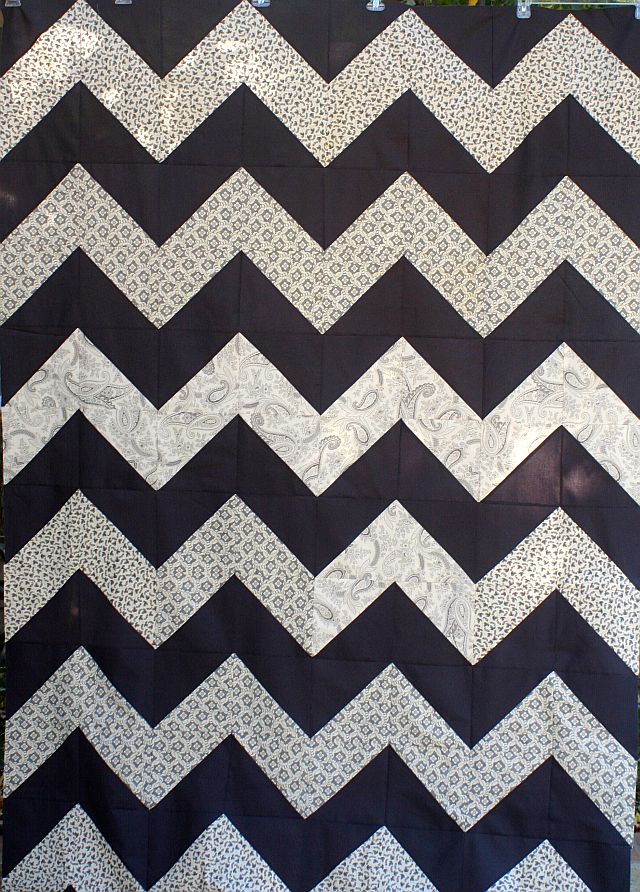
Kathie from California has worked ahead and has completed her lovely chevron quilt top in shades of black, white, and grey. She changed her quilt top up a little by sewing larger blocks and making her top narrower but longer.

She asked about border ideas. I think she could add a thin strip of black and then use her leftovers to make a scrappy pieced border like piano keys or flying geese. Any other ideas??

Kathie's Chevrons

Ellen from Oklahoma was so excited about this project that she’s already completed her first baby chevrons quilt and is now making another. She made her first quilt using one novelty focus fabric featuring owls for the zig zags with a cream background.

Ellen's Chevrons

Owls CloseupI love how she chose the green solid border and the pink binding fabric to pull it all together.

She paper pieced the 3 1/2″ blocks using triangles on a roll.

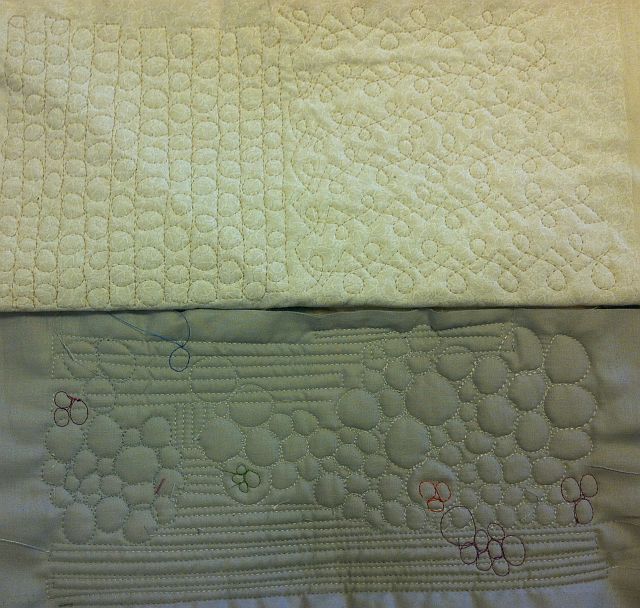
At left is a closeup of her gorgeous background quilting.

She stitched circles and loops with pink thread in the background and outlined the chevron blocks.

I’m going to do some similar pebble quilting with straight lines for my version in 2 weeks.

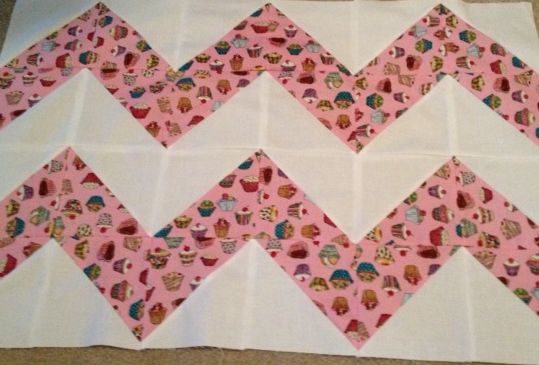
Finally, here’s the next chevron quilt Ellen is working on using a pink cupcake novelty fabric and solid white background. This time she cut her triangles from 6 inch squares to start with.

Cupcake ChevronsIf you want to make a similar chevron quilt using just one fabric for the stripes and one fabric for the background you would need about 2 yards of each. Here’s a link to my original Charming Chevrons supply list and sewing schedule.

For those of you wondering why I don’t just have a link up party, or use Flikr, that’s because eventually, I’ll be hosting the blog myself on its own domain which means I’ll have a lot more flexibility and control over the blog and what bells and whistles we can offer. Jason’s working on that right now but we are still a few weeks away from the big rollout. So more on that later…

Christa’s Quilt Along 3.5 – Charming Chevrons Quilt Top

This week I assembled my Charming Chevrons quilt top made from just four charm packs. Be sure to scroll to the end of this post for links to all of the previous weeks’ tutorials. For your convenience, quilt kits are available for a limited time in 3 different colorways.

It took me a total of 3 hours to follow the steps below and finish sewing my quilt top. (I think it took longer than that just to edit the pictures and write this blog post!)

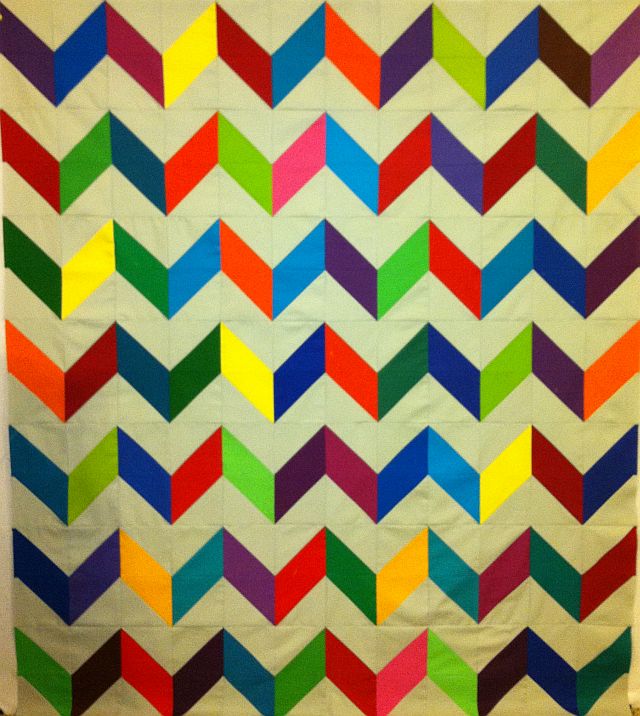
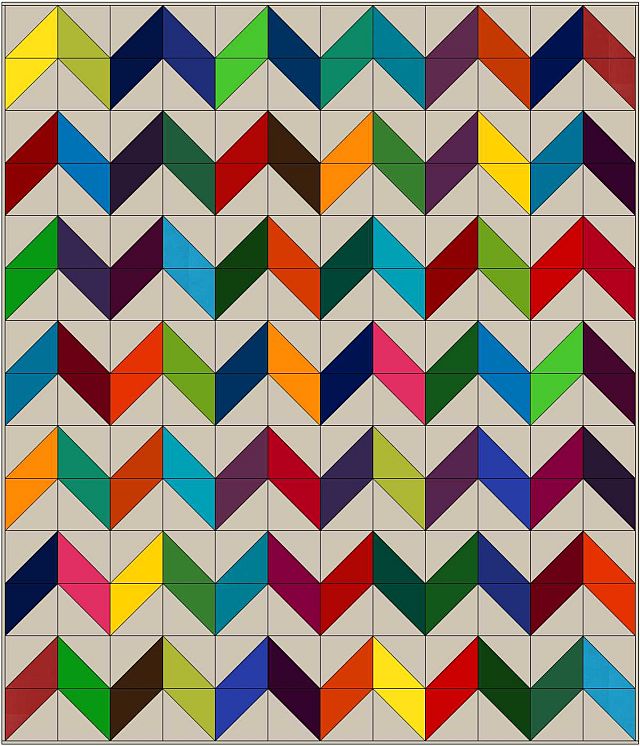
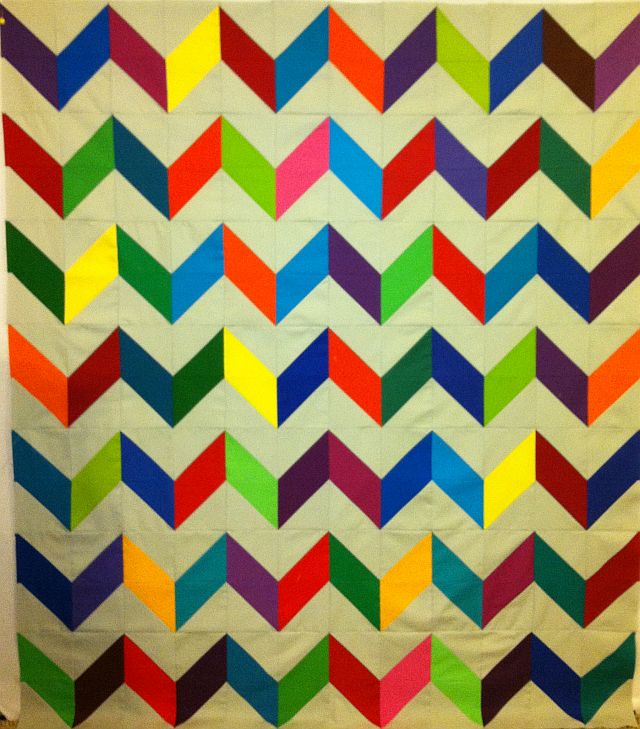
Charming Chevrons Quilt TopAnd yes, this is my actual completed quilt top, not a computer generated picture.

Step 1 – Sewing the Block Pairs (45 Minutes)

Lay out your chevron blocks in a pleasing arrangement on your design wall or other large flat surface. You will have 7 rows with 6 blocks per row for a total of 42 blocks.

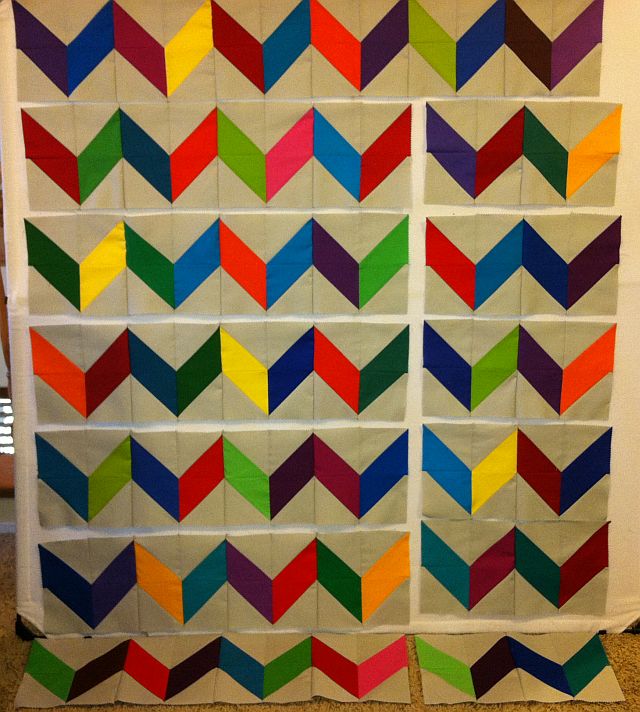
Sew each row into pairs of 2 blocks each. Each row will have 3 pairs of sewn blocks. Now you have 21 w’s instead of  42 v’s! (Yes, I’m missing a row in the picture because it wouldn’t fit on my design wall. You should still have 7 rows.)

Chevron Block Pairs

Step 2 – Sewing the Pairs into Rows (1 Hour)

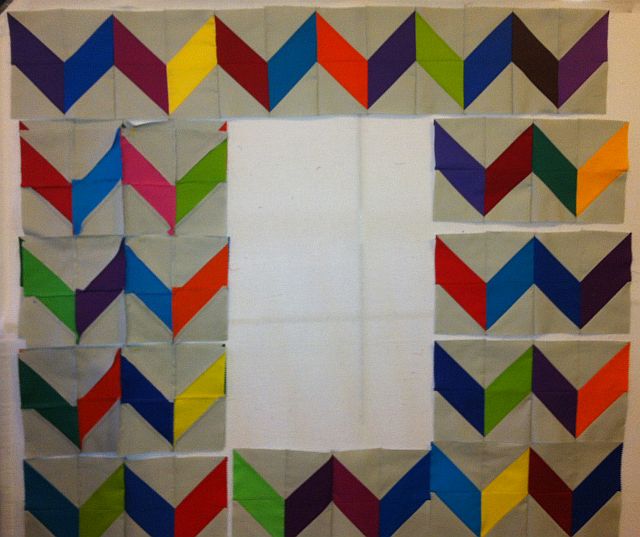
Now you can sew 2 pairs of chevron blocks together in each row. You can see a “hole” in my quilt where I’ve flipped the second pair onto the first along the right side edges. I left the third pair of each row on the design wall so I can remember where each one goes as I sew.

Sewing the RowsNow that you have 2/3 of each row finished, you can add the last pair to the end of each row. Be sure to pin generously and flip over any seams if needed so that your seams lie flat.

Partial Rows

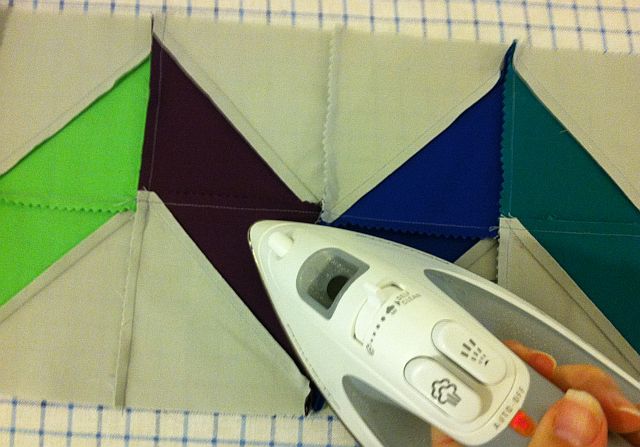
PPress The Seamsress the seams so that they are all going the same direction in each row.

Be sure that your seams for rows 1, 3, 5 and 7 are all going one way and that rows 2, 4, and 6 are pressed in the opposite direction.

You could also press them open if you prefer. This took me a little while but it was worth it.

Step 3 – Join The Rows to Complete The Quilt Top (1 Hour, 15 Minutes)

Join 2 rows together at a time, pinning at the intersections. You will then have 3 pairs of sewn rows with one row left over. Press each long seam open.

Joining The RowsNow join these last 3 seams to complete the quilt top and give it a final pressing. It’s fun to see how the actual top turned out compared to my original computerized drawing. I like the chevrons with the tips pointing down better. But you can decide either way!

Computer Design

Computer Designed Version

Finished Quilt Top

Actual Quilt Top


I’m very pleased with how my top turned out – now I can’t wait to see yours! Please email me pictures of your work in progress and I’ll be glad to share them here on my blog.

Sewing Schedule (All links will be active once each step has been completed.)

Holy Cow I Finished!

I finished quilting my Busy Hands quilt this weekend. I feel like it was quite an accomplishment because I quilted the heck out of it! This quilt is my first official “Modern Quilt” and I have to say, I enjoyed it immensely.

Busy Hands Quilt

(My poor little chevron blocks are just piled up in the corner, patiently waiting their turn on the design wall so they can get turned into my next modern quilt.)

I tend to be a little more “organized” with my piecing rather than embracing the “wonkiness” that is also a hallmark of this quilt genre. But I love modern quilts because of their bright, clear colors, bold geometric shapes and clean lines, with lots of negative space for machine quilting.

Busy Hands Quilt Detail

My favorite part about this quilt is all of the different free-motion designs that I tried. I originally was going to stick to one background fill but after quilting a few blocks I got bored very quickly.

FMQ Detai

One of the things I love about modern quilting is that there are no hard and fast rules, so I was free to switch up the designs whenever I felt like it. I can’t tell you how liberating that was!  I didn’t plan them ahead of time but quilted them serendipitously. I counted a total of 53 different quilting designs when all was said and done!

FMQ Detail

I still have to soak the quilt to remove all of the blue lines around the hands, then block it and bind it. I’m really toying around with the idea of trying to enter it at QuiltCon if I can complete these final steps in time. It’s a juried show and they are accepting entries through November 30th. I’ve never entered a quilt in a “big show” before so I don’t even know if it would get in, but what the heck – I might as well try. It can’t hurt, right??
FMQ Detail

Christa’s Quilt Along 3.4 – Charming Chevrons Block Tutorial

This is the week where our Charming Chevrons quilts really start coming together! We will sew all of the blocks and start laying them out so that the top can get finished by next week. Be sure to scroll to the end of this post for the complete tutorial schedule.

It took me a total of 2 hours, 15 minutes to sew and press all 42 of my Chevron blocks.Chevron Blocks

Step 1 – Sewing the Half-V’s (1 Hour)

Each chevron looks like a V and each half of the block is a mirror image so keep that in mind while assembling your units.

Block UnitsFirst, separate all of your triangle squares from last week  into 4 equal piles, orienting them to form a V.

Note that each half of the V is made from two triangle squares of the same fabric. You should have a total of 42 sewn triangle squares per pile.

Since each half of the block is a mirror image,  I will be sewing one half at a time.

Starting with the left half of the block – the left V – I laid a stack of units next to my sewing machine. They are oriented in the direction I will sew them. Chain piece all left V units.

Chain Piece the VsStacked Units Chain Piecing means sewing pairs of blocks with no stops.

After sewing all of your left V stacks, finger press (or use a wooden seam roller) from the back and then again from the front. Press them all to the same side and repeat for all halves.

Press Front SidePress Back Side

You should have a total of 42 left V units.

Now, repeat the steps above for the other half of the blocks, the right V units. Be sure to press the right halves in the opposite direction so they nestle when sewing the blocks.

Press OppositeRight V Units


Repeat for a total of 42 right V units.

Step 2 – Joining the Halves (1 Hour, 15 Minutes)

Pin the two halves of each block together. If desired, you can flip over any seams so that they will nestle with the other side of the block – look at the pin on the far right below.

Pin the Chevron Halves

The key to sewing crisp points on these blocks  is to hit the “sweet spot” when sewing your seams. Sew from the side where you can see a little “x” made by previous seams. This is right where my pin intersects the block below.

Sew Through the X

When you have sewn all of the blocks together, press or seam-roll them again on both front and back. When finished, you will have a total of 42 blocks.

Finished Chevron BlockPress the Chevrons

Because of the way this quilt is laid out, you will want the major seams in your blocks to alternate. To do this make sure you press 18 blocks in one direction and 24 blocks the opposite direction. You’ll have 3 rows of block seams one way and 4 going the other way.

Seams Pressed Opposite

Once your blocks are complete, you can start laying them out in a pleasing color arrangement on your design wall (watch which way you pressed the seams).

Kona Solids Kit

Kona Solids Kit

You’ll notice that in my original drawings I started with the  Chevrons pointing up first. But now that I’ve laid them out, I think I prefer them as shown in the photo above with the points starting down. It’s your choice! I have kits available for all 3 colorways shown.

American Jane Kit

American Jane Kit

Coquette Kit

Coquette Kit


Sewing Schedule (All links will be active once each step has been completed.)

Christa’s Quilt Along 3.3 – Trimming the Triangle Squares

I am very glad I decided to take some time putting together my Charming Chevrons Do-It-Yourself Quilt Tutorial, and spread it out over several weeks. This week’s step of making the triangle squares is a very simple process; however it was a little time consuming.

It took a total of 3 hours to complete the steps below. That’s not bad considering I’m giving you a whole week to complete it, but I suggest you break it up over a few cutting sessions. It’s too tedious to do all at once! Scroll down to the end for the complete schedule.

Step 1 – Cutting the Squares in Half (20 Minutes)

With your ruler, rotary cutter and mat, slice each pair of sewn squares in half on the diagonal, down the middle on your previously drawn line. You may use scissors instead, but rotary cutting them is definitely faster.

Line up Your Ruler

Cut the Squares ApartEach pair of squares has been sewn together 1/4 inch away from the drawn line, yielding 2 half square triangles per each pair of charm squares (following last week’s instructions).

I like to stack them up as I cut, keeping the same pairs of colors together. They look like little fabric sandwiches. Yummy!

Sewn Triangle Stacks

Step 2 – Pressing the Triangle Squares (1 Hour)

It took me longer then normal to press the squares because I starched each block first.

Press the BlocksI am not sure if I’m happy with the results so I mention this with caution – test on the back side or some scrap fabric first or just skip it.

I got starch marks on the front sides of several of the blocks.

I had to soak them in water to get the marks out.

And yes, I used Mary Ellen’s Best Press which was not supposed to leave any residue.

So I’m not sure if I had my iron on too high of a setting, or perhaps it doesn’t work well with solids?

Press Seams to the Darker SideIs anyone else familiar with this? I’m still a starching newbie.

This is why I’m making this quilt in real time – so I can learn these things!

So if you just press your squares without worrying about starch or sizing, it will be quicker!

I pressed all of my seams toward the darker fabric.

Once my stacks were all pressed, it was time to trim them to size!

Step 3 – Trimming the Triangles (1 Hour 40 Minutes)

This was the tedious part because you will be trimming a total of 168 squares 1 at a time! So set aside a few afternoons and enjoy the process!

With a square ruler and a sharp cutter, trim the blocks so that they measure 4 1/2 inches. Line up the diagonal line of your ruler on the seam of the blocks.

Trim the Blocks

Then trim the sides. You may be able to trim only on 2 sides, or you may need to trim all four sides depending on where you need to slide your ruler so that the diagonal line stays in the center of the block.

Half Square Triangle Blocks

Block TrimmingsWhen you are all finished trimming, you will have a leftover pile of cuttings.

I think it looks rather pretty, don’t you?

You can use it as colorful stuffing or confetti.

Or how about wrapping up used needles or rotary blades with these scraps, put them in a bag, and safely throw away these sharp objects!

Sewing Schedule (All links will be active once each step has been completed.)

UFO Weekend

This weekend was the first time in awhile that I didn’t have to go anywhere or do anything but sew! (And take care of the kids and do laundry and clean the house and cook and work…)

I didn’t finish anything, but I worked a little bit on a bunch of projects I have going on right now so I feel very accomplished!

I finished a couple more paper-pieced units from my Deb Karasik workshop:

Paper Pieced Units

I sewed together all of my half-square triangles for my Charming Chevrons quilt tutorial later this week:

Half Square Triangles

I hand-sewed (yes-by hand!) another chunk of my Winding Ways quilt:

Hand Pieced Winding Ways

And I machine quilted a couple more squares of my Busy Hands quilt.

Busy Hands FMQ

All in all, it was a productive weekend!

Christa’s Quilt Along 3.2 – Marking and Sewing the Charm Squares

Welcome to week 2 of my do-it-yourself quilt along, Charming Chevrons. Last week we gathered our supplies. This week we will mark and sew our charm squares. Scroll down to the end of this post for a link to last week’s supply list and a schedule for the entire tutorial. Three versions below are available as quilt kits on my website; you can also make your own.

Solid ChevronsAmerican Jane ChevronsCoquette Chevrons

You can work at your own pace and I will start posting how long it takes me to complete each step. This will give you a general idea of how long my quilts will take to make. Today’s tutorial took me a total of one hour, 15 minutes to mark and sew.

Step 1 – Mark the Background Squares (15 minutes)

I chose 2 charm packs of Kona Ash grey and 2 packs of Kona Classics Solids (new palette). My pattern calls for 84 – 5″ squares of color and 84 – 5″ squares of background. The Kona color solids only came in 41 pieces per pack, so I had to add an extra charm to each set to ensure I had enough. (I made sure to add extra charms to the kits using this fabric, too!)

Straight Edge with Pen for MarkingMark all Backgrounds

Using a straight edge and marking pen of your choice, draw a diagonal line down the back of each background square. (Kona Solids don’t have a right or wrong side so just pick one. )

After several tries with different marking tools,  I had great success with the Frixion pen because it drew dark smooth lines on the fabric with no snagging or bleeding.

Step 2 – Sew the Seam Lines (1/2 hour each side, 1 hour total)

My favorite method for making half-square triangles is to sew 1/4 inch on either side of your marked lines. This goes really fast and you can sew for a few minutes at a time.
Sew 1/4 inch away from the line.

Grab one background charm and one color charm at random. Flip it over so that the background (grey) square is on top. Starting off of the sewing machine, sew 1/4″ in away from the marked line.
Chain Piece Your Blocks

Do not clip your threads at the end. Rather,  “chain piece” the next pair of charms. Continue sewing together pairs of charms (background/color) until you have sewn a total of 84 pairs, all on one side.

Pile of Colorful Blocks

Now, gather your long chain and this time sew on the other side of the line, again using 1/4″ seams. If they get tangled up, it’s ok to cut a few sections apart. If your seams are not exactly perfect, that’s ok, too. We will trim the blocks next week so they are all the same size.

Sew the other side.

Once all of your pairs are sewn, clip the threads between the blocks, stack them into a pile, and set aside for the next step. Now, give yourself a pat on the back! Wasn’t that fun??

Stacks of Colorful Blocks

If you are now just joining us, here is the complete schedule for making this quilt from start to finish, including quilting and binding. You’ll have a finished quilt in just a few weeks!

Sewing Schedule (All links will be active once each step has been completed.)

Christa’s Quilt Along 3.1 – Charming Chevrons Supply List

Free Quilt Pattern

New to my blog? Be sure to sign up for my email newsletter to get a free pattern!

Charming Chevrons

I am so excited to start my next quilt along! I’m having a blast designing new quilt patterns and breaking them down into easy to follow step-by-step tutorials.

To purchase a PDF download of this pattern, click here.

What do you get when you combine a couple of charm packs with a fun geometric design made from triangles? The answer is Charming Chevrons (48″ x 56″), shown below:

Charming Chevrons

I designed my quilt using Kona Cotton charm packs in their new classic palette.

I have put together quilt kits using the exact fabrics shown above, plus a couple of variations using these Moda charm packs shown below.

American Jane School Days

American Jane School Days

Chez Moi Coquette

Chez Moi Coquette

Supply List

Important! If you’d like to pick your own charms, make sure that each pack contains at least 42 – 5 inch squares. Be sure to purchase or cut extra charms if needed.

Fabric

  • 2 of the same charm packs in darks or prints – 84 charms total (Kona colors above)
  • 2 of the same charm packs in lights or neutral solids – 84 charms total (Grey above)
  • 1/2 yard for the binding (can be same as the background or something else)
  • 3 yards for backing split into 2 equal pieces if using all the same fabric. If you prefer a scrappy backing like I do, collect assorted chunks and scraps to total this amount.
  • Batting piece measuring at least 54″ x 62″ – (why not piece together some leftovers?)

Supplies

  • Basic sewing equipment in good working order
  • Rotary cutting mat and equipment
  • Iron and/or pressing tool
  • A variety of acrylic plastic ruler sizes including a 6 inch square up ruler (or larger)
  • Brand new sewing machine needles (I always start with a fresh needle on a new project!)
  • Frixion marking pen for drawing straight piecing lines (or your favorite marking pen)
  • Neutral cotton thread for piecing
  • Decorative thread to match fabrics for quilting
  • Walking foot for straight line quilting
  • Optional – darning foot for free-motion quilting (FMQ)
  • Optional – design wall or large space to lay out your design
  • Optional – blue water soluble marking pen for marking quilting lines
  • Optional – pinmoors and pins for easy basting
  • Optional – supreme slider, machingers gloves, bobbin washers for smooth FMQ

Sewing Schedule (All links will be active once each step has been completed.)

Based on past tutorials, I am allowing plenty of time to sew the quilt together so no one feels rushed. You are always welcome to work ahead or slow it down. That’s the beauty of this quilt along – you can sew and quilt at your own pace!

Sharing is Caring

Please share your work in progress in my facebook group: Quilt With Christa . 🙂

Christa’s Quilt Along 2.8 – Blocking and Labeling Baby Bricks

Free Quilt Pattern

Be sure to sign up for my email newsletter to get a free pattern!

I have finally finished two Baby Bricks quilts, my Pretty Pink Version and my Boy Blue version. I am very pleased with both and wanted to share a little bit about blocking and labeling in this last tutorial. My next series, Charming Chevrons, will start tomorrow.

Baby Girl Bricks

Baby Boy Bricks


Here are the last steps I took to completely finish my quilts:

Step 1 – Spray Blocking

The blue quilt turned out pretty straight and flat so it did not need to be blocked. However, the pink/green version had a little ruffle in the borders.

Wavy Border

I got all the edges wet with a spray bottle, patted them into place, then let them dry.

Spray BlockingPat in PlaceLay Flat To DryI laid the quilt out on my basting tables so it could dry flat. You can also pin your quilts in place using a large piece of foam core board. I will try that method sometime in the future.

Here is a link to a previous post where I used rulers to make sure everything was straight.

Step 2 – Adding the Label

I must say, I really dislike adding labels to my quilts. Usually it’s because I’m in a rush to finish and I don’t want to think about that step. But I decided I really want to document my quilts better and include important information like what materials and techniques I used.

Iron Freezer Paper

Press The Edges

Add Text

I Using a scrap from the quilt top, I ironed a small piece of freezer paper to the back side of the fabric. (I used the wrong side of the fabric as the front because it was lighter.)

Cut the paper 1/4 inch smaller than the label fabric. Press the edges of fabric over the paper to make a crisp edge around the label. Flip the label over and add your text with a permanent marker. Be sure to remove the paper before attaching to the quilt.

Pin The Label

I pin basted the labels to the back corner of the quilt. Because my backings were pieced from scraps, this helped the labels to blend in a little better with the backing. I think I will try to print my label info on fabric for next time since my handwriting is not very pretty!

Hand Stitch the LabelAttach the label to the back of the quilt by hand using a matching thread.

This is the same stitching I used to finish the binding by hand.

It only took 10 minutes of sewing so I guess I will quilt complaining about what a hassle labels are.

Yay – both of my Baby Bricks quilts are finished. Now, onto the next quilt!

In case you missed it, or have just discovered this blog post, here is the complete schedule of tutorial posts for my Baby Bricks do-it-yourself quilt along:

Sharing is Caring

Please share your work in progress in my facebook group: Quilt With Christa . 🙂