Christa’s Quilt Along 1.6 – Machine Binding to Finish

Free Pattern

Be sure to sign up for my email newsletter to get a free quilt pattern!

Jolly Jelly Roll Quilt Wrap Up


Here are all of the previous bog posts, if you are just now joining us:
Week 1 – Supply ListJolly Jelly Roll Quilt

Week 2 – Sewing the Blocks

Week 3 – Completing the Top

Week 4 – Backing and Basting

Week 5 – Machine Quilting

Remember, you can click on any picture to enlarge it. Now, onto the binding!

I use the same techniques to attach the binding to all my quilts, whether finishing by hand or machine.

Step 1 – Square Up the Quilt

Use a large square ruler to trim up all four corners of your quilt. The square will help you achieve a nice straight 90 degree corner. Trim up all four of the sides with a longer ruler.

Square Up the Corners

Trim the Sides

Step 2 – Measure the Quilt Perimeter and Cut Enough Binding Strips

Measure the perimeter of your quilt so you know how many strips to cut.  Lay it out on your cutting mat or use a measuring tape. I folded my quilt in half to make it easier to measure. Divide your perimeter by 40 inches (the useable length of one strip).
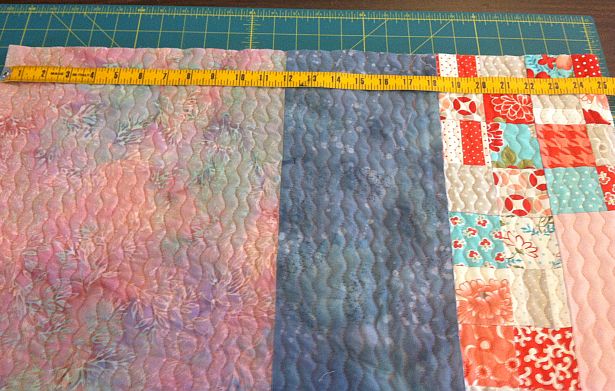
Measure the Quilt PerimeterCut 5 strips 2 1/4 Inches Wide

Round up to the nearest number of strips and cut them 2 1/4″ wide. I cut 5 strips for my quilt.

Step 3 – Make Continuous Binding

This method is called double-fold straight grain binding. Sew all of your strips together to make one continuous piece. Miter the strips by sewing on an angle to distribute the bulk of the seam. If you are using a solid fabric, be sure to sew them all together on the same side!

Join Binding StripsSew on an AngleYou can eyeball the seam.

Trim 1/4 inch seams to the right of your sewing line and press open.

With a small square ruler, cut off one end of your binding on a 45 degree angle. Make sure your binding strips have not been folded or pressed yet. Once the end is cut, then press your binding in half along the entire length, with wrong sides touching and right sides out.

Angle the BegninngPress Binding in HalfWatch your seams if using solid fabric!

Step 4 – Attaching the Binding to the Quilt

Begin sewing your binding to the quilt with a walking foot, leaving a tail of about 6-8 inches unsewn. Be sure to start on the side of your quilt, not at a corner and sew the binding to the front of the quilt. The folded side of your strips will be to your left. The open sides will be to your right. Use a quarter inch seam allowance and match your thread to your binding fabric.
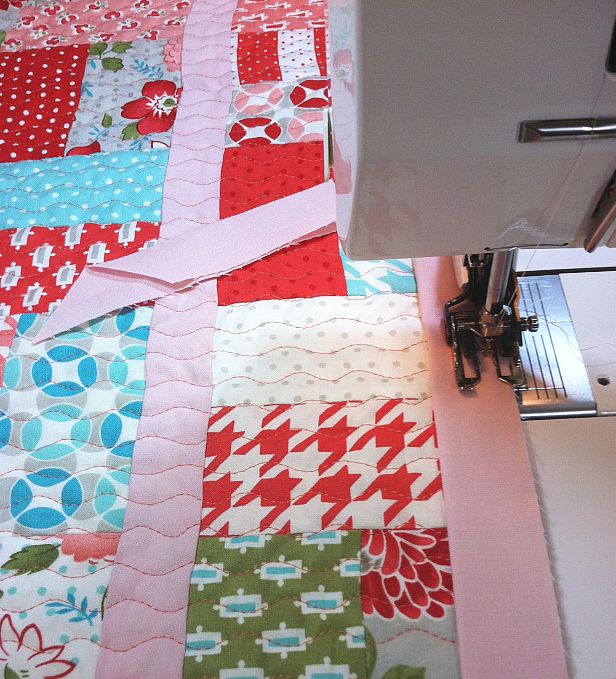
Leave a TailStop 1/4 Inch AwayWhen you reach a corner, stop sewing 1/4 inch away from the end. Mark it with a drawn line or a light pencil mark if needed. Sew off the side.

Rotate the quilt and flip the binding strip up so that it is even with the side of the quilt. Then, flip it back down, forming a “pinch” of fabric at the corner. This will be the fullness that will flip around to the back creating a nice mitered corner on the front.

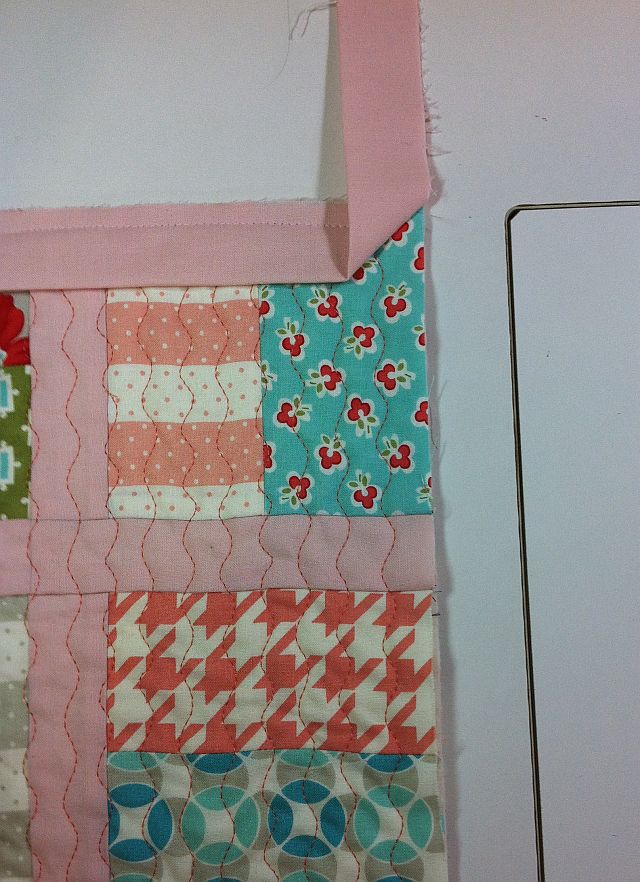
Sew off the Side at 1/4 InchFlip Binding UpThen Flip DownRepeat this technique for all four corners of the quilt. When you are nearly finished sewing the binding onto the front side, make sure to leave another tail of about 6-8 inches of binding so you can join the beginning and ending binding pieces.

Next Corner

Leave a GapNext, you will trim and join the ends so they fit together exactly.

If you have a lot of excess binding, you can trim some off.

Open up both binding ends and nestle your beginning binding piece (the angled cut end) on top of the ending piece so that it is flat and smooth. Mark an angle on the ending piece where the beginning piece rests on it – should be a 45 degree angle. Cut 1/2 inch away from this marked line. This will take into account the seam allowances for both pieces. Make sure your binding is not twisted and that both angled cuts are parallel to each other.

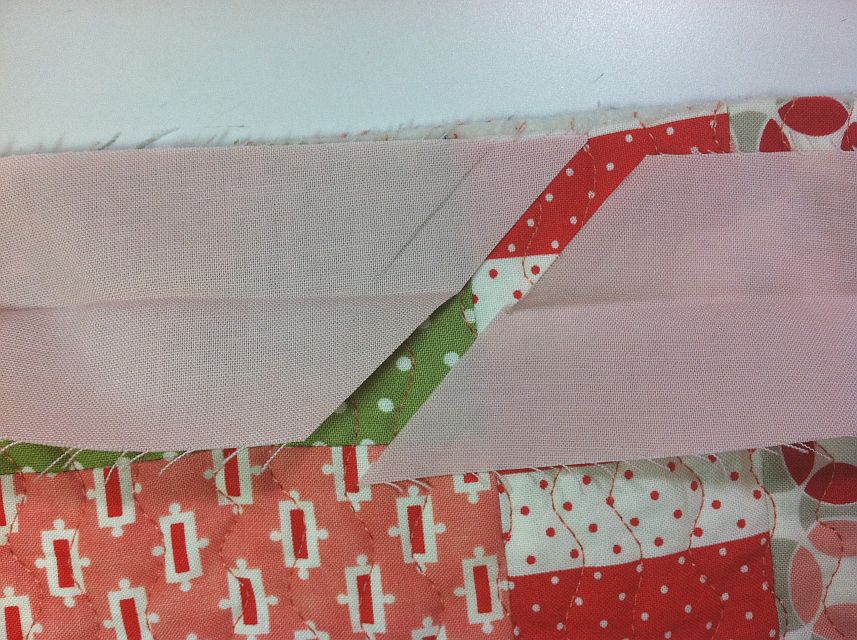
Mark the AngleCut 1/2 Inch Past Marked LineJoin the two ends by offsetting them slightly to create little tiny tips at each end. Where my pin is pointing, sew from the crevice of one triangle tip to the other, with 1/4 inch seam. Trim off the triangle tips, and press the seam open. It should be a perfect fit!

Joining the Beginning and Ending StripsFinishing the Front BindingFinger press the rest of the binding closed and complete your stitching on the front side.

Step 5 – Finishing the Binding with Decorative Machine Stitching

Pinmoors for BindingThe key to a really nice binding, whether finished by hand or machine, is to make sure it lies flat all the way around the quilt and that the corners are secure.

Once the binding is sewn to the front, simply fold it over to the back to stitch.  I like to use pins with Pinmoor anchors for safety to keep everything in place. Fold over the corners to create a nice miter and pin.

Binding by MachineI used the same decorative serpentine stitch for the binding that I used for the quilting.

You will notice I am actually stitching by machine from the back side of the quilt. This seems to give me the best results and I can control how wide the stitching is so it shows up nicely on the front.

You can see where I’ve already stitched some of the binding.

On the back, be sure to cover the line of straight stitching that was used to sew on the binding  from the front side.

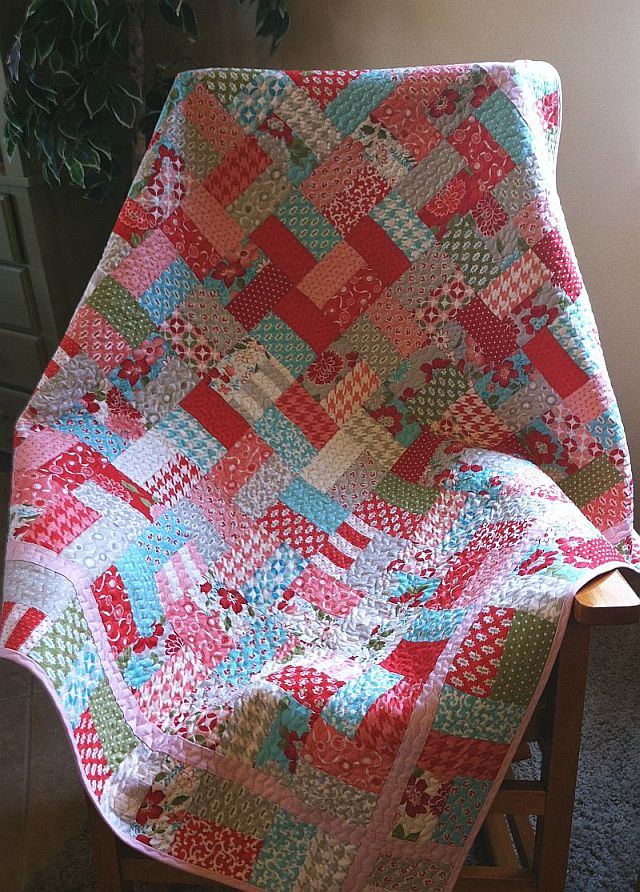
The binding is just as beautiful on the backside as it is on the front. Another finished quilt!

Another Finished Quilt!

Sharing is Caring

I’d love to see your version! Please share your work in progress in my facebook group: Quilt With Christa . 🙂

Christa’s Quilt Along 1.5 – Machine Quilting

This week’s post is the one I’ve been waiting for. I think machine quilting is the best part of making a quilt, so I couldn’t wait to get my Vintage Modern jelly roll quilt top finished and basted so I could start the fun! I quilted it using a serpentine stitch with my walking foot.

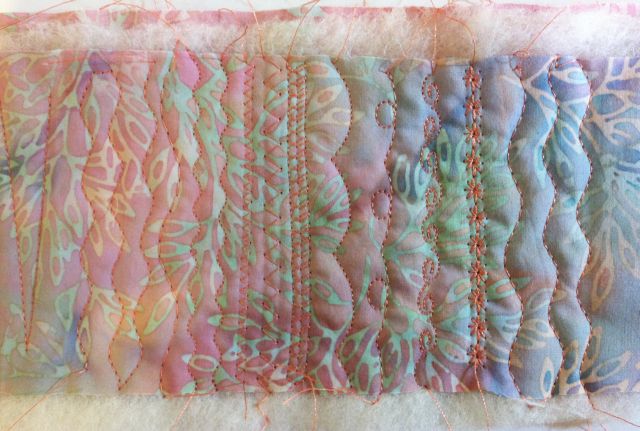
Machine Quilting 2" ApartBefore I started quilting, I tried out a few of my machine’s decorative stitches to see how they would look.  All of these can be done using a walking foot with the feed dogs engaged.

Stitch SamplesI used a 40 weight high-sheen polyester thread with a size 90 needle and used the same thread for both the top and bobbin.

This gives better results than using different colored threads.

Step 1 – Decorative Ditch Quilting

Quilting 4" ApartBe sure your needle plate has a wide enough opening to accommodate your decorative stitch and test it out first so you avoid broken needles.

Quilt along the seam lines in one direction in between your blocks, about 4 inches apart. The first pass took me 30 minutes.

This will secure the quilt and you can remove the pins as you go.

Next, make second pass in between each line of quilting. Now your quilting is about 2 inches apart and the quilt is starting to get some texture! I quilted parallel lines across the quilt. I did not mark any of these lines – I just used the seams as a guide and eyeballed it across the fabric where there was no seam to guide me. This is both liberating and fun!

Quilting Parallel Wavy LinesThis second pass took another 30 minutes so I’m just at 1 hour total quilting time. Not bad! At this point, this is enough quilting to hold your quilt together. However, I want more…

Step 2 – Adding More Quilting

Quilting 1 Inch ApartMy motto is that you can never add too much quilting to a quilt!

So I added another line of quilting in between each of the rows above. This was my 3rd pass and now the quilting lines are about 1 inch apart.

This took only another 30 minutes and I can’t believe how fast this is going!

There is still enough room to add another row of quilting and do a fourth pass, so I decided, what the heck?

The fourth pass took 1 1/2 hours because I had now doubled the amount of quilting on the quilt, but I loved every minute of it!

Half Inch Quilting Lines

I ended up with quilting lines about 1/2 inch apart over the surface of the quilt. Total quilting time was 3 hours and I used up a full 500 yard spool of Superior Highlights thread.

Textured QuiltingSuperior Threads Tri-Lobal Polyster

I love all the texture on the back!

Pieced Backing with Quilting

So next week, we will finish our quilts, can you believe it? We will trim them up and bind to finish. I really can’t wait to see how everyone’s quilting turns out. Be sure to email me pictures of your progress, no matter where you are,  so I can share with everyone else.


Here is the complete Jolly Jelly Roll Quilt-Along Schedule:

Week 1 – Supply ListJolly Jelly Roll Quilt

Week 2 – Sewing the Blocks

Week 3 – Completing the Top

Week 4 – Backing and Basting

Week 5 – Machine Quilting

Week 6 – Machine Binding to Finish

Christa’s Quilt Along 1.4 – Backing and Basting Your Jelly Roll Quilt

Welcome to part 4 of my do-it-yourself quilt along! So far we’ve gathered our supplies, sewn the blocks, and completed our quilt tops. This week we will piece our backings and baste our quilts so that our Jolly Jelly Roll Quilts are ready for machine quilting next week!

Step 1 – Piecing the Backing

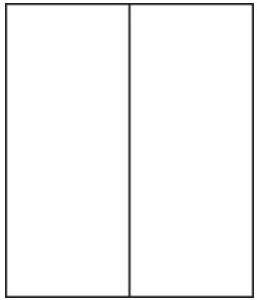
Backing DiagramIf you use one fabric entirely for your backing, sew together two lengths of fabric so that your piece is at least 5 inches longer and wider than your quilt.

For a 52″ x 52″ quilt top you would need 3 1/2 yards of fabric for the backing. Cut that into 2 equal pieces, each measuring 63″ long by 42″ wide. Sew those together on the selvedge edges with a half inch seam and you’ll get one piece that is about 63″ x 80″ – plenty of room!

I wrote up a post a few weeks ago on how to make a pieced quilt backing. With more than one fabric. You can read about that by clicking here.

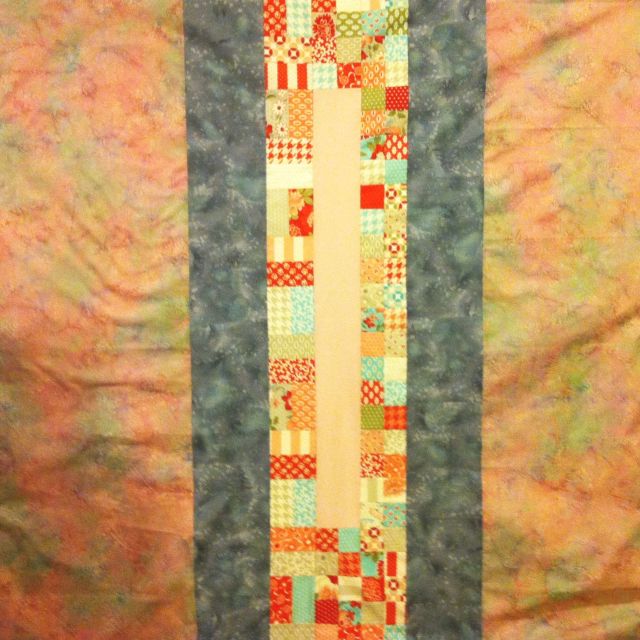
Pieced Quilt BackFor my backing, I chose to use up all of my leftover jelly roll blocks plus some other chunks of fabric, about 3 yards total, to make it a little more artistic.

I sewed two rows of leftover blocks, then filled in with strips of pink and grey fabric from my stash.

The pink on the sides is much wider so a bunch of it will be trimmed off later.

(Don’t mind the wrinkles – I finished it just last night!)

Step 2 – Layering the Quilt

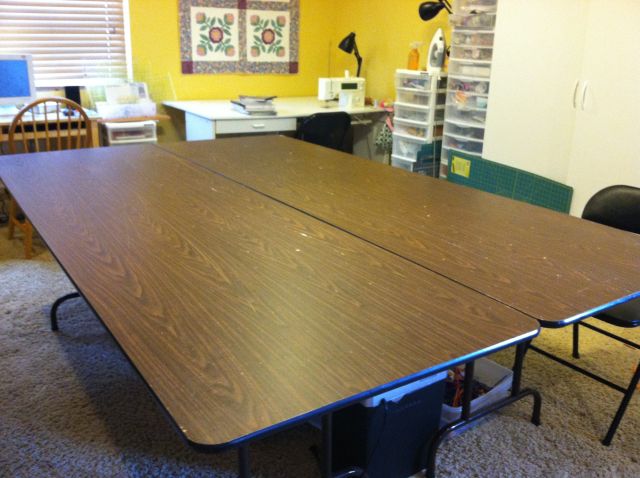
Basting TablesThe most important thing you need for successful basting is plenty of room! I have two 8-foot tables set up in my sewing room at all times. I use them for cutting and basting.

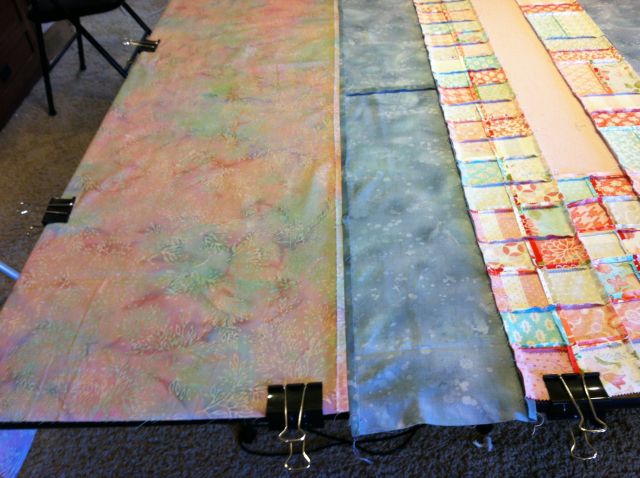
First, you need to secure your backing; this is why you want it to be larger than your quilt top.

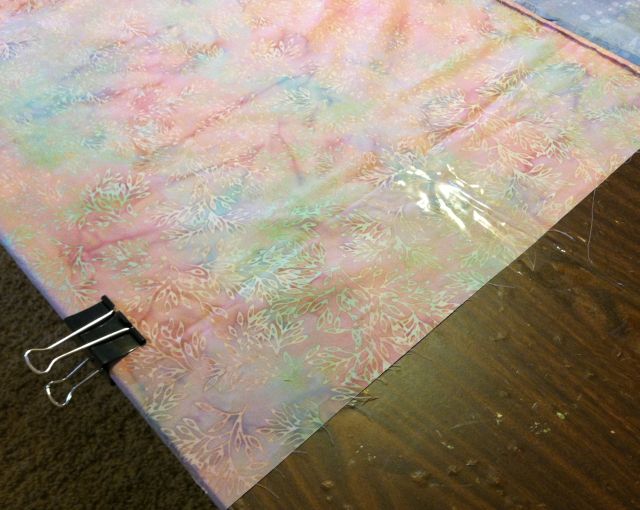
I do this by using office clips to secure the backing to the table. I use tape when the quilt backing does not reach the edge.

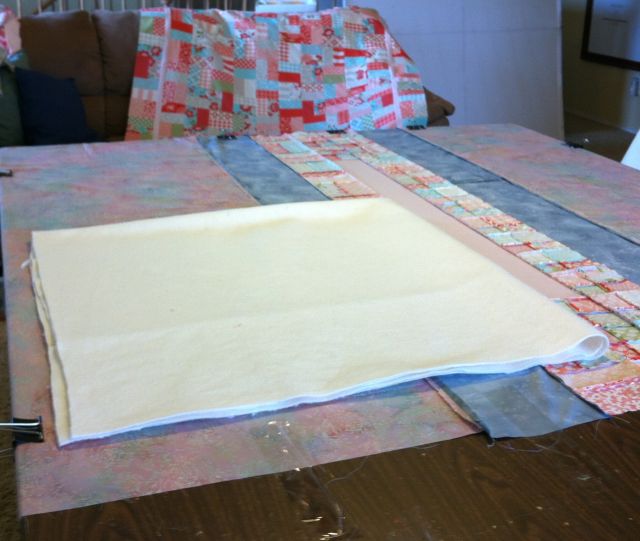
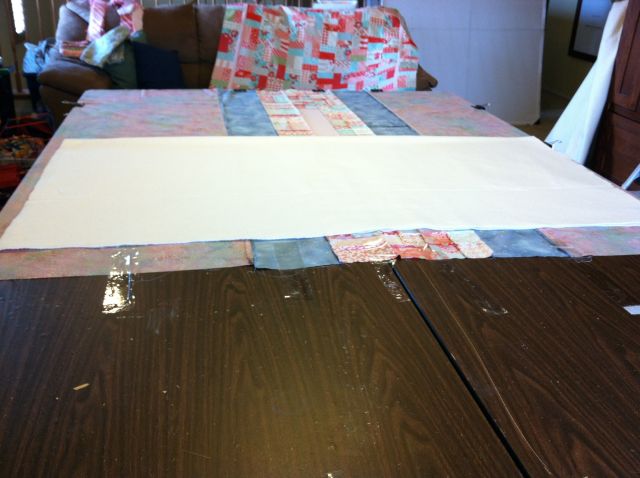
Clamp Down the BackingTape the EdgesNext, it’s time to spread out the batting. I used Warm-N-Natural cotton batting which does have a right and wrong side. The side with the flakes is the front side and the whiter side is the back side. Layer it right side up.

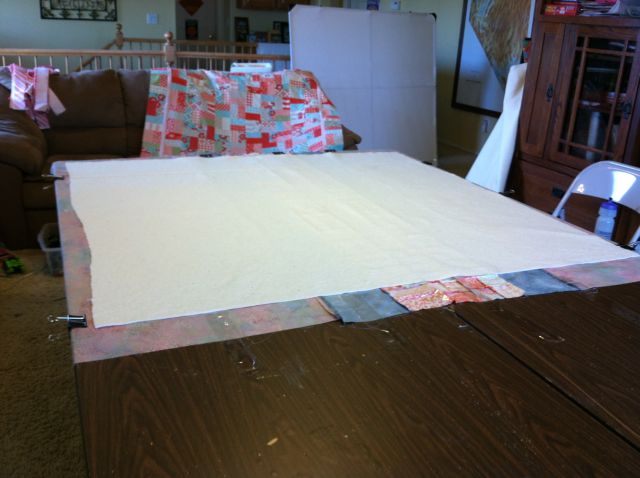
You can start with your batting folded up in one corner, then unfold the batting one step at a time if you are basting by yourself. Be sure to smooth it down so there are no wrinkles.

Batting 1Batting 2Batting 3You can click each of the pictures for a larger more detailed view.

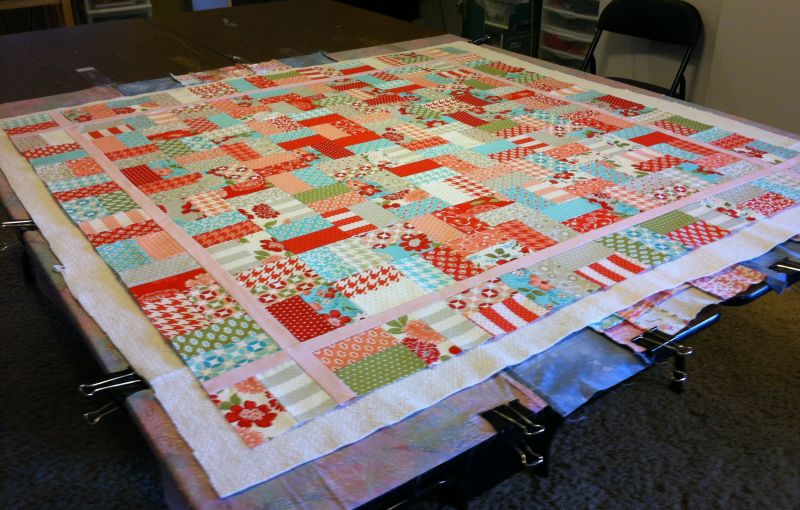
Finally, it’s time to add the top! I don’t clamp down the top, but I do smooth it out and line it up as much as I can so that it is as straight and square as possible.

Layered QuiltStep 3 – Basting the Quilt

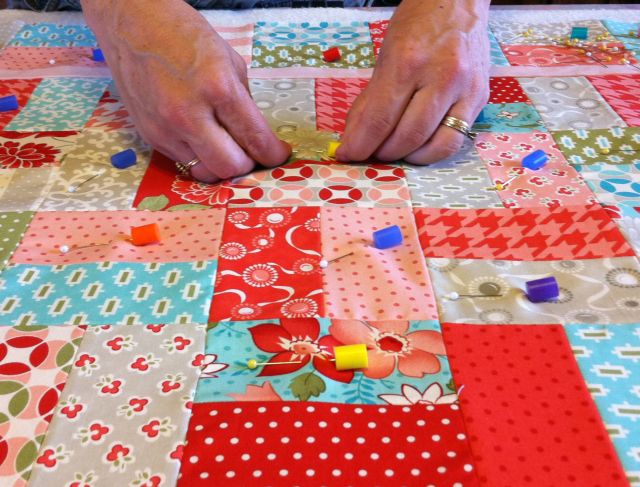
Now it’s just a matter of pinning the layers together so they won’t shift during quilting. My favorite basting tools are Pinmoor pin anchors. They are little  rubber tips that fit on the end of straight pins. You can use any types of pins with them and the pins can jab anywhere into the hard rubber piece. They last forever and are so much easier to use than safety pins.

Pinmoor BastingIt took me about 150 Pinmoors to baste this quilt in under 20 minutes. If you are not ready to buy enough for a whole quilt, start with one package and baste part of your quilt. Baste the rest of your quilt with safety pins. Then, when quilting, take note of how much easier the pins and Pinmoors are to remove and you will be converted!

Here’s a great video you can watch on how to use them, made by the makers of Pinmoors.

Next week  we will machine quilt this baby! That’s the best part of my do-it-yourself quilting tutorial; you are actually going to do it all yourself – no quilting by check here!!

Remember to send me pictures of your completed quilt tops. You can email me directly at Christa@ChristaQuilts.com. It’s “sew” fun to share!


Here is the complete Jolly Jelly Roll Quilt-Along Schedule:

Week 1 – Supply ListJolly Jelly Roll Quilt

Week 2 – Sewing the Blocks

Week 3 – Completing the Top

Week 4 – Backing and Basting

Week 5 – Machine Quilting

Week 6 – Machine Binding to Finish

Christa’s Quilt Along 1.3 – Jelly Roll Quilt Top

This week’s do-it-yourself-quilt tutorial will be pretty long. We are finishing our Jelly Roll quilt tops and I’m including lots of steps with photos. You can click on last week’s post here.

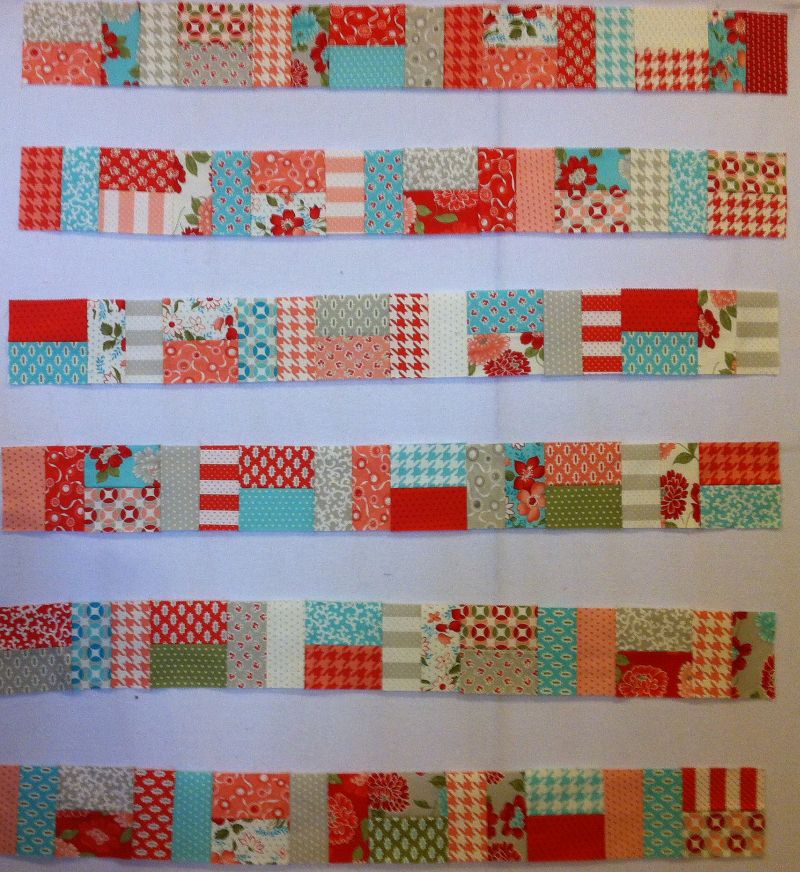
Step 1 – Piecing the RowsBlock Pairs

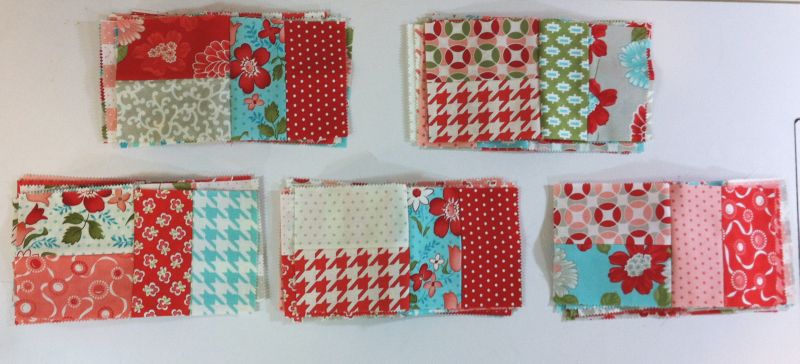
Grab 100 of your sewn blocks and pair them up into sets of 2 like this. Notice the orientation. Sew them all together so that you have 50 block pairs.

Next, sort your pairs into five stacks of ten block pairs each. This will be for 10 rows you will sew.

5 Stacks of 10 Blocks

Sew the top two pairs together and then the bottom 3 pairs together. Of course, you can shuffle them around as desired and assembly line sew all the stacks to make it quicker.

Piecing the RowsJoin these two pieces together to complete a row from each stack. Repeat to make 10 rows of 10 blocks each. They will all look the same and you will flip every other row to create the pattern. Please take this into account if you are using any directional fabrics.

Step 2 – Sewing your “IQ” (Inner Quilt)

Lay out all 10 of your rows horizontally into a pleasing arrangement. Flip every other row to create a horizontal-vertical-horizontal pattern with the blocks.

Pieced Jelly Roll Strip Rows10 Rows of BlocksImplement the 3 P’s for pretty patchwork: Press, Pin, and be Precise!

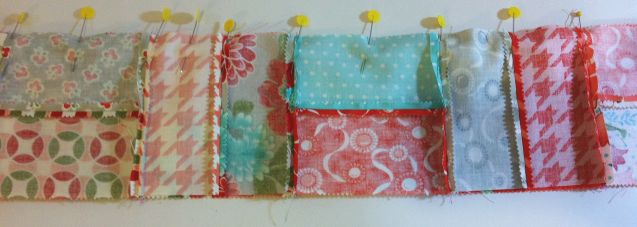
Pin Your RowsSew the rows of blocks together into groups of two. I put each row up on my design wall to make sure I don’t have the same two fabrics touching. Join rows to complete the IQ.

Join the Rows

Step 3 – Adding The Inner Solid Border & Outer Pieced Border

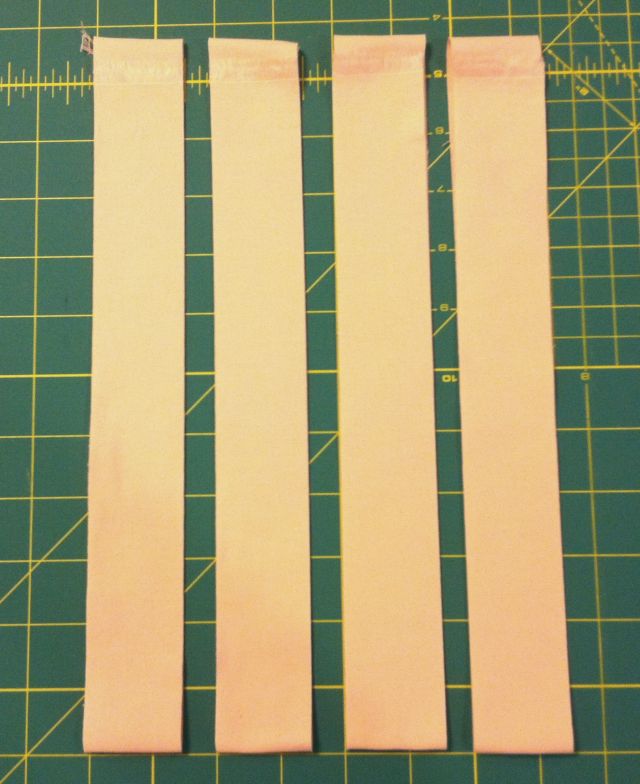
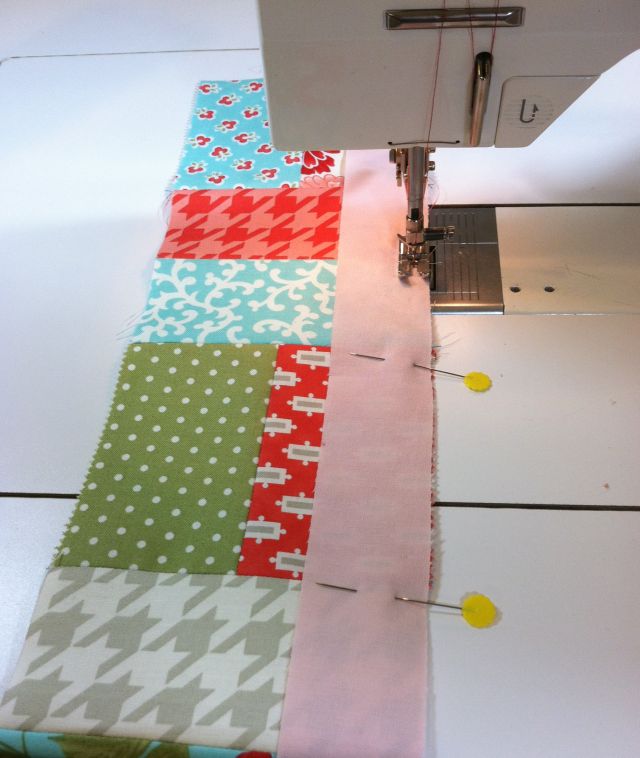
Sew together 4 more rows of 10 blocks each. Keep the same horizontal-vertical-horizontal pattern going. These strips will be for each of your borders. From your solid fabric, cut 5 – 1.5″ strips. Measure each of your rows and trim 4 of these solid strips to that measurement. Add a strip to each pieced border row on the same side so that they all look the same.

Cut 5 - 1 1/2 Inch StripsAttaching Accent StripsThe rows should measure 40.5″ unfinished. However, my rows grew to 41.5″.

That’s ok as long as they are all consistent!

Sold Strip with Pieced BordersNext, set aside 4 extra pieced blocks for each of the corners. Add a strip of 1.5″ solid to two sides of each block so that it looks like an L. Be sure to sew as shown below to make sure they are positioned carefully. If your blocks measure 4.5″ unfinished, you can trim 4 solid side strips to 4.5″. Trim the other solid side strips to 5.5″.

Adding Corner StripsBorder CornersTwo of each block will be the same.

Now it is time to sew two of your pieced borders to the top and bottom of your quilt. Flip the border strip so that your vertical-horizontal-vertical block pattern continues in the borders.Sew Top and Bottom BordersTo make the rows line up properly, flip the border strip down so you can match up the seams. Use lots of pins to keep everything lined up straight.

Match the SeamsUse lots of Pins

Corner Detail

Add corner blocks to either side of the remaining two pieced borders trips. Again, watch the rotation of your blocks.

You will notice I changed the design slightly from my original drawing.

I like the look of the solid border extending out into the edges of the blocks. I also liked continuing the alternating block pattern into the pieced borders.

Join the side rows to complete the top!

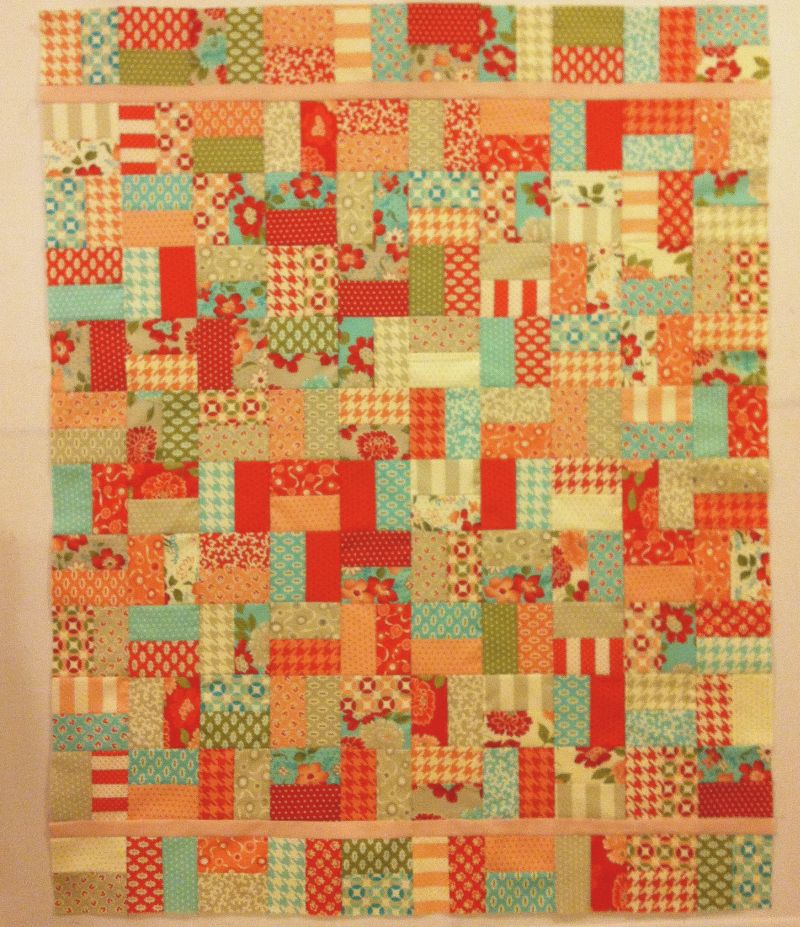
Jolly Jelly Roll Quilt TopCongratulations! You’ve now finished your Jolly Jelly Roll Quilt Top! Please email  pictures of your completed top to christa@christaquilts.com and tell me which Jelly Roll or set of fabrics you used. I’ll share your pictures before next week’s tutorial.

Next week we will prepare the backing and baste so it’s ready to quilt! You’ll need backing fabric (3.5 yards), batting (at least 60″ square), and basting pins. Here is the supply list.

I used one Vintage Modern jelly roll by Bonnie and Camille with 1 yard of Kona Cotton Solids in flesh pink for my quilt top. I will pick out my backing fabric later this week and will use the remaining blocks to add a little interest to the back of my quilt.


Here is the complete Jolly Jelly Roll Quilt-Along Schedule:

Week 1 – Supply ListJolly Jelly Roll Quilt

Week 2 – Sewing the Blocks

Week 3 – Completing the Top

Week 4 – Backing and Basting

Week 5 – Machine Quilting

Week 6 – Machine Binding to Finish

More Jolly Jelly Roll Quilt Blocks

I’ve been having “sew” much fun with our quilt-along and have been impressed with the comments and pictures I’ve been receiving from those that are participating. Unfortunately I don’t have a way to link up with everyone’s blogs who are following along. So I’ve decided to post pictures of everyone’s progress at  least once a week.

If you are sewing along with us, please email me your pictures, no matter how far along you are and I’ll post them here on my blog.  Here’s a link to last week’s tutorial for those of you that are just joining us. It’s never too late!

I just received a wonderful picture from Linda & Martha showing three different jelly roll collections that they and their quilting buddies are doing. They chose Trick or Treat, Christmas Spirit, and Meadow Friends for 3 of their Jolly Jelly Roll quilts.

Jolly Jelly Roll Quilt BlocksLinda and her “strip club”  meet every other month at their local quilt store. Like me, they think it’s so much fun to see what fabric everyone uses and what they look like when done!

Here’s a fantastic picture from Kathie that I just had to add. She’s using Leaf Haven from Benartex for her strips. If I can stop drooling over all these great quilt pictures and actually get to sewing my own, I can finish my top and show you the next step, LOL!

Kathie's Jelly Roll Quilt Blocks