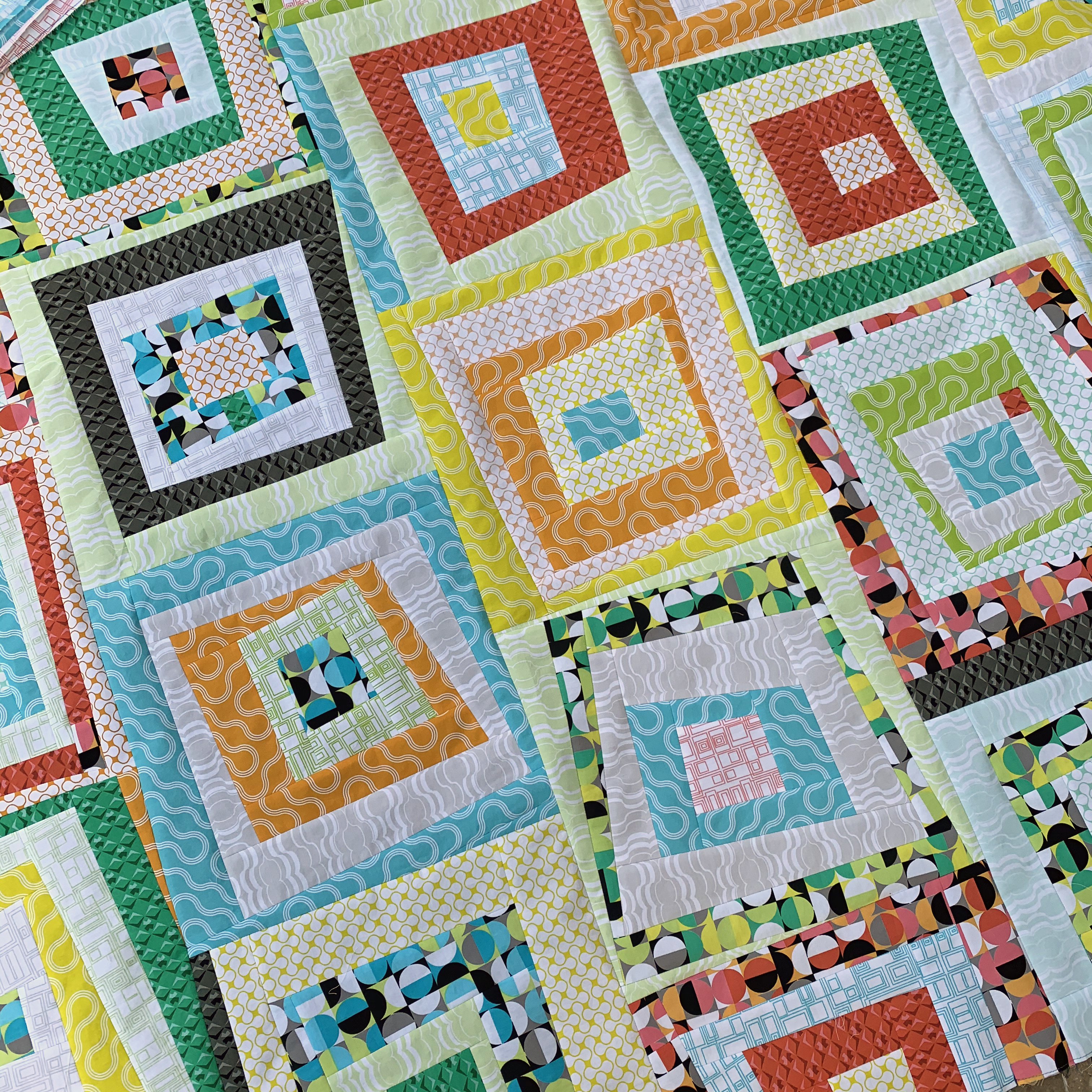
Daisy Chain QAL Week 4 – Sewing the Quilt Top

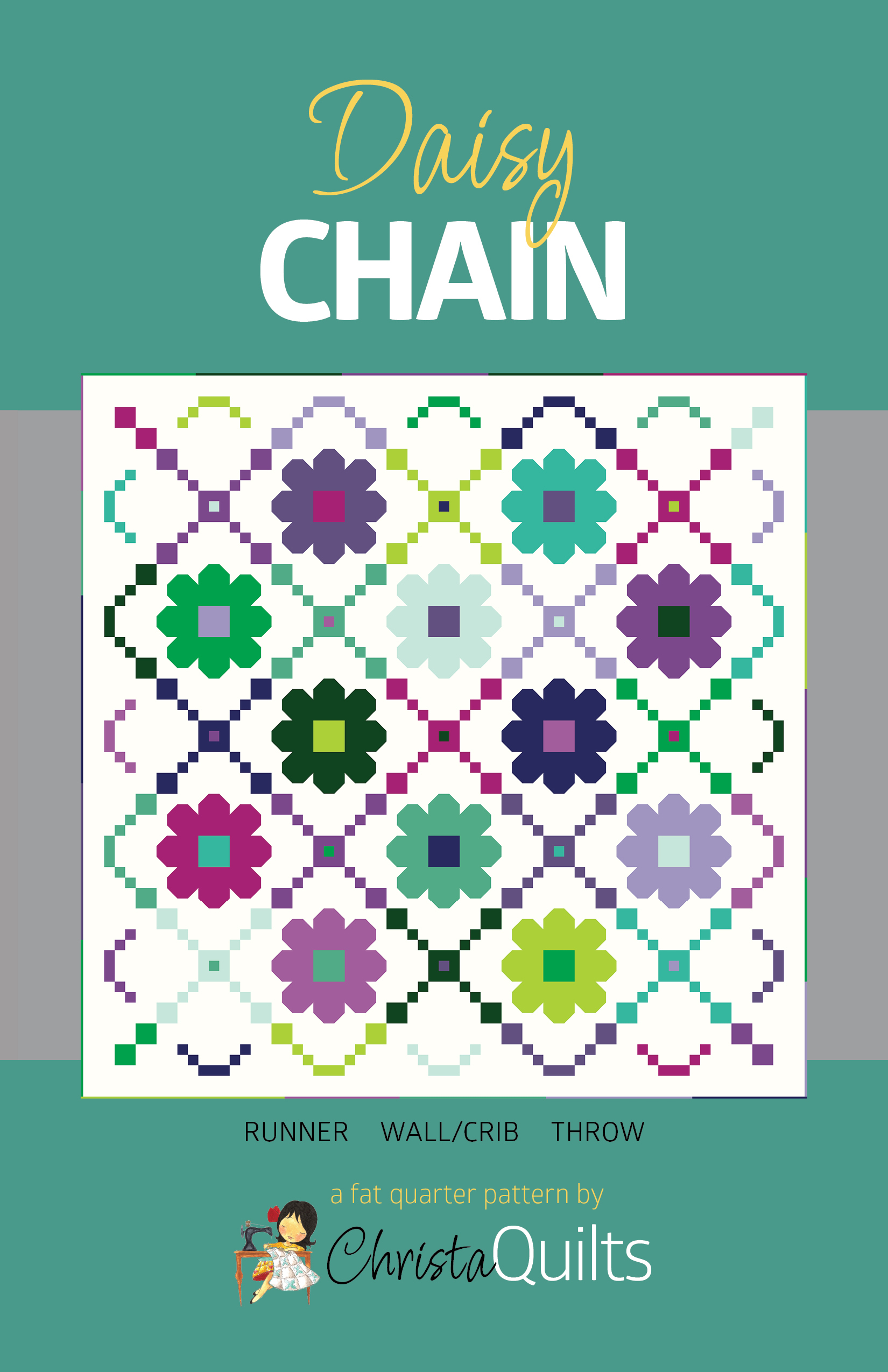
How are your Daisy Chain blocks coming along? If you are just starting, be sure to grab a copy of the Daisy Chain quilt pattern and join the fun. We are currently working through pages 12-13 of the pattern. But the tips I’m sharing below can apply to any quilt in your UFO pile!!

Click here to see how I made my design wall.

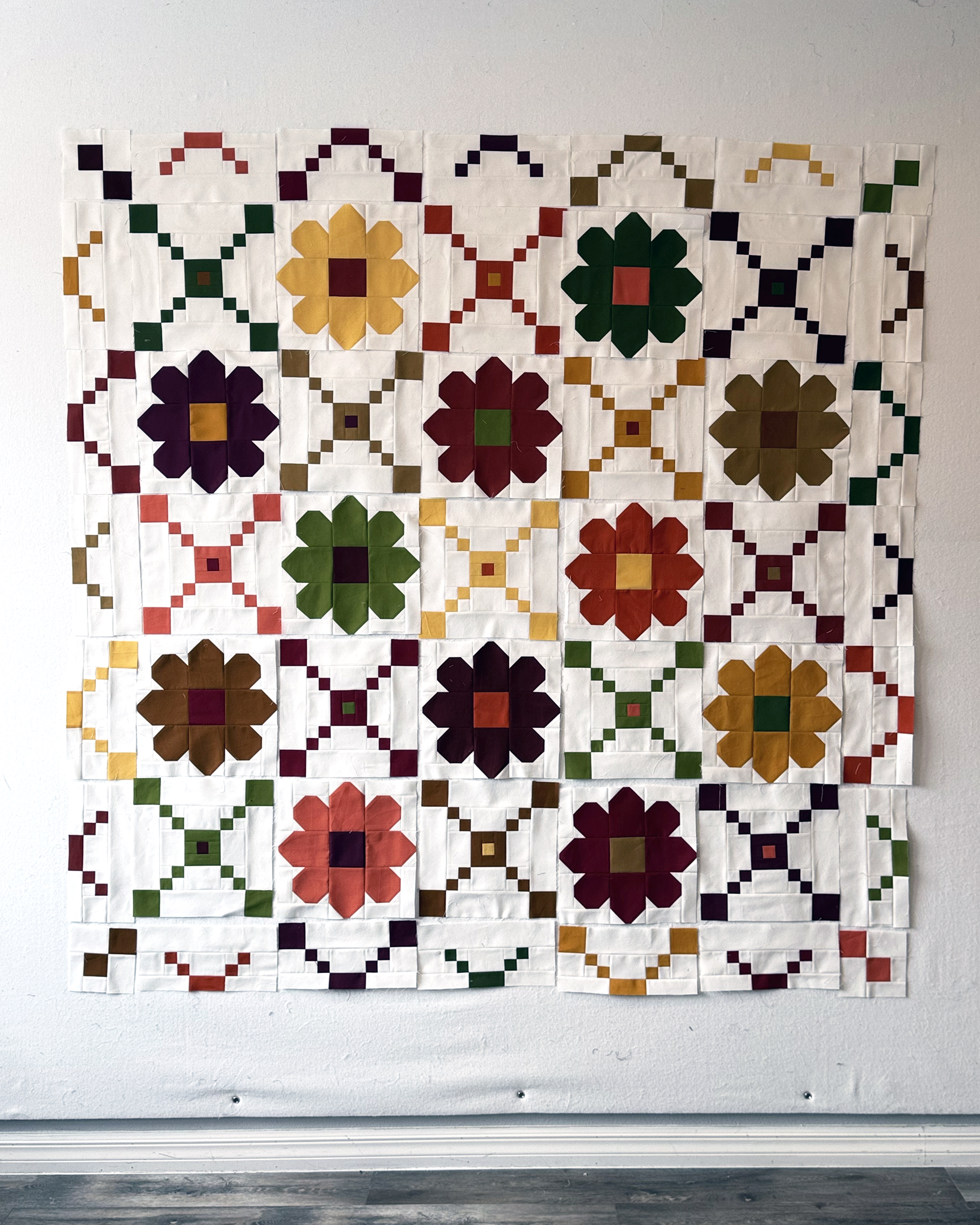
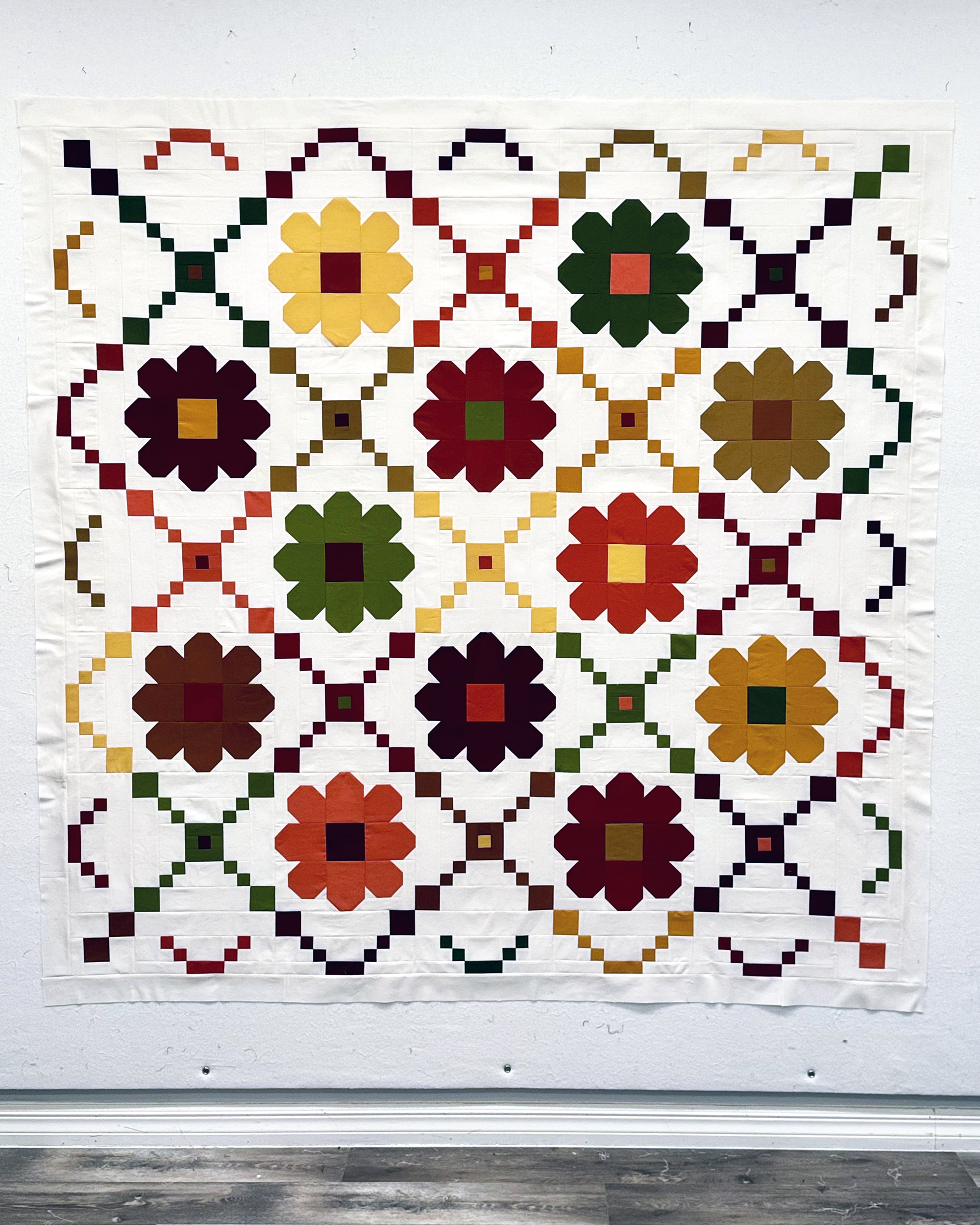
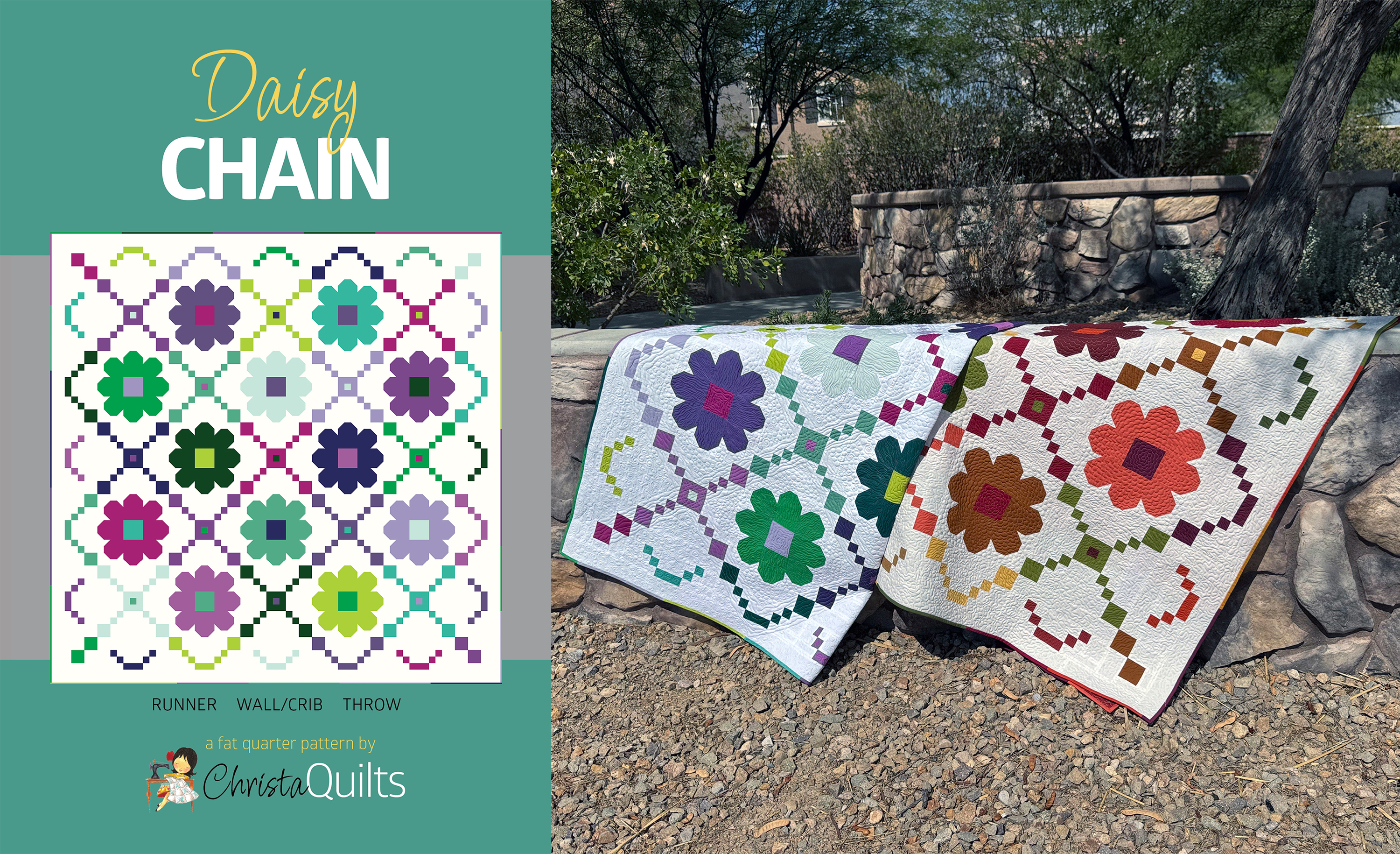
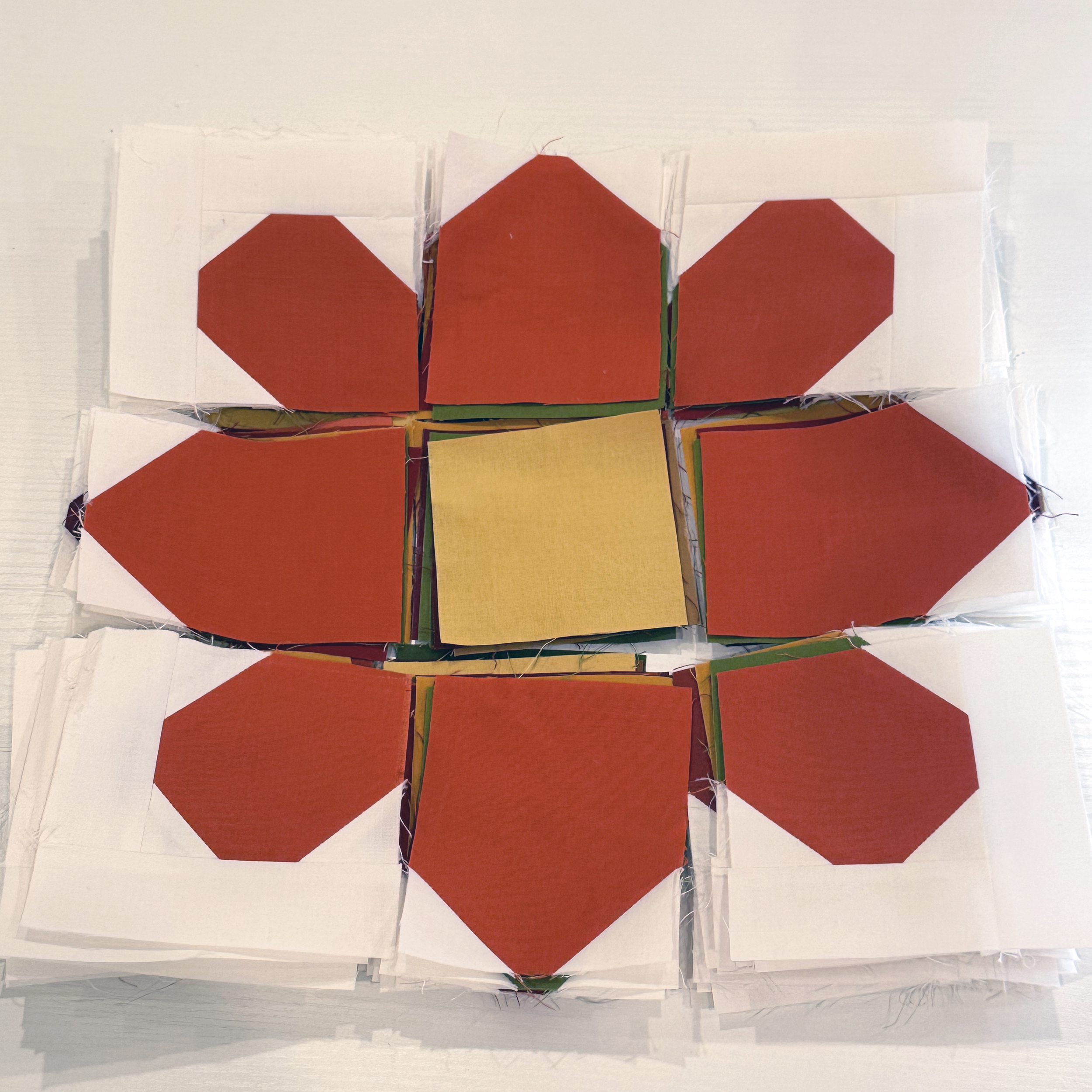
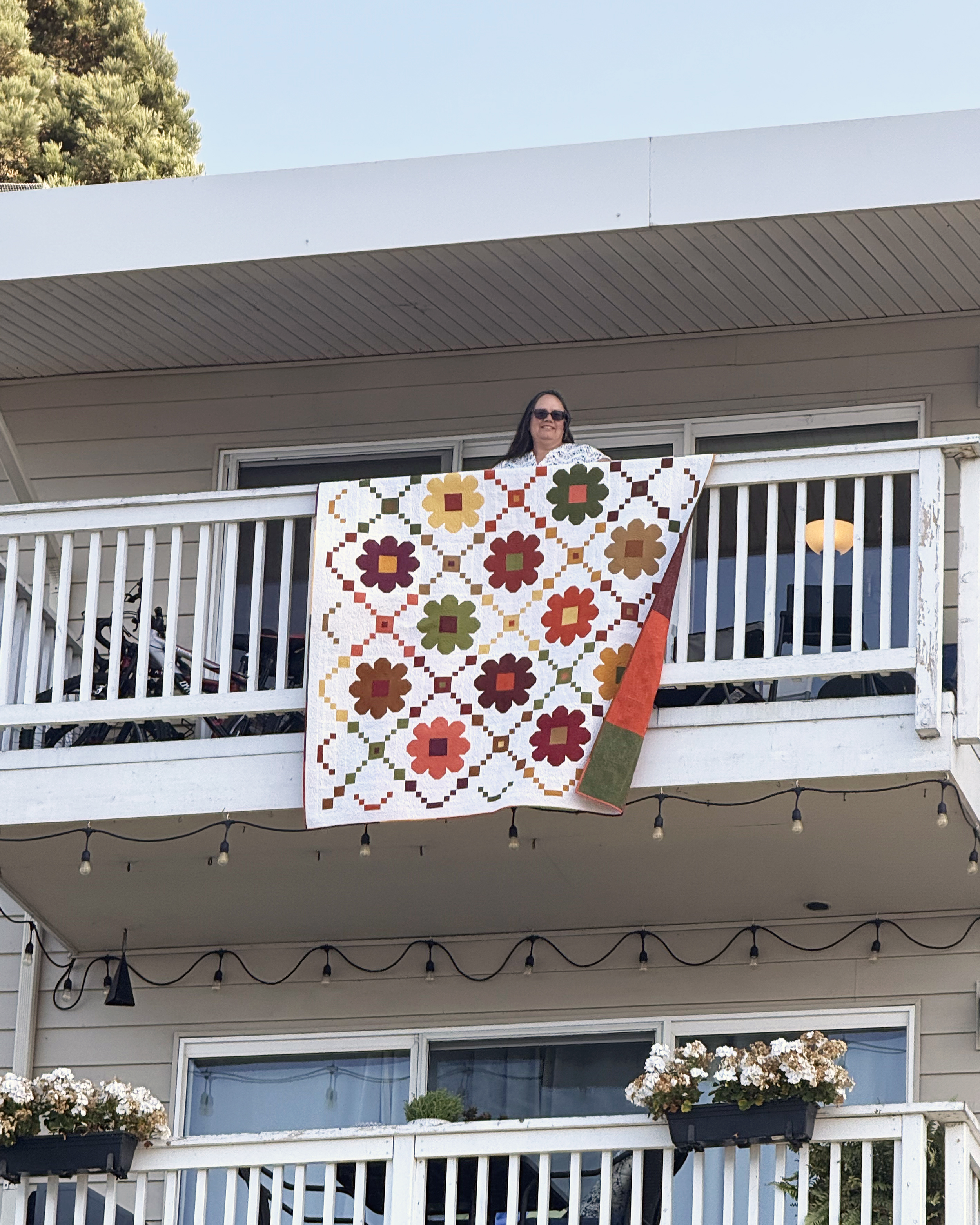
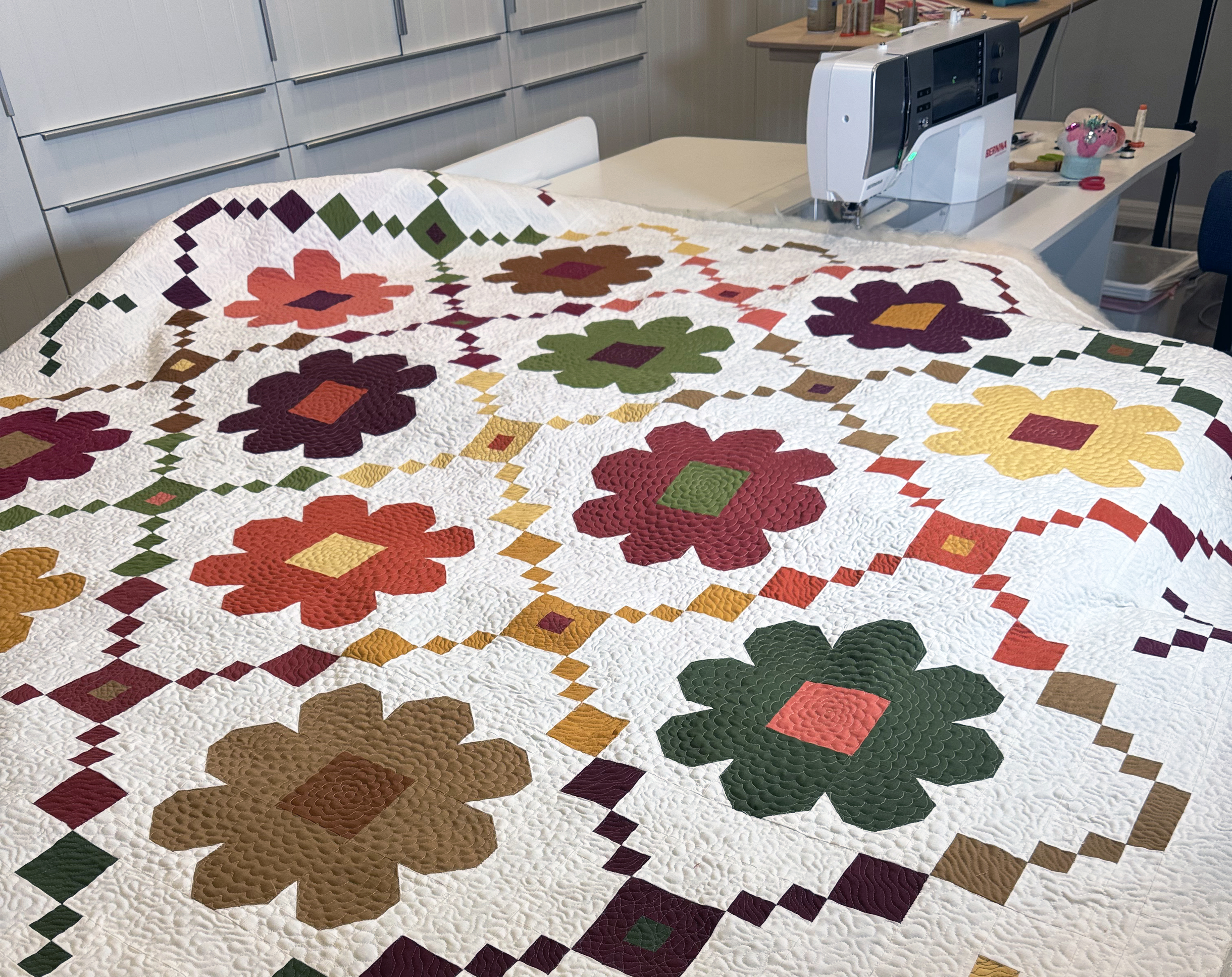
The first thing I like to do whenever sewing a quilt top together is to get all of my blocks up on the design wall and spread out the color. Then I’ll take time to arrange them into a pleasing layout. That’s what I did for the first version of this quilt I made in Autumn colors shown above.

A Design Bed Works Too!

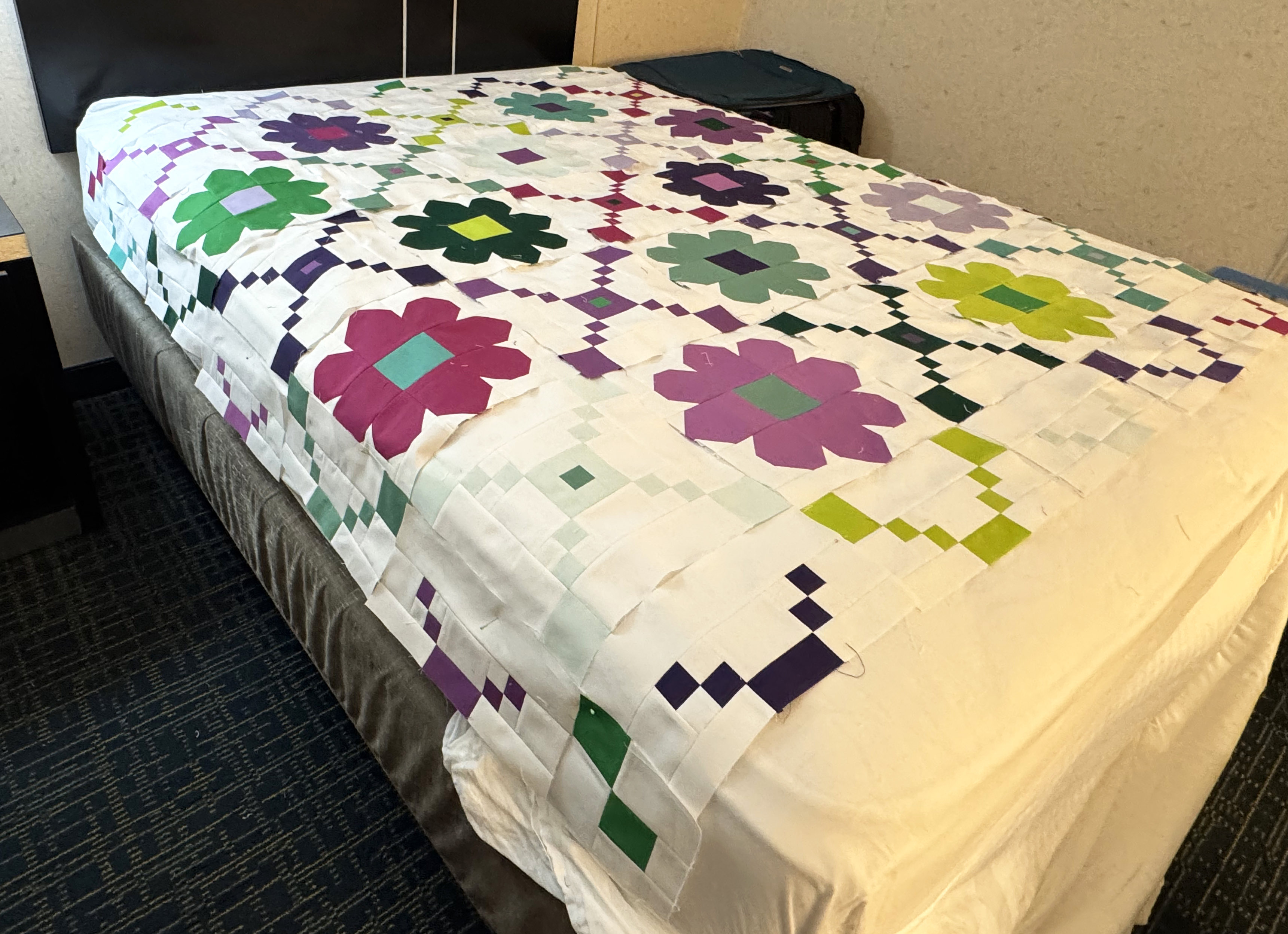
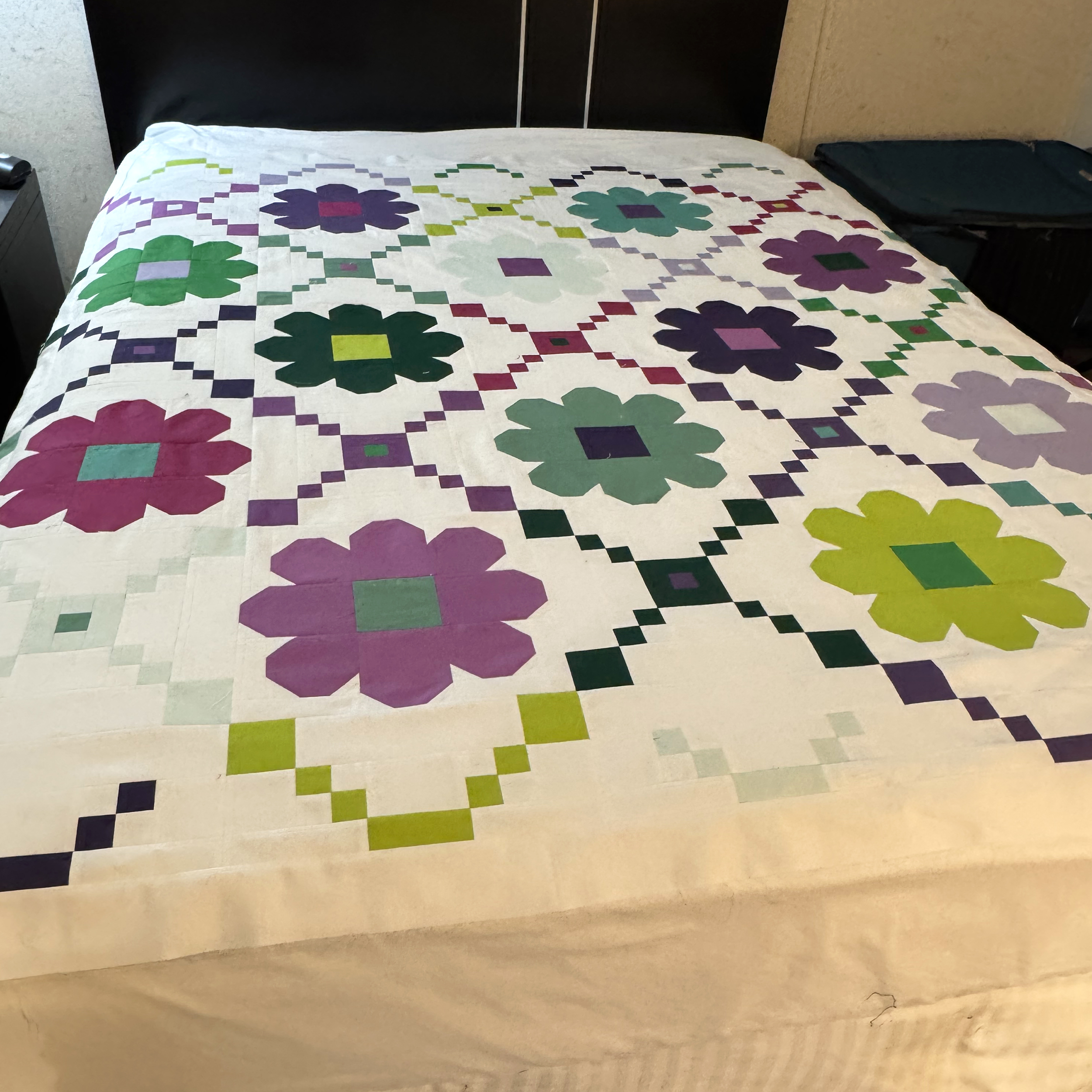
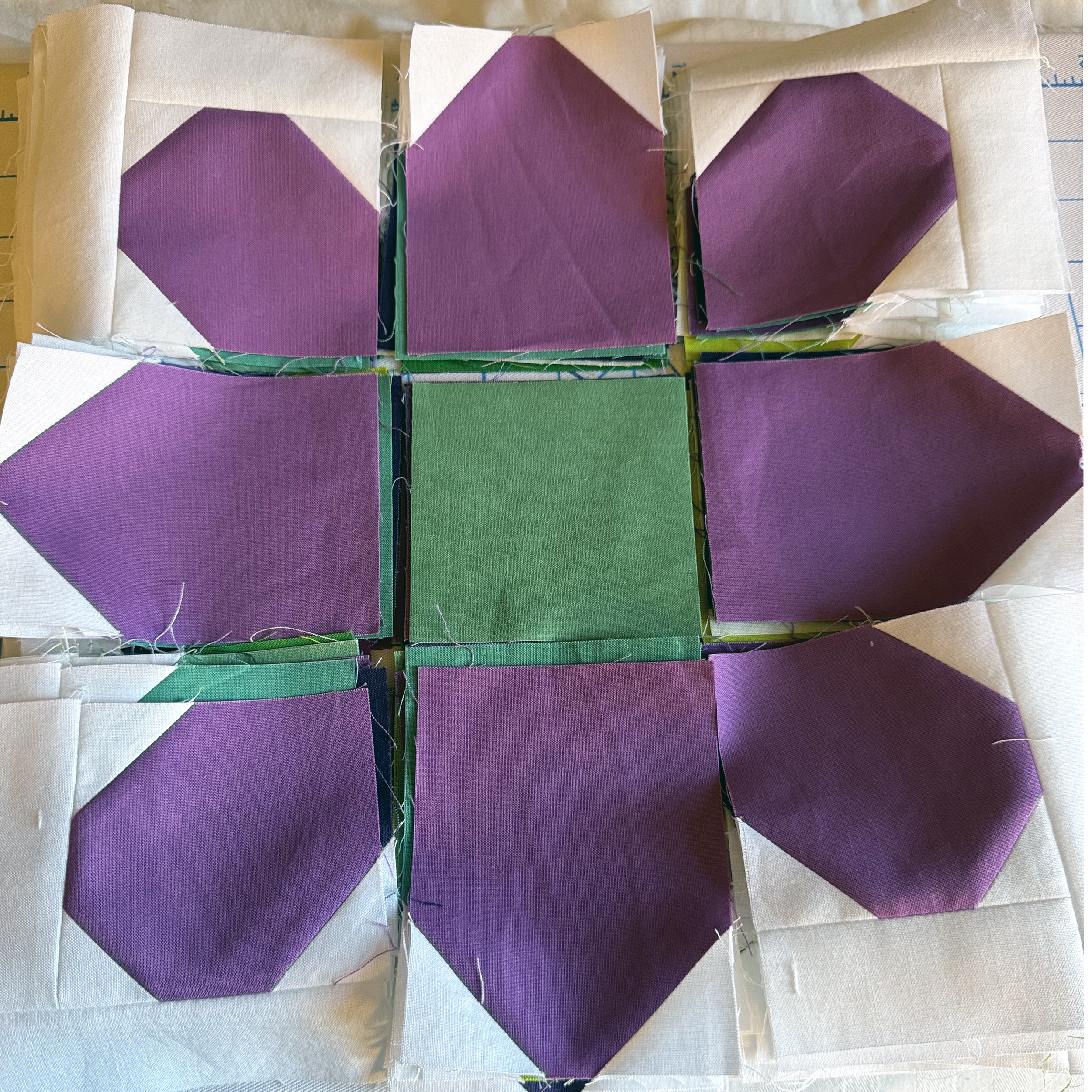
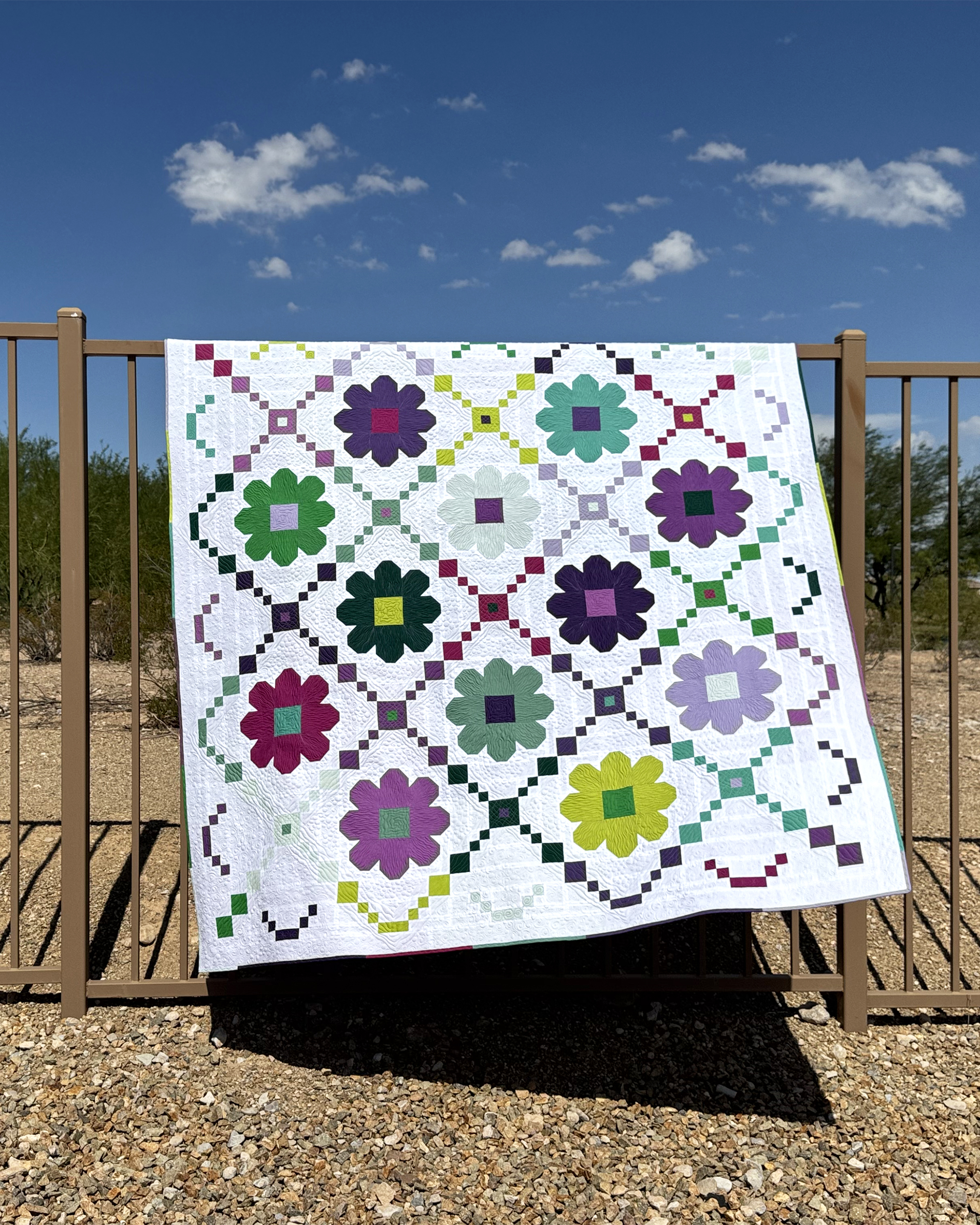
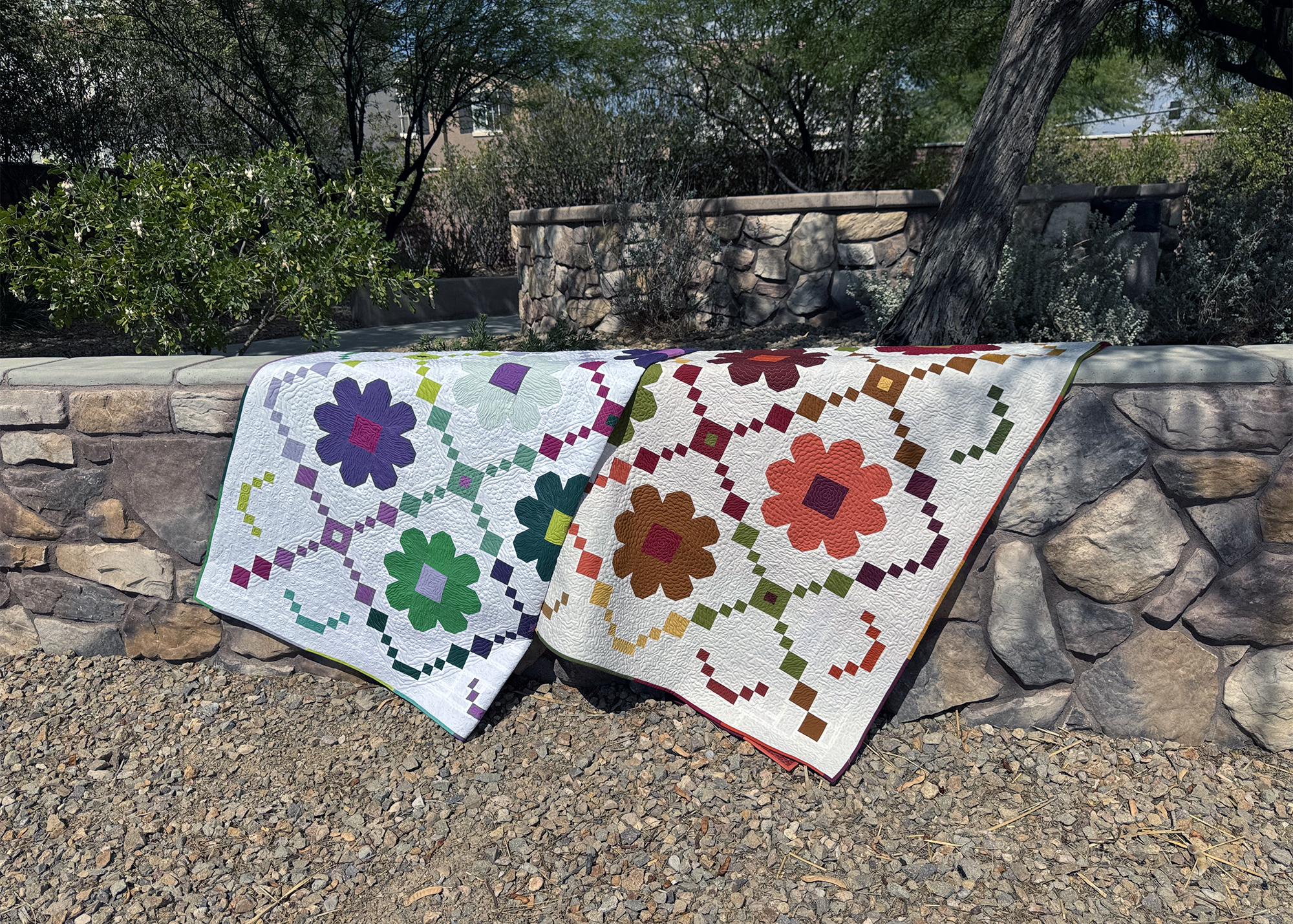
If you don’t have a wall, you can use the floor, a bed, or anywhere there’s room to spread out a little. For my Purple Vibrations colorway below, I sewed the entire top in a hotel room when I was out of town teaching. My bed worked great for the layout, LOL!!

Use what you have to lay out your blocks!

Once I’m happy with the layout, I will take a picture that I can refer to while sewing everything together. This helps me keep the blocks in order. I’ll pick up the blocks in stacks of 2 and then put them next to my sewing machine in order. Just like when sewing my blocks, I press each and every seam as I go. I pin generously and prefer to press all my seams open, but you can press whichever way works for you.

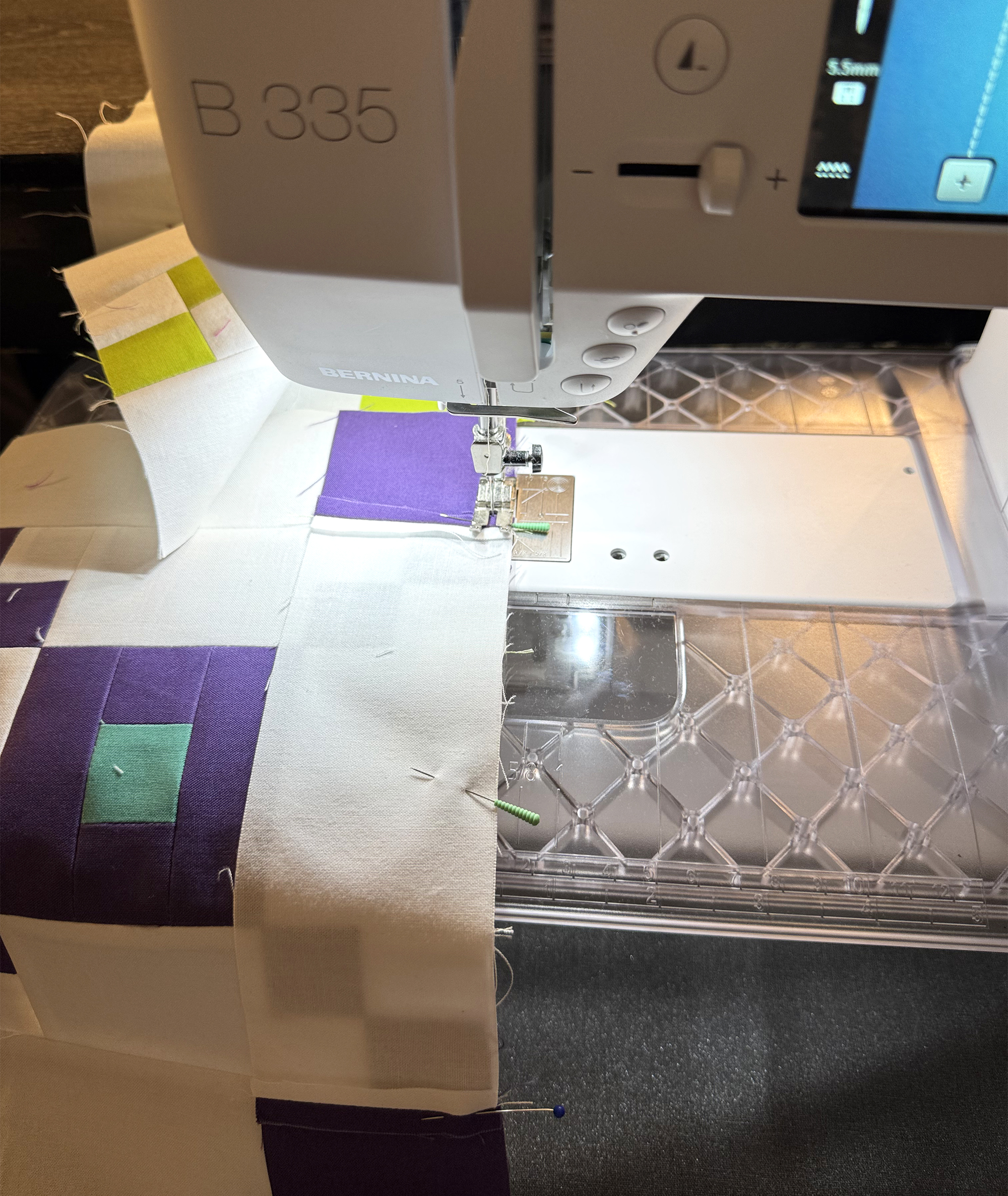
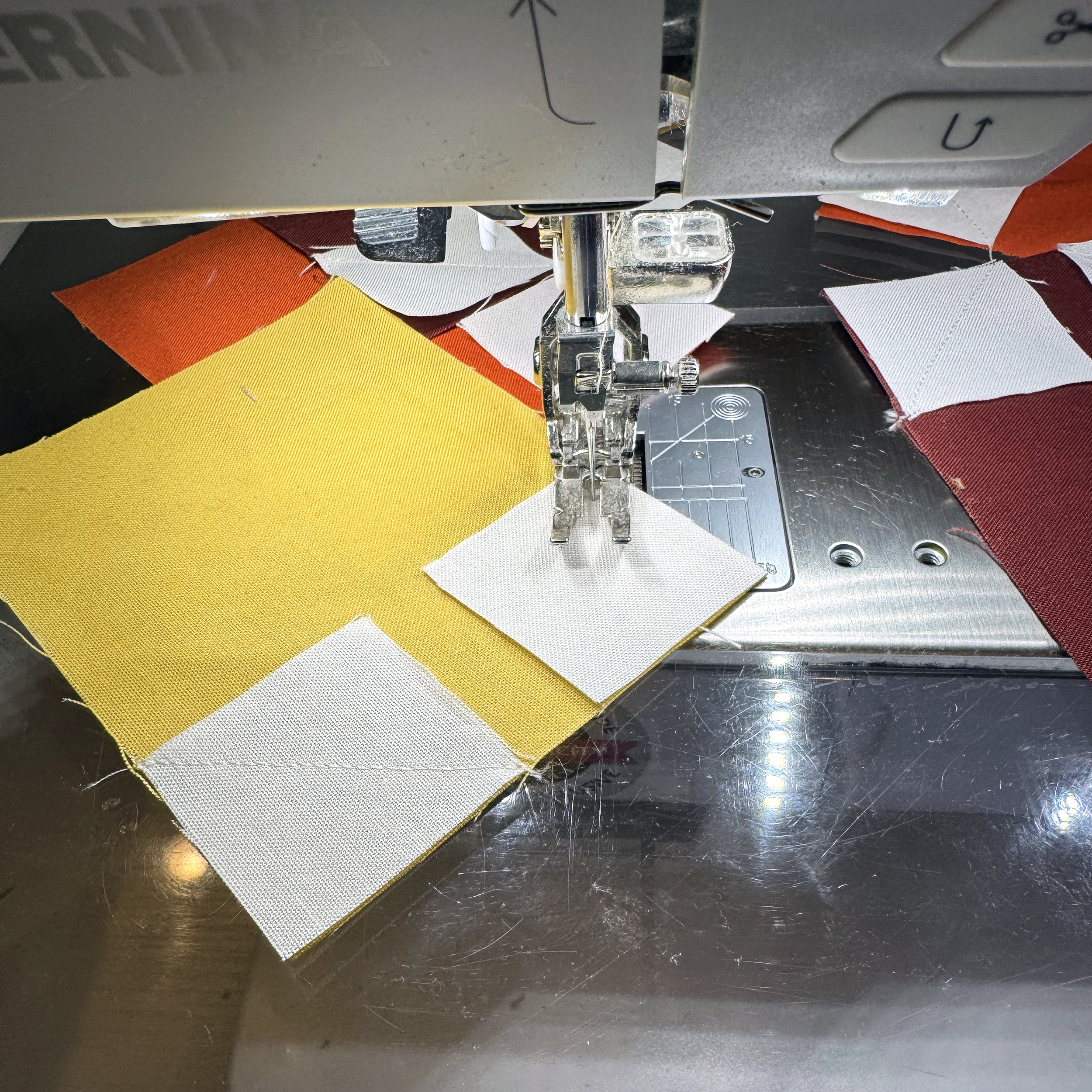
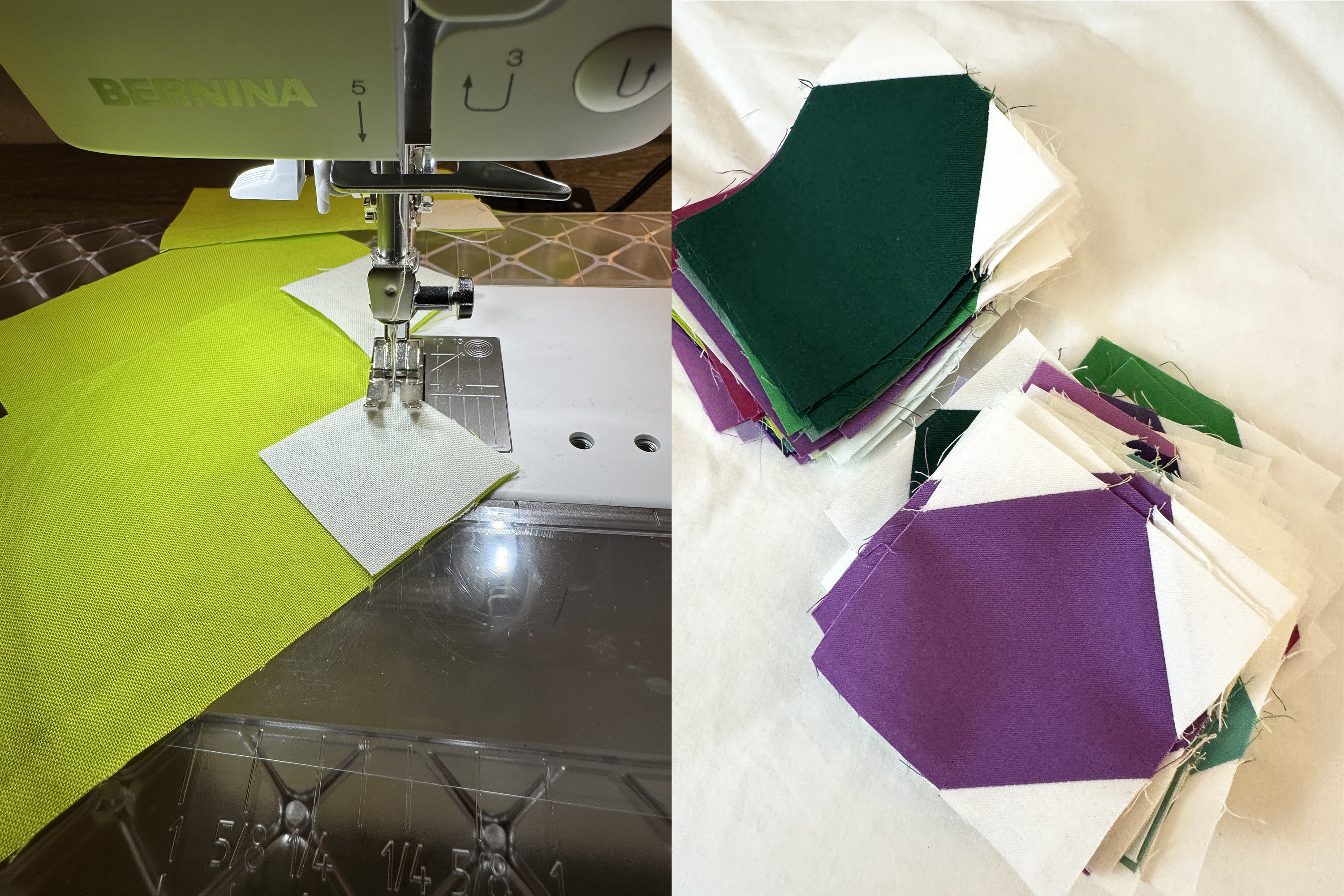
Below is a pic from when I was sewing in my hotel room. I had borrowed a BERNINA 335 machine to sew on which was perfect because it’s so lightweight. It didn’t take up much room in the hotel but it did the trick and I pieced the entire quilt top on it!!

As I complete each row, I will press the entire row from the front and again from the back, then put it back up on the design wall (or bed) to make sure everything stays in the correct order. I’ll repeat this until all of the rows are complete. Then I’ll join rows together to make bigger sections of the quilt.

Once the rows are done I will add the borders. I often like to add a “floater” border which is just more of the background fabric that frames the quilt and gives it a little breathing room. This also comes in handy later when it’s time to square up the quilt and add the binding.

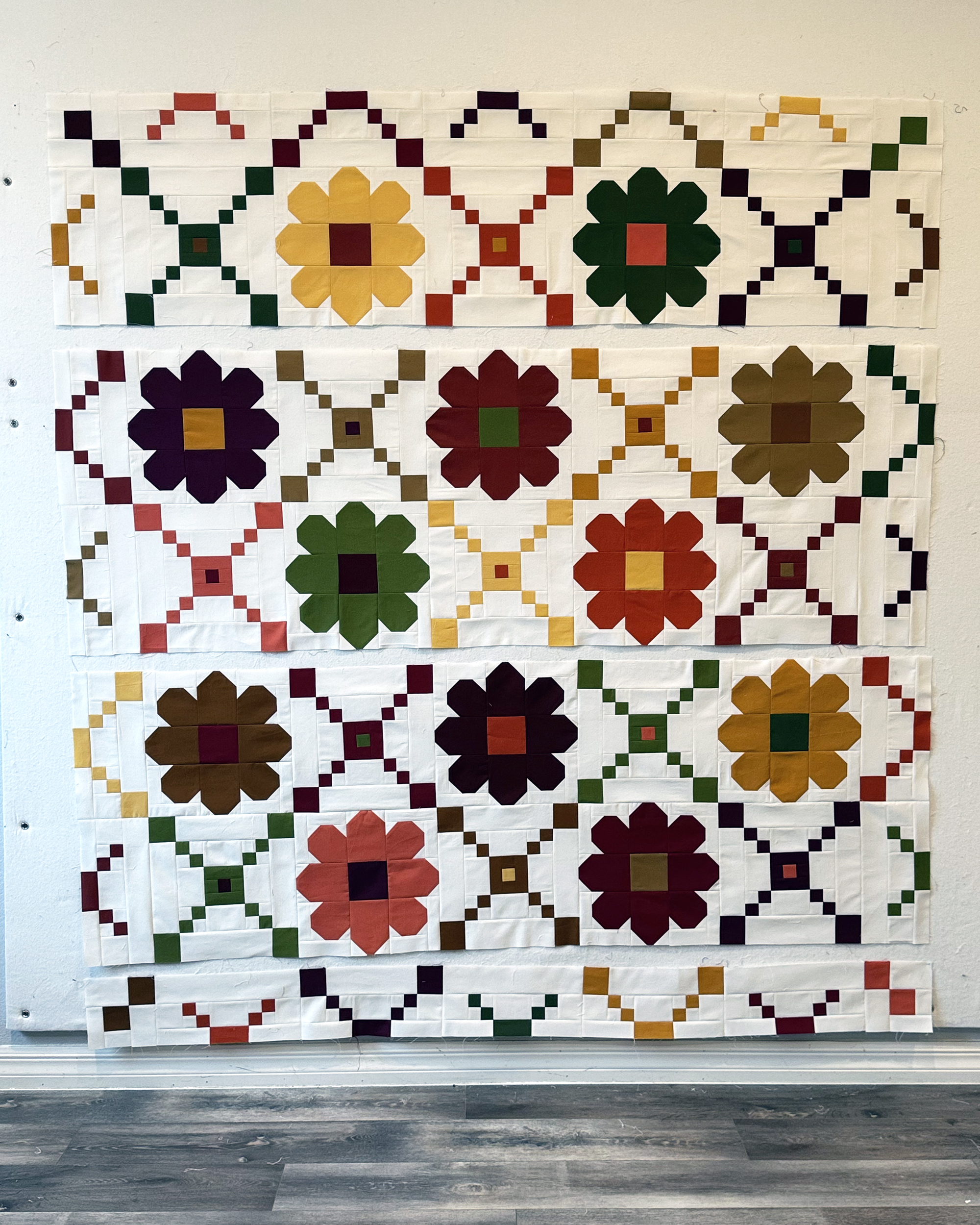
Finished Daisy Chain Quilt Top

Ta-Da! Both of my quilt tops are complete and ready to quilt!

Quilty Homework

Finish your quilt top and share pics of your work. Next week it will be time to prep the backing and baste. That will give you some time to catch up if you’re just getting started. But remember, you can work on this quilt on your own schedule!

Daisy Chain Quilt Along Week 3 – Sewing the Chain Blocks

Follow along in the Daisy Chain quilt pattern pages 8-11 as you work on this week’s quilty “homework.” Start by chain piecing your strips that create the small 4-patch units. I’ve given step-by-step diagrams to follow in the pattern so it shouldn’t feel so daunting. Just remember to take it one section at a time!

Aren’t these units so cute??

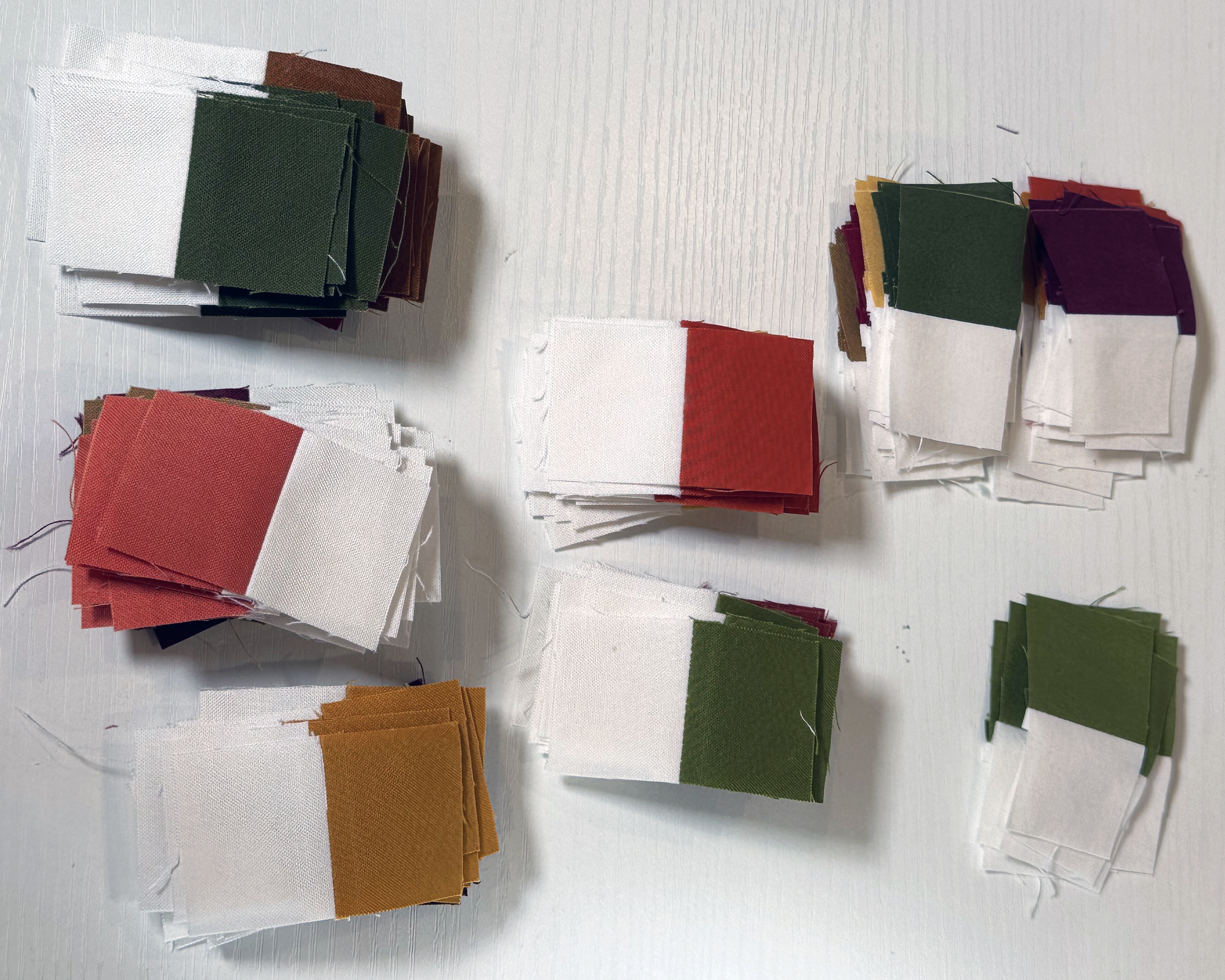
Keep all similar colors together so it’s easier to create each chain block or border unit. I’m pressing all of my seams open and sewing with a shorter stitch length so my small pieces will lie flat as everything goes together. I’ll work on the border blocks first, since those are smaller and it’s nice to get them out of the way.

Once the 4 patches are sewn, they can be treated as a single unit when sewing the rows together in each block. I’ll stack all of the same units on top of each other so I can sew a whole bunch at once.

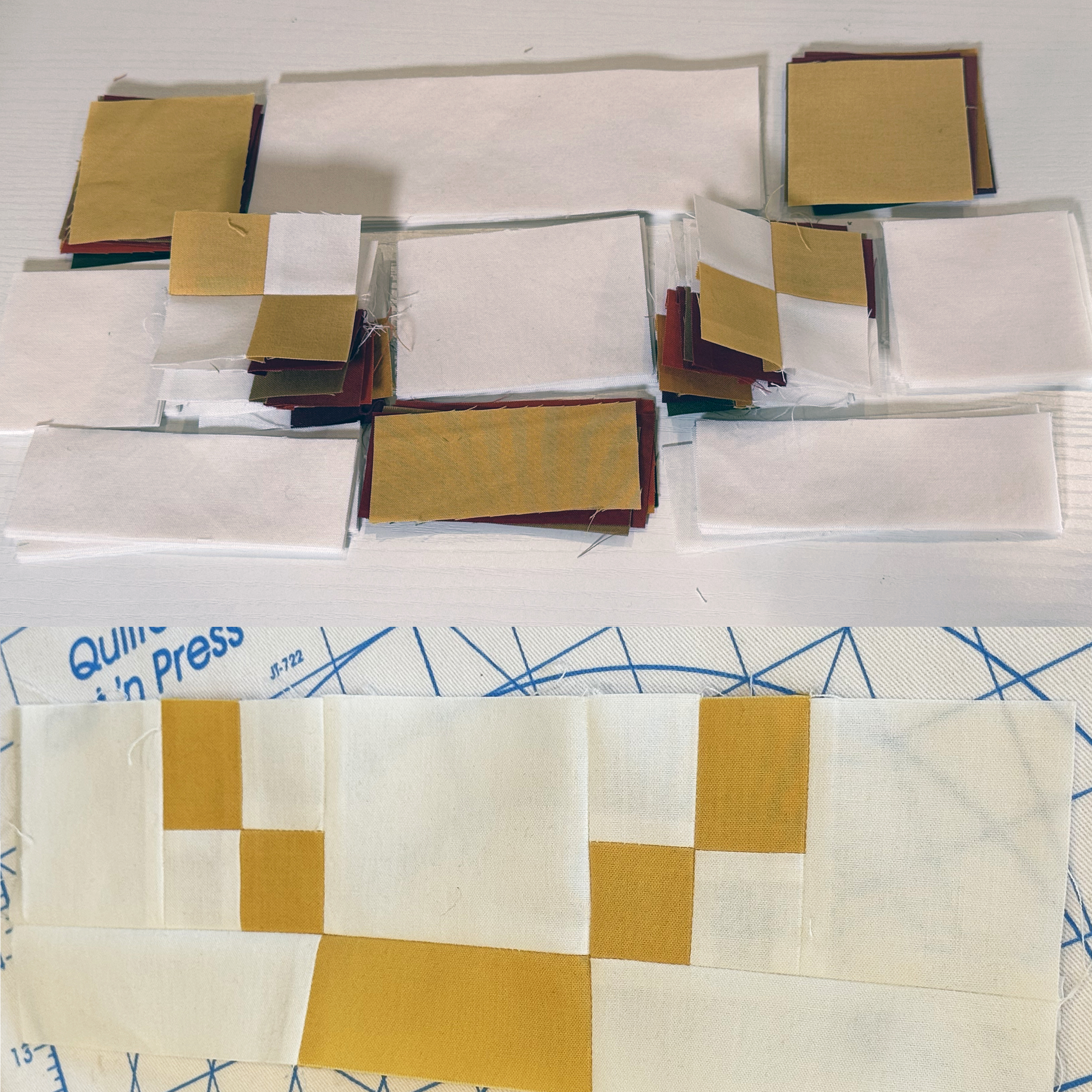
This is one of the border units. Each piece is the same color so you can play around with final block placement later.

I use lots of pins and press after each and every seam. The Daisy Chain pattern includes the correct sizes that each unit should be at each step so you can double check your measurements as you sew. Accuracy is key to getting things to line up, so test your 1/4″ seam allowances and adjust if needed.

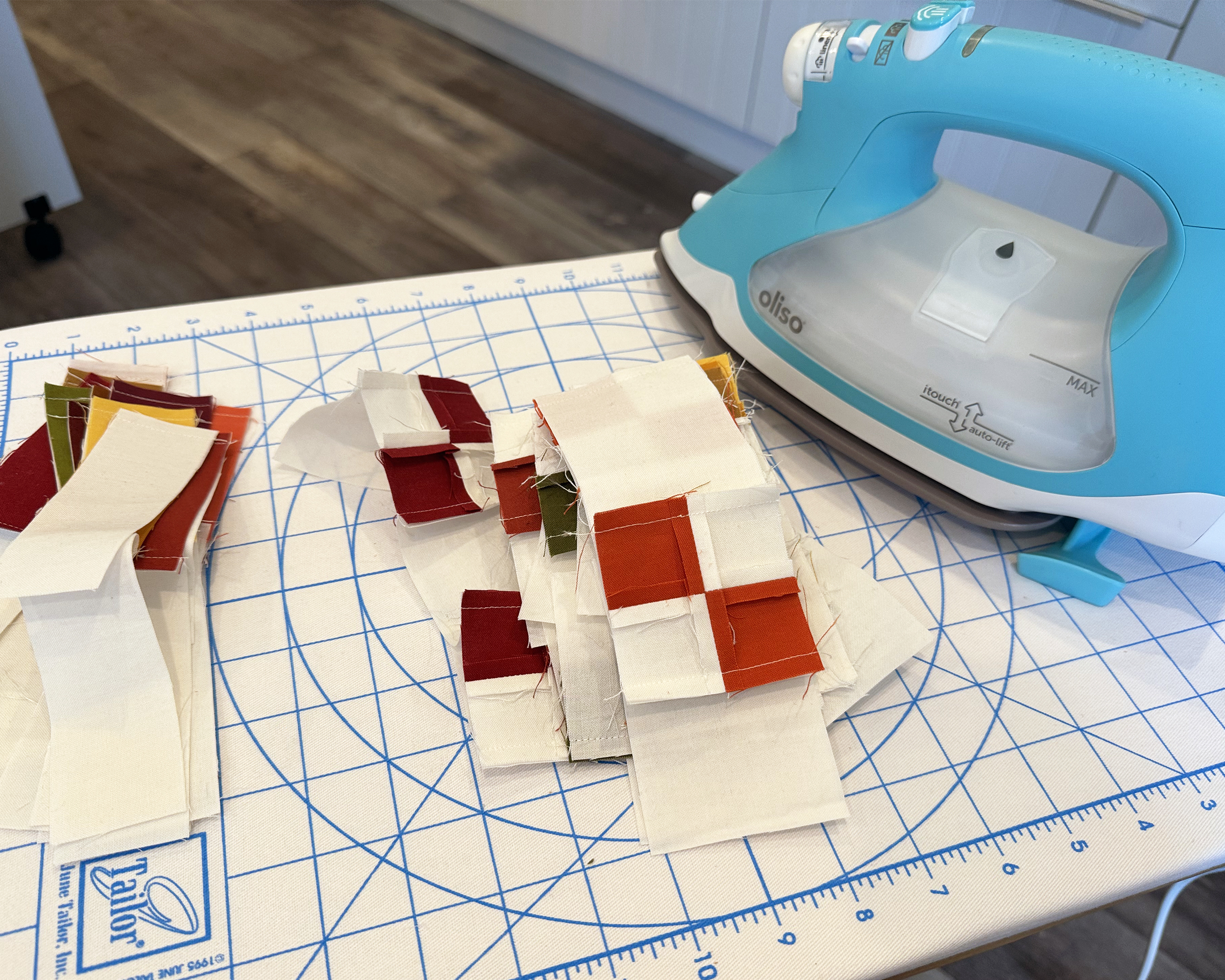
I chain piece, and then I assembly line press to speed things up.

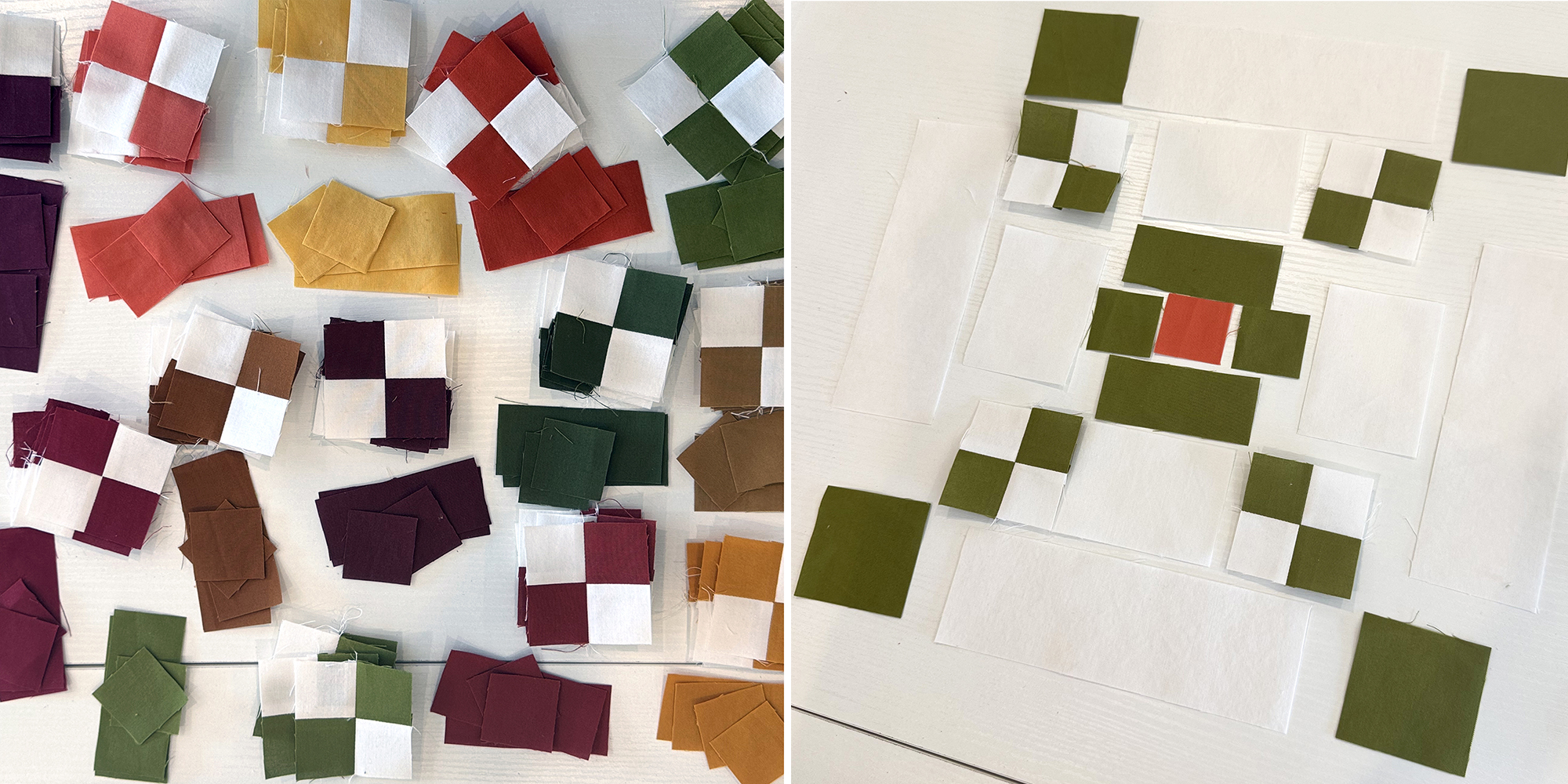
Now it’s time to organize everything else for the full size chain blocks. It’s a lot of pieces but as long as you organize all the smaller units by color, they go together fairly quickly. I make sure that the pieces for all of one block are laid out correctly first.

It’s really fun to sew all of these units at once, then stack them together by color.

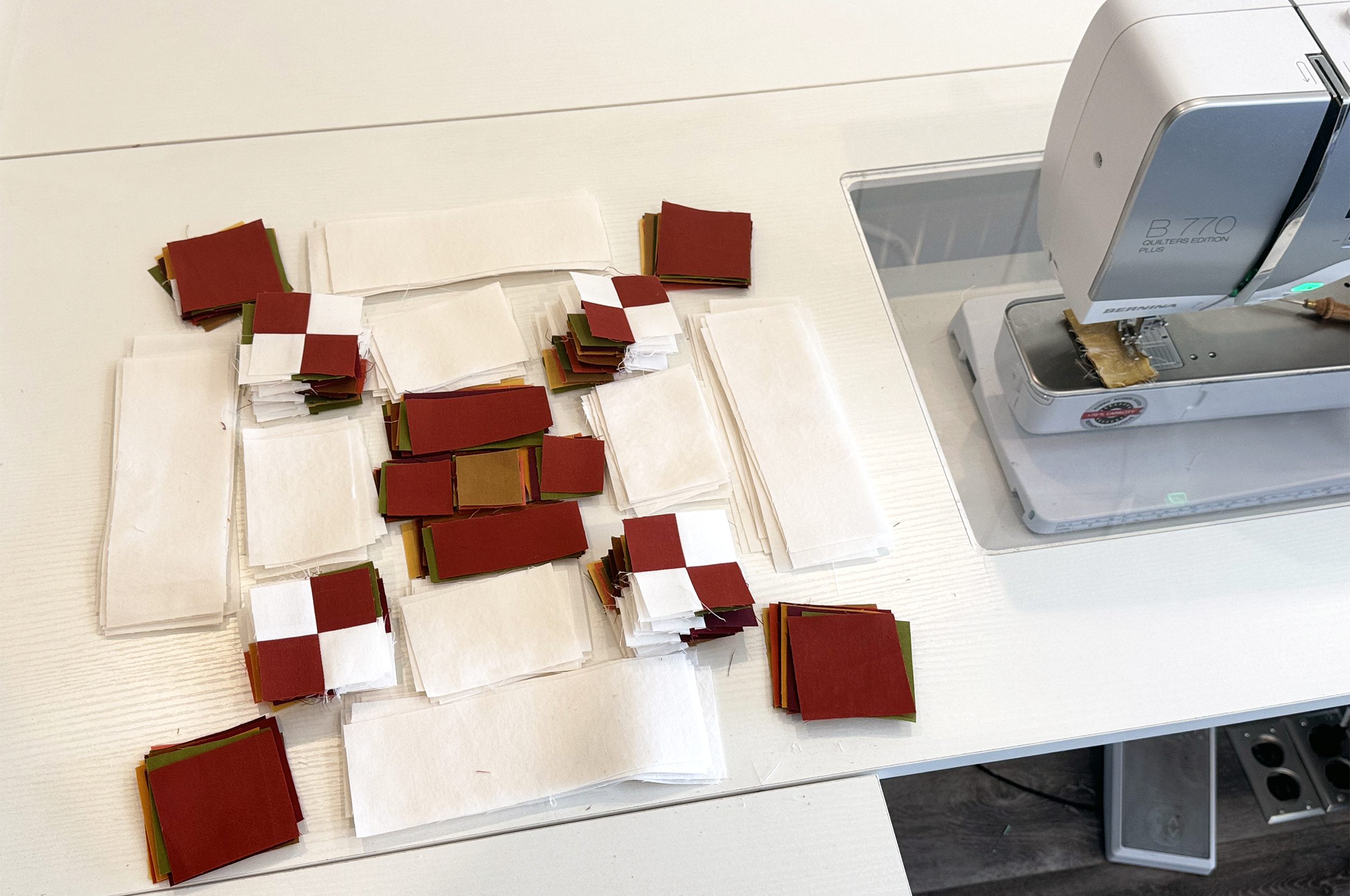
Next, I stack all of the rest of the units on top right next to my sewing machine. I like to chain piece, or assembly line sew as I go. This means I don’t cut threads in between each pair of units I’m sewing. I’ll do that at the end. It looks like the background pieces are so much smaller, but that’s only because the seam allowances aren’t sewn yet.

Bonus tip: be sure to use a contrasting fabric for your center square of each block so the colors don’t look “muddy.”

When I chain piece, I will sew 2 units together at a time and finish up a whole stack at once.

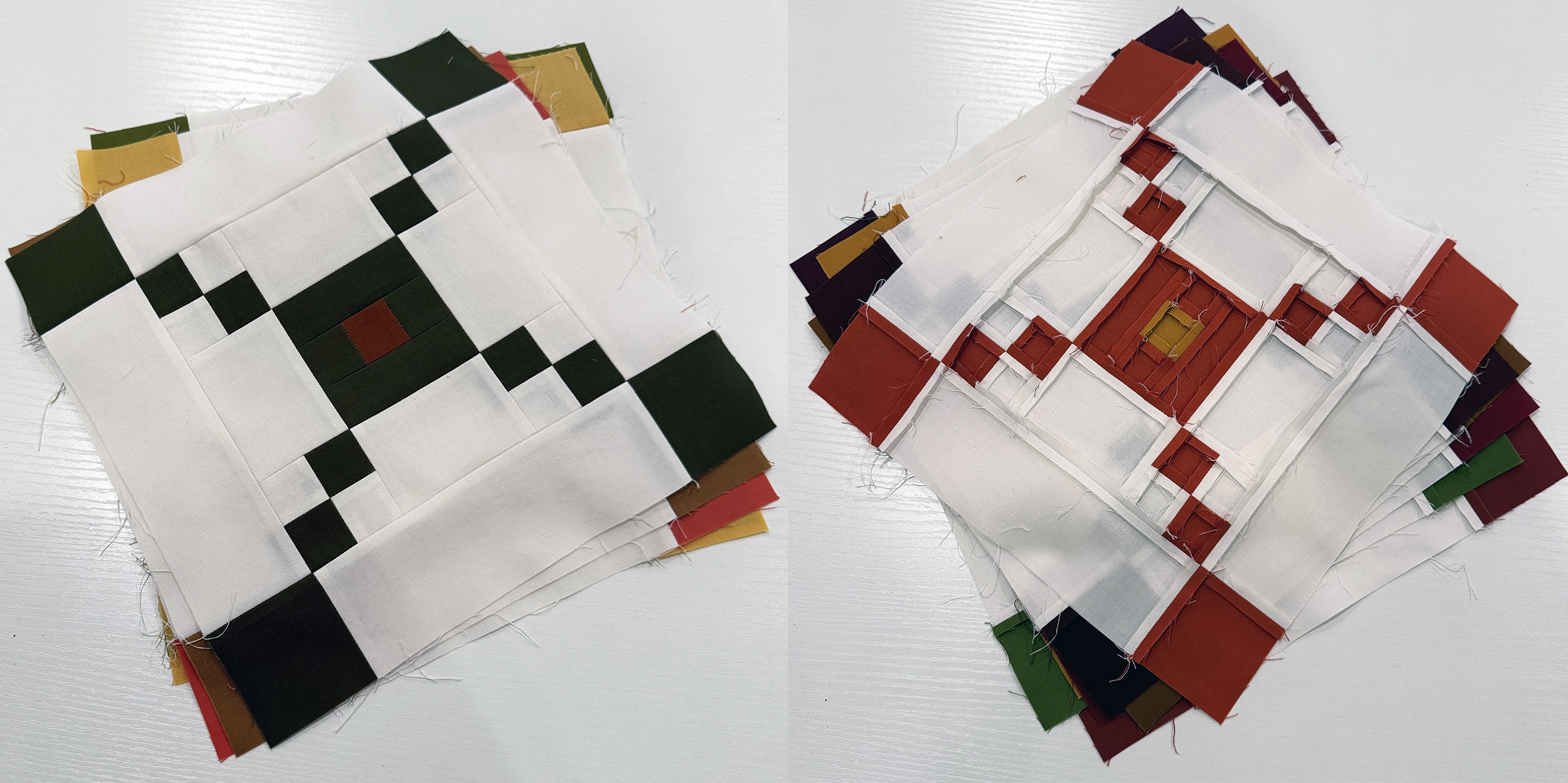
Below is my pretty stack of finished blocks! I used pins at each intersection so that my corners matched up nicely. Here you can see that I’ve pressed each an every seam open, resulting in super flat blocks!! I made another stack in another colorway, but sadly forgot to take a pic of my finished blocks, but you’ll see more of the other version in the next post, so stay tuned!

Homework for next time

Don’t forget to sew the corner blocks, and next week it will be time to assemble the Daisy Blocks, Chain Blocks and border blocks into the quilt top.

If you are just finding the quilt along, it’s never to late to jump in! Grab a copy of the quilt pattern and get started!

Daisy Chain Quilt Along Week 2 – Sewing the Daisy Blocks

Whenever I’m sewing quilt blocks that have lots of pieces, I find it much easier to sew the smaller units of each block into larger units, then chain piece everything for speed and efficiency. Follow along in the Daisy Chain quilt pattern on page 6-7s for the images and tips shown below. I’m making two of these at the same time in 2 different colorways: Autumn & Purple Vibrations.

Making Stitch-N-Flip Units

So the first thing we are doing is sewing all of the stitch-n-flip units which will make the petals of each daisy flower block. You can either mark lines down the center of each background unit, or you can eyeball since they are very small.

At each step in the pattern I give what the measurements should be so that you can closely follow along. It’s not that huge of a deal if your units aren’t the exact same size as mine, but you do want them to be all the same size for consistency.

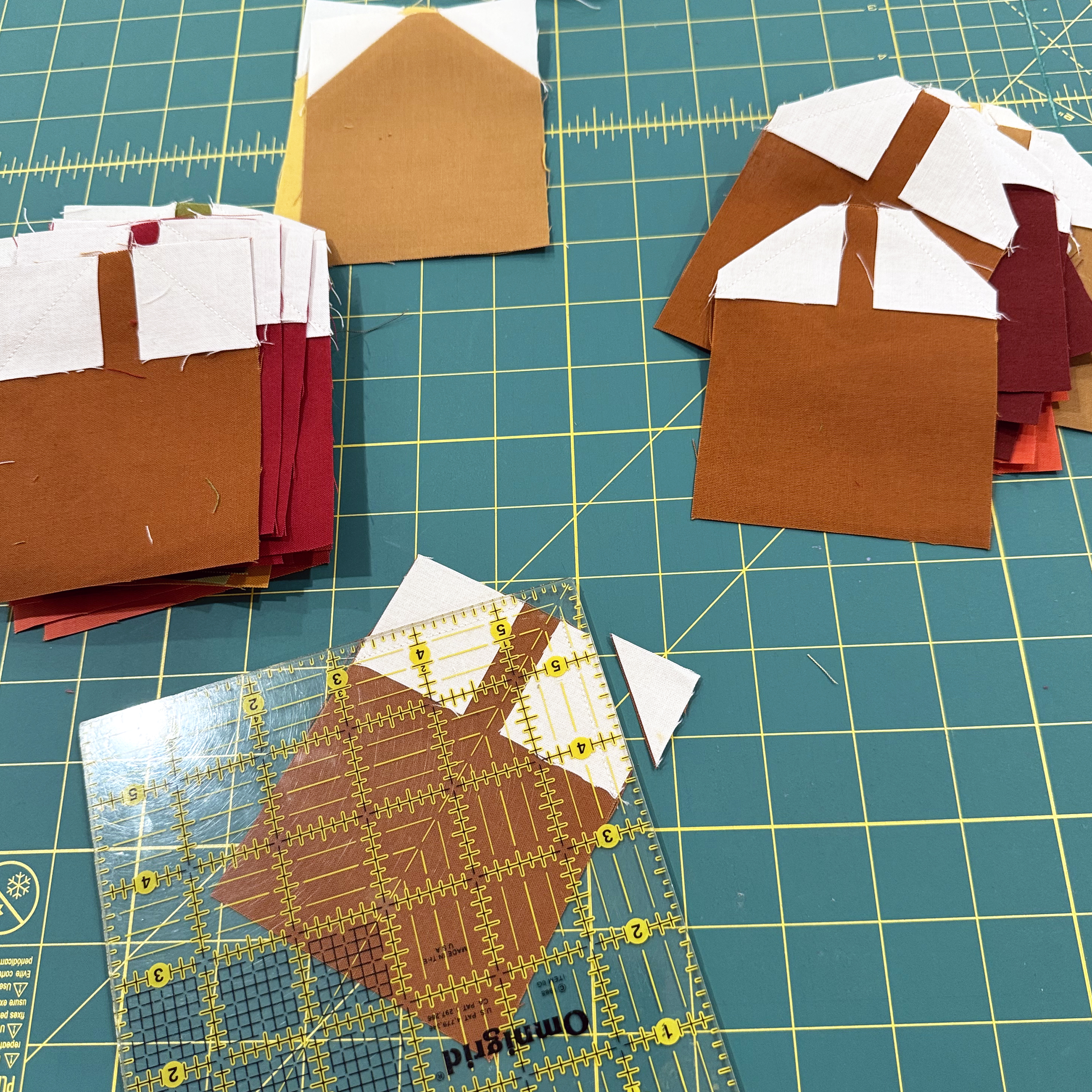
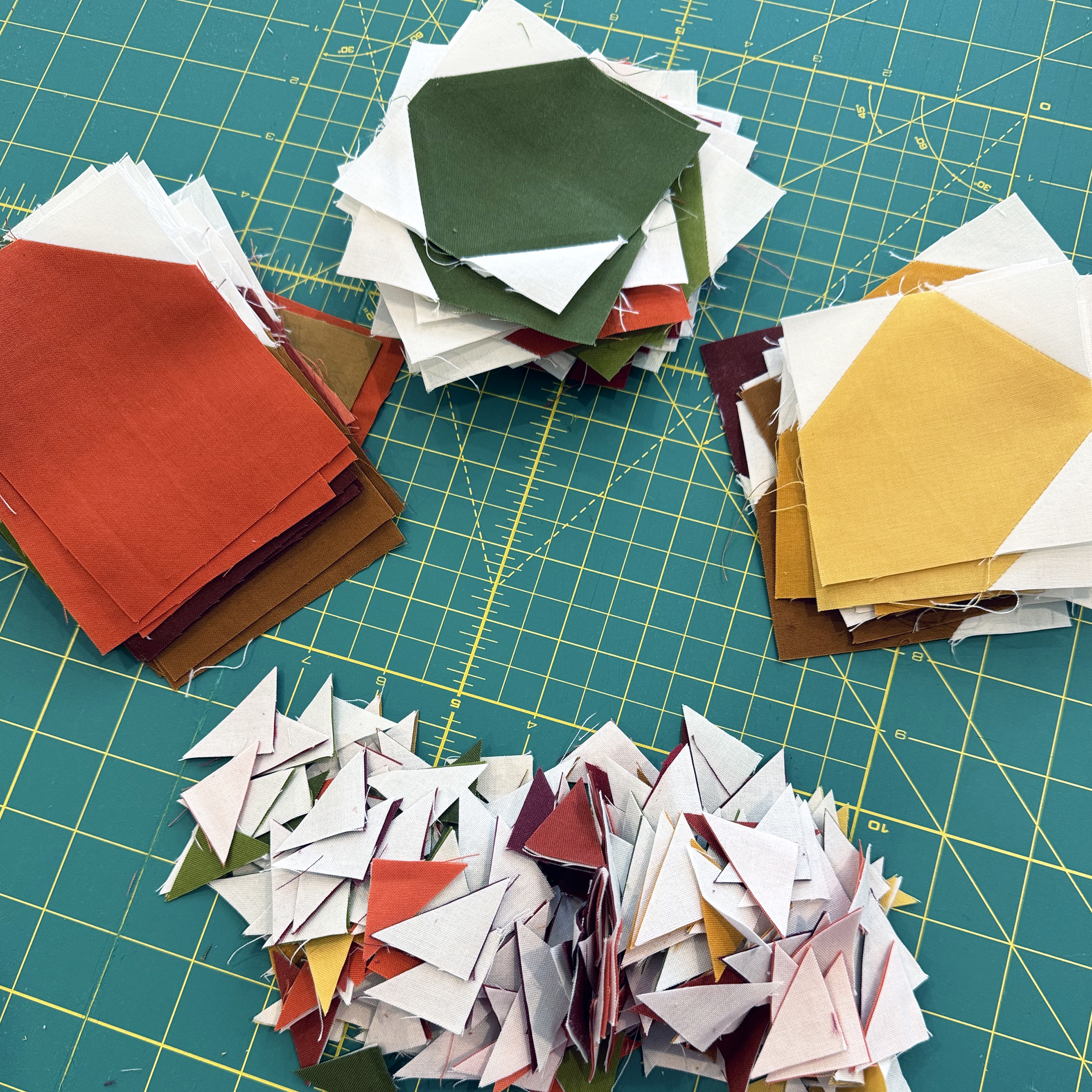
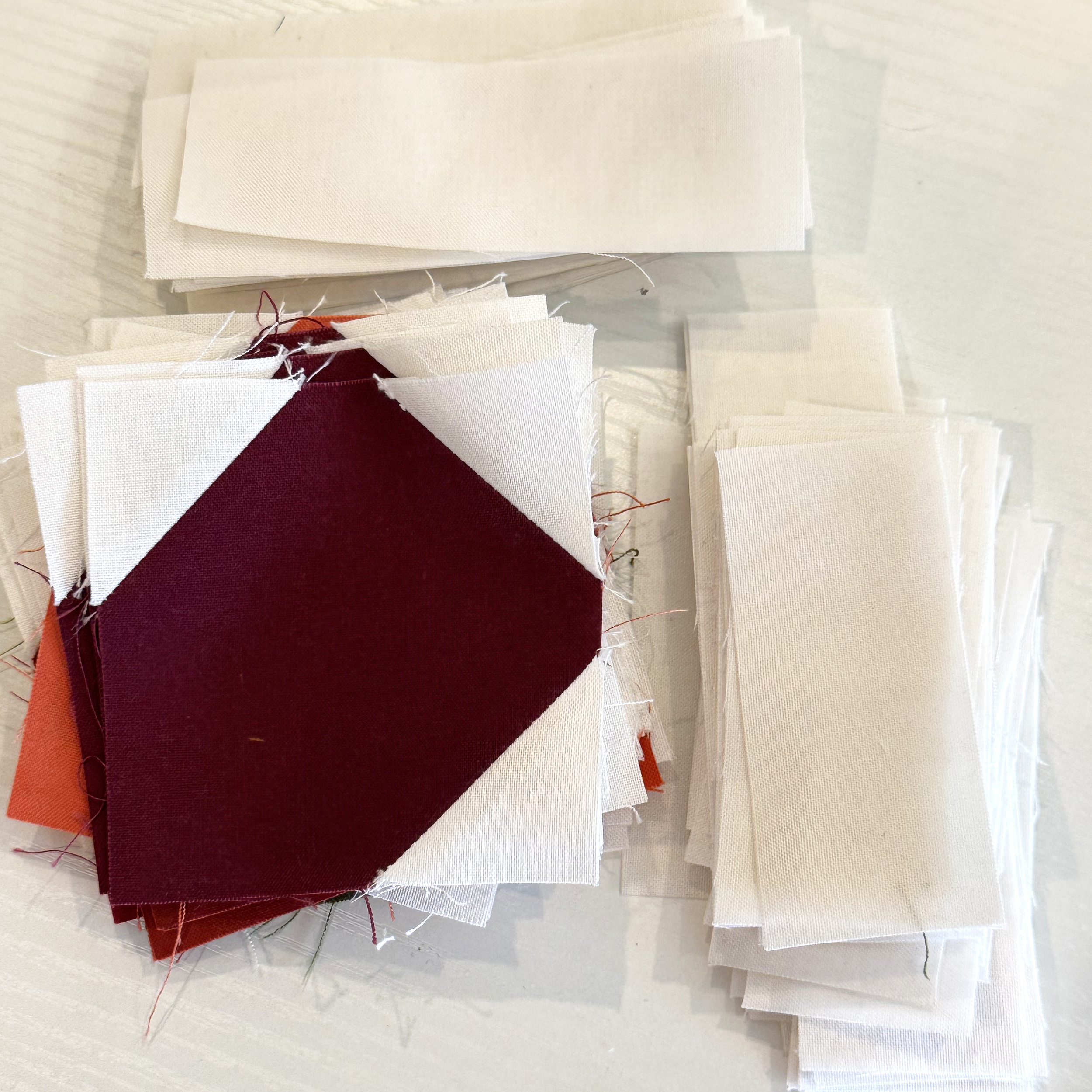
I prefer to sew all of the little stitch-n-flip squares on one side of each block so I can chain piece. That means assembly-line sewing a whole bunch without cutting threads in between. Then I will trim off all the corners at once and press my seams open.

I end up with a lot of leftover triangle tips at the end. You can totally save these for another project if you want to! You’ll also notice that some of the petals have 2 white corners and others have 3. Be sure you follow the pattern diagrams closely to sew them onto the correct corners.

Once the petal units are sewn, you will be adding extra background strips to the square petal units to make them the correct size. I’ll stack all of the units up facing the same direction before adding the background strips. Notice that one background strip is shorter and one is longer. As long as you sew ALL units the same, you’ll be able to rotate them into position correctly.

I will continue to assembly line sew by laying out all of the units for each block and stack them on top of each other. The main flower parts are all the same color so it’s easy to keep track of what unit goes where. Then you can decide which color you want for each center flower.

One thing to notice is that 4 of the petals look a little pointier than the others and that’s correct. They will appear more rounded once the blocks are finished and sewn together due to the seam allowances.

Why Make 1 When You Can Make 2??

Here’s what it looked like when chain piecing the stitch-n-flip units for the second colorway I made.

And my units are all in position and ready to sew!

This Week’s Homework:

Finish all of your Daisy Blocks for the size you are making, and then post pics of your progress in my facebook group!

Daisy Chain Quilt Along Schedule

Are you excited to make Daisy Chain along with me? See below for the complete quilt along schedule. Although this event will be quickly paced, I’ll leave these blog posts up indefinitely so you can work on your quilt any time you wish. I’m here to help you each step of the way!

Daisy Chain – Autumn Colorway

Daisy Chain – Purple Vibrations Colorway

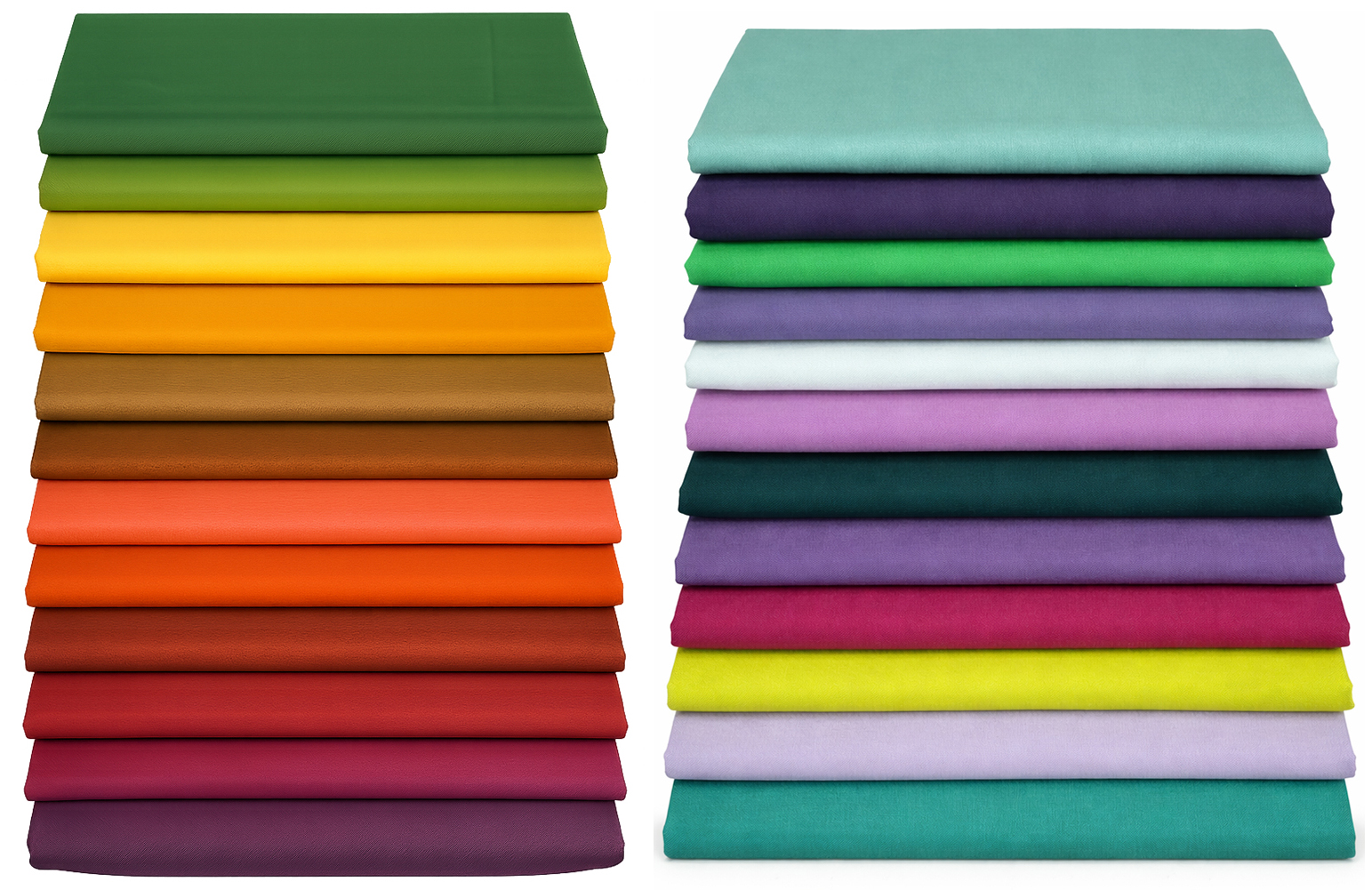
I made both versions of this quilt using fat quarters of Riley Blake Designs’ Confetti Cotton solids. The throw sizes shown here are made with 12 fat quarters plus 4 yards background, and the leftovers form a scrappy binding. Color selection is super easy for this quilt – just grab your favorite fabrics and pair them up with a highly contrasting background and you are good to go!!

I used fat quarters in the Autumn & Purple Vibrations Colorways for my Quilts

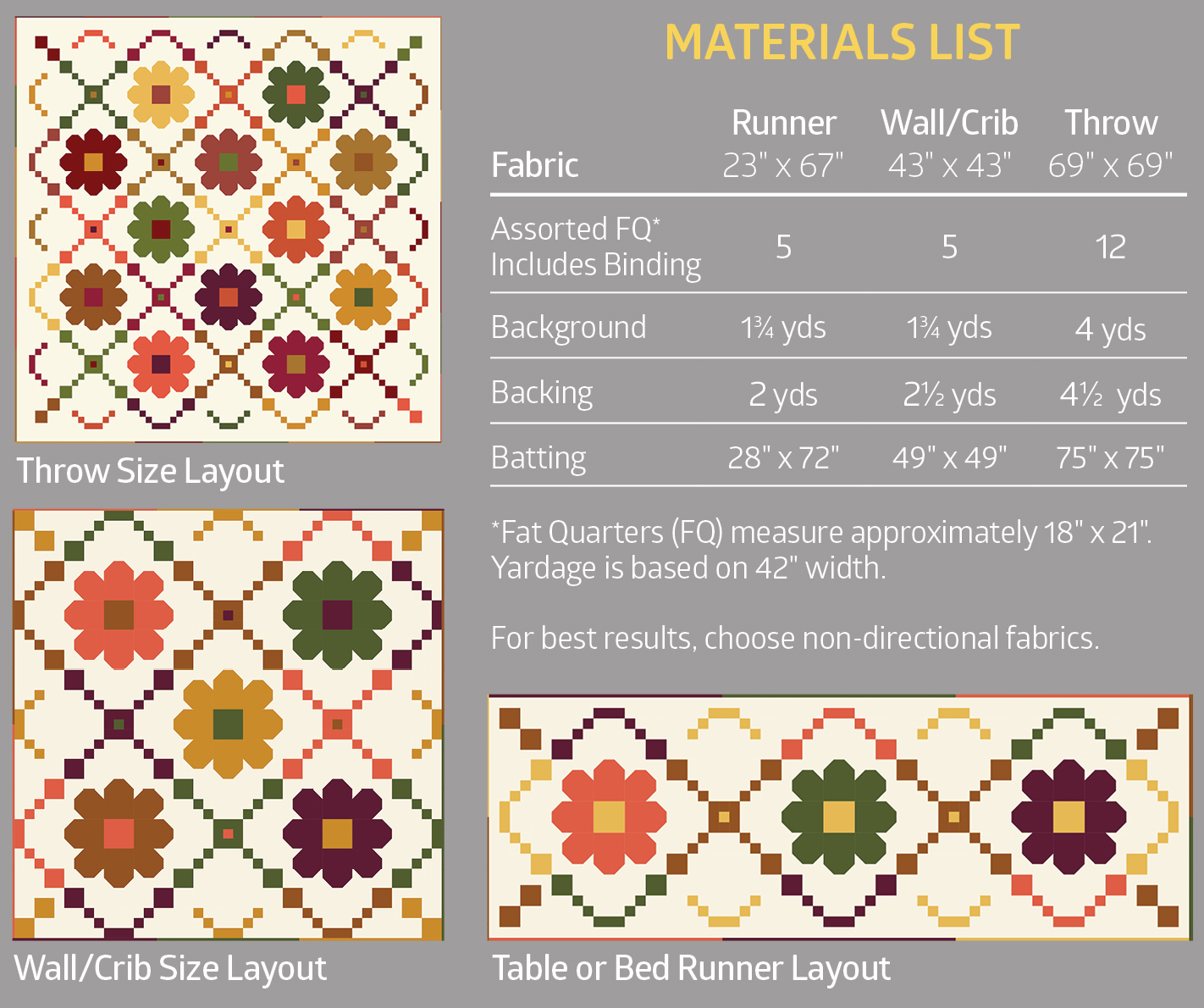
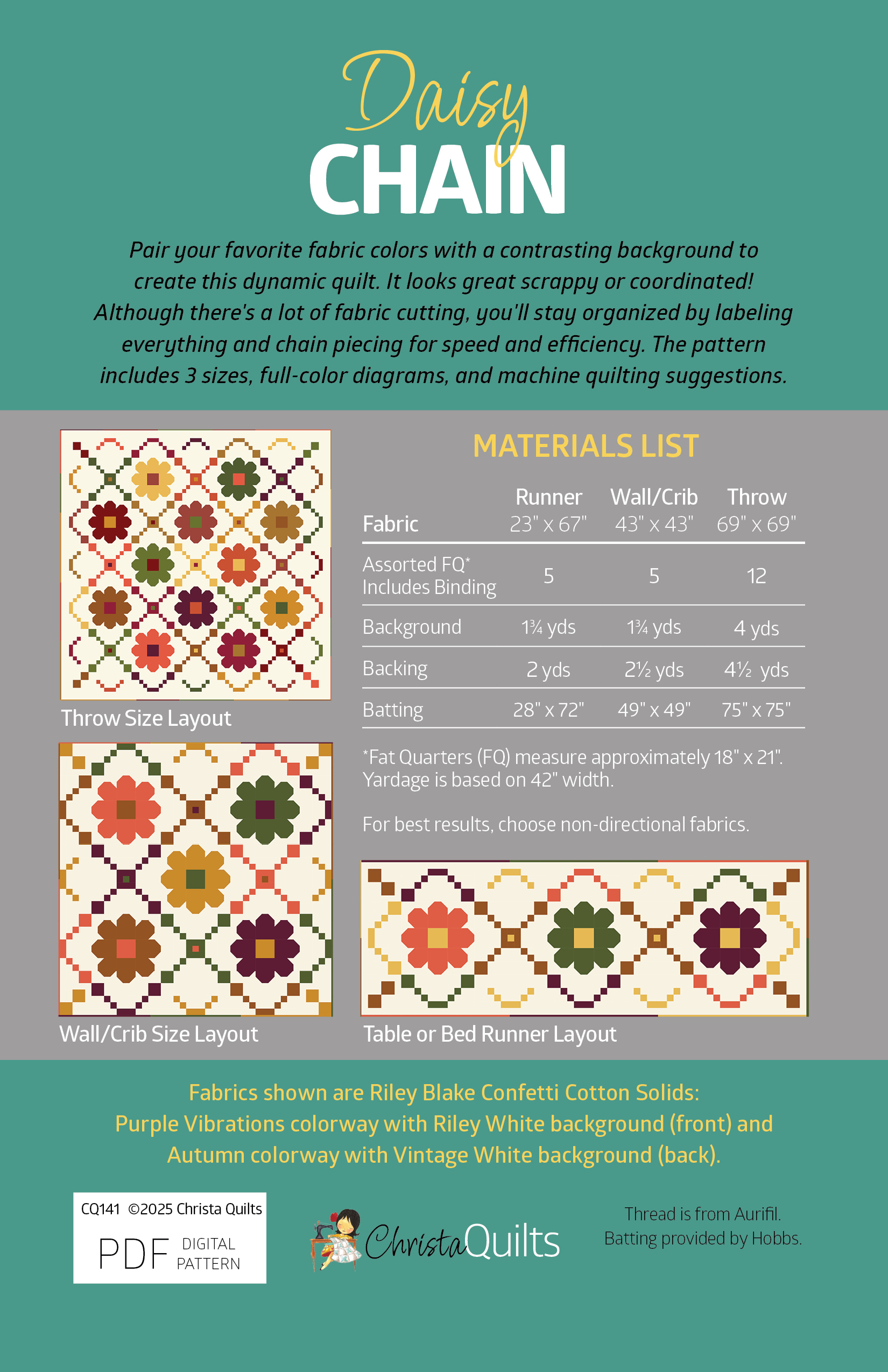
Here’s a the complete supply list so you can make this quilt in 3 different sizes. It’s a LOT of cutting, but it’s all just straight seams with traditional piecing techniques. So there’s no specialty rulers required. I do recommend getting some small label stickers though so you can label all your pieces to stay organized.

Quilt Along Schedule

Throughout the quilt along I will refer you to specific parts of the pattern and will share lots of in progress pics and bonus tips. When it’s time to machine quilt, I’m going to share 2 bonus videos showing how I quilted each version. Hopefully this will inspire you get it done!! After all, machine quilting is my favorite part of the entire process, and there’s lots of room for experimentation and play in this quilt.

  • Feb 27 – Week 1: Cutting
  • March 6 – Week 2: Sewing the Daisy Blocks
  • March 13 – Week 3: Sewing the Chain Blocks
  • March 20 – Week 4: Sewing the Quilt Top
  • March 27 – Week 5: Backing & Basting
  • April 3 – Week 6: Quilting Option #1 – With Bonus Video Tutorial!!
  • April 10 – Week 7: Quilting Option #2 – With Bonus Video Tutorial!!
  • April 17 – Week 8: Binding to Finish

Machine Quilting in progress – can’t wait to share more details on how I quilted them!!

I’m happy to offer lots of support during this quilt along. You can share pics in my ChristaQuilts group on Facebook or leave a comment here on the blog with any questions you have. You can also share on social media using #daisychainquilt. I can’t wait to see how you make this your own!!

New Year – New Pattern – New Quilt Along for 2026!

Let’s kick off the new year right with a new pattern and Quilt Along! Check out Daisy Chain, a super fun pieced pattern shown in 2 colorways, with multiple sizes.

It’s been awhile since I’ve made a quilt completely from solids, and I chose to work with Riley Blake Confetti Cotton solids for both colorways. It really shows off the quilting and I’m thrilled with how they turned out.

I thought it would be fun to host a quilt along to make this quilt completely from start to finish. The quilt along will kick off right here on my blog, beginning February 27, 2026 so save the date if you’d like to join in. The quilt along is free – all you need is a copy of the quilt pattern.


Pre-sales of this pattern to quilt shops have been the best I’ve ever seen, so you can always ask for it at your local quilt shop, and any shop owners out there can purchase it wholesale directly through Riley Blake.

Stay tuned for next week where I’ll share a break down of the quilt along schedule, along with a supply list to make this quilt. For now here’s a sneak peek of the back cover, showing the different sizes and alternate colorways.

If you’d like get notified when the quilt along begins, be sure to sign up for email notifications (in the sidebar of this blog post) so you don’t miss a thing! You can also join my ChristaQuilts group on Facebook to share pics of your quilt in progress and to ask questions at any time. I can’t wait to tell you more, so stay tuned!!

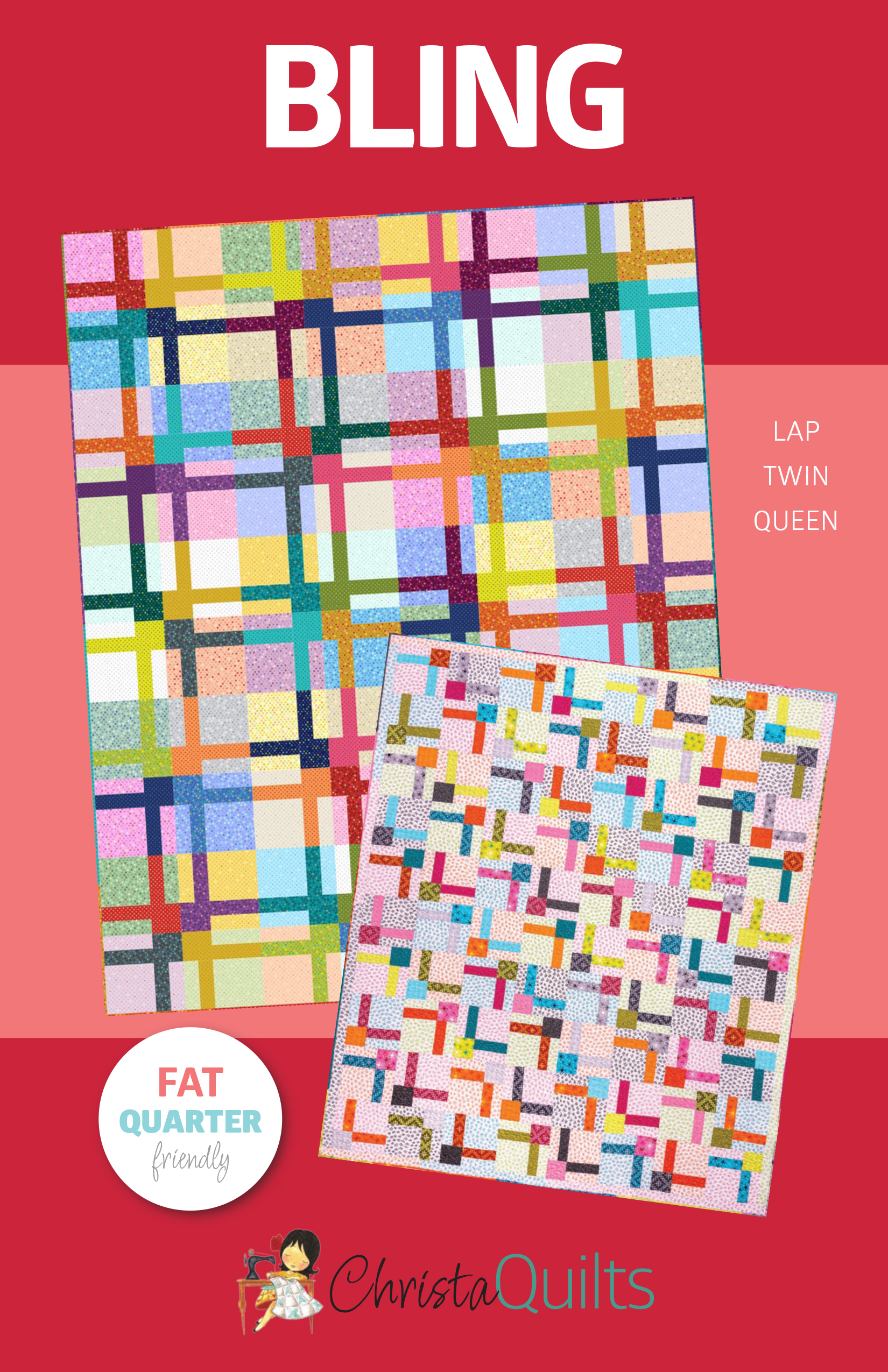
Bling Quilt Along Week 3: Quilt Top Assembly

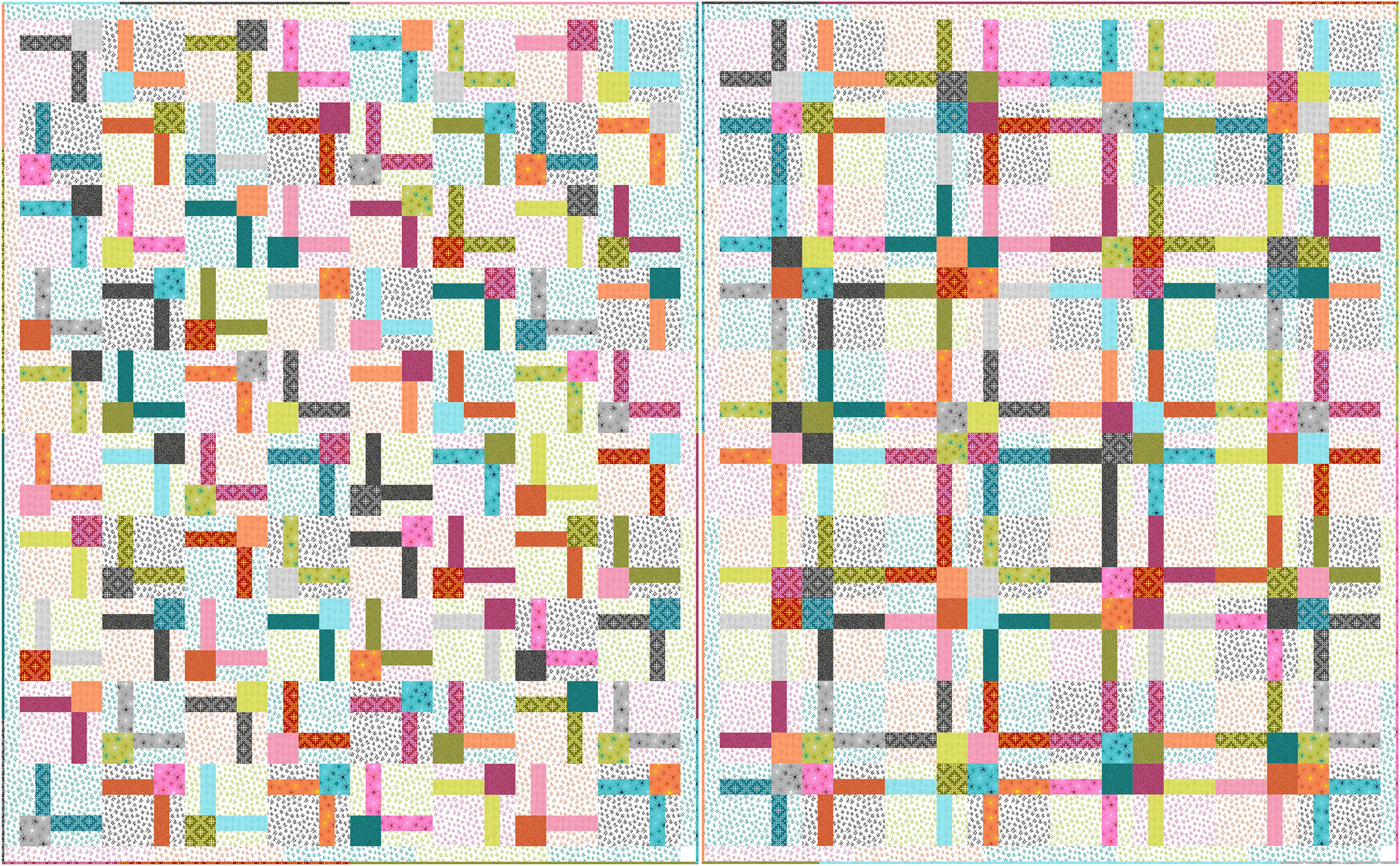
How are you doing with this quilt along thus far? Just remember, you can make this quilt at your own pace, and on your own schedule! This week we are assembling our quilt top. For my Dazzle Dots version of Bling, I rotated the individual blocks so that each set of 4 formed a larger hashtag block. Then I sewed the larger block units into rows, and then joined the rows to complete the top.

Click here to get the Bling quilt kit – Dazzle Dots version
Click here to get the Bling quilt kit – Stitchy version

In the Bling quilt pattern, I share several different layouts. Pick your fave and then find a large flat area to lay the blocks out before you sew. I use a design wall to help me decide which blocks go where, and I tried not to have any 2 blocks with the same fabrics touching.

bling quilt pattern

Click here to get the Bling quilt pattern – PDF version
Click here to get the Bling quilt pattern – Printed Paper version

Bling is one of those designs that will look different depending on how you rotate this blocks. I’ve actually made this quilt several different times, so take a look at these other variations for inspiration as you sew your quilt top together!

Any Questions? Share Your Work!

If you have questions, or want to share your progress, feel free to do so over in my Christa Quilts Facebook group. It’s fun to see what others are making and cheer each other in our efforts!

Color Weave Quilt Along is Coming!!

My Color Weave Quilt along kicks off Monday, Sept 16th and I’m doing something a little a little different this time around. I’ll be sharing everything via email rather than here on my blog. Lately I’ve been rethinking my social media strategy and looking at numbers. Because I get higher engagement via my direct newsletter, this will be an experiment to see if that format works best for a quilt along. Keep reading below to see how you can join in the fun….

Click here and download any of my free patterns to join my email list!

Now, not to confuse things, but this is my blog post you are reading right now. You may get this delivered to you via email if you’ve signed up for that. But that’s a totally different system than my regular, weekly email newsletter. So if you aren’t sure if you are on that list, you can sign up here. This link will take you to my free patterns page which automatically signs you up for my emails. Got it??

Everyone already on my email list will automatically get the Quilt Along emails, and the best thing about it is that it’s free and you don’t even have to make the quilt! I will share tips and tricks for making the entire quilt from start to finish, including basting, machine quilting AND binding. These are techniques that will apply to any quilt you make. I really love empowering others to actually finish their quilts and reduce their UFO piles!

So to recap, click here to grab any of my FREE patterns and join my email list. That will give you free access to the entire Color Weave quilt along. Now if you DO want to make the quilt, pick up a copy of my Color Weave quilt pattern in either PDF or print.

Click here to get the Color Weave quilt kit – made from Dazzle Dots.

And while supplies last, I’ve put together kits made from precut strips of my Dazzle Dots fabric line. This includes the beautiful rainbow colors as well as both the light and dark grey strips. This is everything you’ll need for the quilt top – including the binding.

So – who’s excited for this one??? I know I am!!!

Modern Logs QAL Part 6: Free Motion Stipple Quilting

I love it when we get to the machine quilting part of a Quilt Along! I’ve just finished my fourth book on machine quilting so I feel like that is one of my specialties. I’m excited for you to try free motion stipple quilting like I did on my Modern Logs, or another quilting design of your choice.

I made a video with all my best tips and tricks for quilting Modern Logs. Just nine minutes but it’s packed full of help and guidance! Click play below to watch.


If you’ve never tried free motion quilting or a stipple (also called a meander), layer up a couple of fat quarters with batting and practice there before you start on your real quilt. You can quilt on this practice sandwich many times over, using it as a warm-up if you like.

I can’t wait to see how you decide to quilt your Modern Logs!

Click here for links to the Modern Logs quilt along.
Click here to get the Modern Logs quilt kit while supplies last.
Click here to purchase Modern Logs quilt pattern – paper version.
Click here to purchase the Modern Logs quilt pattern – PDF version.

Click here to see other people’s Modern Logs and how different and exciting they are!

Modern Logs Inspiration

The Modern Logs Quilt Along is in full swing, and that means everyone has started to post their blocks, tops and finishes. This is one of my favorite parts! And I want you to explore your own creativity so I’m thrilled when you add stash fabrics or play around with the setting or otherwise add your own special touch.

Today I’m sharing a variety of other people’s Modern Logs in different stages so you can appreciate the versatility of this design. I hope you enjoy them! Be sure to check out my facebook group and #modernlogsquilt on instagram for more great examples!!

Modern Logs by Barbara F

Barbara F. used one fat quarter bundle of Good Vibes as she grouped similar colors together in each block. She also chose a straight set instead of the offset design shown in the pattern. Those random bits are fabulous, and I love it when you all make this design your own!

Modern Logs by Laina L

Laina L. used a variety of colors from all my fabric lines.  Isn’t her finish beautiful?


Modern Logs by Michele H

Michele H went for an earthy look with rich batiks that  feel like a gentle autumn morning. Well done!
 
Modern Logs by April S

I often say that prints from my collections over the years work great together, and April S took me at my word. I see Abstract Garden, Gridwork, Modern Marks, Fandangle and Good Vibes for sure. What a lovely mashup!

Click here to shop all of my fabrics!

Modern Logs by Judi H

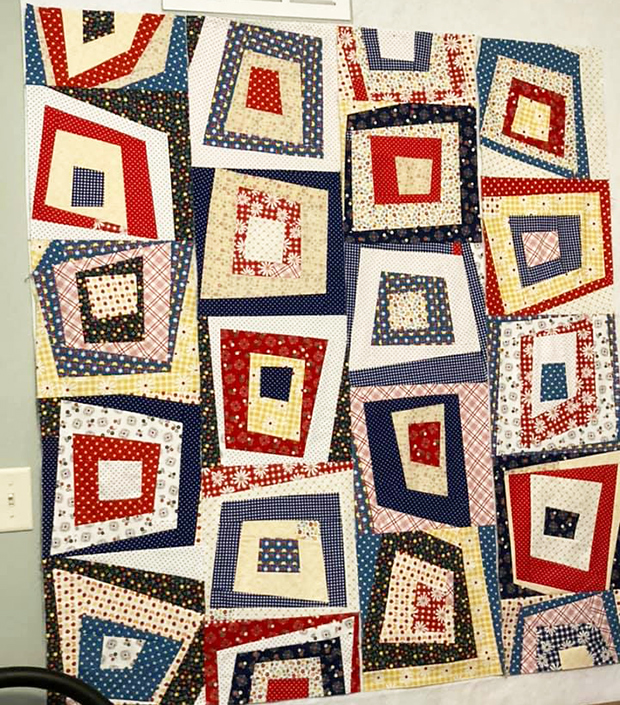
I love the patriotic look chosen by Judi H for her Modern Logs. Classic red, white and blue with a touch of gold, maybe for a yellow ribbon?! She wondered if they were too wonky, but I think not. The beauty of improv is that everyone’s quilt comes out differently!

Modern Logs by Sharon C

Sharon’s working on her version of Modern Logs made from the Modern Logs quilt kit. You can can choose to orient the rows horizontally or vertically – the choice is up to you!

Although Sharon has used the exact same fabrics as my version below – notice how different they look. That’s the versatility of this design and I can’t wait to see more!

My version of Modern Logs

Shop my Good Vibes fabric collection!

Modern Logs by Jo O

Jo O’s version of Modern Logs really makes me smile. Notice the cats? I can almost see their tails swishing. I love the pops of dusty pink. And the deep gold is heavenly! So much to love right here.

Modern Logs 1 by Ellen A

Ellen went for a graphic quality with bright blues and yellows. It’s a winning combination! And she didn’t stop there.

Modern Logs 2 by Ellen A

She used just four blocks and some ingenuity to create another improvisational design. Both quilts are headed to a NICU. That’s pretty heartwarming!

As you have seen, this quilt can take on any personality. Your stash can make it totally unique, or it looks terrific in my fabrics, too.

My thanks to all the makers above for joining me for the QAL and sharing their work. It inspires me and I hope it does the same for you!

Modern Logs Quilt Pattern

If you still need the pattern:

And remember that the Quilt Along steps will remain up, so you can jump in and sew at your convenience any time.

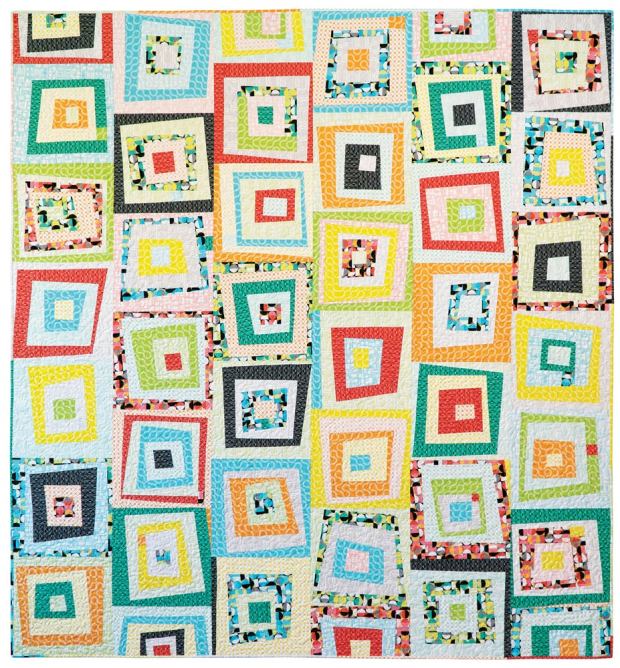
Modern Logs by Christa Watson

Modern Logs QAL Part 4: Optional Pieced Quilt Backing

Whenever I make a super scrappy looking quilt like Modern Logs, I often have a lot of leftovers that I love to incorporate into the back of the quilt. This allows me to use up more fabric, personalize the quilt a bit, and make the back (almost) as interesting as the front! If you prefer to use a plain pieced back, this week will give you more time to finish your quilt top.

Modern Logs pieced quilt backing, made from leftover Good Vibes fat quarters, 2 yards of Gumballs print in Coral and a few leftover odds and ends from previous fabric lines.

Set aside the Binding Strips

Before you begin the pieced backing, be sure you’ve set aside enough of the straight strips for a scrappy binding. See the note in the pattern on page 3. Or you can use all of one fabric for binding and use up ALL of the leftovers on the back. The choice is up to you. We will come back to binding at the end of the QAL so stay tuned.

The image above shows half of the binding strips I cut from one set of Good Vibes fat quarters. I decided to double the size of my quilt so in reality I had twice as many. Notice how a couple are shorter – that’s because I ended up using a few extra chunks of fabric for my blocks.

There’s also 20 fabrics in the group, but only 18 strips here because I used a couple of them to finish some blocks. I still had plenty of leftovers for binding, and if for some reason you ever run short, just grab a similar color from your stash and no one will ever know!!

Now, let’s get on with sewing the pieced back!

Sew Scraps into Larger Pieced Chunks

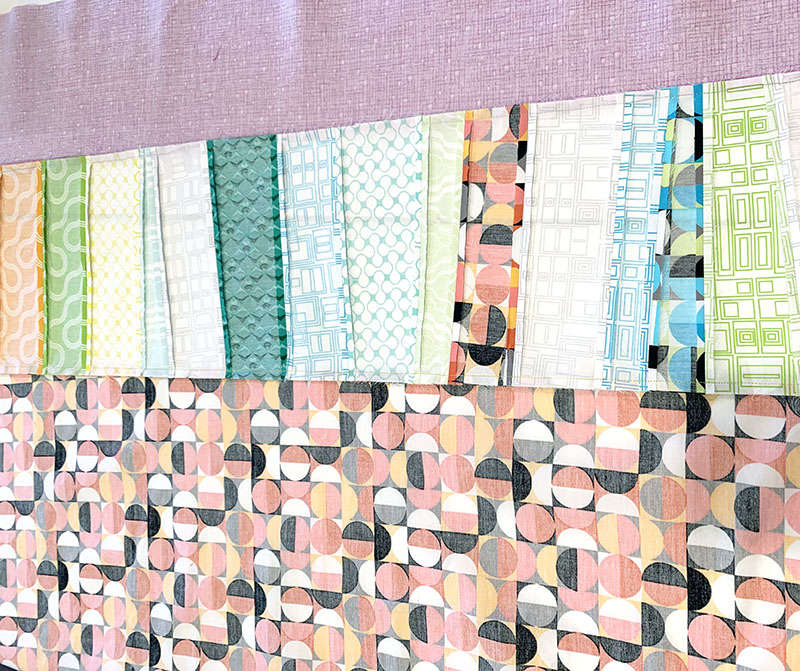
When making a pieced backing from leftovers, think of it like a puzzle. You want to cover the quilt top with enough extra fabric on all sides (about 5-6″) and you want each of the “chunks” of the puzzle to be rectangular or square in shape so it all fits together.

First I sorted all of my leftover strips in similar lengths.
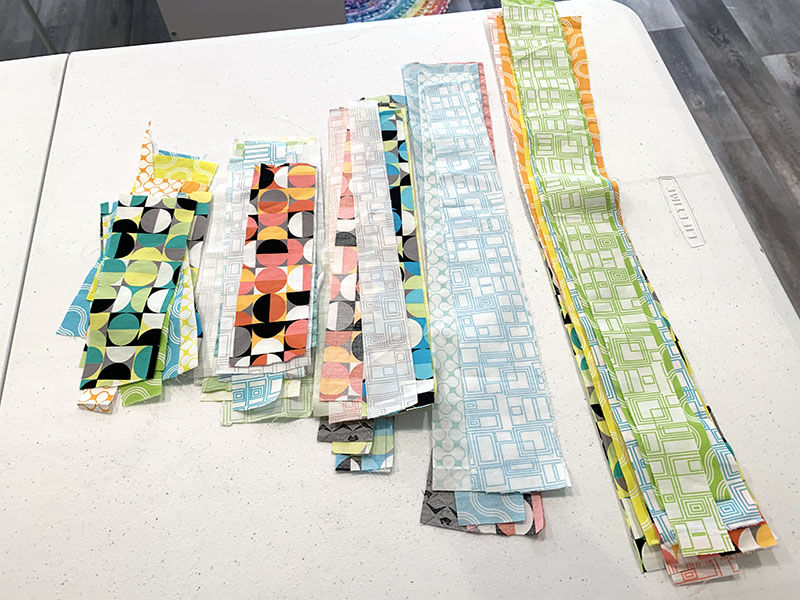
Then I sewed similar length strips into pairs and joined those into bigger complete chunks. Be sure to alternate seams when sewing so that the strips don’t warp or bend out of shape.

Now, your sizes and numbers of leftovers will vary so don’t overthink it too much. I sewed these together randomly and it was fun, mindless sewing! You can even do this anytime you have leftovers!

Once the leftover bits are sewn, it will look pretty messy and uneven. But not to worry, just trim off the ends and you’ll have a nice piece of “made” fabric that you can treat just like you would a regular piece of fabric with evenly trimmed sides. It doesn’t matter how long or wide this pice is. It’s just one of the “chunks” in your puzzle piece!

Repeat this process until all of your leftover bits are sewn into larger pieced chunks. You get to decide how small of a piece you want to use. I think my smallest pieces were about 4″-6″ long and the longest ones were full sized strips.

If you want to, you can sew some of the smaller pieced chunks into larger chunks, filling in with bits and pieces of other fabrics – leftover charm pack squares or jelly roll strips, odd shaped pieces that are too big to go in your stash, but too small to throw away.
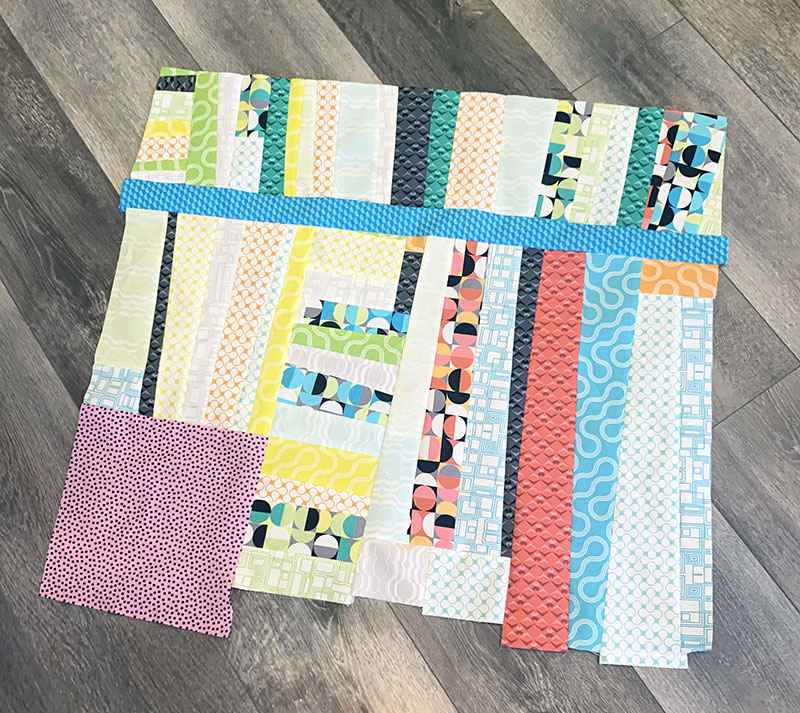
When making these improv pieced blocks, the size doesn’t matter because it all depends on what you have to work with. Just square up the pieced chunk once you join the pieces together. When it’s finished, trim all sizes so that you have a pieced rectangular or square in shape. Make as many of these as you can, or save some of the improv patchwork to fill in the holes in your puzzle.

Piecing the Puzzle

Now comes the really fun part! Using your “puzzle” pieces, start covering up your quilt top! You can do this on the design wall, floor, bed, or anyplace you can lay out the quilt nice and flat. You can calculate all the math ahead of time, or just let it take shape randomly, which is what I did. Just like sewing your quilt blocks, it’s important to always sew straight edges together.
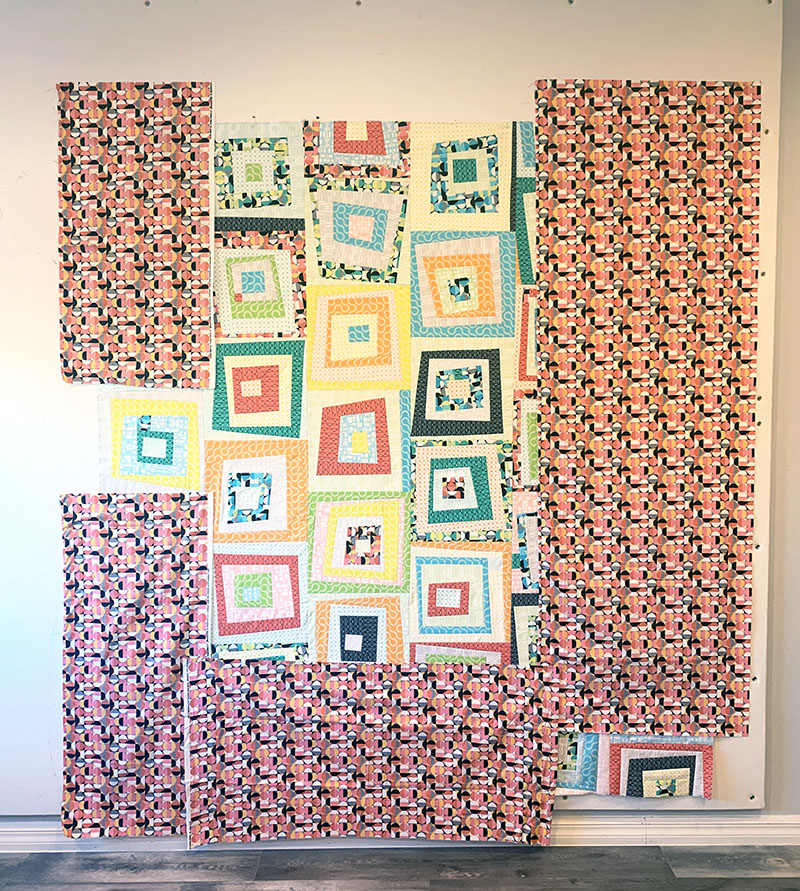
Step 1 – establish a framework

In the image above, I first started with a big chunk of fabric. I had 2 yards of Good Vibes Gumballs in Coral so I cut it into a few random pieces. I wanted these to be big chunks but none of them was large enough to go across the entire quilt. I’m establishing a framework here of 3 big areas to piece: left, middle and right.

Look how the edges are hanging over a few inches all around. I also left the selvages intact on both pieces on the left side. Because it’s my fabric with my name on it, I thought that would be a fun addition to the quilt!

Now it’s time to fill in the gaps!
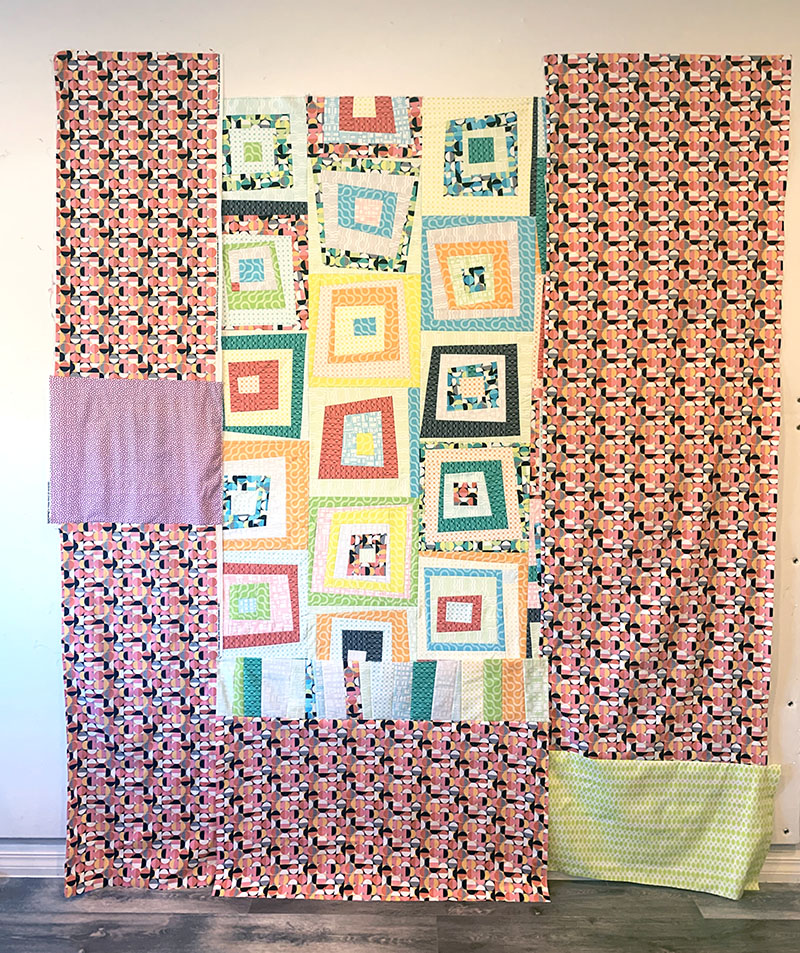
Step 2 – fill in the gaps

I used two leftover chunks of fabric from my Gridwork line in coordinating colors to fill in 2 of the holes. These will give a pop of color to the back and keep things interesting. The piece looks more dynamic with the seams placed at different eye levels. Just remember that anything placed around the borders will get trimmed off so keep any border pieces nice and big.

I also started filling in the middle section with a bit of pieced patchwork near the bottom. I made it the same length as the chunk of Gumballs fabric below it so the edges wold match up nicely. This meant trimming off the selvage on one edge of the Gumbals print in the center bottom section.
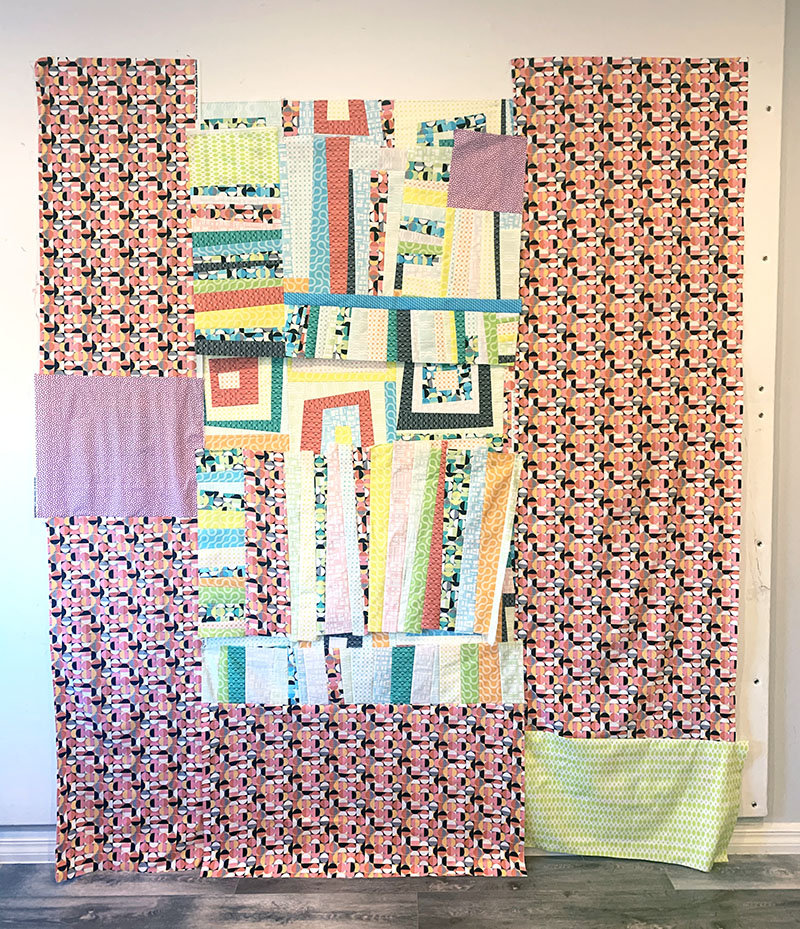
Step 4 – add more pieced chunks

Keep in mind that the entire center section will need to be the same pieced width, so use a round number that’s easy to remember. My center section is somewhere around 36″ wide if I remember correctly. That math works nicely with leftover 40″ long pieces since they are quick and easy to trim up.

I filled in the center section with the rest of my pieced patchwork chunks. Trim them down, or add more pieces to make them all the same length. The fun part is deciding how far apart to space them and what else to use as fillers. Once I have an idea of where the patchwork units will go, them I trim them to size and treat them like regular pieced blocks.

Don’t forget to press as you go!

Be sure to use good technique while sewing: accurate 1/4″ seams and lots of pressing. I pressed seams open for all of the patchwork improv chunks and to the side when the chunky seams were sewn next to a plan flat piece of fabric. Press each seam just like you would when sewing blocks and rows together.

Step 5 – add pops of color  between the pieced units

I wanted to separate the pieced chunks a little so that I could admire the patchwork and allow my eyes to move around the piece. It was fun to add pops of color to tie it all together. Once the 3 sections were finalized, I sewed them together to finish the backing.
At this point, it’s ok that the outside edges aren’t even because that will get trimmed off after quilting. As long as the pieced backing covers the quilt a few inches on all 4 sides, it’s good to go!

Next week we will baste the quilt!

Helpful Links