Shades of Grey – Pieced Backing Tutorial

I love to make pieced backings and by popular request I’m sharing with you a tutorial on how to put one together. This goes with my String of Pearls Quilt Along.

Shades of Grey Backing

Shades of Grey Pieced Quilt Back, 72″ x 72″

Before we start, there are a few things to consider. First of all, how big is your quilt top? You want to sketch out a backing design that leaves plenty of wiggle room around the sides. A good rule of thumb is to make your backing at least 6 inches larger than your quilt top.

String of Pearls

String of Pearls Quilt Top 66″ x 66″

For example, my String of Pearls quilt finishes approximately 66″ x 66″. Therefore, I need to have a backing that measures about 72″ x 72″. That’s a nice measurement because 72 inches is the same as 2 yards, so you can visualize a backing roughly 2 yards wide by 2 yards long.

One Fabric Backing

Backing, One Fabric, 72″ x 72″

The second thing to consider is, do you want to make your backing from all one fabric (most efficient), or would you like to make it a little more artistic (my favorite)?

The solid backing above requires 4 yards of fabric (two – 2 yard lengths). Join them with a seam down the middle making a rectangle of approximately 72″ x 80″. Trim off about 8″, making a 72 inch square and throw the excess into your scrap bucket.

Finally, you need to decide ahead of time if you will be quilting the quilt yourself, or hiring a longarmer to do it for you. When quilting yourself, you can get away with less extra around the sides.

When sending a quilt out for professional quilting, however, you may need more fabric around the edges for the longarmer to work with. She also may request that your seams need to run either horizontal or vertical depending on how she loads the quilt on the machine. Be sure to check ahead of time (or just quilt it yourself like I love to do!)

One Fabric Backing

Leftover Pearls

When deciding on a pieced back, I like to incorporate leftover fabrics or blocks from the top to give it a little interest.

Pieced BackingFirst, I lay the quilt top on the floor or a large table, then start randomly placing leftover pieces of fabric on top until it’s covered. I rearrange all my pieces as needed until I’m happy with the layout.

Pieced BackingNext, I will trim up my pieces and start joining them together in sections until my backing is big enough to overlap the top on all sides by at least 3 inches. Remember, it will shrink up some with seam allowances, so be sure to add more if needed.

Pieced Backing Diagram

Pieced Backing Diagram

For your convenience, I have included cutting diagrams for my pieced back. The measurements include seam allowances. Note, the pieced Pearl Bracelets section is made from 12 (3.5″ x 4.5″) rectangles to create a 3.5″ x 36.5″ unit.

Voila! Time for basting!

For more inspiration on making a pieced backing, check out Elizabeth Hartman’s FREE online Craftsy class, “Creative Quilt Backs.”

You can also see how I made these pieced backs by clicking the links below the pictures:

Hugs N Kisses BackSea of Squares Pieced Back

Charming Chevrons Pieced Back


Hugs ‘N Kisses Pieced Backing Tutorial
Sea of Squares Pieced Backing Tutorial
Charming Chevrons Pieced Backing Tutorial

Craftsy Memorial Day Sale – Support our Veterans!

Memorial Day weekend is traditionally the kick-off to summer – a great time to gear up for fun times ahead and a chance to start on some summer sewing.

But of course it’s so much more than that. It’s really a time to honor our veterans and remember those brave men and women who have served in the US Armed Forces and supported the cause of freedom.

This Memorial Day, let's honor our verterans.

You can honor our veterans and kick off your summer by signing up for a Craftsy class this weekend. From now through Monday, when you sign up for an online class, Craftsy will donate a portion of the proceeds to benefit a veterans’ organization. Select classes will be on sale up to 60% off!

I took a quick look to see which quilting classes were on sale and there was quite a good selection to choose from. Here are a few that look interesting:

Pictorial Quilting Techniques by Wendy Betler Burns Design It, Quilt It by Cindy NeedhamPictorial Techniques by Wendy Butler Burns. I met her at Road to California 2 years ago and she was full of energy! This one’s on my to-do list at 25% off.

Design It, Quilt It by Cindy Needham – 25% off. I signed up for this class the last time it was on sale and it’s one of my favorites. It includes an excellent basting tutorial, too!

Big Techniques from Small Scraps by Sarah Fielke

Stupendous Stitching by Carol Ann Waugh

Big Techniques From Small Scraps by Sarah Fielke combines traditional techniques with fresh design. Fun – and 50% off!

Stupendous Stitching by Carol Ann Waugh explores of embroidery designs, decorative sewing machine stitches, couching and binding. It’s 33% off.

Quilting Big Projects on a Small Machine by Ann Petersen

The Machine Embroidered Quilt by Eileen Roche

Quilting Big Projects on a Small Machine – I can’t get enough domestic machine quilting classes! It’s 38% off through Monday.

The Machine Embroidered Quilt with Eilleen Roche looks like another fun class where you add embroidery elements to embellish your quilt. It’s 38% off, too

Re-Piecing the Past by Kaye EnglandQuick-Strip Paper Piecing by Peggy Martin

Civil War Blocks by Kaye England – learn precise piecing methods and make 12 traditional blocks, inspired by the stories of strong women of the Civil War era – 50% off!

Quick-Strip Paper Piecing with Peggy Martin – now that sounds like something I could use! Another one at 38% off. That’s kind of a weird discount amount but it’s better than paying full price. 🙂

I make it a point to only sign up for Crafsty classes when they are on sale and so far I’ve been impressed with how often that happens. Click here to see the rest of the classes that are on sale this weekend. Happy sewing!

Modern Dresden Block – Paper Pieced Pattern

Pattern Update

I have now turned this block tutorial into a full-fledged foundation paper pieced pattern called Party Time. It includes multiple sizes, the foundation pattern to photocopy & quilting suggestions.

Click here to purchase the Paper Pieced PDF Download.

Original Design Idea – Modern Dresden

This my contemporary interpretation of a Dresden Plate block.

Modern Dresden in OrangeI started with the idea of “plates” or “wedges” radiating out from a center. But instead of classic curves, I wanted to keep my design straight and angular. So I played around with lines and angles in EQ and this is what I came up with.

And just for the fun of it, here’s the same design in purple. It really sparkles by using lighter hues of the same color at the edges of the blocks.

Modern Dresden in Purple

Techniques and Tools – Intro to Free-Motion Quilting

Welcome to Technique Tutorial Tuesday. This is a long post so sit back, relax, and read awhile!

Today I will be presenting an introduction to Free-Motion Quilting (FMQ for short). I will cover topics such as thread selection and tools needed for successful quilting, as well as starting and stopping and the density of your quilting.

I quilt all of my quilts on a Bernina machine that’s almost 20 years old. If I can do it, so can you! I hope you will give FMQ a try because I think it’s the most fun part of making a quilt!
Machingers Quilting GlovesSupreme SliderTopstitch NeedlesThread


For starters, here are my 3 favorite tools for quilting:

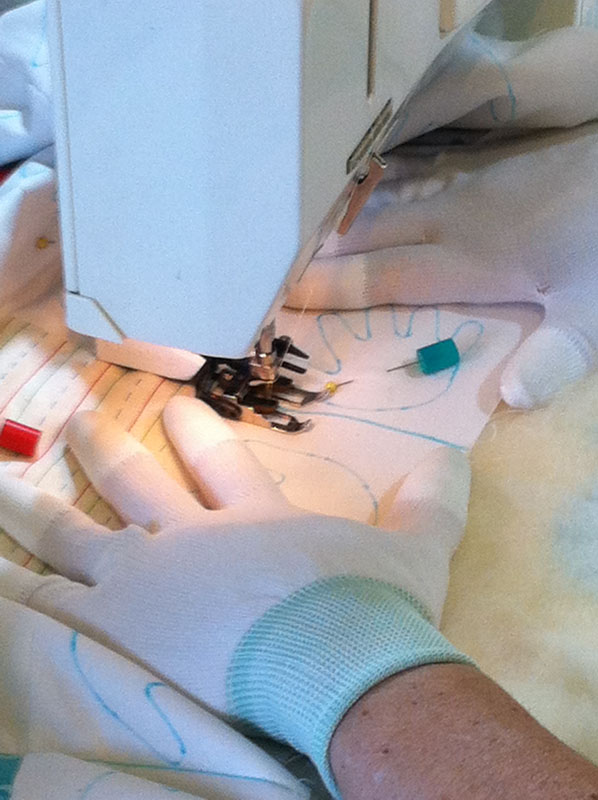
  1. Machingers quilting gloves help grip the quilt while quilting which in turn reduces stress and tension on your shoulders. They are machine washable and breathe well.
  2. A Supreme Slider helps for two reasons: it allows your quilt to glide smoothly under the bed of the machine. It also acts as a cover for your feed-dogs so you can still have FMQ success even if you are unable to drop them.
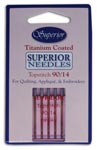
  3. Superior Titanium Coated Topstitch needles come in several sizes according to the weight of your thread. They have a larger eye which makes them much easier to thread. They also have a longer needle shaft which helps prevent thread breaks. I use a new needle at the start of each quilt and change them about every 8-10 hours of quilting.

FMQ FootFor FMQ, you also need to use a darning foot or free-motion foot made specifically to fit your machine.

Speaking from experience, it’s best to get this straight from the dealer. The best type of foot has an “open toe” so you can see where you are stitching.


Thoughts on Thread and Tension

I love lots of quilting on my quilts but I want the quilting to show, not the thread. In order to do this, I try to blend my threads as much as possible on my quilt. I have a rainbow of colors and I don’t mind switching thread colors or weights when needed, even in the same quilt.

Auditioning Thread Choices
Auditioning Thread Choices

Quilted Thread

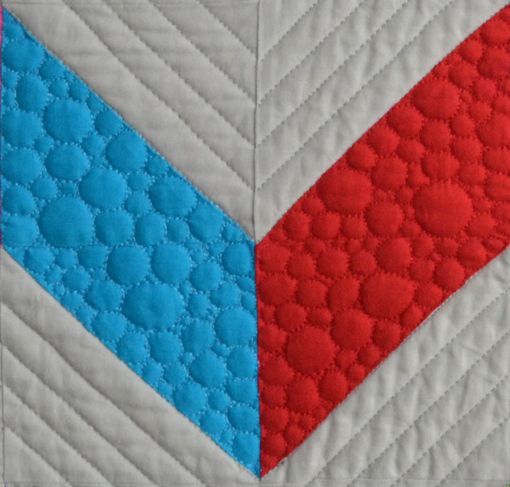
Light Grey for Background, Colors for Blocks


To decide on the correct thread color for a quilt, I will audition several choices and see which one “disappears”  most into the quilt. I test the thread out on a practice piece first,  to check the tension and to see how well the thread blends or stands out. Here are more tips:

  • With a thinner thread like silk or 60 weight polyester, your stitches will blend more, even if the thread does not exactly match the fabric. You can use neutrals to quilt over lots of different colors. If you want your stitches to show, use a heavier 30-40 weight cotton or polyester. A medium 50 weight cotton is a great choice for beginners because it is very forgiving and can cover a lot of area quickly without looking too “thready”.
  • Some of my favorite brands that I use are Superior Threads (in cotton, polyester or silk), Isacord (polyester), or Aurifil (cotton). Unfortunately, I have not had good results with invisible threads so I stay away from them as much as possible!
  • Use the same color thread in the top and bobbin. You don’t have to use the same weight. You can use a heavier weight on top and a lighter weight in the bobbin, or they can be from the same spool. No matter how well I balance my tension, little thread “pokies” still show through if the thread colors are vastly different.
  • If you can’t match your thread exactly to your fabric, opt for a darker thread color rather than a lighter color. A darker color will blend more; lighter colors stand out.
  • Use a “busy” backing for the lining of your quilt. This will easily hide any less than perfect tension issues or quilting mistakes. A busy back also hides lots of different thread color changes. Save the solid backings for when you want to “show off” your precise quilting, or if “thread play” is a part of your intended design.
  • To balance your tension, do not be afraid to change your bobbin tension as well as your top tension. Superior Threads has a great visual on how to balance your tension:

Thread Tension

Click to Enlarge

Starting, Stopping and Smooshing

When beginning a session of free-motion quilting, I like to use this phrase: needle down – foot down, needle up – foot up to bring the bobbin thread up through the top of the quilt. Be sure that your feed-dogs are disengaged, or covered with your stitch length set to zero.

Catch Bobbin Thread

Ending Thread


Hold both thread tails lightly with your hand, then take a few tiny stitches in place to lock your threads. When you come to the end of a quilting session, you will need to end with a few small stitches, then pull up a loop of bobbin. You can either clip the threads close to the surface, or make a knot by hand and “pop” it through to the batting.

When quilting a larger quilt, I use my hands as a hoop and quilt in one  small area at a time.
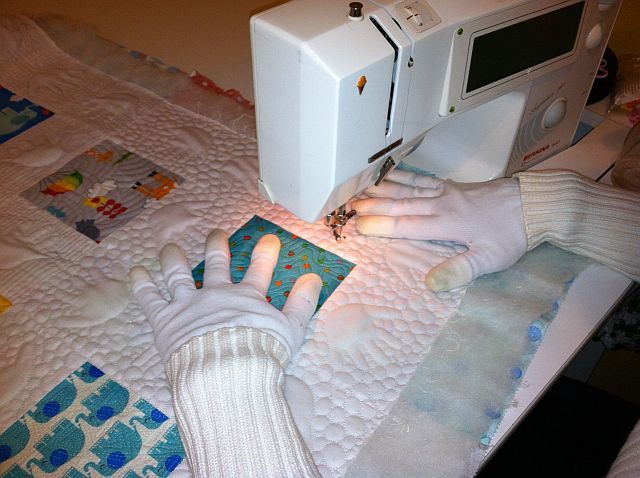
Hoop Your HandsYou will want to quilt your quilts enough so that the batting will not fall apart during washing. How much more dense you quilt is a matter of personal preference. I personally think that quilts look best when all areas are quilted, but this does take some time to do.

When the bulk of a quilt gets too much to handle, I simply move and “smoosh” it out of the way. If it’s been basted properly, all of the tugging, pulling and scrunching of the quilt will not cause any problems.

Smoosh and Scrunch

Smoosh and Scrunch

Practice, Practice, Practice!

It cannot be stressed enough: you need to practice a lot to get really good at FMQ. Make several practice sandwiches by inserting a piece of batting between two scrap pieces of fabric. It will take some time to find a rhythm that you are comfortable with. It took me a good solid year of FMQ to get to where I was happy with it.

Scrap 1

Scrap 1

Operate your foot pedal at a speed that keeps you in control of your hands and do not move your hands faster than the speed of your machine. Here’s a good rule of thumb (or foot!): if you are making tiny stitches, you need to slow down the speed of your foot pedal and increase the speed of your hands moving the practice sandwich around under the machine.

Scrap 2

Scrap 2

If your stitches are too big, you need to slow your hands down and and speed up your foot. Practice different combinations of speed between your hands and feet until it feels right. Your stitch movements should not be jerky, they should be nice and smooth.

“Handwriting Practice”

Handwriting PracticeIf you can draw it, you can quilt it! Think of your needle as an electric pen writing on a quilted canvas.

You have to practice your handwriting to know where your hand is moving on the paper. The same thing applies to FMQ with needle and thread.

You need to build muscle memory and hand eye-coordination.

The best way to do this is to draw, draw, draw. Take some time and sketch out some doodles like I did. I can sit for hours sketching out pages full of quilting designs!
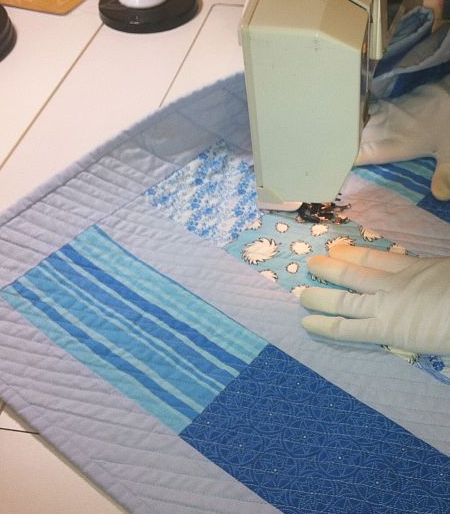
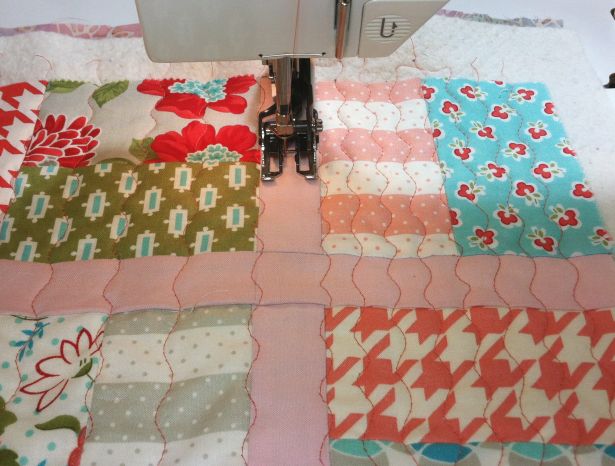
Straight Line QuiltingSerpentine QuiltingThese are just a few of my favorite tips when it comes to free-motion quilting.

But do not overlook the possibilities of quilting with your walking foot, too.

Straight-line quilting can add lots of texture, especially when quilted closely together.

You can also add interesting designs by playing around with decorative stitches, too. The quilt below was quilted entirely with a serpentine stitch and my walking foot.

My final words are to have fun with it and don’t stress too much. Stick with it and you will see improvement over time, I promise!

Artistic Pieced Quilt Backing Tutorial

As promised, here is a mini-tutorial on how I made my pieced backing for my Charming Chevrons quilt-along. I like to call it “Back Art.”

First, I started with a rough sketch of what I want the backing to look like. I designed it  EQ7, but paper and colored pencils work well, too. Next, I measured my finished quilt top and added three  inches around the perimeter (six inches total to the length & width)  to calculate how large the backing needed to be.  I came up with a backing measurement of 54″ x 60.”

Pieced Quilt Back Diagram

Measure Quilt Top

The thing I like about pieced quilt backs is that it’s almost like making another quilt top. I know how the pieces will fit together and it’s much easier to assemble from large scraps and chunks I have leftover in my stash.

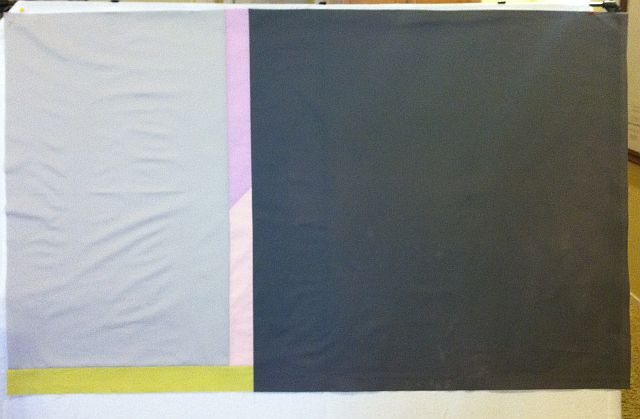
For my backing above, I cut out three chunks of dark grey and one chunk of light grey, plus some assorted colored strips, all Kona Solids.

Light Grey Piece

Going from left to right and top to bottom, we could label these sections 1-4. In this order, the cut measurements are:

  1.  19.5″ x 31.5″ (light grey)
  2. 33.5″ x 33.5″ (dark grey)
  3. 21.5″ x 27.5″ (dark grey)
  4. 31.5″ x 25.5″ (dark grey)

I then cut out several 2 1/2″ strips of color to add a touch of whimsy to the back.

I sewed them to the two opposite corners, log cabin style on either side of a light and dark grey piece.

I was working with some leftover fat quarters so I just pieced enough partial strips to get the length I needed.

Once the light grey chunk was pieced, I added a solid dark grey chunk (#2) to the right side.

Top Half of the BackingI repeated the process for the bottom half of the quilt top also. I sewed 2 1/2″ strips of Kona colors to the left side of a dark grey chunk (#4) and then added the solid piece of grey (#3) to form  bottom half. Then I joined the two halves to complete the backing.

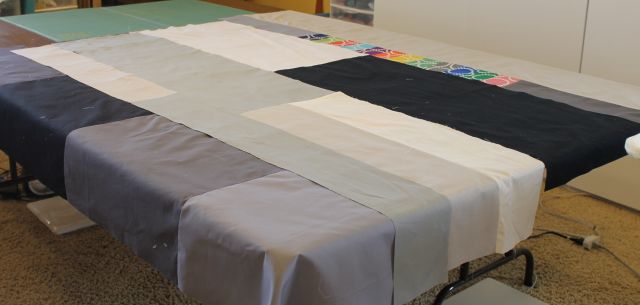
Pieced Quilt Back

While sewing, I made sure to press every seam open and use pins so that my pieces would line up correctly. Because I had a stripe roughly in the center of my quilt, this helped me line everything up straight when it came time to baste the quilt.

I like this technique so much I will probably sew a pieced back for every quilt I do in the future. One more idea I may try on my next quilt backing is to sew a colorful square somewhere on the back near the corner of the quit (but away from the edges). This could serve as a label ready to write on as soon as the quilt is finished!

If you were inspired to create some “back art” of your own, I’d love to see it! You can email your pictures to christa@christaquilts.com.

Yes I’m old school when it comes to technology. I don’t really use Facebook or Twitter very often and I haven’t gotten on the Flikr or Instagram bandwagon yet – sorry!!

Sew and Tell – Designing Quilts in EQ7

I have been busy playing around with my computer design program this week. It’s long been a dream of mine to take my original quilt  ideas and turn them into published patterns.

Jolly Jelly Roll PatternHere’s one of the first quilts I designed in EQ7, my Jolly Jelly Roll Quilt, which later became my first quilt-along tutorial series featuring quilts from precuts.

I was happy with it but during the tutorial I slightly modified  the borders, and used different fabrics for the actual quilt.

However, until recently, I didn’t know how to change my digital design to reflect the pattern updates.
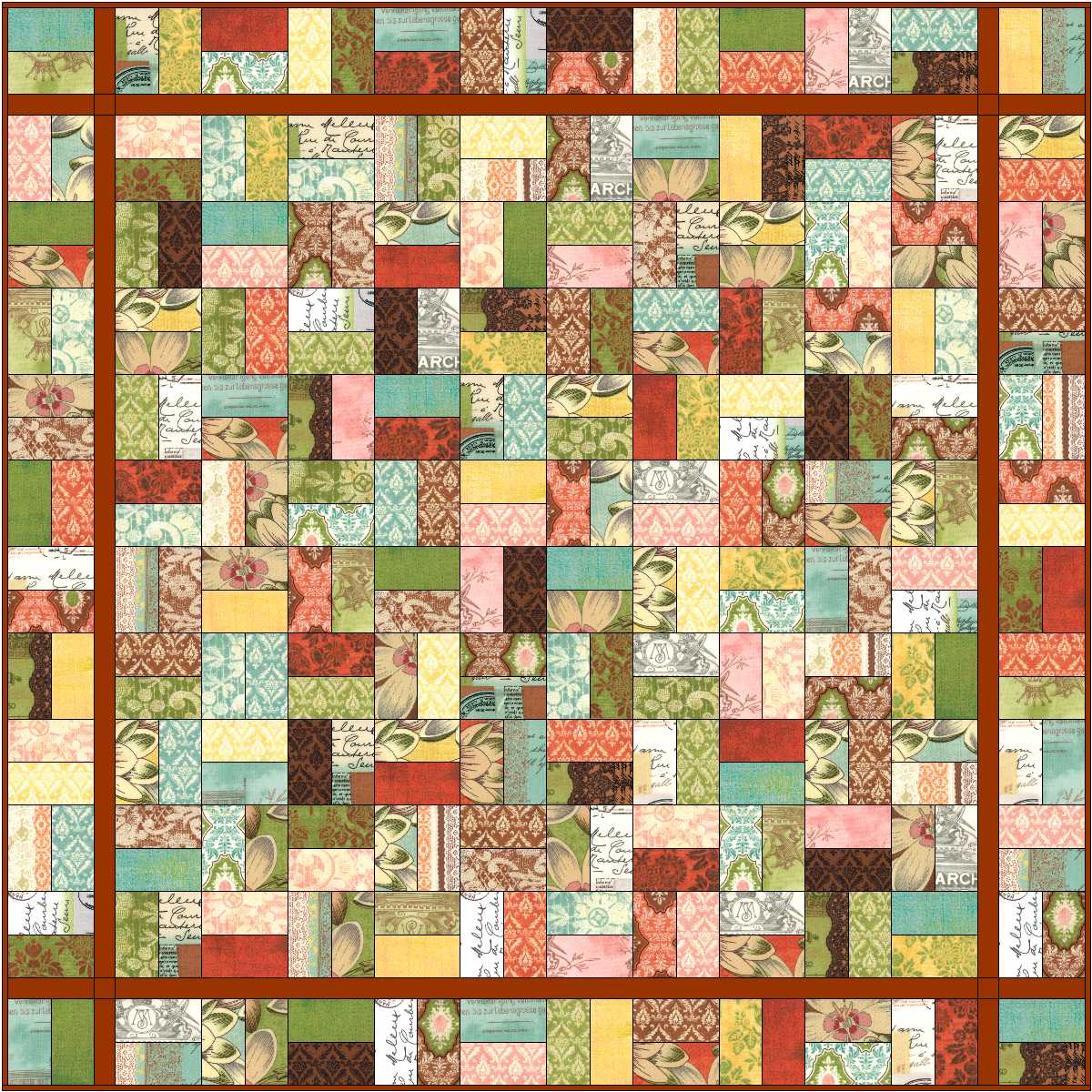
I finally had an “a-ha” moment when I realized I could take image files of my fabrics, upload them to the program and then use them to design quilts with current fabrics. Now fabric choices are limitless!

Meadowfriends Girl Jelly Roll QuiltMeadowfriends Boy Jelly Roll Quilt


This is what I’ve come up with now – quilt designs that reflect the actual sewing pattern, using Jelly Rolls that I currently have on hand. I went a little crazy and designed 4 of them in one day. I could have kept going with other ideas except that I had to stop to eat and sleep!

American Jane Jelly Roll Quilt

BasicGrey Curio Jelly Roll Quilt


I am offering these as quilt kits in my store until they sell out. Then I’ll design some more!

Working on my do-it-yourself-quilt tutorials has definitely helped me grow as a designer. By blogging about my quilts on a weekly basis, I can take a large project and break it down into smaller steps and actually feel like I’m accomplishing something.

Now I’m off to design my next tutorial. (This is almost as much fun as the  actual sewing!)

Just in case you’re interested, here are links to the three full tutorials I’ve done so far:

  1. The Jolly Jelly Roll Quilt
  2. Baby Bricks
  3. Charming Chevrons

Feel free to quilt-along with me any time!

American Warriors Quilt Tutorial – American Rails Quilt

JOIN MY QUILT ALONG!

For more fun with upcoming quilt alongs, click here to subscribe!

Darlene S. posted a question on my blog asking about a pattern for my Wounded Warriors Quilt that a few of us gals from church made. So I decided to post a few more of the step-by-step pictures along with some simple instructions.

This quilt is JELLY ROLL friendly!

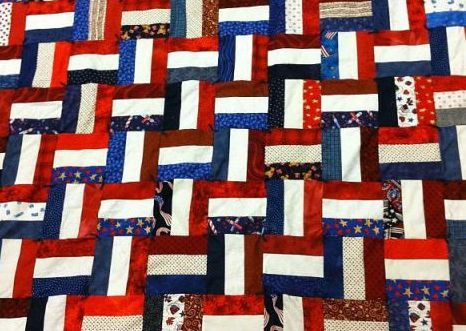
American Warriors Quilt

The quilt is basically a modified rail fence version with 3 strips of color instead of 4. Since it’s made from red, white, and blue strips with the white strip in the middle, the design forms sort of a woven look. It would make a perfect signature quilt, too!

So easy peasy, here you go:

Step 1 – Our lap size quilt finished at 60″ x 72″ and consisted of 120 blocks set 10 x 12. Each block finished 6 inches square. So you would need about a 1.5 yards of each color. Use scraps for variety, or your favorite jelly roll.  I used several prints of each color. Cut each fabric into 20 – 2.5″ strips.

Subcut those into 120 rectangles each of red, white and blue, measuring 2 1/2″ by 6 1/2″.

Red, White, Blue Strips

Step 2 – Sew all of the rectangles into sets of three with the same red-white-blue color orientation. For best variety, mix up the pieces while sewing as much as you can.

Sew Strips into Blocks

Step 3 – The tricky part – lay out all of your blocks so that they form an interesting zig-zag  pattern. This was probably the hardest part of making the whole quilt and keeping the colors going the right way! If you look closely at the picture you will see continuous streaks of red and blue on either side. Constantly refer to your layout to keep it going the right way.

Zig Zag Blocks

Step 4 – When all of the blocks are laid out in the correct orientation, you can join the blocks into rows. Then join all of the rows to make your top. We tied our quilt, but it would look great quilted in the ditch with a decorative stitch!

Join the RowsIf you are wanting to make a signature quilt you can either piece all of the blocks and have people sign them ahead of time. Or finish the quilt and bring it to your party or wedding reception and have the guests sign directly on the quilt!


Updated: This quilt has now been featured as a favorite on FaveQuilts.com. They renamed it American Rails. That makes my day. 🙂

Click here to see my other FaveQuilts featured tutorials.

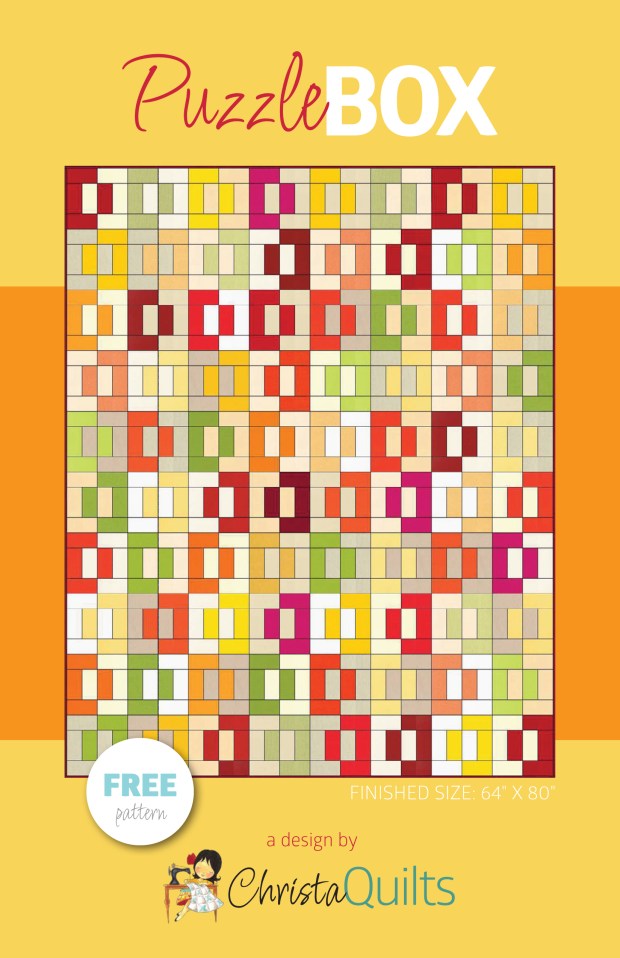
Free Jelly Roll Quilt Pattern

Want to make another quick and easy jelly roll quilt? Click here to sign up for Friendly Threads, My weekly email newsletter and get the PDF pattern for Puzzle Box emailed to you.

Puzzle Box Pattern

Bungle Jungle Charm Quilt Week 4 – Ditch Quilting

Bungle Jungle QuiltI didn’t make a ton of progress on my Bungle Jungle modern quilt this week, mostly because I was packing up to go on our family vacation and getting all my ducks in a row ahead of time.

(They are quacking nicely now!)

But, I did get all of my stitch in the ditch quilting done so I’m ready for the best part, the free motion quilting next week!

I think my plan will be to quilt a different motif in each charm square, to practice a bunch of free-motion quilting designs.

Stitch in the DitchI want to add tons more quilting. By pressing the Quilt Back with Grid Quiltingseams open, stitching in the ditch in between the charm squares was a breeze. It created a grid over the surface of the quilt which you can see on the back side of the quilt. Click for closeups.

Sewing LineI used an acrylic ruler and a blue washout pen to mark straight lines where needed to complete the grid.

The quilt is now anchored so I can remove the rest of my basting pins and it’s ready for more quilting!

Be sure to join me tomorrow as I launch my new tutorial series: Do It Yourself Quilts!

Bungle Jungle Week 3 – Layer Cake Back Art and Basting

This week I marked and basted my Bungle Jungle charm pack quilt. I will start quilting it next week. You can read about last week’s progress here.

Layer Cake Back ArtWhen I finished marking the top, I couldn’t decide on the backing. Then it hit me – why not use a Bungle Jungle layer cake and make back art for my modern quilt?

(The back is probably even more modern than the front since I threw the blocks together totally randomly!)

Each layer cake square is precut to 10 inches, so when you sew them together into 7 rows of 6 blocks each, the finished size is 57″ x 66.5″. My quilt top measures approximately 52″ x 60″ so that was perfect! It took me less than 2 hours to stitch all the backing squares together, including pinning and pressing the seams open.

Marking with Water Soluble PenUsing a stencil, I drew little hands in the white spaces randomly over the surface of the quilt.  This is going to be cute!

I marked all the hands before basting, using an inexpensive water soluble blue pen. I’m going to join the hands with loopy quilting so I can quilt them continuously.

I still haven’t decided what I’m going to quilt in the charm squares, so I left those unmarked for now. Any ideas??

Finally, I basted the quilt using about 150 Pinmoors. This is the 3rd quilt I’ve basted using Pinmoors and I’ve decided they are awesome! It’s a little spendy to buy enough of them for a big quilt, but they are totally worth it. It made basting a breeze and they are super easy to take out when quilting. I don’t even worry about pinning over my marked lines. The rule of thumb is to baste about a hand-width apart. That was easy for this quilt!

Basting With Pinmoors I’ve been following quilting blogs like The Free-Motion Quilting Project, WIP Wednesdays, Moda’s Bakeshop and the 2012 Free Motion Quilting Challenge for quite some time. I have so thoroughly enjoyed these projects that I have now been inspired to start my own sew along called Do-It-Yourself-Quilts!

I want to share step-by-step tutorials on how easy and fun it is to make your own quilts completely, including piecing and quilting. Then you can truly say you made it yourself!

Be sure to follow my blog for the official announcement about that on Thursday, July 19th, along with a sneak peak of my first project and a supply list if you’d like to join in!

Li’l Rascals Charm Pack Quilt #4 – Blocking and Binding

I’m finishing up my Li’l Rascals charm pack quilt this week and it has been such fun to make!

Week #1 was the free pattern and cutting instructions to make the top.

Week #2 was machine quilting the large nine-patch blocks.

Week #3 was using a stencil to mark and quilt the sashing and borders.

I will finish the quilt this week by blocking and binding it. I’ve enjoyed putting together this tutorial so much that I may make this a regular blog feature. Let me know what you think!

Li'l Rascals Charm Pack QuiltThe first step in blocking the quilt (whether you do this before or after binding) is to get the quilt completely wet. You can soak it in a tub, or in your washing machine on the hand-wash cycle. It will start out as a wet lump, but that’s ok, because you’ll smooth it all out.

Wet QuiltSmooth the Quilt

I have 2 large tables set up in my sewing space that I use for basting and blocking. I laid the quilt out on the corner of the table and began blocking it into place.

I use several acrylic rulers to help me block it into place. I overlap them and measure some of the areas of the quilt to make sure they are nice and square. Using the numbers on the rulers I can tug and pull the quilt into place.

Acrylic Rulers for BlockingQuilt BlockingIt  takes about 1-2 days to dry nice and flat.

Once I’m happy with how the quilt looks, I use large square rulers to trim the corners and long rulers to trim the sides. The long lines help me make nice straight trimming cuts.

Trim the Quilt

Now it’s ready to bind! Here are two binding tutorials I’ve put together from previous posts. I bind most of my baby quilts using these methods. Now, onto the next quilt!

Binding Blog Post #1

Binding Blog Post #2

By the way, if you are interested in making this same quilt, it requires just one charm pack of your choice and 1 yard of coordinated fabric for the sashing. I used Lil Rascals by Chloe’s Closet for Moda with Funky Monkey Sock Texture in dark brown.