Click here to sign up for more fun and free quilt alongs!!
Today I will show you two different ways to make a pieced quilt backing: (1) All from one fabric, or (2) from scraps and chunks. I have a little “cheater” disclaimer here. Since I am on vacation this week, I haven’t actually had time to sew my back together. Most of my tutorial pictures were designed in EQ7, but I’ll whip up my own back in no time when I return!
Step 1 – Measure Your Quilt Top

A good rule of thumb is to measure your quilt top and then add 4 inches around the perimeter on all four sides. This means you will take your quilt dimensions and add a total of 8 inches to each number. Let me demonstrate:
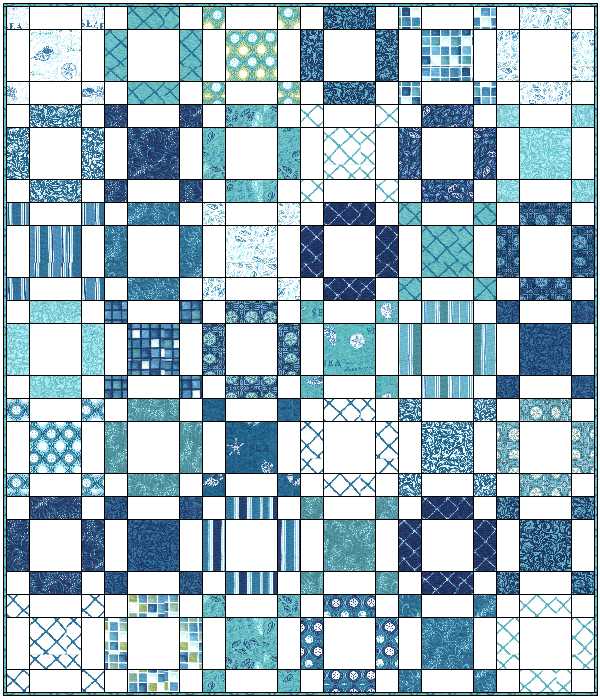
My quilt top measures 51″ x 62″ from raw edge to raw edge. I will add 8″ total giving me a needed back dimension of 59″ x 70″.
Step 2 – Calculate the Yardage Needed For One Fabric
The backing width I need is 59 inches as stated above. Rounding that up to the nearest 1/4 yard increment gives me 1.75 yards of fabric (or 63 inches). However, that will give me a length of just 44 inches from selvedge to selvedge (which I round down to 40 inches to account for seam allowances and trimmed edges). But I need a total length of 70″.

Pieced Back 63″ x 80″
To solve this problem, I will need to double the amount of fabric purchased to 3.5 yards. This will allow me to use two 1.75 yard pieces and seam them together to get a total measurement of 63″ wide x 80″ long.
Step 3 – Calculate Pieced Sizes for a Scrappy Backing
If you like an artistic backing like I do, take your diagram above and subdivide it into smaller chunks and random pieces. Use your creativity and fabrics from your stash as a guide. Here’s one hint – if you have a lot of white in your quilt top like mine, try to use lighter fabrics on the back so they don’t show through to the front.
I will “draw” a pieced backing measuring 60″ x 70″ (for easy math) and fill it in like a puzzle, adding random chunks wherever I choose. My diagram looks nice and straight but you can certainly use improve techniques with more wonky lines to achieve a similar effect.
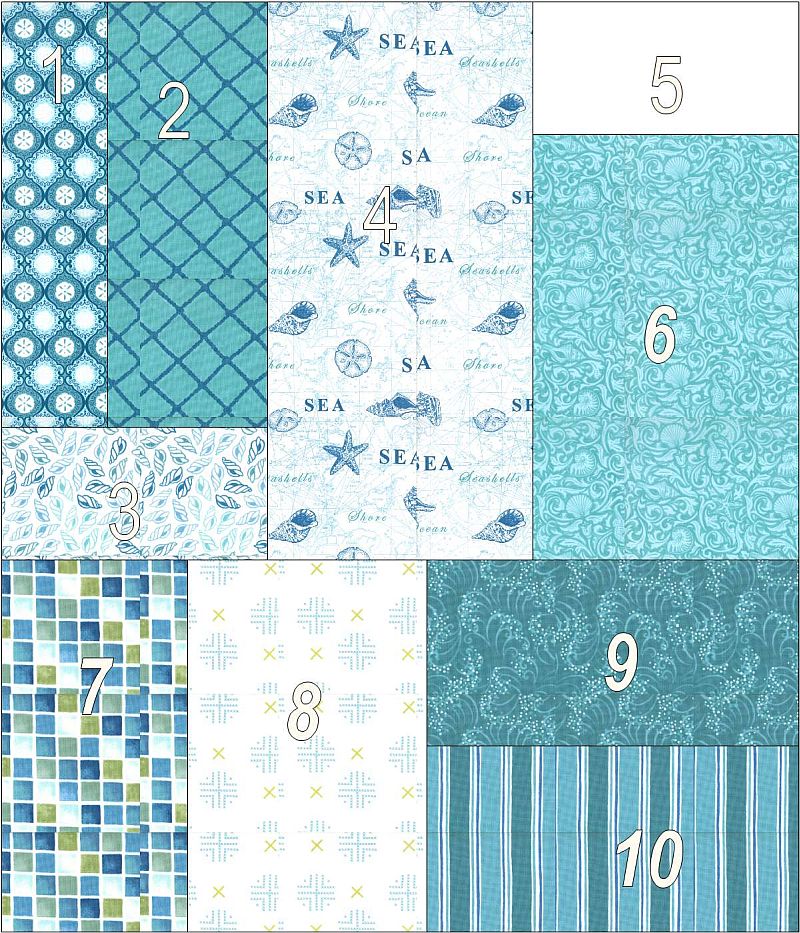
Just remember that the outer 4-5 inches will be cut off so do not place any smaller chunks near the edges. For my diagram above, I have selected 10 chunks of fabric. Let’s look and see how they would be sewn together:
- Add chunks 1, 2 and 3 together, then chunk 4
- Sew 5 & 6 together, then add to piece 1-4
- Next, sew 7-8 into one unit and 9-10 into another unit
- Piece both of these sections together
- Then add the top piece (1-6) to the bottom piece (7-10)
I will press seam allowances open and use a liberal amount of starch to keep everything tidy.
If you would like to follow my diagram exactly, here is how large you would cut each piece:
- 8.5″ x 32.5″
- 12.5″ x 32.5″
- 20.5″ x 10.5″
- 20.5″ x 42.5″
- 20.5″ x 10.5″
- 20.5″ x 32.5″
- 14.5″ x 28.5″
- 18.5″ x 28.5″
- 28.5″ x 14.5″
- 28.5″ x 14.5″
Quilt-Along Schedule – Links are Active at the Completion of Each Step:
- Week 1 – Supply List
- Week 2 – Sorting and Cutting the Charms
- Week 3 – Sewing the Blocks
- Week 4 – Completing the Quilt Top
- Week 5 – Piecing the Backing
- Week 6 – Basting
- Week 7 – Machine Quilting
- Week 8 – Optional Extra Quilting
- Week 9 – Machine Binding to Finish
Sharing is Caring
Please share your work in progress in my facebook group: Quilt With Christa . 🙂































 Christa Quilts