Pat Sloan Book Tour – Teach Me to Machine Quilt

First of all, I have a question for you – how does one write 33 books and still stay sane? The answer of course, is if you are the amazing Pat Sloan – the Wonder Woman of the quilting world! I’ve been a big fan of Pat’s ever since I discovered her weekly quilting podcast with American Patchwork and Quilting. (I’ve been a guest a couple of times and it’s really top notch!)

pat_christa_market

Pat and me at Fall 2016 International Quilt Market

Pat does it all: she’s a pattern designer, book author, fabric designer, thread curator, fearless facebook leader, community quilting organizer, and more! Plus she’s knows anything and everything when it comes to quilting. And I literally think she knows the entire quilting community by name!!

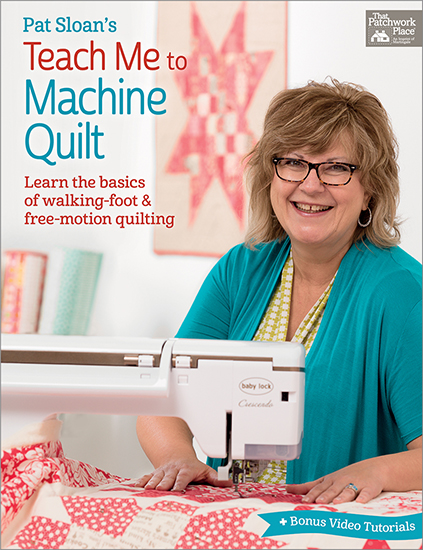
So without further ado, let’s take a look at her latest book, Teach Me to Machine Quilt, published by (my favorite publisher) Martingale/That Patchwork Place. Photography courtesy of Brent Kane.

teach-me-to-machine-quilt

Whenever I teach machine quilting, I always recommend that students learn from as many different instructors as possible. We all have our own ways of teaching similar material, and sometimes it takes hearing the same thing presented in different ways before it really sinks in.

That’s why I highly recommend Pat Sloan’s Teach Me to Machine Quilt. Not only does she cover both walking-foot quilting and free-motion quilting, but she shows them on real quilts so you can actually get a better feel for the process. Here are just a couple of my favorites from the book:

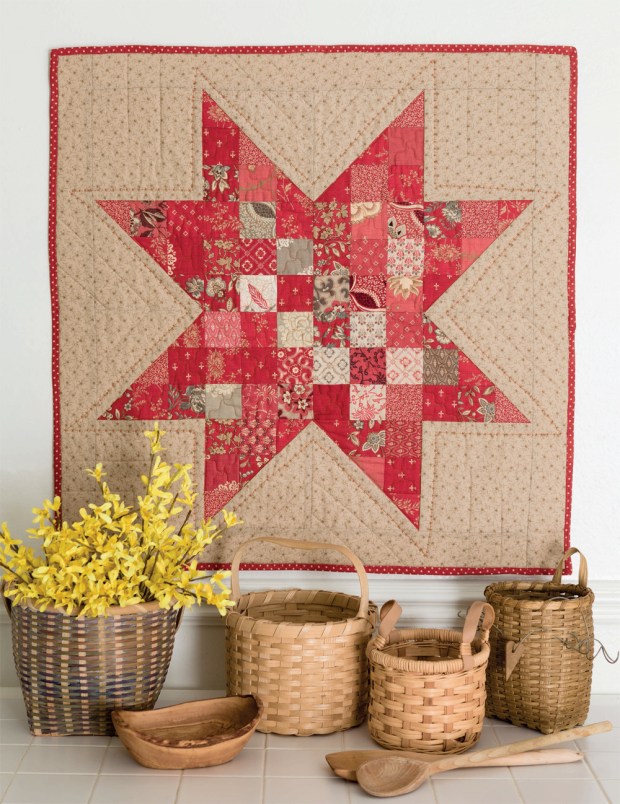
2-mini-charm-star-quilt

Mini Charm Star Quilt

3-checkerboard-hearts-quilt

Checkerboard Hearts Quilt

8-dresden-candy-dish-quilt

Dresden Candy Dish Mini

Aren’t those just fun?? I would say that my favorite part of the whole book is on page 7 where Pat says, “Yes, You Can Machine Quilt!” With her helpful advice, detailed stepouts and gorgeous photography, owning this book will really improve your machine quilting techniques.

Time for a giveaway!

And now, for the best news of all, Pat’s giving away 5 copies of her book over on HER blog.
Here’s the direct link to enter the giveaway:  blog.patsloan.com/pats-mega-fun-book-tour/

I’m one of the last stops on the tour that runs through Nov 30, so be sure to visit these other sites today:

Click here to see the entire blog hop schedule. Good luck and happy hopping!

Quilt As Desired Article 5: Quilting Negative Space

The following article was originally written as part of my Quilt As Desired column for the National Quilting Association’s Quilting Quarterly magazine. The association was disbanded after nearly 46 years, so this article was never published. Scroll to the end for links to all of my previously written articles.

Quilting Negative Space by Christa Watson

Negative space, also known as “the background” or “white space,” can include any color of fabric and is not relegated to solids only. Negative space creates contrast in your quilt, allowing the main design to shine. In many modern quilts, there can often be more negative space than design or “positive space,” leading to a conundrum of how to quilt it.
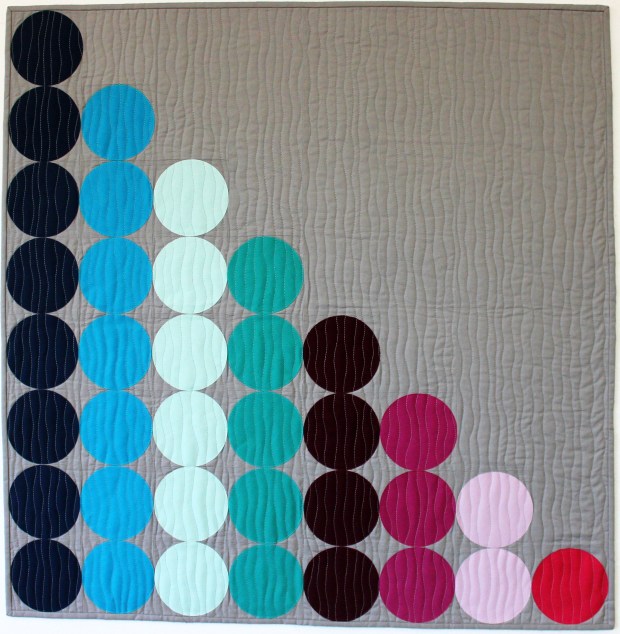
Here are four suggestions on how to quilt negative space:photo1 Photo 1 – Abacus Quilt by Christa Watson

(1) Quilt an allover linear design such as the continuous wavy lines in Abacus (see photo 1). This type of quilting works well regardless of block layout. It can help emphasize the textural quality of the quilt, rather than the absence of design. Continuous wavy lines can be quilted easily with a walking foot and a straight stitch by turning the quilt from side to side, or using a decorative machine stitch. Confident free-motion quilters can comfortably quilt continuous wavy lines back and forth across the entire surface of the quilt.

photo2
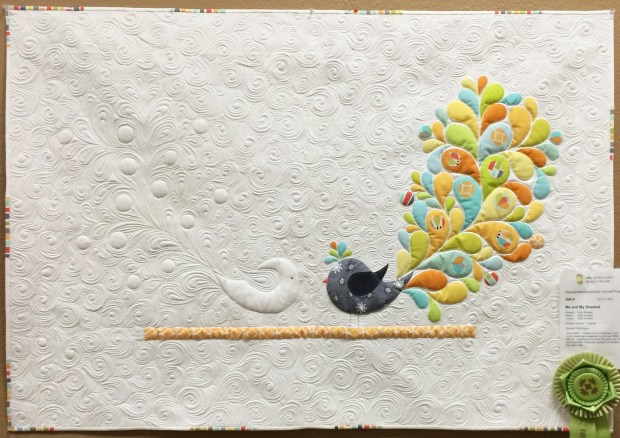
Photo 2 – Me and My Shadow by Vicki Ruebel of Orchid Owl Quilts

(2) Create a secondary composition in the negative space. Vicki Ruebel quilted a near-mirror image of her whimsical bird in her award winning quilt, Me and My Shadow (see photo 2). She sketched the outline of the bird and feathers, and used the same drawing to create both the quilted and appliqued birds. She used two layers of batting to create definition, filling in the areas around both birds with free-motion swirls on her long-arm machine.

photo3
Photo 3 – Wholecloth by Ida Ewing of Ida Rather Be Quilting

(3) Divide and conquer if the negative space is too much to tackle at once. Ida Ewing created her negative space design by marking an “E” and echoing around the letter. She then subdivided each section of the quilt and filled it in with a different free-motion motif (see photo 3). This filler technique looks stunning on any size quilt from a small wholecloth piece to a bed-size quilt with vast amounts of negative space.

photo4

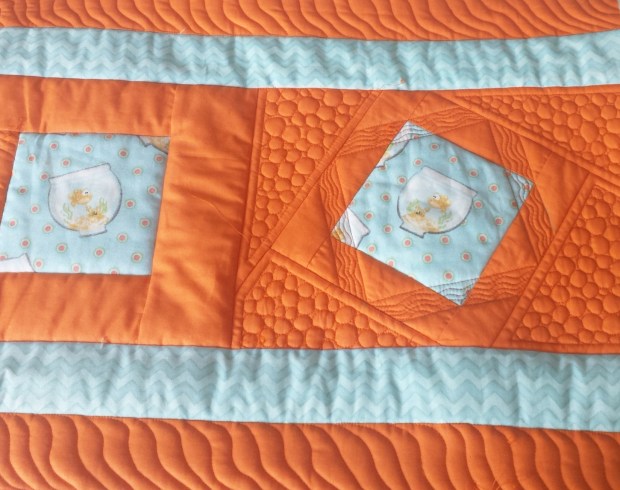
Photo 4 – Ida shows what a difference the quilting can make!

(4) Repeat elements from the block into the negative space. For Ida’s Little Guppy quilt (see photo 4), she created a diamond in a square motif with her quilting, emphasizing the square block design. The pebble quilting relates to the circles in the print, unifying the piece.
The next time you are stumped on how to quilt negative space, grab a piece of paper and a pen or pencil and just start doodling. You never know when inspiration will strike!

Further Reading

Click the links below to read all the articles I wrote for NQA:

QuiltCon 2015 (co-authored with Jacquie Gering)
Modern Machine Quilting
Embrace the Line
Filler Designs Add Texture
Handwork Makes a Comeback

Latest Finish – Nested Pinwheels Quilt and Podcast Interview

Earlier in the year, my friend Becky from Patchwork Posse invited me to design a small project exclusively for her subscription based online quilt group.

nested_pinhweels_finished_large

Nested Pinwheels 27″ x 27″ by Christa Watson

I came up with Nested Pinwheels, shown above. It’s a great design to practice one of my favorite walking foot quilting designs, the large continuous spiral. I teach how to do this design in both of my machine quilting books.

The trick is to mark the center spiral and then use your walking foot to quilt the entire thing – using the edge of the foot as your guide for consistent spacing.

photo-2

Your starting spiral doesn’t have to look perfect!

Along with this project, Becky interviewed me for about 20 minutes talking about my adventures in quilting. You all know that  machine quilting is my favorite part of making a quilt!

photo-3I use the integrated dual feed on my BERNINA – it does the same thing as a walking foot!

Click the link below to learn more about my Nested Pinwheel quilt, read my interview and to listen to the podcast. (You can listen to it directly from your computer, about halfway down the page.)

Click here to listen to the Patchwork Posse guest designer podcast.


Quilt As Desired Article 3: Filler Designs Add Texture

Today I’m continuing to share the series of machine quilting articles that I originally wrote for the National Quilting association as part of my Quilt as Desired column. This article first appeared in the Spring 2015 issue of the Quilting Quarterly.

Click here to read the other machine quilting articles I’ve written.

Happy reading!

qqspr15_p26

Spiral Flower Machine Quilting on Maggie’s First Dance BOM

My good friend Jacquelynne Steves has been hosting a gorgeous free Block of the Month program she started over the summer, and I finally have a free minute to tell you about it! It’s a 6-part series called Maggie’s First Dance featuring 5 adorable blocks plus border and finishing instructions.

Maggies First Dance

Click here to sign up and get all of the blocks that have been shared so far.

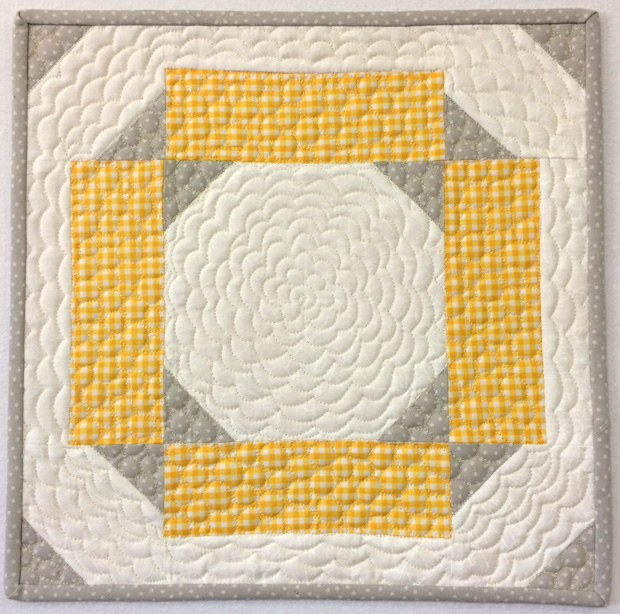
This month’s  design is the setting block, and I thought it would be perfect to showcase one of my favorite free-motion quilting designs: spiral flowers. So I decided to make a cute mini from one of the blocks and take pictures of my process so I can walk you through how I did it. This block uses my no-mark method for free-motion quilting that I teach in both of my machine quilting books.

Aurifil Thread

Step 1 – choose your thread

Look at your beautiful finished block and think about how you want to quilt it. I always like to audition several thread choices to see which one will look the best. In this case I chose to go with a light yellow, 50 weight cotton Aurifil. White or light gray would have looked nice, too. I’m going to quilt it with one color thread only so that I can custom quilt the entire block without starting and stopping.

Quilt Design Sketch

Step 2 – Sketch Your Design

Print out a color copy of your block on paper and sketch out some design ideas. This allows you to plan out how you will move around the block quickly and efficiently before you try it on the real thing. I chose  a large spiral flower in the center of the block surrounded by pebbles.  I’ll repeat the flower petal design in the white areas, and add some more pebbles in the corners. This will allow me to quilt the entire design in one pass, traveling (backtracking) in the seams if needed to quilt each section of the design.

I only sketched enough of the design to give me a general idea of what I was going to quilt. Of course, you can draw the design over the whole block if you prefer. Doesn’t it look like I drew right on the block? Don’t worry, it really is just a color printout of the block. 🙂

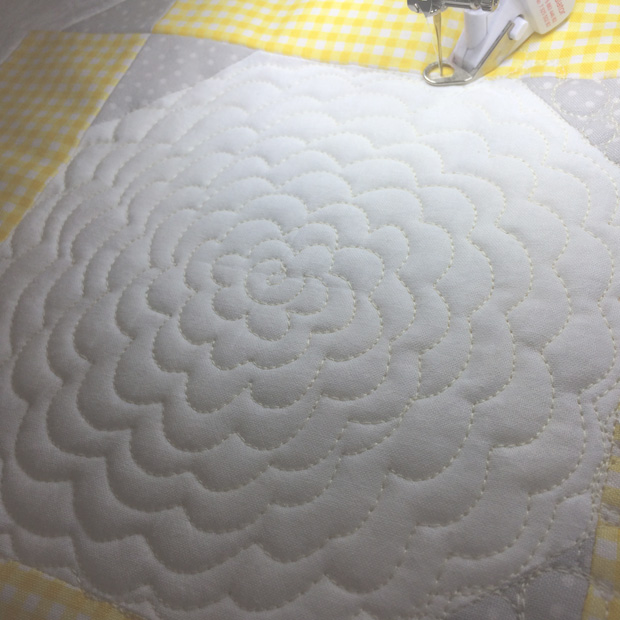
Free Motion Center Spiral

Step 3 – Start the Center Spiral

Starting in the middle of the block, pull up the bobbin thread to the top and move it out of the way for now. You can go back and tie off the knot later and bury the thread within the batting. Or just start with a series of teeny-tiny stitches to lock your beginning threads in place.

Quilt a small spiral to start and then immediately turn the spiral into a series of small, irregular flower petals. It doesn’t matter which direction to stitch in, or how many petals you quilt as you spiral around. Aim for nice, smooth stitches, but they don’t have to be perfectly uniform in length.

Spiral Flower Quilting

Step 4 -Complete the Center Block

As you echo back out around the center spiral, quilt a series of petals that don’t quite touch each other. Fill in all of the space, backtracking in the seam if needed to get to any areas you missed. Again, notice that each petal is not perfect or uniform. You are aiming for texture over perfection.

Pebble Quilting

Step 5 – Fill in the Rest of the Block

I quilted the area around the flower with pebbles, a dense texture that would allow the floral quilting to really pop. Because I used the same color thread, I was able to easily switch back and forth between quilting motifs as needed. To create interest in the block, I repeated the petal shapes in the outer portion of the block, with an extra pop of pebbles in the corners.

Although I’m only showing one block as an example, you can easily apply this design to all of the setting blocks. I like dense textural motifs that lend themselves well to any size block or quilt!

Ta-Da! Enjoy Your Finish

Machine Quilted Block

If you are new to machine quilting, I recommend making one or two practice blocks like I did to get the hang of it, or to try out different quilting ideas. You can always refer to your practice blocks as a stitch journal of your progress. I turn mine into class samples, so I don’t have to pack up a suitcase full of quilts when I teach. 🙂

Let’s Have a Giveaway!

To celebrate the release of Jacquelynne’s latest BOM installment, 7 other bloggers and I have teamed up to give away a fun prize pack of my PDF patterns, perfect for practicing your machine quilting skills! So that means that 8 people will win, one for each stop on the blog hop below.

Pattern Giveaway

Visit each of these blogs to increase your chances of winning. Leave a comment at each for your chance to win! The giveaway is open to everyone and runs through October 10th.

Farmhouse Quilts

My Go-Go Life

The Crafty Quilter

LilyPad Quilting

Grey Dogwood Studio

The Quilting Nook

EvaPaige Quilt Designs

Christa Quilts – You Are Here!

New Around Here? Everyone’s a Winner!

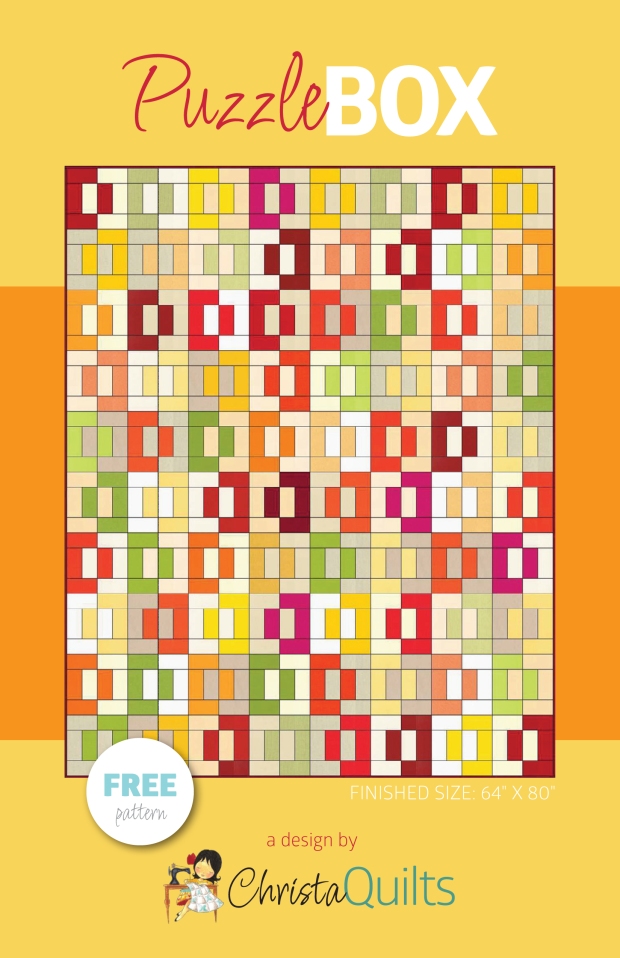
Puzzle Box Pattern

Click here to get my free Puzzle Box quilt pattern.

As an extra bonus for anyone new to my blog, be sure to check out Friendly Threads, my weekly email and get this free PDF pattern instantly. My Puzzle Box pattern uses two Jelly Rolls and goes together super quick!

Quilt As Desired Article 1: Modern Machine Quilting

Last week I shared an article that Jacquie Gering and I had written for the National Quilting Association which dissolved last year after 46 years as an organization. Now that a period of time has passed and the rights have reverted back to me, I thought it would be an appropriate time to share with you the series of articles I wrote for them about Machine Quilting. There’s a total of 5 articles (2 of which were never published) and I plan to share them with you approximately once a week. Hopefully you’ll pick up a tip or two. Happy reading friends!

Note: The following article was written as a sample of my writing style and helped me land the free-lance writing gig. NQA asked if I wanted to go ahead and use it for my first column, but I chose to write on a different topic which I’ll share next time. So this is the first time this article is being shared in public.


Modern Machine Quilting

 Whether you prefer to quilt by hand or machine, or send your quilts off to a professional for finishing, I’m here to share my expertise and offer advice on how to enhance your quilt’s overall appearance with appropriate quilting choices. This will be a regular feature in each issue of the Quilting Quarterly. We hope you enjoy it!

I love to make modern quilts and explore how to quilt them. Functional modern quilts are meant to be used and washed and they often include vast expanses of negative space. For bed quilts, the quilting should provide enough texture and interest to fit into a modern décor, without being so excessive that the quilt becomes scratchy, stiff and unusable.

I will illustrate an example of functional, modern machine quilting on a quilt I designed named Abacus. It’s made from circular blocks that are machine appliqued. It is sewn together in rows with increasing lengths of grey strips forming the background.

illustration_1_abacus_design

The first thing I do when considering how to quilt a quilt is take a picture of the actual quilt top or the quilt pattern, and print it off in color on a piece of 8 ½” x 11” paper. I will then sketch different quilting ideas until I come up with something I like.

The pen marks indicate the quilting lines, but not necessarily the color of the thread. I will quilt Abacus with a series of gently waving lines, using my walking foot on my home machine and slightly turning the quilt to form the waves as I stitch. This can also be accomplished by using a decorative stitch and maxing out the length and width. (Be sure try out different stitches to find one you like!)

illustration_2_abacus_sketch

Next, I will practice on a smaller sample piece with the same fabrics, thread, and batting I plan to use for the quilt. I think grey is a nice neutral thread choice, and I will use the seam lines between the rows to give me a relatively straight guideline to follow. Spending time on these steps now helps prevents disappointment down the road when a quilt doesn’t turn out like I envision it in my head.

illustration_3_abacus_quilting

Finally, I will quilt the real quilt, starting in the middle of the quilt and quilting the wavy lines from top to bottom, moving halfway across the quilt. When I get to the edge, I will turn the quilt around and quilt the other half.

machine_quilting_abacus

If you are using a long-arm machine to quilt this quilt, just load it from the side and quilt the wavy lines back and forth horizontally across the quilt, advancing the quilt as you go.

abacus_detail_sm


Click here to purchase a PDF version of my Abacus quilt pattern.

cwatson_abacus_full

Abacus 32″ x 32″, designed pieced and quilted by Christa Watson

My Local Teaching Schedule, Fall 2016

I enjoy traveling around the country at various quilt shows, guilds and events to teach. But I can’t neglect my local friends and fans, so I’ve made sure to schedule a few classes around here, too. If you live nearby, or plan to drop by for a fun Vegas weekend, be sure to sign up for my machine quilting classes this fall, taught at three fabulous quilt shops in town:

Upcoming Machine Quilting Classes in Las Vegas:

Quatrefoil-Applique_Christa_detail

Sept 8, 5:30-8:30 PM at The Christmas Goose
Ultimate Free-Motion Fillers

Learn 12 fun fillers in just 3 hours! This class will walk you through a dozen of the free-motion motifs from The Ultimate Guide to Machine Quilting. This will be a fast paced class, so students should be comfortable working with their machines and have a little bit of experience with machine quilting. Class size is limited to 10 students. Call the shop at 702-877-1158 to register, or stop by the shop at 2988 South Durango #109.

improv_machine_quilting_image

October 14, 2:30-5:30 PM at Quiltique
Improv Machine Qujilting

Liberate yourself from traditional quilting symmetry by combining your favorite machine quilting motifs in a seemingly random way. Add amazing texture to the negative spaces in your quilts and create your own unique combinations.

The class will cover basic free-motion filler designs such as pebbles, swirls, leaves, paisleys, triangles, and more. Learn how to improvisationally combine them for stunning results. Students should be comfortable with basic machine quilting techniques.

Stop by Quiltique’s class sign up day event in August to register, located at 213 N. Stephanie Street, Suite E, Henderson, NV 89074. Or call the shop after Sept. 1 at 702-563-8600.

spirals_swirls_classimage

October 15, 1-4 PM at Sew Yeah Quilting
Machine Quilting spirals and swirls

Learn how to quilt modern, geometric spirals and swirls using both walking foot and free-motion motifs. Students will learn how to quilt stunning designs from Machine Quilting with Style, such as large continuous spirals, geometric spirals, and several swirl variations. Spirals can be quilted in different areas of your quilts, or used as an allover design. Combine motifs for even more possibilities! Students should be comfortable with basic machine quilting techniques.

Click here to register online. You can also register in person at the shop, located at 3690 N Rancho Dr, Las Vegas, NV 89130, or call the shop at (702) 586 – 8687.

fmq_straight_line_alternatives

November 16, 6-9 PM at THE CHRISTMAS GOOSE
Free-Motion Alternatives to Straight Line Quilting

Go beyond the straight line and use your free-motion quilting skills to their fullest. In this workshop, students will learn how to turn basic shapes into linear free-motion quilting designs. Quilt them as allover designs across the surface of your quilt, or use them sporadically to create custom quilting motifs. Students should be comfortable with basic machine quilting techniques.

Class size is limited to 10 students. Call the shop at 702-877-1158 to register, or stop by the shop at 2988 South Durango #109.

My Traveling Schedule

If you live outside of the Las Vegas area, be sure to check out my traveling and teaching schedule here. My schedule is currently booked through the end of 2017 but I’m now accepting offers for 2018, so I may be visiting a place near you!

My Week at John C Campbell Folkschool 2016

I had the most fabulous time teaching a group of students how to make a modern quilt at the John C. Campbell Folkschool last week. We used my Charming Chevrons pattern and it was so fun to see all of the variations!

charming_chevrons_class

I had a wonderful group of 8 students who made 9 quilts in 5 days!!

The Folkschool has been around since 1925, offering classes on dozens of different arts and crafts disciplines. For a week long class, students arrive on Sunday and get settled in, then work for 5 days straight in 6 hours of classes per day, with breaks for yummy meals 3 times a day!

My students started cutting and sewing on Monday, and by the time of the student presentation on Friday afternoon, every single one of them had a finished quilt top, two had completely finished quilts, and most of the rest of them had their quilts basted and ready to finish at home.

Gerry_Basting

Gerry smooths out her quilt after it has been spray basted, while Fran is ironing one of two charity quilts she was able to complete during class. Check out those mountain views!!

I taught a similar class last year, using my Modern Logs pattern. This year I encouraged the students to work at their own pace, and several of them took advantage of open sewing time in the evening to get a little more done. We covered all aspects of making a quilt: cutting, piecing, basting, machine quilting and binding.

Pam_Modern_logs

Pam Howard is the resident Weaver at the Folkschool. She took my modern logs class last year and brought back her completed quilt! Her Charming Chevrons blocks are on the wall behind her.

It was so fun to see the students’ faces light up when they realized that yes, they can make an entire quilt on their home sewing machines!!

Susan_quilting

Susan was so excited to quilt her chevron quilt in class! Each student had their own table and design wall – plenty of space in which to work! That’s Barb’s top hanging on the wall.

Each students’ quilts were so unique. Whether it was their first quilt, or they had been quilting for decades, all had fun and created a beautiful work of art!

Lucy_quilting

First-time-quilter Lucy quilted an easy wavy plaid design with her walking foot. I brought along copies of my machine quilting books so students hand plenty of designs from which to choose!

While I was teaching quilting, my husband Jason took a photography class. In fact, he told me he hopes I teach there on a regular basis, so he can take a class each time I teach.

jason_folkschool

Jason poses beside the welcome sign on the first day of class.

The good news is, I’ll be back again in the summer of 2018. (My 2017 teaching calendar was already full.) We haven’t set an exact date yet, but I’m thinking sometime in June would be great.

jason_photography

One of the landscape pictures Jason took during his photography class. The folkschool is nestled in the mountains and the views are just spectacular!

Each Folkschool instructor has their own specialty, and I love that mine is teaching how to make a complete quilt from start to finish, while emphasizing the modern aesthetic.  I’ll repeat this format in 2018, albeit with a different pattern. Several of the students have already said they plan to come again, so it will be a fun reunion!!

Machine Quilting Tips in Modern Patchwork Magazine

I love that more and more people are jumping on the modern quilting bandwagon! I’m a huge fan of quilting magazines and I love that more and more of them are devoted to the modern aesthetic. I’ve been pleased to work with several of them (in between other sewing deadlines) so I’ll be sure and share updates with you whenever I’ve published something new.

cover

My quilting tips are found on page 38 in this issue of Modern Patchwork!

I was recently able to share some of my favorite domestic machine quilting tips in the summer issue of Modern Patchwork Magazine. I’ll share a little bit about how this came about, for those of you who are interested in what goes on “behind the scenes.”

The Modern Quilt Guild put out a call for submissions for QuiltCon magazine last year (for this year’s 2016 issue), so I submitted the idea originally for that magazine. When I heard back, they said they had already selected content for QuiltCon magazine, but would I be willing to write it up for Modern Patchwork, since they are owned by the same company? That was a quick and easy yes.

Then, quite by chance, the editor happened to be in one of my QuiltCon classes earlier this year. I love when stuff like this happens. It makes me feel like we are all friends and associates in this industry, connecting us together in more ways than one.

Christa Watson Books

My books – all about quilting on a domestic machine!!

I wrote up my top 10 tips for domestic machine quilting, then got permission from my publisher to share a few images from my books to go along with the article. That way, the photography would be of the highest quality, and help cross promote the books. Because I’m the type of person who likes to make sure I dot my i’s and cross my t’s (and because I want to make sure I never step on any toes) I always try to keep everyone in the loop of what I’m doing and make sure I never share the same the exact same content word for word.

tentips_image

Credit goes to Angela Walters, my co-author of The Ultimate Guide to Machine Quilting for her version of Swirling Butterflies, the white quilt shown in the title of the article.

Although I write and teach about the art of machine quilting on a regular basis, I always try to present my material in a somewhat different way between books, patterns, and workshops. Besides, it really helps to hear/read the same information in different ways to really let it sink in.

In addition to my article, the current issue of Modern Patchwork has loads of other interesting articles to read as well as a plethora of fabulous machine quilting designs. It’s a little on the pricey side for one issue, but it’s worth it because it has as much content as a book!

Click here to get your hands on a copy of Modern Patchwork, and be sure to let me know what other quilting magazines you enjoy, modern or not!

Check out 180 Doodle Quilting Designs – Free Motion Ideas for Blocks, Borders, and Beyond

I’m so excited to tell you about a brand new machine quilting book that I am privileged to be a part of. It’s called 180 Doodle Quilting Designs and it features a plethora of free motion quilting ideas for blocks, setting triangles, and borders. The book has been published by my friends at Martingale/That Patchwork Place (who published both of my machine quilting books.)

b1381_cover

This book is different from most machine quilting books out there, in that it is more of a reference book rather than a how-to book with patterns. This clever idea was the brainchild of acquisitions editor Karen Burns, and it features 60 different motifs from 9 talented designers. Each motif is shown how it would work 3 different ways, for a total of 180 possible designs. Check out fun free-motion quilting ideas from:

  • Yours truly – I’m so inspired by seeing my fellow contributors’ designs!
  • Vicki Ruebel – One of my super talented BQF’s (best quilting friends).
  • Karen Burns – Be on the lookout for more collaborations you are sure to love!
  • Melissa Corry – This girl can finish more quilts in a week than most can do in a month!
  • Lori Kennedy – Shh, don’t tell – I have a quilter’s crush on her!!
  • Maddie Kertay – Irreverent and awesome founder of the BAQS (you’ll need to google it… :-))
  • April Rosenthal – I want to be her when I grow up.
  • Sheila Sinclair Snyder – Amazing award winning quilter.
  • Angela Walters – Need I say anything more??

Here’s an example of how the information is laid out for each design:

2page_spread

Plus there’s some handy-dandy info at the front of the book with tips on how to use it, such as tracing over the motifs to get a feel for how each design will flow. I love adding books like this to my reference library. They are great to look through whenever I’m stumped for a machine quilting idea!

As of this writing, 180 Doodle Quilting Designs was ranked #1 new release on Amazon in quilting. To help it stay there, click here to purchase your copy and then be sure to leave an Amazon review. You’ll be glad you did. 🙂 Now I’m off to a do a little more doodle quilting of my own…..

Update – Video Tutorial

Check out this clever video that my friends at Martingale made, showing how to use the book. Simply trace, doodle and quilt! You’ll gain confidence in no time! (Press the play icon to view. )