Christa’s Soapbox – Why I Teach Quilting

Teaching quilting is in my blood. I love it, I need it – I can’t live without it! I began teaching quilting classes nearly 16 years ago when my oldest son was just a baby. It kind of happened by accident when a local quilt shop (who’s no longer in business) needed a shop teacher and I was in the right place at the right time.

Hugs 'n Kisses Quilt Along

Hugs ‘n Kisses Quilt Along

Fast forward 16 years, 3 kids and a business later, and I am finally returning to what I love.

I’ve been doing my quilt alongs for a few months now and it gives me such joy and satisfaction to see my students create a beautiful work of art from just a few bits of cloth.

I love the entire process – designing an original quilt, putting together photos and instructions, making the quilt, and editing and rewriting until everything is clear.

After attending QuiltCon and meeting up with editors and publishers last month, I’ve decided I want to take things to the next level.

One of my strongest desires is to start publishing my work in magazines and books.

I feel like I have so many ideas it’s hard to pinpoint where to begin. The biggest eye opener for me after speaking to a few editors was learning that things I want to publish in print cannot be published on my blog first. That’s okay because I have so many ideas that I can’t possibly blog about them all in the first place.

My plan is to continue developing my quilting techniques with free patterns here on the blog. Then I will take what I’ve learned to create original patterns for publication. I will also learn to practice patience.

From talking to friends of mine who’ve written books and magazine articles, I’ve learned it takes anywhere from 18 months to 3 years to get a book written and on the shelves. That means if I start today – you won’t see anything from me in print until at least 2 years down the road! But that’s ok, too.

In the coming weeks and months you can be my cheerleader by continuing to follow my blog, joining my quilt alongs and giving me your honest opinions about how you like the techniques I’m teaching. And maybe someday soon (or not so soon) you’ll get to see me in print!

Original Hugs and Kisses

Original X and O Quilt, 1st Place Pieced, DQN Show 2002

Christa’s Quilt Along 5.1 – Hugs ‘n Kisses Supply List

Free Quilt Pattern

New to my blog? Be sure to sign up for my email newsletter to get a free pattern!

Time for another fun quilt-along! My Hugs ‘n Kisses design is based on a quilt I made several years ago. If you look closely, it’s similar to the quilt shown on my blog’s header. Over the years I’ve had several requests for this quilt pattern, so I finally decided to make one!

Hugs 'n Kisses

Hugs ‘n Kisses

About This Quilt – Finished Size 48″ x 64″

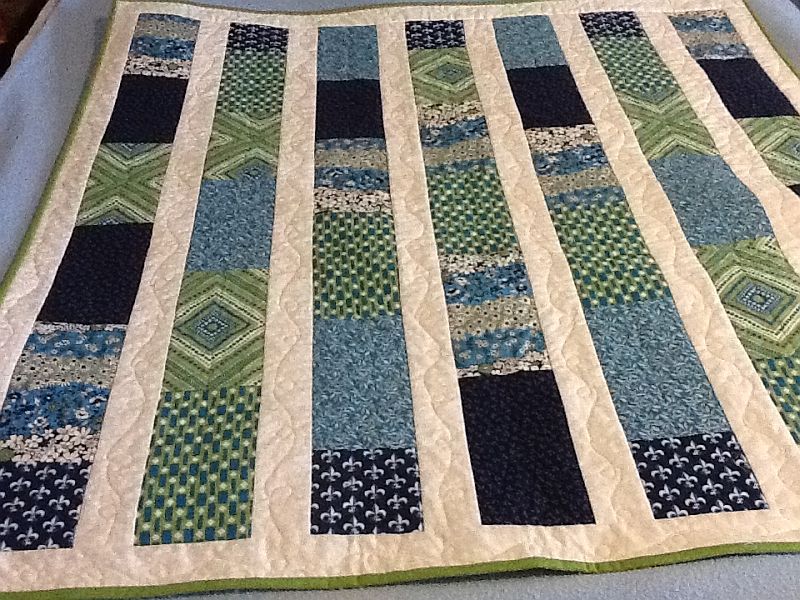
I designed this quilt using EQ7  so that it will work with Jelly Rolls or precut strips.  Although I am making this quilt in the size stated above, you can easily double the yardage requirements, purchase additional kits, or add borders to make it bigger.

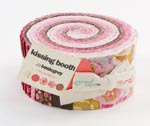
Kissing Booth Jelly Roll

Kissing Booth Jelly Roll

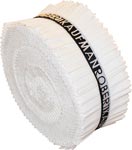
Kona Snow Roll Up Strips

Kona Snow Roll Up

Kona Solids Brick

Kona Solids Brick


Fabric Requirements (Hugs and Kisses Quilt Kits are available for a limited time.)

  • 1 Jelly Roll of print fabric. You may use any jelly roll or set of precut strips you like as long as you have at least 38 – 2.5″ strips.
  • 2/3 Jelly Roll of solid or background fabric,  or 24 – 2.5″ strips.  If you prefer to purchase yardage and cut the strips yourself, you will need 1.75 yards.
  • 1/2 yard fabric for the binding in a coordinating color – I prefer to use solid 2.25″ strips. Purchase a little more if you like wider strips.
  • At least 52″ x 68″ piece of batting; my favorites are high quality cotton or wool.
  • 3 yards of non-directional fabric the backing, or scraps and fat quarters to total about 3.5 yards if you prefer to make it scrappy like I do.
Machingers Gloves

Machingers Gloves

Supreme Slider

Supreme Slider

Superior Needles

Superior Needles


Supplies Needed


If you have any questions please be sure to join my flickr discussion or email me directly at christa@christaquilts.com.

Quilt Along Schedule – Links will go to each active post when published.

Sharing is Caring

Please share your work in progress in my facebook group: Quilt With Christa . 🙂

Christa’s Quilt Along 4.9 – Sea of Squares Binding by Machine

Machine Binding

Today I am going to show you a quicker way to bind your quilt – by machine. Sometimes when I am in a hurry (like this week trying to finish all my quilting tasks before heading off to QuiltCon), a machine binding is just what I need!

It took me a total of 2 hours to bind this quilt using my home sewing machine. I love how it looked outside today with the quilt against the cloudy sky. A cool juxtaposition…

Sea of Squares Finished

Step 1 – Trim Your Quilt (10 Minutes)

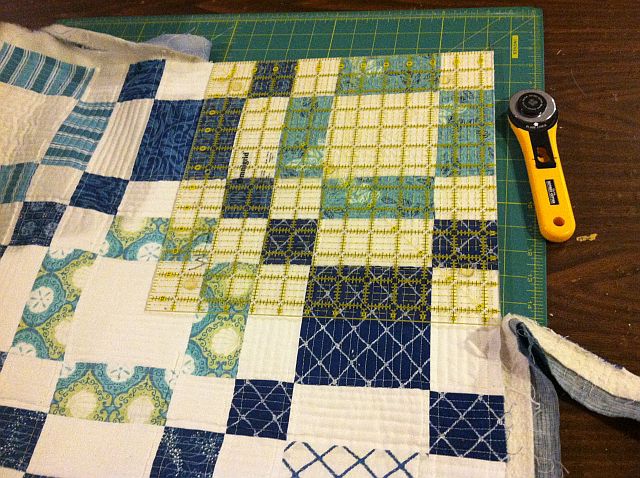
Before binding, you want to start with a nicely trimmed edge, flush with your quilt. I don’t leave any batting peaking out. My method ends up with a fully stuffed, flat binding.

Using a large square ruler, I trim up all 4 corners first. If anything is out of alignment, I gently tug it back into place. Then I trim up all the sides with a long ruler.

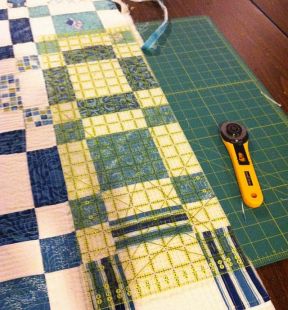
Trim Corners FirstTrim the Sides


By starting with trimmed corners, I can match up the cutting lines so that things stay straight (as possible). You can throw your trimmings away or recycle them as pillow stuffing. 🙂

Step 2 – Calculate the Length of Binding Needed & Cut Strips (10 Minutes)

My favorite binding is called double fold straight grain binding, and it is super easy to make. You start off with strips of fabric, cut them on the straight of grain, then fold them in half twice to get the double fold. It holds up well especially on quilts that get a lot of use.
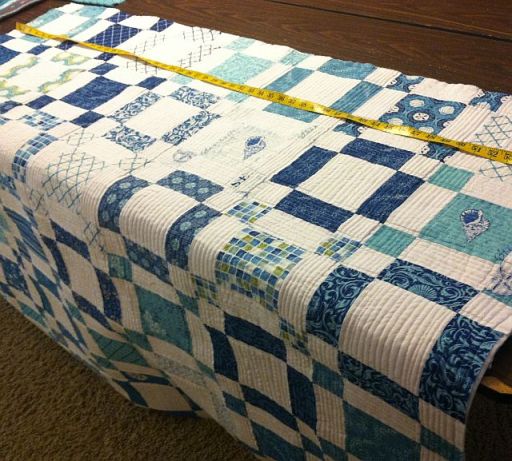
Measure the Perimeter

First, measure the perimeter of your quilt and add on 10 inches for corner folding, seams and “insurance.” In this case, my Sea of Squares quilt measures 50″ x 58″. It shrunk about 2 inches due to the intensity of the quilting on it.

I need a total length of 226 inches (50+50+58+58+10). If I divide this by 40 inches (the length of a fabric strip), I end up with 5.65 strips which I round up to 6 binding strips needed for this quilt. I cut all my strips 2.25 inches wide.
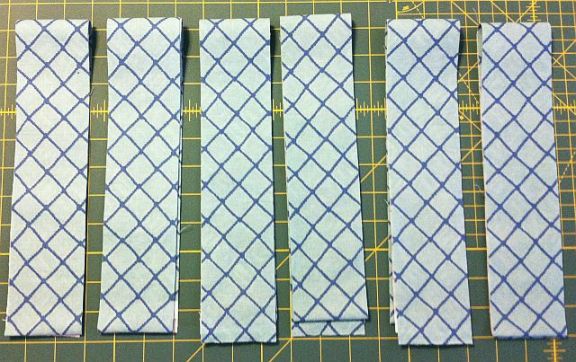
Binding Strips

Cut Six 2.25″ Wide Strips

For those of you sewing along using one of my Sea of Squares kits, binding fabric is included.

Step 3 – Sewing the Binding Strips Together (5 Minutes)

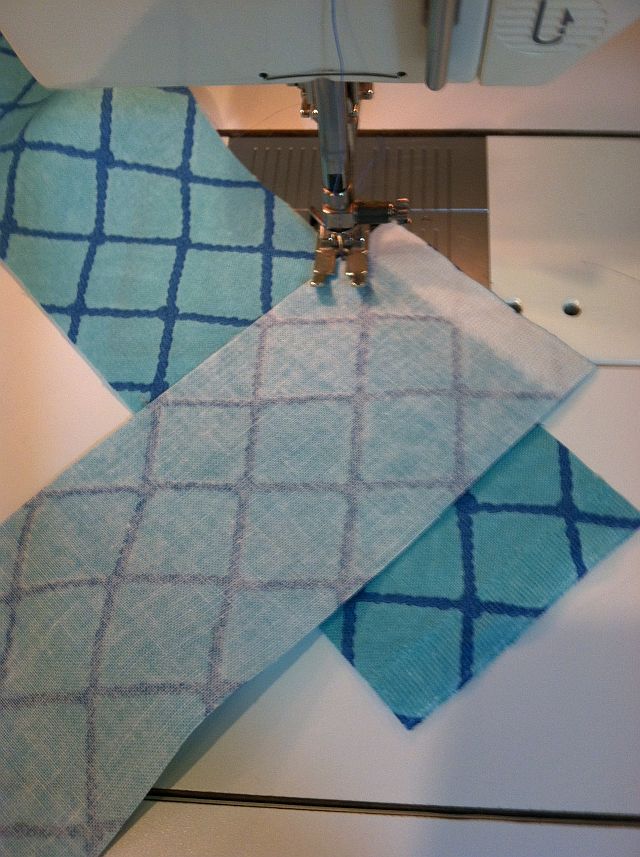
Join all of your binding strips into one long piece. Sew the ends on a mitered angle so that the bulk of the seam will be distributed more evenly. Be sure to cut one end of the binding on the same 45 degree angle. Fold the strips wrong sides together and press along the length with a dry iron.

Sew Continuous StripsFirst Fold

Before attaching to the quilt, I will pin part of the binding to one side, starting somewhere in the middle. Loosely walk the binding all the way around the quilt to ensure there will not be any mitered seams falling on the corners of your quilt.

Step 4 – Attaching the Binding to the Quilt (30 Minutes)
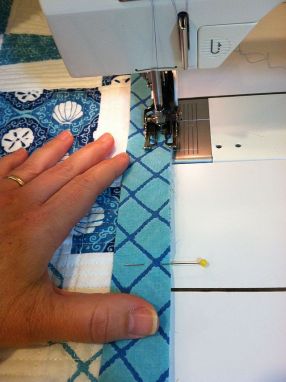
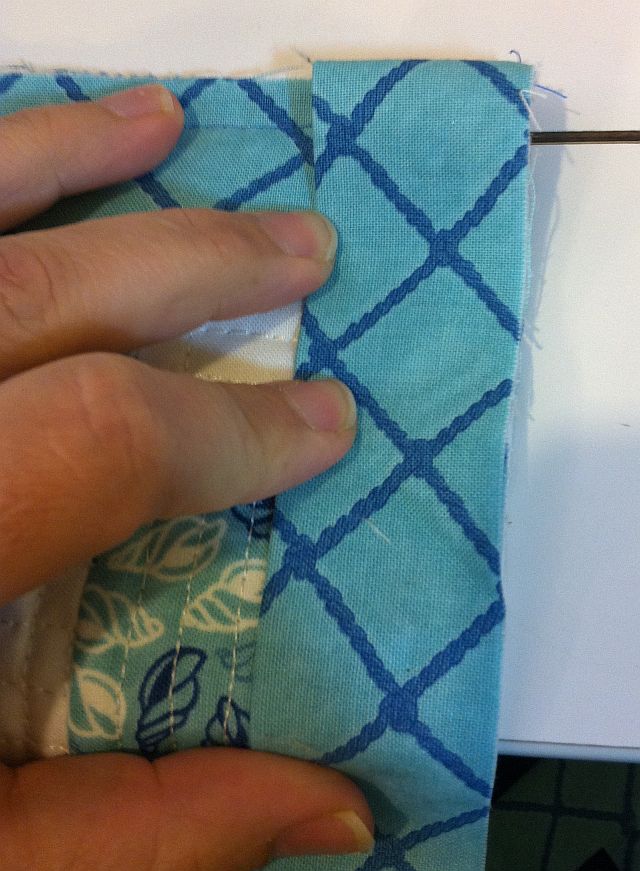
Sew from the front.Whether finishing the binding by hand or machine, this part is the same. Using coordinating or matching thread in top and bobbin, sew the binding to the front side of the quilt.

Starting with the binding on the angled end, leave a few inches of unsewn “tail” and use quarter-inch seams.

Be sure that you are sewing with the raw edges of the binding and the raw edges of the quilt in the seam. These will be covered with you flip your binding to the back.

You may wish to add a few pins to secure.

When you near a corner, be sure to mark a line 1/4″ away from the corner. Stop sewing at this line, then turn your quilt 90 degrees and sew off the edge.
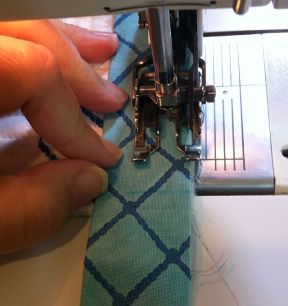
Stop 1/4 inch from end.

Sew perpendicular to edge.


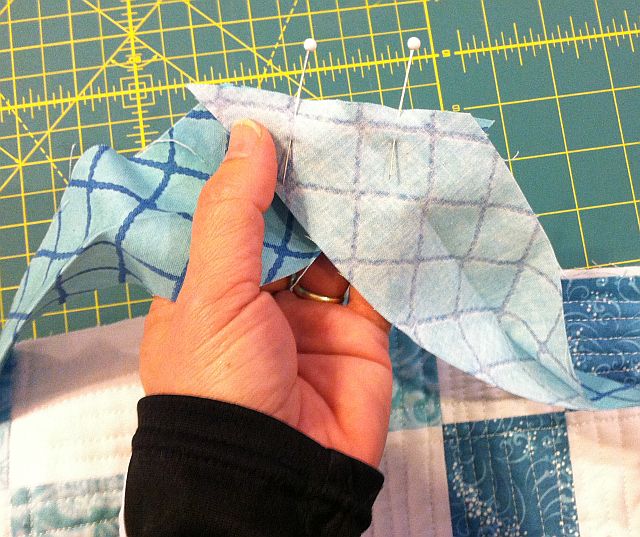
Flip the binding strip to create a 45 degree angle, pinch the excess, and then fold it back down. This creates the excess fabric allowing for a nice miter on both front and back of the quilt. Begin sewing the next side starting at the corner of your quilt. Repeat for all 4 corners.
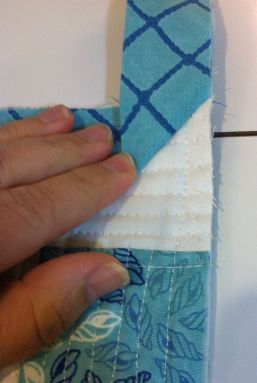
Flip binding up.Flip binding down.


Leave about 6 inches of tail when you finish sewing. This will be joined next to create a continuous binding.

Step 6 – Joining the Ends Together (5 Minutes)

This is probably the trickiest part of the whole binding process. You want the ends to be joined with a nice miter seam that does not give any extra slack.

Leave a Tail

Open the Blunt End


Open both tail ends. Place the angled tail on top of the blunt tail and draw an erasable line along the edge of the angled tail where it meets the blunt end. You will need to account for both seam allowances, so cut 1/2 inch away from this line, keeping the 45 degree angle.

Trace the Angle

Now join the two ends together with 1/4″ seam. Use pins if needed and offset each of the triangle tips by about 1/4″. Finish attaching the binding to the front of the quilt.
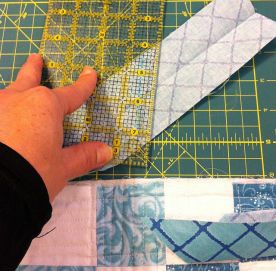
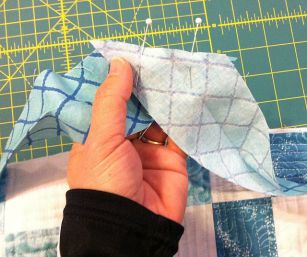
Cut 1/2 inch wider.Pin ends and sew.


Step 7 – Binding by Machine (1 Hour)

I have a tendency to pull on my binding as I’m sewing, stretching  it and creating a wavy edge that needs to be blocked. By pinning first, this can eliminate most of the stretching.

Pin Binding

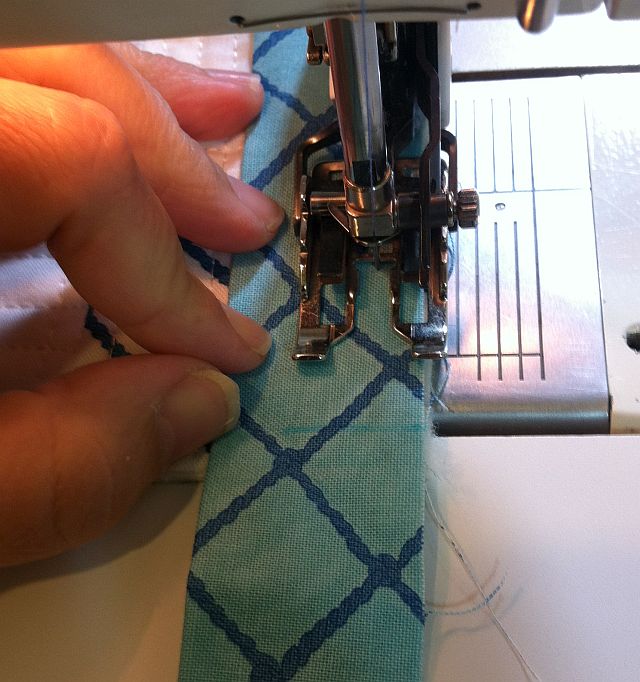
There are several different ways you can finish stitching the binding on by machine. For example, you can stitch in the ditch from the front side but only if you are absolutely sure you are catching the binding on the backside, too. You can stitch using straight lines or decorative stitches. Just sew slowly and be sure to catch the corners as you go around the quilt. A decorative stitch can hide a lot of mistakes!

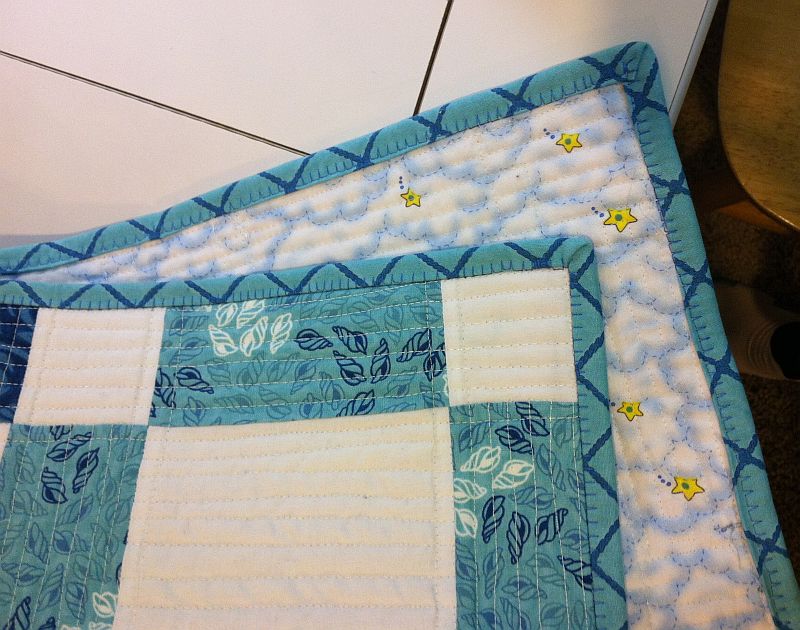
For Sea of Squares I chose to use a reverse blanket stitch (similar to the regular blanket stitch I used for my machine applique table runner). The stitching won’t line up perfectly on the back but if you use a blending thread it won’t matter too much.

Sea of Squares Binding

Often times I have finished by quilting a decorative stitch from the backside, too.The picture below shows the binding I did on my first quilt-along, the Jolly Jelly Roll Quilt. I used one of my favorite stitches on my machine, a wavy serpentine stitch.

Jolly Jelly Roll QuiltI hope you have enjoyed following along as I made my Sea of Squares Quilt. I learned a lot from it and I encourage you to give this quilt a try. If you are currently working your way through your own version of Sea of Squares, I’d love to see it! You can share photos of your work in progress on my flickr group: Christa’s Quilt Along.

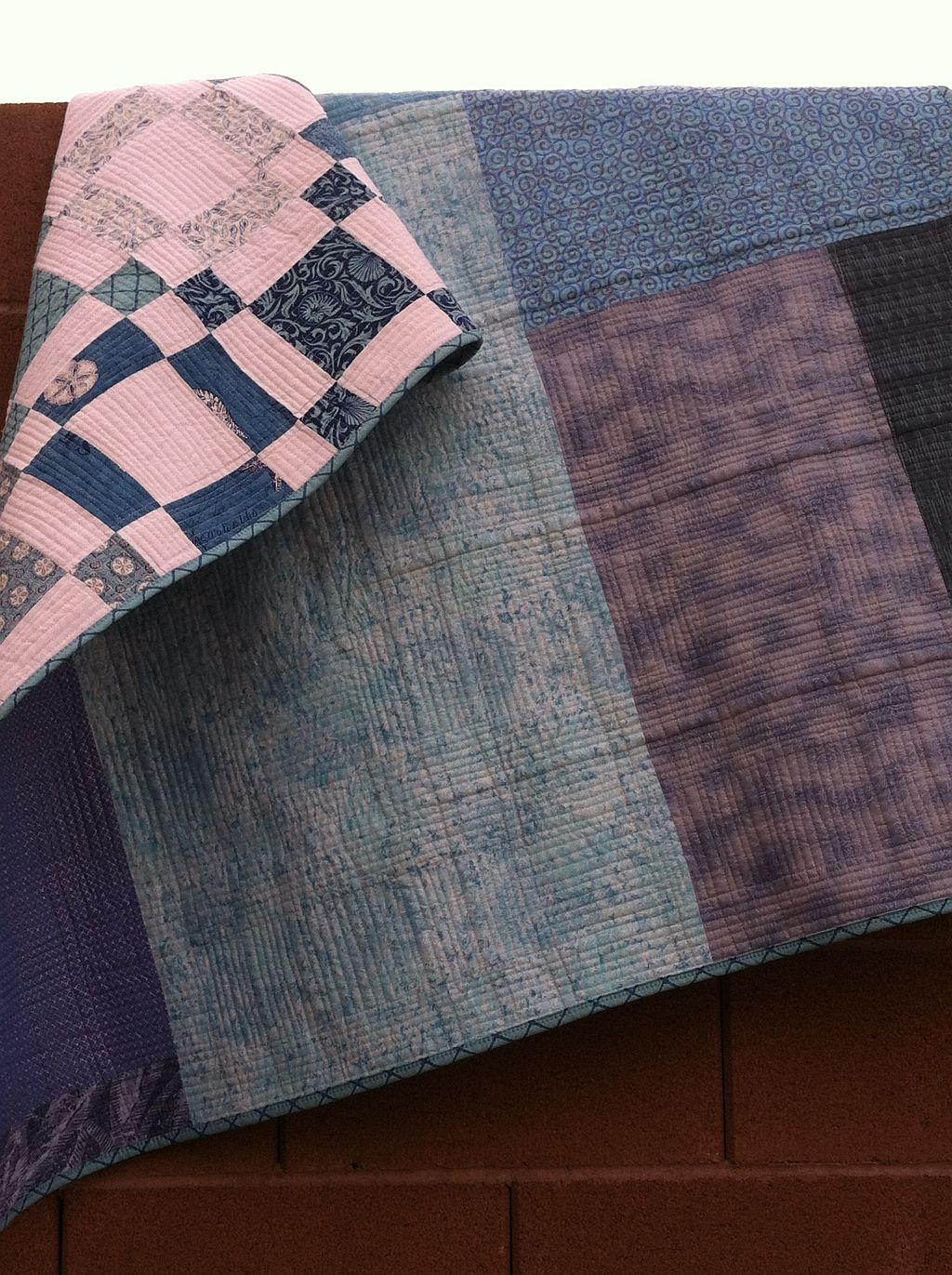
Here is a picture of the back of Sea of Squares, showing all that machine quilted texture.
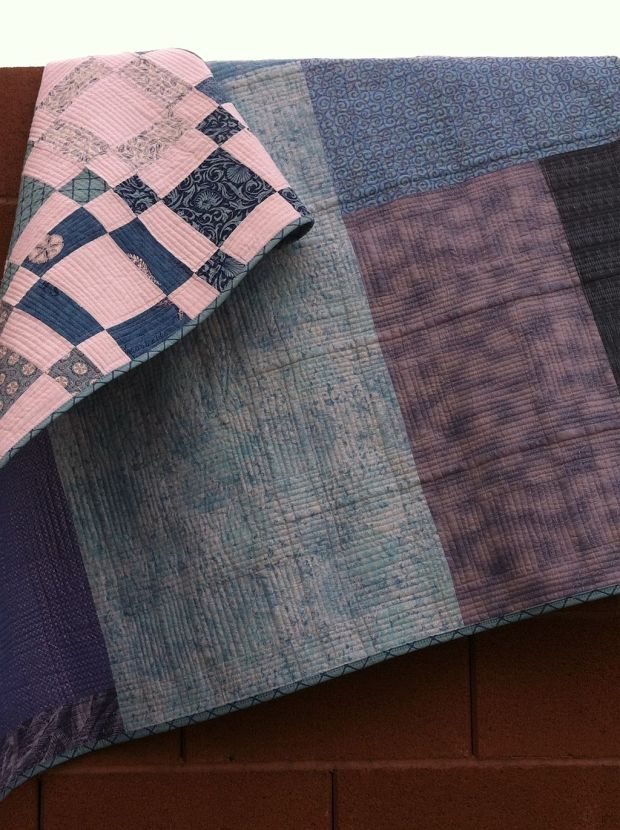
Backside of Quilt


Complete Quilt-Along Schedule for Sea of Squares
Click any of the links below and follow along at your own pace.

Sharing is Caring

Please share your work in progress in my facebook group: Quilt With Christa . 🙂

Christa’s Quilt Along 4.8 – Sea of Squares Extra Quilting

Can you believe this quilt is almost done? Next week I will show you how to bind it by machine. The following week I will start all over with another brand new quilt-along. Here’s a hint for my next quilt: it requires 1 Jelly Roll and a 1 1/2 yards of background.

Extra Quilting

This week I added tons more quilting to my Sea of Squares quilt. I spent an extra 7 hours gleefully quilting along, adding loads of texture with straight slightly wonky lines using my walking foot. If I had planned ahead I would have quilted about an hour a day for 7 days. Instead, being the procrastinator I am, I did it all in one day, but it was still fun!

Step 1 – Quilting the Sash Rows (1 Hour 45 Minutes)

First I started with what was easy. I quilted parallel lines all going the same direction through all of the skinner sash rows. I worked my way across the quilt, one row at a time, flipping the quilt when there was too much bulk under the machine.

Quilt Parallel Lines

Step 2 – Quilting the Rest of the Rows (5 Hours, 15 Minutes)

Now it’s time to fill in the rest of the space. I quilted the rectangles with lines running perpendicular to the previous quilting lines. For the big squares I alternated directions. I quilted the print squares all one direction, and the solid squares the other way.

Quilt Perpendicular Lines

It was cold that day so I bundled up while quilting!

I wanted to try out the continuous reverse feature on my machine. I can push a button once and it will sew backwards until I push it again to stop (and I don’t have to keep my finger on the button). So I would quilt one line of quilting, then push the reverse button and quilt a line backwards without having to turn the quilt all the way around. It was great!

Reverse Quilting

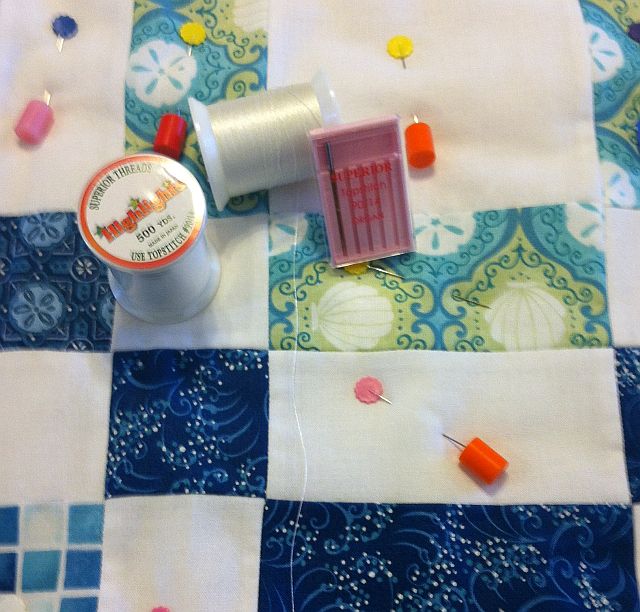
It took about 1000 yards (2 spools) of thread just for the top. I used the same color in a thinner weight for the bottom so I wouldn’t run out of thread.

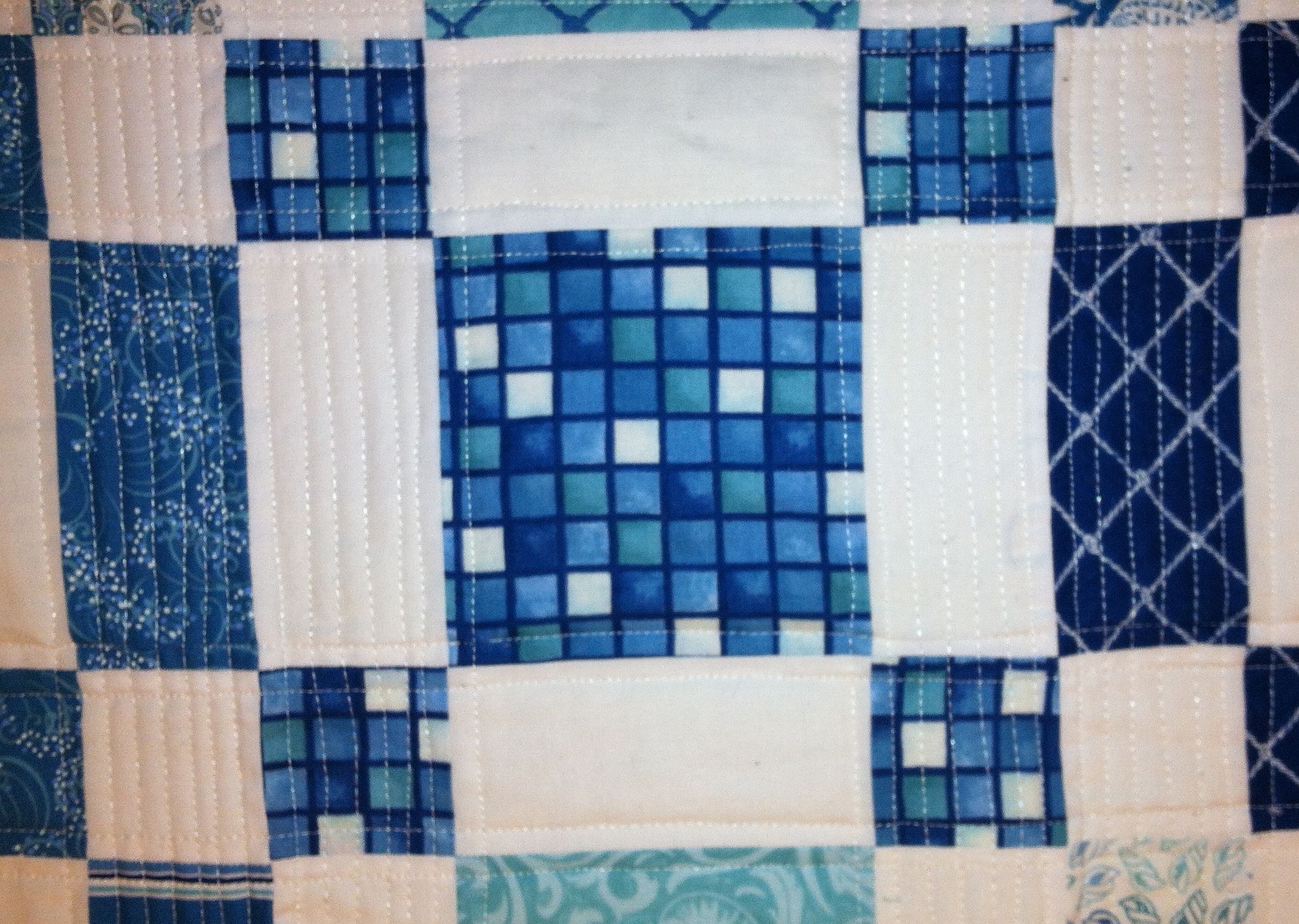
Quilting this quilt was very liberating for me. I did not mark the quilting lines because I wanted to add a touch of modernity to the quilt with more organic-looking texture. Once I let go of my perfectionist tendencies and got into the “waviness” of the lines, it set me free to enjoy the process. Jason is always telling me to go bold and let out my inner artist. So now I’m giving you the same permission!

Quitling Makes the Quilt

Be sure to take a look at my flickr group so that you can see the wonderful quilts being made by everyone else. And if you are working through any of my quilt-alongs, I’d love to see your progress!

In fact, Judith shared her version of Sea of Squares in beautiful brown and cream. Notice the wonderful quilting she did with wiggly lines across the surface and quilting motifs in the blocks. I love it when you can really make your quilt your own. Nice job, Judith!

Judith's Sea of Squares

Please share your pictures here:

http://www.flickr.com/groups/christasquiltalong/


Quilt-Along ScheduleLinks are Active at the Completion of Each Step:

Sharing is Caring

Please share your work in progress in my facebook group: Quilt With Christa . 🙂

Christa’s Quilt Along 4.7 – Machine Quilting Sea of Squares

For today’s post I will be showing how to quilt this quilt with a walking foot and straight lines. This is enough quilting to hold the quilt together and give it some definition. It took me a total of 5.5 hours to quilt this part of the quilt

I will be adding more quilting to my quilts because one of my quilting mottos is, “Quilt the heck out of it!” I will show that optional extra quilting next week.

Thread Choice

Thread ChoiceFor this quilt, I would like my quilt to have some definition but I don’t want the stitches to stand out too much. I selected a little bit heavier weight thread – a 40 weight polyester with larger quilting needle (size 90) to go with it.

I wound my bobbins with the same color but in a lightweight 60 weight polyester. I chose a cream thread because there is so much white in the quilt. The cream will blend into the white but It’s not quite as “stark” as white so it won’t be too bright against the blue fabrics.

Warm UpStep 1 – Warm Up Session (15 minutes)

It’s a good idea to practice on a scrap quilt sandwich first, even when quilting straight lines.

This way you can check tension, stitch length, and thread color before you begin.

Step 2 – Anchor Quilting (1 Hour, 15 Minutes)

Before you get into any fancy-shmancy quilting, it’s a good idea to “anchor” your quilt first by quilting a few of the major seam lines. This will help stabilize your quilt. While doing this anchor quilting, you want to stabilize your quilt in all four directions. Think of this as a large grid across the top of your quilt. I can quickly and easily pull out the pinmoors as I quilt.

Begin Quilting

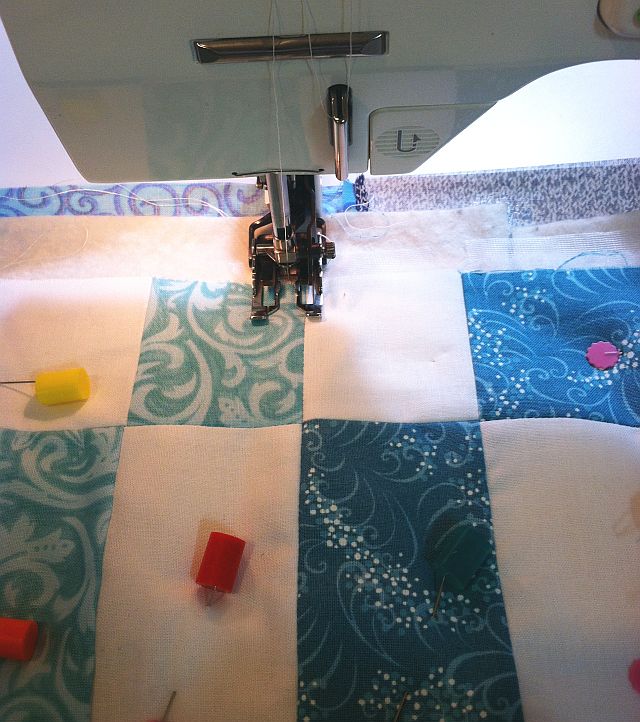
With the quilt laid out horizontally, I started quilting on one edge of the quilt. Using my walking foot as a guide, I stitched about 1/4 inch away from the ditch. I used a slightly longer stitch length and quilted continuously in one long row from the top of the quilt to the bottom. Because the lines go all the way across the quilt and the edges will be covered by the binding, I did not need to lock my stitches or tie them off.

Anchor Quilting

When I got the the end of this first line of quilting, I “scooted”  over a whole block width to the right (leaving less bulk under the machine). I quilted 2 more rows in the same manner.
Don’t quilt the very edges of the quilt yet; you can do that at the end.

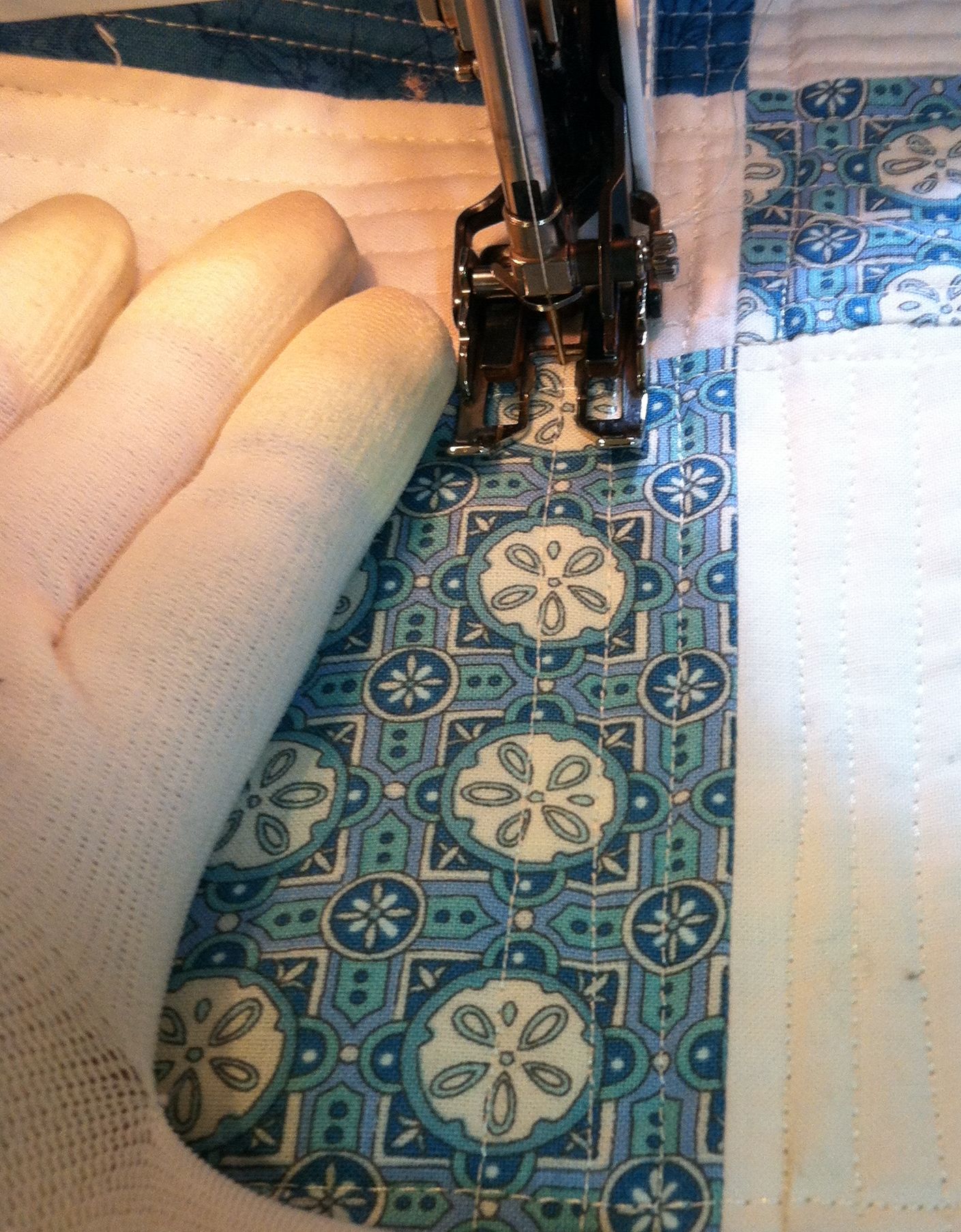
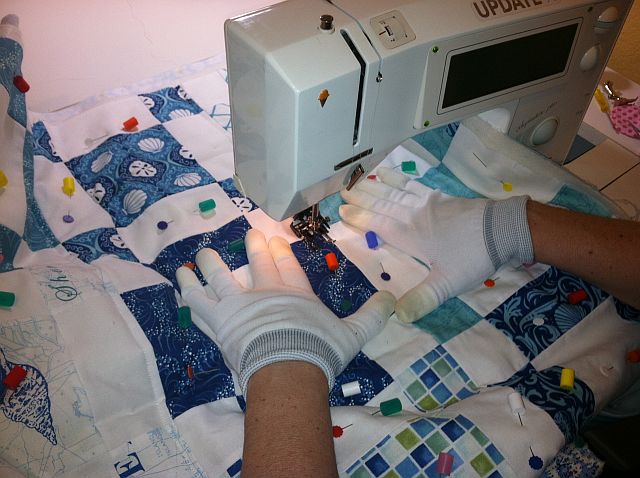
Next, it was time to rotate the quilt 180 degrees and quilt some anchor lines on the other half of the quilt. Again, I quilted them about 1 block width apart. Now the quilt has been quilted in 2 directions. By the way, I love the Machingers quilting gloves because they provide a good grip on the quilt while moving and squishing it under the machine.

Anchor Stitching

It’s time to rotate the quilt 90 degrees and quilt all of the vertical anchor lines now. Again, start in the middle and quilt about 3 rows, one block width apart. Then rotate the quilt completely and finish off the other side.

The quilting is now ready to be finished.

Step 2 – Stitching all the Vertical Lines (1 Hour, 45 Minutes)

I like the “stitch near the ditch” pattern so much that I am outlining every seam about 1/4″ away from the center. I’m not too worried about whether my lines are perfectly straight so I didn’t worry about marking. My other quilt motto is, “Finished is better than perfect!”

Quilting Vertical Lines

Now I can start in the middle of the quilt and quilt all of the vertical lines halfway across the quilt edge of the quilt. When there is too much bulk under the machine, I rotate and finish the other side of the quilt.

Step 3 – Quilting all the Horizontal Lines (2 Hours, 15 Minutes)

This section took a little longer because there were more rows to stitch. Again, I quilted half of the lines going one way, then rotated the quilt to stitch the other half.

Quilting Horizontal Lines

On the very last row which was near the edge of my quilt, I actually quilted 1/2″ away from the seam line rather than 1/4″. This is to take into account the seam allowance which will be covered by the binding.

Edge Quilting

This is now enough quilting for this quilt, but as I said at the beginning, I will add more. Join me next week to see how I finish the rest of the quilting.

If you’d like to try something a little jazzier than just straight lines, why not play around with the decorative stitches on your machine?

Wavy Quilting

The picture above shows me quilting my Jolly Jelly Roll Quilt which was my first DIY Quilt Along. I used a wavy serpentine stitch which would also work well for Sea of Squares!


Quilt-Along ScheduleLinks are Active at the Completion of Each Step:

Quilt Kits are available from my shop for a limited time in these two colorways:

Apple Jacks

Apple Jacks

Sea of Squares

Sea of Squares

Christa’s Sew and Tell – A Few Quilt Along Finishes

Here are a couple of great finishes from followers of my previous quilt-alongs:

Joanne P. finished her version of Baby Bricks featuring some fantastic geometric prints. It looks very modern and makes me want to make another one to try out more fabrics! (I’m still in the the process of adding more quilting to my two baby bricks quilts).

Joanne's Baby Bricks

Kathleen W. sent me a picture of her lovely Charming Chevrons finish. Doesn’t it look fantastic in shades of black, white and gray? She did a wonderful job with the quilting, too.

Kathleen's Chevrons

Both of these quilts are posted on my flickr group. I want to see your quilt-along pics, too!

No matter what tutorial step you are on, or which quilt pattern you are making. I hope you’ll join so we can all share in the fun and get inspired!

The link is: http://www.flickr.com/groups/christasquiltalong/

Christa’s Quilt Along 4.6 – Basting Sea of Squares

I finished my pieced backing from last week and now it’s time to baste Sea of Squares!

The backing took me 2 hours to cut, piece and starch. The basting also took 2 hours, so it was a very pleasant way to spend my day today. 🙂

Pieced Quilt Backing

Sea of Squares Pieced Backing

I follow these four steps whenever I baste a quilt:

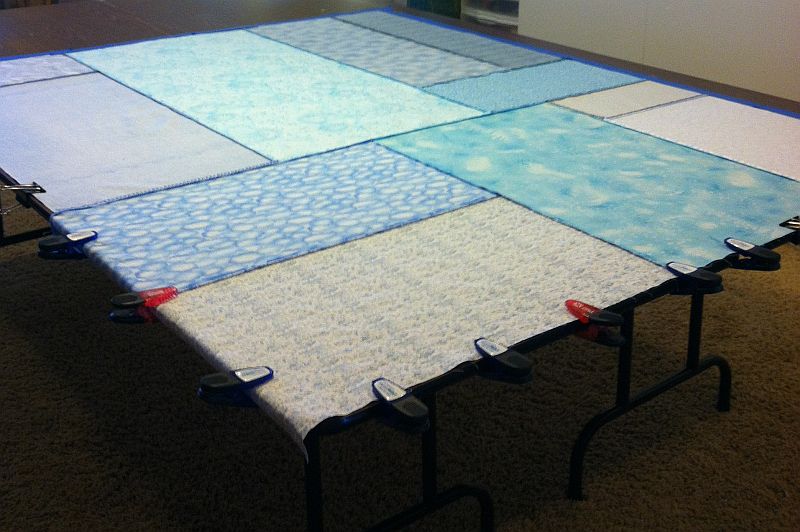
(1) Completely secure the backing to a large flat surface. I use two heavy duty utility tables that I got from an office supply store. They are 8′ long and I keep them up all the time. It’s my work surface and my cutting area, plus the kids use them for art projects and homework. So they get a lot of use!
Secure The Backing

  • You can also use just one table if space is limited and move your quilt around as needed. I use office binder clips to secure the two edges of my backing to the edge of the table.
  • Then I use a generous amount of tape to secure the other edges. You want to make sure that your backing extends past your batting and quilt top by at least a couple of inches.

Batting (2) Next, layer your batting on top of your backing and smooth it out nicely.

I am using 1 layer of cotton batting with 1/2 layer of wool – yes, it actually pulls apart. (For my previous quilt, Charming Chevrons, I used a layer of cotton and a full layer of wool. I loved the “heft” of it but it was a bit thick to quilt through. I’ll let you know I like it.)

  • Notice that there is no need to secure the batting layer.

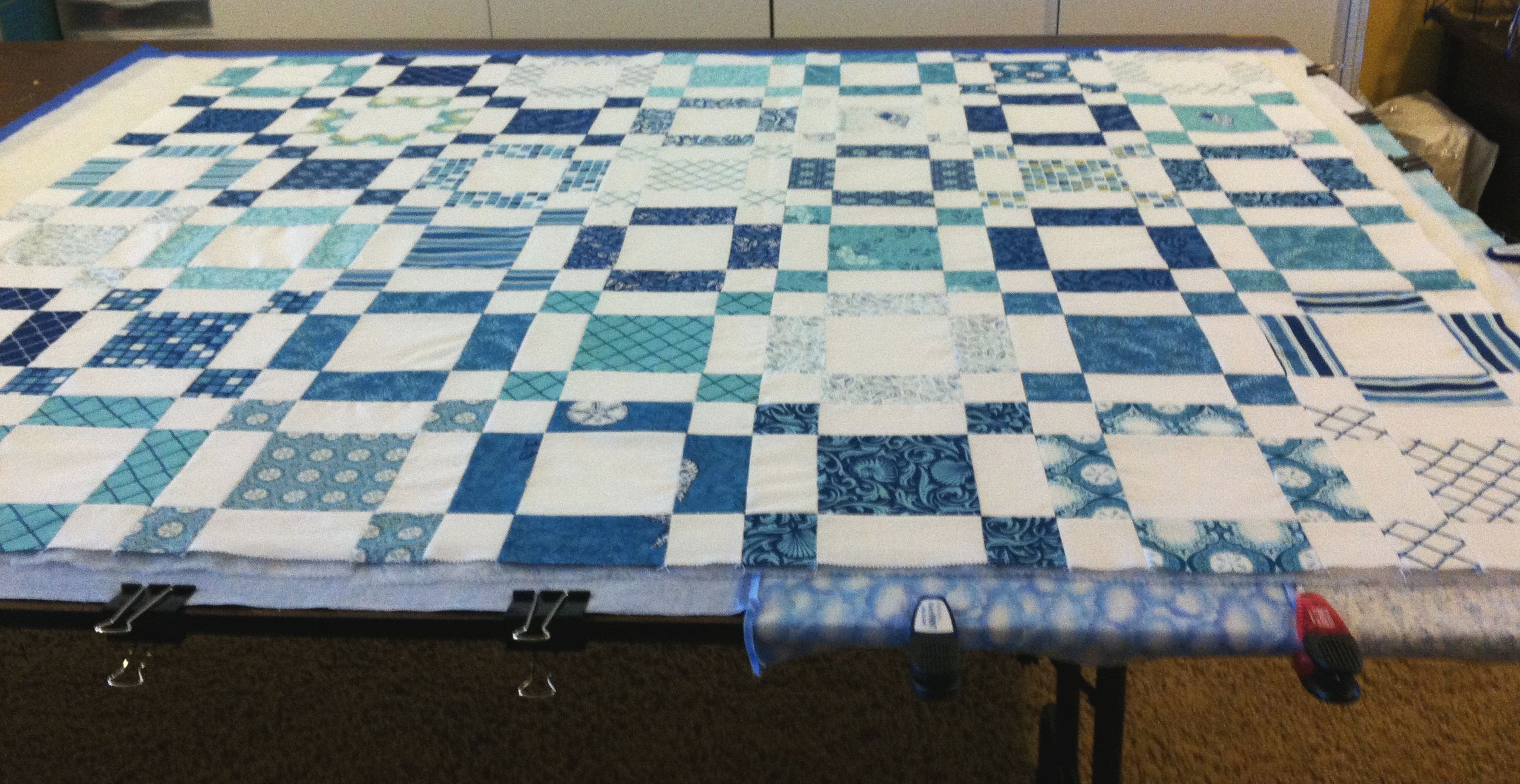
Sea of Squares Quilt

(3)  Grab a helper to gently lay your quilt top onto the center of your batting/backing layer.

If you are doing this solo, you can quarter your quilt instead and unfold it one quarter of a time. But I prefer a helper if I can manage it! If either your top or backing are directional, don’t forget to check to make sure your quilt is oriented correctly before you begin.

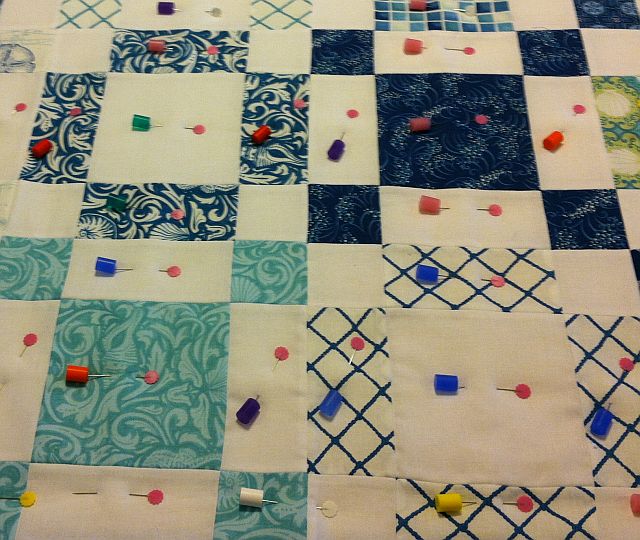
Add the PinsCap with Pinmoors


(4) Finally, let the basting begin! I prefer to use flat flower pins and pinmoors to baste. I insert the pins in the quilt first, one section at a time. Then I cap them all with pinmoors.

  • With my table, I can reach all the way to the center of the quilt, so I can baste half of the quilt from one side; then I finish up on the other side.

Pinmoor Basting

A note about Pinmoors…

Pinmoors are a bit pricey but are well worth the investment. If you’d like to try them, I suggest buying one package and baste as much area as you can. Then, baste the rest of the quilt with regular safety pins.

When you are done quilting, take note of how much quicker and easier the pins and pinmoors were to remove versus regular safety pins!

One note of caution – if you move and scrunch your quilt under your machine like I do, watch for any pinmoors that accidentally fall off so you don’t get poked! Be sure to push the pins in far enough so that they are secure.

Now the quilt is ready for quilting next week. Be sure to post pictures of your quilt top, pieced backing or quilting on my flickr group: Christa’s Quilt Along.

You can also share pictures of any of my previous quilt-alongs that you are working on!


Quilt-Along ScheduleLinks are Active at the Completion of Each Step:

Quilt Kits are available for a limited time in these two colorways:

Apple Jacks

Apple Jacks

Sea of Squares

Sea of Squares

Christa’s Quilt Along 4.5 – Sea of Squares Pieced Backing


Click here to sign up for more fun and free quilt alongs!!


Today I will show you two different ways to make a pieced quilt backing: (1) All from one fabric, or (2) from scraps and chunks. I have a little “cheater” disclaimer here. Since I am on vacation this week, I haven’t actually had time to sew my back together. Most of my tutorial pictures were designed in EQ7, but I’ll whip up my own back in no time when I return!

Step 1 – Measure Your Quilt Top

Sea of Squares Quilt Top

A good rule of thumb is to measure your quilt top and then add 4 inches around the perimeter on all four sides. This means you will take your quilt dimensions and add a total of 8 inches to each number. Let me demonstrate:

My quilt top measures 51″ x 62″ from raw edge to raw edge. I will add 8″ total giving me a needed back dimension of 59″ x 70″.

Step 2 – Calculate the Yardage Needed For One Fabric

The backing width I need is 59 inches as stated above. Rounding that up to the nearest 1/4 yard increment gives me 1.75 yards of fabric (or 63 inches). However, that will give me a length of just 44 inches from selvedge to selvedge (which I round down to 40 inches to account for seam allowances and trimmed edges). But  I need a total length of 70″.

Pieced Back 1 Fabric

Pieced Back 63″ x 80″

To solve this problem, I will need to double the amount of fabric purchased to 3.5 yards. This will allow me to use two 1.75 yard pieces and seam them together to get a total measurement of 63″ wide x 80″ long.

Step 3 – Calculate Pieced Sizes for a Scrappy Backing

If you like an artistic backing like I do, take your diagram above and subdivide it into smaller chunks and random pieces. Use your creativity and fabrics from your stash as a guide. Here’s one hint – if you have a lot of white in your quilt top like mine, try to use lighter fabrics on the back so they don’t show through to the front.

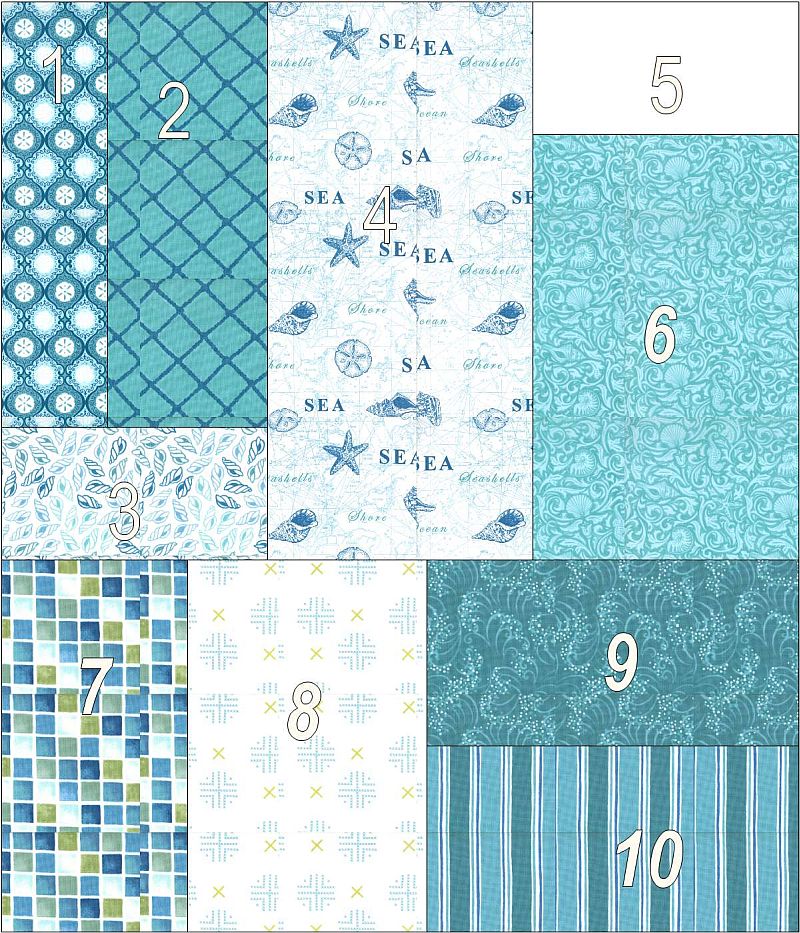
I will “draw” a pieced backing measuring 60″ x 70″ (for easy math) and fill it in like a puzzle, adding random chunks wherever I choose. My diagram looks nice and straight but you can certainly use improve techniques with more wonky lines to achieve a similar effect.

Pieced Back

Just remember that the outer 4-5 inches will be cut off so do not place any smaller chunks near the edges. For my diagram above, I have selected 10 chunks of fabric. Let’s look and see how they would be sewn together:

  • Add chunks 1, 2 and 3 together, then chunk 4
  • Sew 5 & 6 together, then add to piece 1-4
  • Next, sew 7-8 into one unit and 9-10 into another unit
  • Piece both of these sections together
  • Then add the top piece (1-6) to the bottom piece (7-10)

I will press seam allowances open and use a liberal amount of starch to keep everything tidy.

If you would like to follow my diagram exactly, here is how large you would cut each piece:

Pieced Back

  1. 8.5″ x 32.5″
  2. 12.5″ x 32.5″
  3. 20.5″ x 10.5″
  4. 20.5″ x 42.5″
  5. 20.5″ x 10.5″
  6. 20.5″ x 32.5″
  7. 14.5″ x 28.5″
  8. 18.5″ x 28.5″
  9. 28.5″ x 14.5″
  10. 28.5″ x 14.5″

Quilt-Along ScheduleLinks are Active at the Completion of Each Step:

Sharing is Caring

Please share your work in progress in my facebook group: Quilt With Christa . 🙂

Christa’s Quilt Links – Finish Your Quilts with these fun Sew-Alongs

There are so many fun projects to work on that I could literally start a new project a day for an entire year.  Since there’s no way I would have time for that, I will share a few fun project ideas and inspiration that I found on some blogs instead. Join the fun below:

A Year of FinishesSewBitterSweetDesigns is hosting A Lovely Year of Finishes.

The way it works is that you pick one project per month that you know you can finish. You check in at the beginning, middle, and end of each month to show your progress.

Prizes will given each month as well as year-end prizes for those who finish. Sounds like a great way to set some goals!


Finish AlongSpeaking of setting goals to finish your  sewing projects this year, Leanne from She Can Quilt is hosting her own Finish-Along. Each quarter, you will have a chance to show pictures of projects you want to finish over the next 3 months. Those that finish are eligible to win prizes, too! The opening for the first quarter has already passed, but you many want to follow along anyway, so you can secure your spot to join up in April for Q2!


Project QuiltingIf a weekly finish is more your thing, be sure to check out Project Quilting‘s Weekly Challenges, hosted by Persimon Dreams.

There will be loads of inspiration, prizes, and of course, fun!


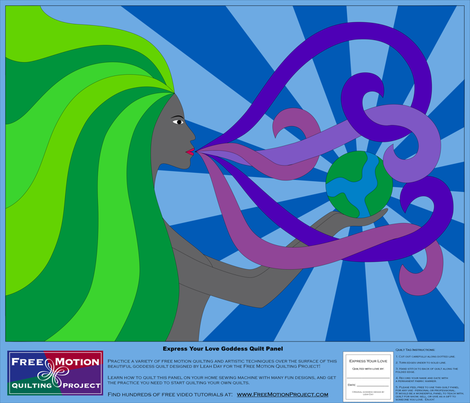
Express Your LoveLeah Day from the Free-Motion Quilting Project invites you to quilt-along with her Goddess Quilt series she is offering on her blog.

This talented quilter has so many ways for you to make this outstanding piece of art: order a pre-printed panel, outline-stitch on your machine, or practice your applique techniques.

You can Express Your Love in so many ways with quilts!


Row AlongIf a quilt-along is too much for you, how about a Row-Along?

Lori Holt from Bee in my Bonnet has been hosting a lovely set of tutorials for making a row quilt.

She’s on row 9 right now but you can hop on over to her blog to join the fun.  She has a flickr group, too!


And if you think all of the above is great, but you still want to add to your pile of UFO’s  Finished Quilts, you can start on your own version of a scrappy Trip Around the World. Unless you’ve been under a rock, I’m sure you’ve heard of it by now. This is the beauty of social media – someone has a fantastic idea and it goes viral!

Check out Bonnie Hunter’s Scrappy Trip Along Tutorial at Quiltville!


Christa’s Quilt Along 4.1 – Sea of Squares Supply List

New to my blog? Be sure to add your email in the box on the right side bar (or scroll to the bottom if reading on a mobile device) so you never miss a new post!

Sea of Squares

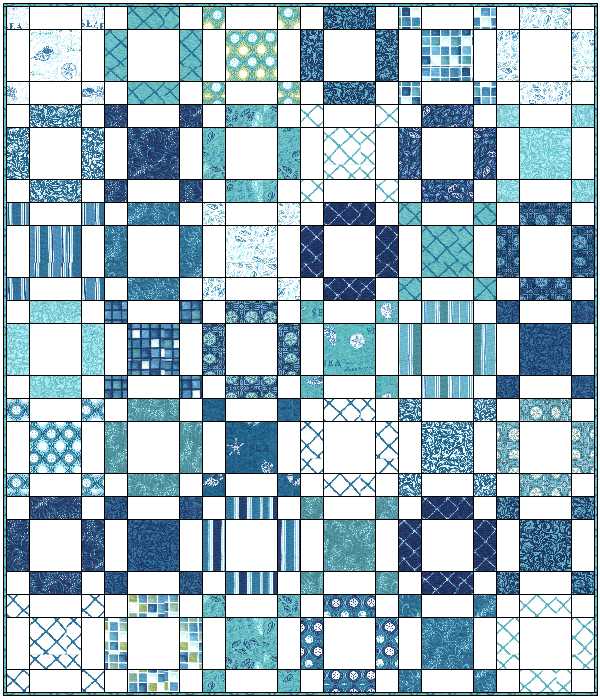
Sea of Squares is the 4th in my series of do-it-yourself quilts where I will take you through all of the steps of making a quilt from fabric selection to cutting, piecing, basting, machine quilting and binding. If you follow along with me you will have a completed quilt in no time!

Sea of Squares

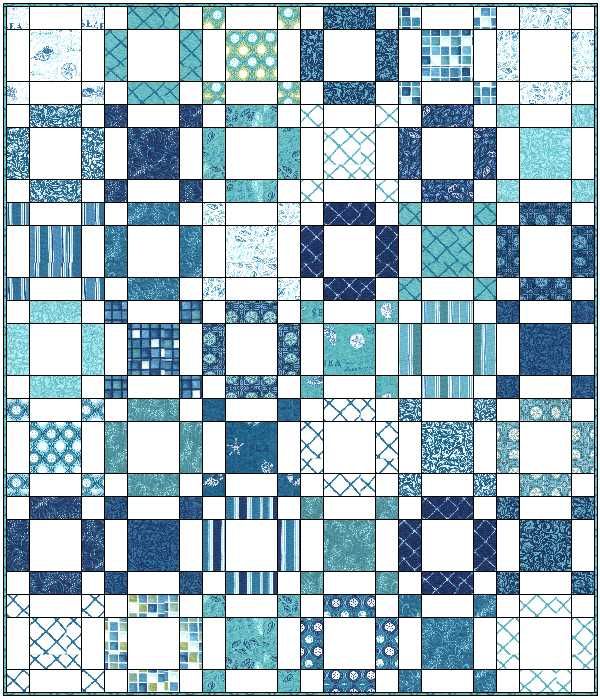
About This Quilt – Finished Size Approximately 51.5″ x 60″

I designed this quilt in EQ7 and downloaded fabric images from Moda to color it.

I named it “Sea of Squares” because I wanted to make a simple quilt pattern from nothing but charm squares. I used Deb Strain’s Seascapes in calming shades of blue from teal to navy to aqua, with Bella Solids in white for the background. This monochromatic color-scheme calls to mind the tranquility of the sea with the occasional whitecap of a breaking wave.

SeascapesBella Solids White


Supply List

Important! If you’d like to pick your own charms, make sure that each pack contains at least 42 – 5 inch squares. Not all manufacturers are consistent with their charms.

Each block consists of 4 charms (2 light/2 dark) so cut or purchase additional charms as needed for a bigger size. You may also use layer cakes if you want to super-size it!

Fabric

  • 2 of the same charm packs in darks or prints – 84 charms total (seascape blues)
  • 2 of the same charm packs in lights or solids – 84 charms total (solid white)
  • 1/2 yard for the binding (one of the blues in the picture above)
  • 3.5 yards for backing split into 2 equal pieces if using all the same fabric. If you prefer a scrappy backing like I do, collect assorted chunks and scraps to total this amount.
  • Batting piece measuring at least 60″ x 70″

Supplies

  • Basic sewing equipment in good working order
  • Rotary cutter with a fresh blade, ruler and mat
  • Brand new sewing machine needles
  • Neutral cotton thread for piecing
  • Decorative thread to match fabrics for quilting
  • Walking foot for straight line quilting
  • Optional – pinmoors and pins for easy basting
  • Optional – machingers gloves for smooth quilting

Quilt-Along ScheduleLinks are Active at the Completion of Each Step:

I plan on posting each week on Wednesday or Thursday depending on how my “homework” goes that week. Even though I will be sticking to the above schedule, feel free to work at your own pace.

By the way, this quilt uses the exact same fabric requirements as my previous Charming Chevrons quilt – so you can do either one, or both, depending on your mood!

Sharing is Caring

Please share your work in progress in my facebook group: Quilt With Christa . 🙂