Beaded Lanterns Quilt Along Week 5 – Make a Quilting Plan

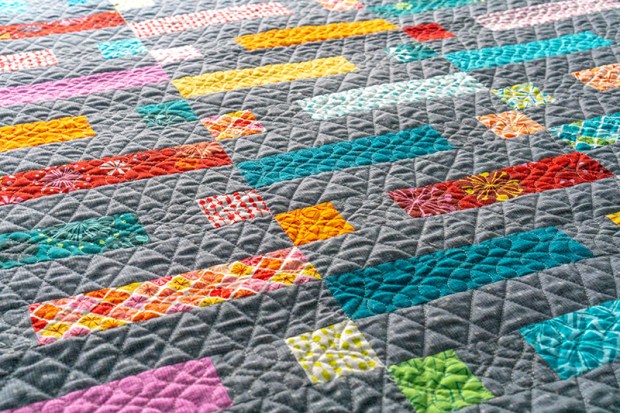
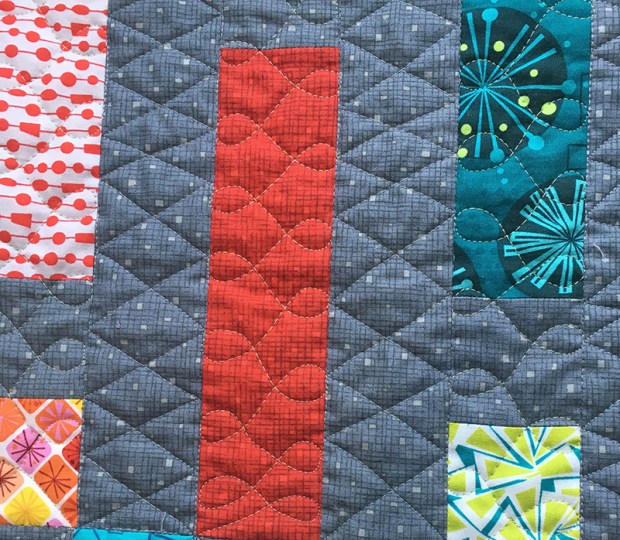
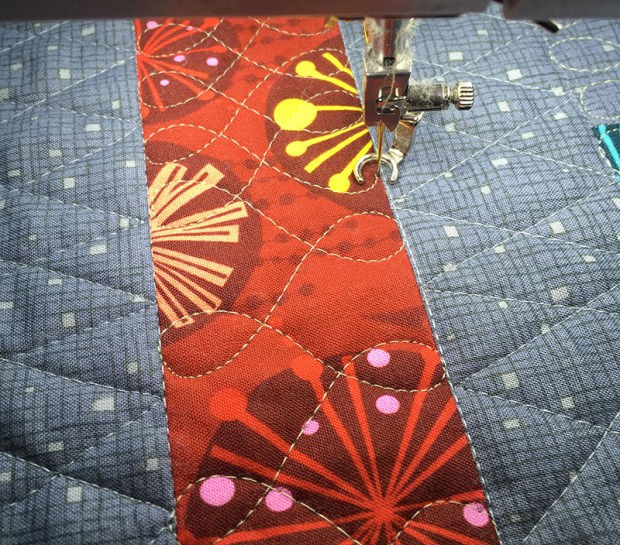
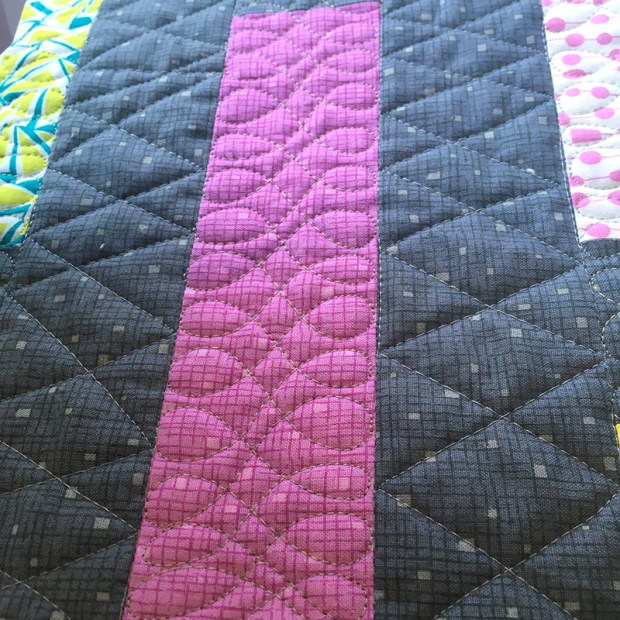
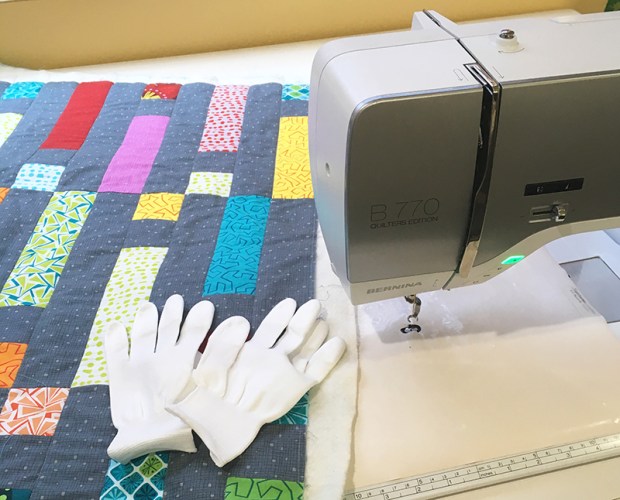
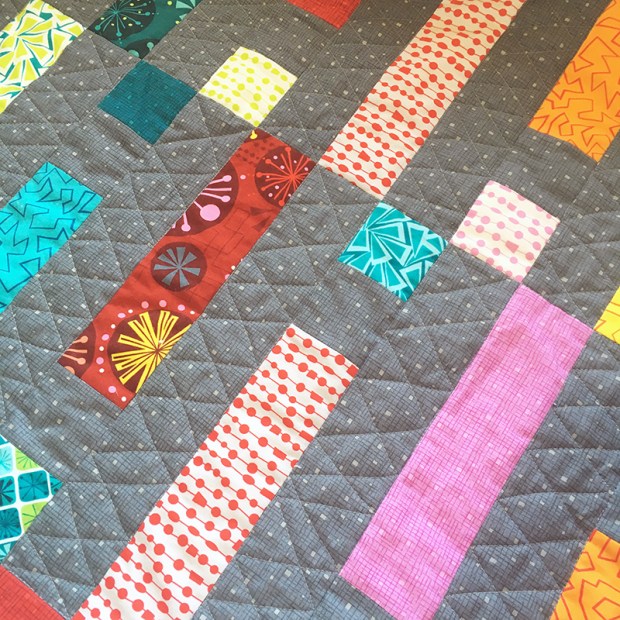
I love seeing all of the Beaded Lanterns quilts in progress! Remember, you can share your work in my ChristaQuilts facebook group, or on instagram #beadedlanternsqal. For my latest post hosted over on the BERNINA blog, We All Sew, I’m chatting about the quilting plan I created and how I broke the steps down into walking foot quilting and free-motion techniques.

Stitching in the ditch walking foot quilting

One of the easiest ways to quilt a quilt is to stitch in the ditch and then echo it to highlight certain areas of the quilt. For more tips and to check out the rest of the quilt along, be sure to click any of links below.

Beaded Lanterns QAL Links

Click here to purchase the Beaded Lanterns Quilt Kit
Click here to get the free Beaded Lanterns Quilt Pattern

Week 1: Supply List
Week 2: Making the Blocks
Week 3: Sewing the Quilt Top
Week 4: Spray Basting Tutorial

Pre-order My New Fall Patterns

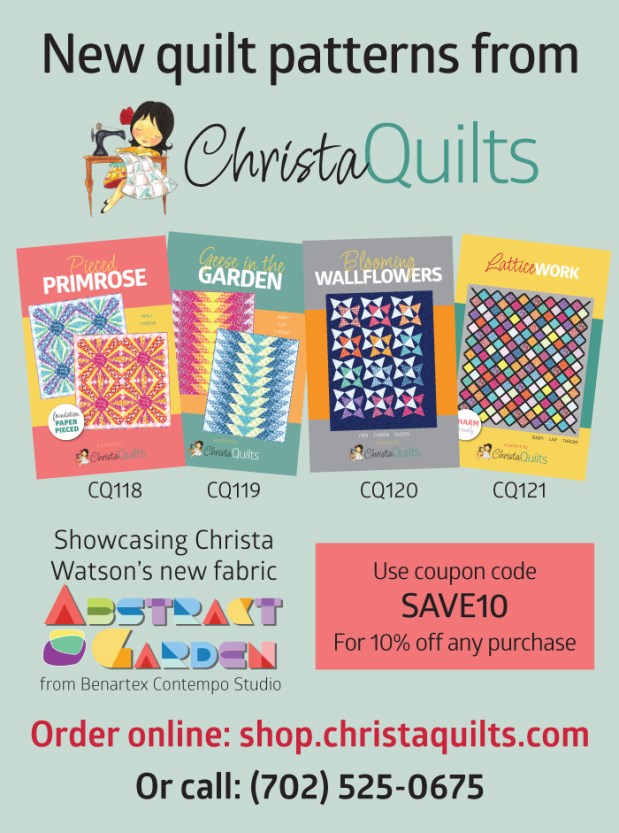
I release quilt patters twice a year now, in conjunction with my new fabric lines. (More about the fabric later…) So today I’m happy to introduce 4 new patterns which will be released on November 16, but you can get them at a discount when you preorder now!

Christa Quilts Patterns

All four of my new patterns are available as print or PDF. Print versions will be shipped to you approximately November 16th. When you order the PDF version through my Craftsy shop, you’ll be able to download the cover now, and then the pattern itself will be emailed as an update on November 16th.

Use coupon code SAVE10 to get 10% off the price of the print version. The PDF version is automatically on sale through November 16th. (The code and sale applies to all current patterns in stock, too!) Here’s what’s new:

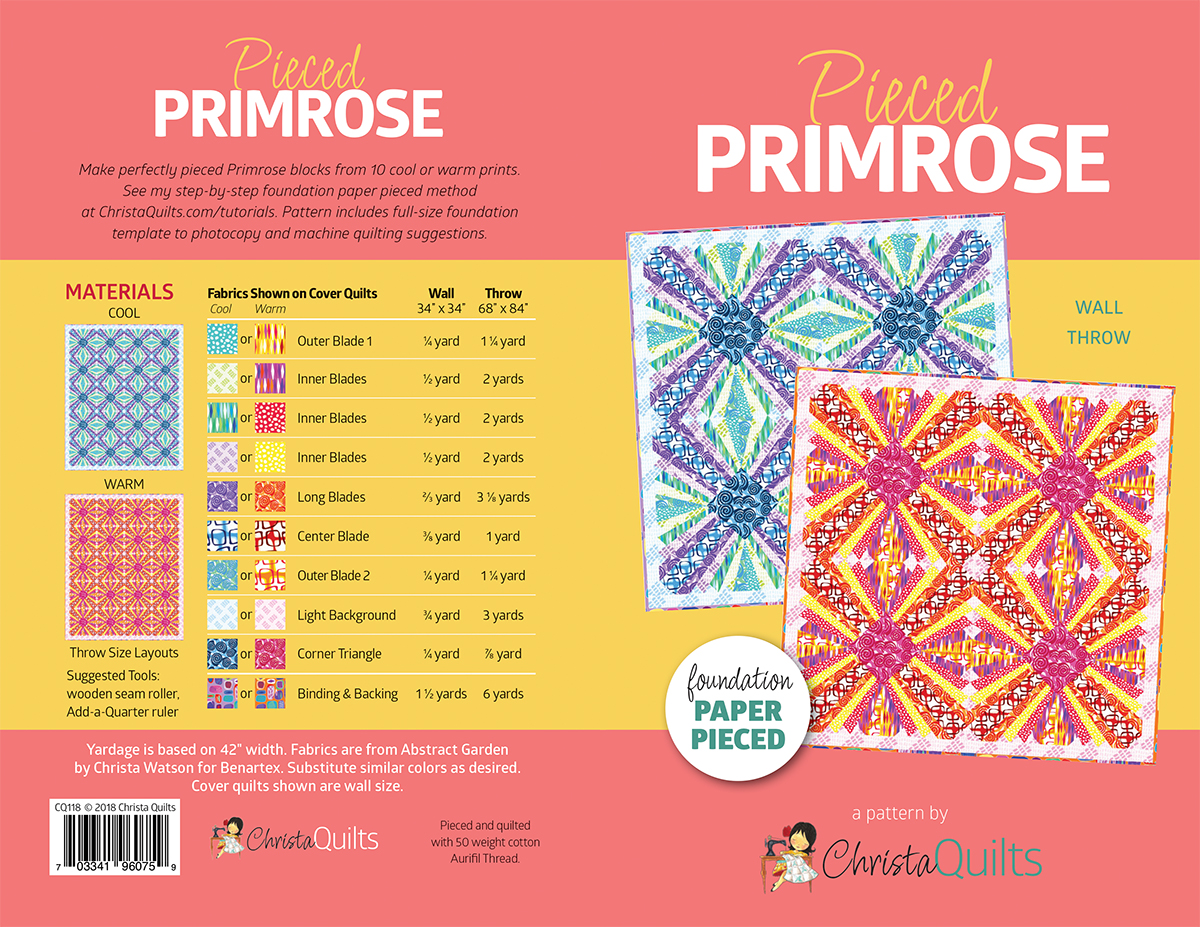
Pieced Primrose

Click here to purchase the PDF version instant download.
Click here to order the print version which will be shipped.

Pieced Primrose Quilt Pattern

Click the image above to enlarge the detailed materials list.

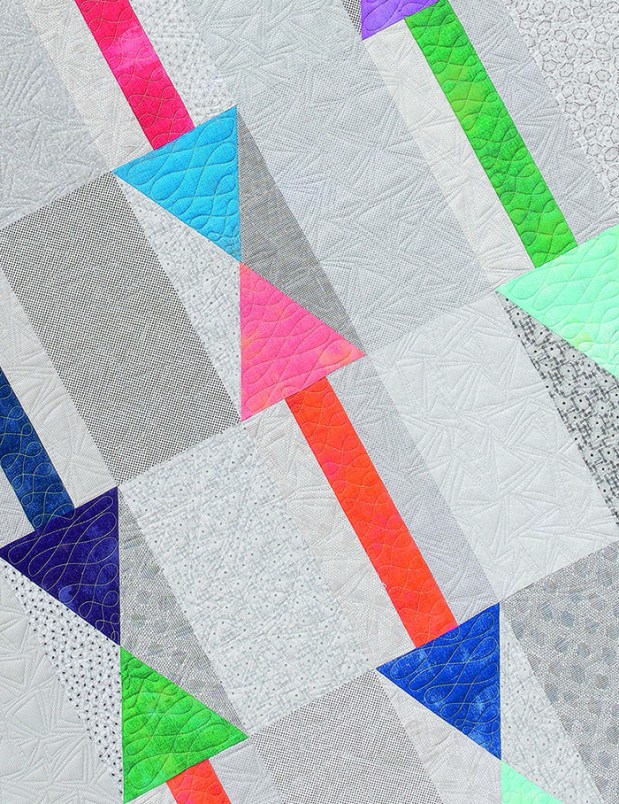
Geese in the Garden

Click here to purchase the PDF version instant download.
Click here to order the print version which will be shipped.

Geese in the Garden Quilt Pattern

Click the image above to enlarge the detailed materials list.

Blooming Wallflowers

Click here to purchase the PDF version instant download.
Click here to order the print version which will be shipped.

Blooming Wallflowers Quilt Pattern

Click the image above to enlarge the detailed materials list.

LatticeWork

Click here to purchase the PDF version instant download.
Click here to order the print version which will be shipped.

LatticeWork Quilt Pattern

Click the image above to enlarge the detailed materials list.

Wholesale Inquiries

These patterns will be available from most major distributors. Or email me christa@christaquilts.com for order info.

I hope you’ll enjoy making these quilts as much as I did!

Beaded Lanterns Quilt Along Week 4 – Spray Basting Tutorial

Have you always wondered how I spray baste my quilts? Over on the BERNINA blog at WE All Sew, I’m sharing my spray basting method using my design wall. It’s part of the Beaded Lanterns Quilt Along I’m hosting over there on the blog, so be sure to check it out!

Whether or not you are making the Beaded Lanterns quilt, you can apply this technique to any quilt.

Beaded Lanterns Quilt Along Links

Week 1 – Supply List and Schedule
Week 2 – Sewing the Blocks
Week 3 – Quilt Top Assembly
Week 4 – Backing and Basting

Click here to purchase Fandangle fabric, kits and bundles.

Dot ‘n’ Dash Quilt Along Week 8 – Machine Quilting Part 3: Double L’s

Good news! I’ve restocked the Dot ‘n Dash Kit in the light gray colorway.
Click here to order or visit shop.christaquilts.com.

I’m so glad we spent a little extra time machine quilting this quilt. Making a quilt from start to finish isn’t hard – it just takes a little time to break down the steps into doable chunks of time. This week we are going to finish up the quilting with a fun free-motion variation inspired by one of the quilting designs from my third book, Piece and Quilt with Precuts.

Free Motion quilting on Dot n Dash by Christa Watson

I’m all about perfectly imperfect texture in my quilts!

I like to quilt my quilts densely to add amazing texture and the more they are loved, used and washed, the softer they’ll get!

After quilting the double zig-zags last week, it’s time to tackle the “Double L’s” motif this week. These are based based on the “Cursive L’s” motif as shown in the Arrows quilt on pages 78-85 of the book, and also on the cover.

Free Motion quilting

Arrows is the cover quilt from Piece and Quilt with Precuts.

Sketch it. Then quilt it.

I’ve also used this design in a slightly different way on Twinkling Diamonds found on pages 56-63. So take a look at the quilting plans for those quilts to give you a better understanding of how to form the design.

The first thing I do when figuring out any design is sketch it first on paper. You can see in my rough drawing below, I tried a couple of different versions of the cursive L’s.

Sketch it. Then Quilt it.

Sketch it – then quilt it!

 At first I thought I would quilt the L’s and then echo them, but when I tried that on a practice sample, it didn’t look so good. I also thought of doing a more linear geometric version (in the upper left of my sketch) but that wasn’t right either. So I opted for two rows of cursive L’s, overlapping each other just like I overlapped the modern zig-zags in the gray areas of the quilt.

I tried quilting the L’s both horizontally and vertically and found it much easier to rotate the quilt so that I was quilting them vertically, from top to bottom in each row across the quilt.

Free Motion Quilting on Dot n Dash Quilt

I’ve rotated the quilt so I can quilt each row from top to bottom.

First Pass Across the Quilt

First, I did one pass of Cursive L’s across the quilt, starting on the upper right of the quilt, quilting one row at a time from top to bottom, and working my way toward the center. Once the quilt got too bulky in the middle, I rotated it and started from where I left off (center, top) to the other side of the quilt.

I’m using the same Aurifil gray thread (top and bobbin) that I’ve used for the whole quilt, and it blended in nicely on all the different Fandangle fabrics.

Cursive L's Free-motion quilting

Cursive L’s quilting – 1st pass across the quilt. Notice the gaps between the loops.

I recommend practicing a couple of times on scrap fabric and batting to get the hang of how you’ll form the design.

I’m not at all worried about the spacing of each motif or whether or not all of the loops are perfectly smooth. I’m aiming for texture over perfection. To get from one strip unit to the next, I’ll aim for the corner, or I’ll backtrack in the seam as needed to get to the next section to quilt. Notice that I’m treating the pieced units and the small gray background square as one area to quilt.

Cursive L's Free-Motion quilting

Head for the corners, or backtrack in the seams to get to each new section to quilt.

After the first row of Cursive L’s, I repeated the process, adding another row of L’s on top of the first row, intersecting the lines and quilting the design in opposite directions.

I squeezed in the second set of loops in the gaps between the previous loops. This added more texture and also made the imperfections less noticeable.

Second Pass Across the Quilt

Cursive L's detail quilting

Squeeze the second round of quilting in between the gaps of the first.

The more quilting you add to the quilt, the more thread you’ll use of course. So I would check your bobbin level at the end of a row of quilting and change it out as soon as it looks low (or pay attention to your bobbin indicator light if you have one on your machine).

Don’t play bobbin chicken!! I’d rather have a little leftover bobbin than run out in the middle of the quilt. If you are using cotton thread in your bobbin, you can always use the leftovers when piecing your next quilt.

Cursive L's Dense Quilting

I love using soft 100% cotton thread and natural fiber batting for my quilts.
This allows me to quilt densely while still ensuring a cuddly quilt!

Quilting Homework

Finish quilting the quilt! Feel free to mix and match quilting motifs from my books, or use some of your favorite designs. However you decided to quilt it, please share your quilt in progress in my Facebook group and on instragram #dotndashqal. I love seeing everyone’s work!

Next week, we’ll trim up the quilt and bind it to finish. I can’t wait!

Quilting at the Beach

I love how these surfboards at the beach match the coloring of my quilt!

Click here for the quilt along schedule, supply list, and links to all the tutorials.
Click here to purchase Fandangle precuts and coordinating yardage.

Beaded Lanterns Quilt Along Week 3 – Quilt Top Assembly

Great news for those of you following the BERNINA quilt along to make Beaded Lanterns. More of the kits are back in stock at shop.christaquilts.com.

beaded lanterns

Last Thursday, the lastest installment was shared over at We All Sew. The next step in the process  is to sew the blocks to make the quilt top. Click the links below to catch up on the Quilt Along and feel free to jump in at any time!

Beaded Lanterns

BERNINA Beaded Lanterns Quilt Along Links

Week 1 – Supply List and Schedule
Week 2 – Sewing the Blocks
Week 3 – Quilt Top Assembly

Click here to get the optional Beaded Lanterns quilt kit, while supplies last.

My Quilt in American Patchwork and Quilting – Featuring Fandangle

Today I’m happy to introduce you to my quilt “Out of the Box” that can be found in the December Issue of American Patchwork and Quilting. It’s made from one fat quarter bundle of Fandangle and 4 yards of white background fabric.

Out of the Box by Christa Watson

Image shared with permission from American Patchwork & Quilting® magazine.
©2018 Meredith Corporation. All rights reserved.

Look closely and you’ll see that I used leftover fabrics to make a scrappy binding. It’s one of my favorite ways to use up leftovers from a fat quarter bundle without having to purchase any more fabric.

Fandangle Fabric + Color Tip

All it takes is one 20 piece fat quarter bundle and a contrasting background to make this quilt. Here’s a tip when working with fabric bundles: pair them with a very light or very dark background, and you’ve got a winning combo, no matter which fabrics you choose!

Click here to purchase a 20 piece fat quarter bundle of Fandangle, while supplies last!

Fandangle fabrics

Fandangle is my second fabric with Benartex Contempo Studio.

Here’s what the cover of the December issue looks like which I believe goes on sale tomorrow. I’ve already received my contributor copy and am in love with several projects in the issue. This is by far one of my favorite magazines because they feature such a wide variety of techniques and styles. (And they pay designers very well for their patterns, too!)

American Patchwork and Quilting DecemberImage shared with permission from American Patchwork & Quilting® magazine.
©2018 Meredith Corporation. All rights reserved.

Quilting Plan

Here’s the quilting plan I created for Out of the Box, a simple wavy grid. It’s one of my go-to quilting designs that’s fast and easy to do with your walking foot or dual feed. I use the pieced seams of the quilt as a guideline for how far apart to space my lines so I can quilt the entire design without any marking!

Wavy Grid quilting plan.

I always make a quilting plan for my quilts before I quilt them.

Although the pattern includes instructions for the piecing, you can learn how to machine quilt the wavy grid motif in my Craftsy class, the Quilter’s Path, and also in my third book, Piece and Quilt with Precuts. It’s my go-to design when I’m in a hurry, and it looks great on any quilt!

machine quilting detail by christa watsonMachine quilting detail – click the image to enlarge.

Here’s another view of the quilt where you can really see the quilting. My hubby Jason has been helping me photograph quilts in order to showcase the fast, fun, and easy machine quilting designs that I love to teach! For me it’s all about texture over perfection.

machine quilting detail

Learn how to quilt this walking foot design from my book Piece and Quilt with Precuts,
and also in my Craftsy class, The Quilter’s Path.

I really enjoyed making this quilt to showcase my fabrics and the best news is, it will be on display in the American Patchwork and Quilting booth at International Quilt Market in Houston, Texas next month!

When you make this quilt, be sure and tag me @christaquilts on social media so I can see what you’re doing. You can also share pics of your progress with this quilt (and anything else you make from my books, patterns and fabric) in my ChristaQuilts group on facebook!

Out of the Box by Christa Watson for American Patchwork and Quilting using Fandangle fabricOut of the box by Christa Watson, Made from Fandangle Fabric

Quick Links to Items Mentioned Above

American Patchwork and Quilting Magazine
Fandangle Fat Quarters
Online Video Class – The Quilter’s Path
My book Piece and Quilt with Precuts

Dot ‘n’ Dash Quilt Along Week 7 – Machine Quilting Part 2: Double Zig-Zags

It’s time to embellish our quilts with some fun machine quilting this week! In my book Piece and Quilt with Precuts, I’ve shared 18 different quilting ideas that you can mix and match along with the 11 projects in the book. We are going to do a little bit of mixing and matching of motifs this week!

(By the way, If you are a little unsure of your free-motion quilting skills, be sure to check out my machine quilting class on Craftsy for my best machine quilting tips and tricks!)

Dot n Dash Quilt Along

Original Dot N Dash Quilting

Here’s how I quilted the original Dot ‘n’ Dash quilt. I quilted “crazy 8’s” in the background areas, and wavy lines in the print strips. I followed a similar quilting plan to what we are doing today, but with different designs. If you’d like to follow this quilting plan, see pages 50-55 of the book.

Free-Motion Quilting Dot n Dash

Original quilting plan for Dot ‘n’ Dash – from the book.

For this week’s quilting “assignment,” we are going to play with one of the walking foot designs from another project in the book to  come up with a really fun variation. Take a look at the “Frequency” quilt on page 28 of Piece and Quilt with Precuts. You can create amazing texture by quilting “sort of” straight lines, zigging and zagging from side to side across each strip.

Quilting Modern Zig-Zags

Notice the random irregularities. Not only do they add interest to the quilt, they are fast and easy to do because there’s no marking involved and you don’t have to measure any spacing. This is MY kind of perfectly imperfect quilting!!

Frequency Quilting

See page 28 of Piece and Quilt with Precuts to practice this design.

quilting with your walking foot/dual feed

Rotate the quilt so that you are quilting each strip row from the top to bottom. Quilt a short line by eye and stop with the needle down when you get to the side of your strip. Lift the foot up and slightly rotate the quilt so that you can angle the line in the opposite direction. Keep going, quilting the irregular lines from side to side. If you have a knee-lift or hover feature on your machine, use it so that you can leave your hands on the quilt the entire time.

To prevent whiskering (wrinkles) or puckers on your quilt, quilt each row starting at the top of the quilt and working your way to the bottom each time. Just like when I stitched in the ditch last week, I’ll start on the right side of the quilt and work my way towards the center, then rotate the quilt and keep going from the center out.

Alternate Method: Free-Motion Quilting the Zig-Zags

To get started free-motion quilting, I recommend using a Supreme Slider – a slick sheet that clings to the bed of your sewing machine, and a pair of Machingers gloves that will give you a better grip on your quilt. Just remember to only use the Supreme Slider while FMQ, not walking foot quilting, so that you don’t accidentally stitch through it! (Ask me how I know….)

Tools for free motion quilting: open toe foot, gloves, supreme slider

The gloves and slider will help me control the quilt with less strain on my hands.

I’ve lowered my feed dogs and I’m quilting with an open toe free motion foot so I can better see what I’m doing. Although my machine does come with a stitch regulator, I actually prefer quilting without it. I learned without a regulator so that’s the movement I’m most comfortable with.

However, if you have a stitch regularot, give it a try and see which feels more comfortable to you – with or without. Here’s another tip I picked up from my good buddy Leah Day: try quilting both with your feed dogs up and down to see which gives you a better stitch. The nice thing about using a Supreme Slider is that it covers the feed dogs, keeping them out of the way if you decide to keep them up!

Free Motion Quilting Zig-Zags

Free-motion quilting is faster, but requires more control and lots of practice.

Did you know you can free-motion quilt short straight lines without a ruler? If they are done in short bursts, you can eyeball a straight line if you look ahead and pick a point you are trying to get to.

The reason I’m quilting this design free-motion instead of with a walking foot is that it’s faster, since I don’t have to stop and turn the quilt for each zig and zag. However, it requires more muscle control, so practice both ways first on a scrap of batting and fabric and then decide which technique is easier for you to master.

Free Motion Modern Zig-Zag Design

First pass across the quilt – zig-zags in all the gray areas.

Notice that I’m quilting modern, random zig-zags in the gray strips between each print strip (not including the small gray squares). To quilt one long continuous line without breaking thread, zig or zag over to the next gray section to quilt. If needed, it’s okay to backtrack (or quilt over a precious quilting line) in the seam to get to where you need to go.

After quilting one pass of zig-zags, I decided that I wanted to quilt another set of lines, intersecting what I had already done. I’m using the same method to quilt the random short lines, but crossing over each previous line as shown below:

Double Zig-Zags fmq

Notice how I’m quilting each row from the top of the quilt to the bottom.
I will rotate the quilt as needed to find a comfortable quilting position.

Machine Quilting Homework

Quilt all of the gray areas with a blending thread. I used the same Aurifil 50 weight gray that I used for stitching in the ditch last week. Quilt one pass across the quilt like the pictures I showed above. Then quilt a second pass across the quilt to give it more random texture.

We will tackle the print strips next week, using another free-motion motif from a different quilt in the book. It’s been fun to mix and match the designs to show how versatile they can be!

Free Motion Quilting Double Zig-zags

Divide and Conquer – quilt all of one design first before moving on to the next.

It’s Not to Late to Start!

Remember – you can jump in and make this quilt any time. Just grab a copy of the book and your favorite fabrics (strips, scraps, or stash).

Click here for the supply list and links to all of the previous posts.
Then share your progress on instagram #dotndashqal or in my Christa Quilts facebook group.

Free motion quilting double zig zags

I love yummy machine quilting texture!! Next week I’ll show you how to quilt the rest.

Behind the Scenes: My Design Process for Fandangle

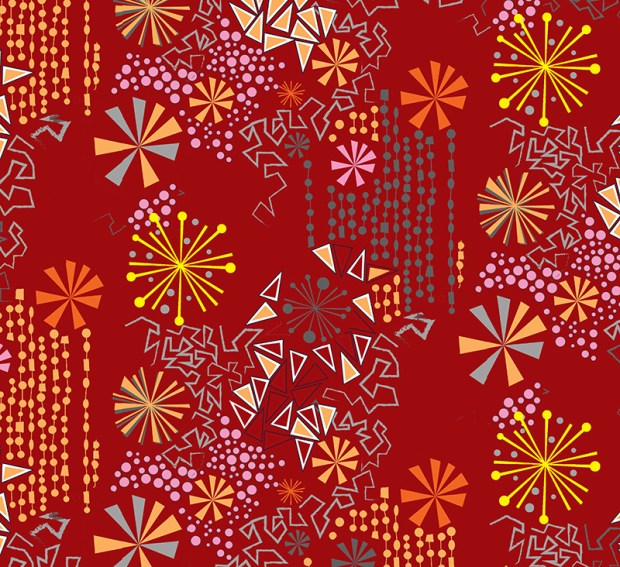
Today I thought it would be fun to share a little bit of my fabric design process for Fandangle. The line includes 6 designs in multiple colorways so I’ll take you through the design process of 3 of them. (When my first line, Modern Marks came out, I shared a bit of my process along with some some of the rejects, and that got a lot of interest. Read about  that here.)

Fandangle Fabric

Click here to get yardage and bundles of Fandangle, while supplies last.

For Fandangle, I knew that I wanted it to coordinate with Modern Marks, but still stand on its own as a separate collection. In fact, as I was working on the line, I scattered some of the in-process paper swatches onto my Modern Marks Rainbow Taffy quilt, just to make sure they’d look good together:

Fandangle and Modern Marks

If you look closely, you’ll notice that the orange, yellow and green tone on tones are not the final versions I ended up with. Read more about those “rejects” below!

Whenever I design a line, I start with a concept and a rough color palette. When inspiration strikes, I can see what I want in my head, but the hard part is technically getting that into the computer to form a proper repeat. Fortunately, I work with a fabulous stylist and graphic designer at Benartex who can help translate my ideas into reality. I thought it would be fun to walk you through the design process of three of the prints so you can see how they evolved.

Evolution of Baubles and Bits

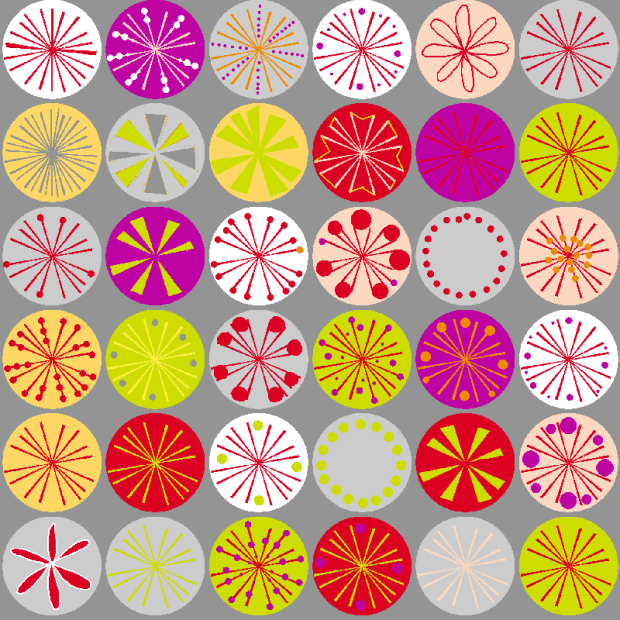
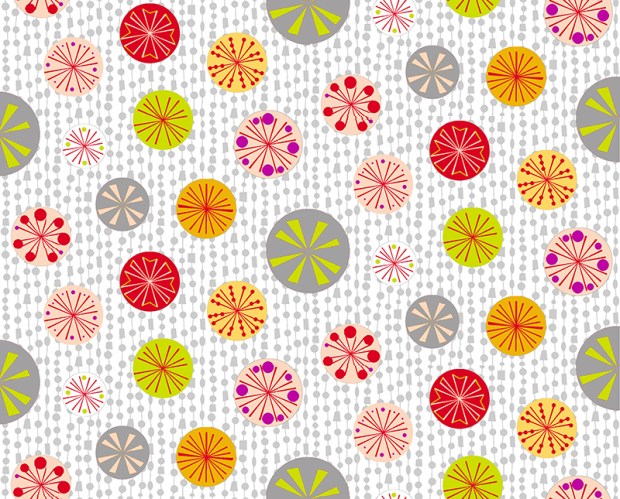
This print was the hardest to finalize and the one that took the most work. I knew I wanted to create a fun, funky medallion that would almost read as a floral. So we started with the basic medallion shape. You’ll notice that colors and designs change quite a bit during the process. First I finalize the shapes, and then the colors. So any in-process and designs and hues are always just placeholders.

First Try:
Second Try:
Baubles and Bits in Process

Third Try:

Final Design:

Baubles and Bits final design

Isn’t it fun to see how it evolves? Of course there were a lot of intermediate steps in between each image involving more sketches, lots of cutting and pasting, and the painstaking decisions to add or remove colors that didn’t work. Did you notice that I cut the purple? It just didn’t work this time around (although we were able to work in some nice pink and lilac). But don’t worry, purple will work its way into my fabrics in the future – I promise!!

Multiply these design and color changes by each print and color in the line and you can see what an involved process fabric design can be!

Triangle Trinkets Design Process

This print was a lot quicker to finalize. It began with a simple line-drawing sketch of my arrowheads quilting design in several different arrangements.

Original Concept:
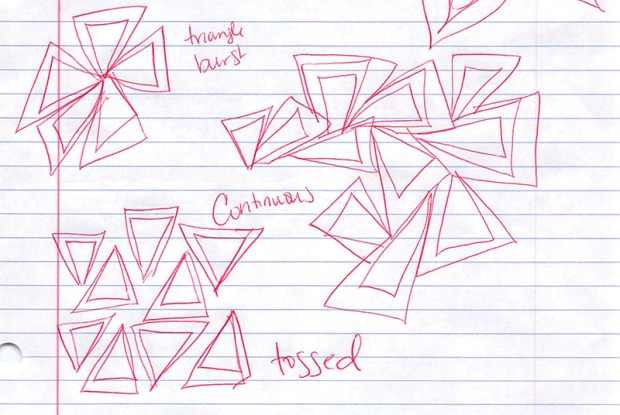
Triangles sketches

Then we put the designs into the computer and tried different color groupings and design layouts to see what worked. The teal colorway was one of my favorites, but I thought the stripe arrangement below was too directional.

Good Color, Bad Layout:

Final Design:

Once the design was finalized, we recolored them in a dozen different colors that coordinated with the rest of the prints. It was hard to narrow it down to the final three colors I included in the line, but sadly, I knew I couldn’t include them all!

Fandangle fabric -Triangle Trinkets

Paper Cuts – the Tone on Tone Blender

This print was one I felt strongly about from the beginning. I knew exactly what I wanted but it took awhile to get there. Again, I started with a simple pen and ink sketch on paper, inspired by another one of my favorite free motion designs – jagged stipple.

Design Sketch:

The design team at Benartex wasn’t so sure it would translate well as a design, so we tried a couple other things first that I ultimately rejected. First of all, we revisited the boxes print from Modern Marks with a different take on the design.

Boxes Blender:

Boxes blender

Nice, but nope, that wasn’t it. It turned out very nice but was too close in concept to the boxes design from Modern Marks.

Loops and Strings:

blender loops

We tried something that looked like loops and strings, again based on one of my free-motion quilting designs. This print would have worked well, but it wasn’t what I wanted.

Jagged Design – First Try:

Blender print

Finally, they were willing to let me try the jagged, edgy design that I really wanted with this line. The first iteration was a little too dense for my taste, so we spaced it out to give the design a little more breathing room.

Final Tone on Tone Design:

Paper Cuts design from Fandangle

It was worth all of the time and effort we put into this print! After the design and scale were finalized, the hardest part was naming it. “Jagged Stipple” didn’t really go with the other design names inspired by the idea of ornamentation and embellishment.

So I finally renamed it “Paper Cuts” because that sounded cutesy and crafty. The irregular jagged lines reminded me of small cuttings of paper. I almost named the print “scherenschnitte” which literally means “scissor cuts” but I knew people would have a hard time trying to pronounce that word it, let alone spell it, LOL!!

Fandangle Quilt Patterns
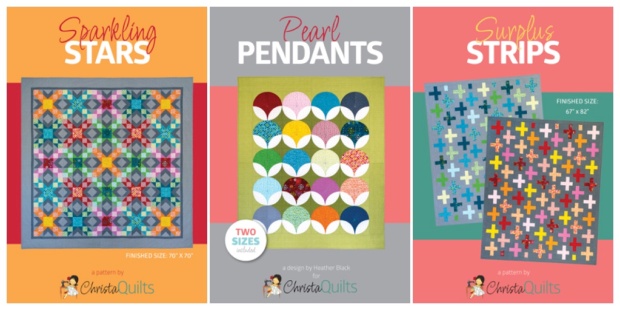
Fandangle Quilt PatternsClick here to get PDF versions of the Fandangle Quilt Patterns
Click here to get print versions of the Fandangle Quilt Patterns

Of course, once the prints were finalized as digital images, it took me nearly as long to come up with quilt patterns to showcase the fabrics effectively. Designing quilt patterns is a very similar process for me as fabric design: I start with an initial sketch, and tweak it until it feels right. All of this work was finalized before I even received fabrics to work with. It’s a long process for sure, but I enjoy every minute of it!

Fandangle Finalized

Fandangle fabric by Christa Watson for Benartex Contempo

I hope you enjoyed seeing this peek behind the curtain of how one designer’s process evolves. I know it’s different for each and every fabric designer, but so far this process has worked very well for me. I went through a similar process described above for all six prints in the line, but it was worth it to create a collection I love!

In fact, as I write this, I’m developing additional concepts, sketches, colorways, and ideas for future fabric lines. I’m starting to get the hang of how things works which each new collection I create, and it’s been such an incredible journey. As long as you all continue to love them as much as I do, I’ll have more to share in the coming months – so stay tuned!

Dot ‘n’ Dash Quilt Along Week 6 – Machine Quilting Part 1 SITD

Can you believe we are 6 weeks in to the quilt along?! The work you all are doing is fabulous and I’m excited to get to my favorite part – machine quilting!! This week we will Stitch in the Ditch (SITD) to secure the quilt for the jazzy free motion quilting we will do later. Many times, this crucial step is overlooked, and although it’s not the most exciting part of machine quilting it’s one of the most important steps for successful free-motion quilting.

Machine Quilting Detail on Dot n Dash Quilt

Machine Quilting Detail on Dot ‘n’ Dash Quilt. Stitching in the ditch allows you to break down the quilting into sections, which makes for more successful free-motion quilting later.

My Fave Machine Quilting Supplies

First of all, let me tell you about the needles I prefer to use for machine quilting. They are from Superior Threads and are called Topstitch needles. Look at the image below to see the difference between a Topstitch needle and a Universal needle. The Topstitch has a slightly sharper point which is helpful for penetrating the fabric. But the most important feature is a slightly longer eye (the hole) so that your thread won’t shred. I love these needles so much that I use them for piecing as well.

Needle Closeup

I buy the needles in the blue package as they are most economical for my projects:

Next, the thread I use for piecing AND machine quilting is 50 weight 100% cotton from Aurifil. The 50 weight is thin, yet strong so that it will blend into your quilt. I’d rather see the overall texture of the quilting rather than the individual stitches, and quilting densely helps me mask any mistakes. After all, the easiest way to hide imperfect stitches is to surround them with more imperfect stitches!

Piece and Quilt Collection Aurifil Thread by Christa Watson

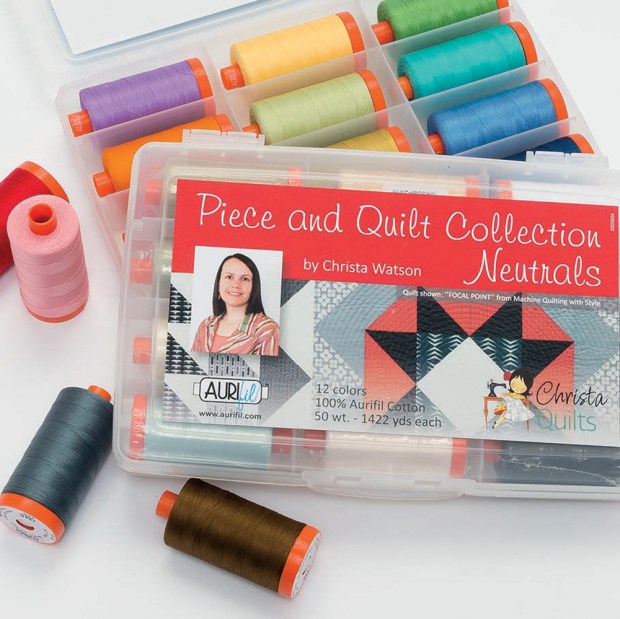
For this quilt, I’m using the medium gray #2605 from my Piece and Quilt Neutrals thread collection. (My neutrals box also includes a lighter gray and a darker gray so that you’re covered, no matter which shade of gray you like!)

Stitching in the Ditch

Whenever I do any custom quilting, I will always “anchor” the quilt by stitching in the ditch first, in key areas of the quilt. For Dot ‘n’ Dash, it made sense to stitch in the ditch between each long row. I recommend using a walking foot, or a machine that has a built in dual feed system (such as the BERNINA 770 QE that I’m using).

The nice thing about pressing seams open, is that you can actually stay in the ditch, and you don’t have to worry about switching thread colors for the low vs. high side of the ditch. Contrary to popular myth, stitching in the ditch with seams pressed open will NOT weaken your seams. I’ve been doing it for years with no problem, and I find it actually strengthens my quilts and adds more stability. (Just think about it – if stitching over a previous line of stitching would cut your threads, then you’d never be able to backtrack over a seam, right??)

Stitching in the Ditch on Dot n Dash Quilt

I use the terms walking foot quilting and dual feed quilting interchangeably.
Stitch slowly , so you can stay in the ditch as much as possible

The built in dual feed turns my 1/4″ patchwork “D” foot into a walking foot, feeding the quilt through evenly with no puckers. I recommend quilting with a slightly longer stitch length (3.0 instead of 2.5) to help compensate for any drag on the quilt. I also recommending reducing your presser foot pressure when doing walking foot/dual feed quilting (but not for FMQ).

Because you are making contact with the quilt on every stitch, this puts a lot of pressure on the quilt which can lead to tucks and puckers, especially when crossing seams. By reducing the presser foot pressure, it enables you to quilt with a lighter hand (or should I say foot?) on the quilt.

Modern Marks Quilt Backing

Look how nicely the gray thread blends into the blue Modern Marks print on the back.

When stitching long straight lines across the quilt with a walking foot, I recommend stitching in one direction only, from top to bottom, rather than going back and forth. This will keep the quilt flatter, with less torque on the quilt. Many times, “whiskering” – or lots of little creases will appear if you stitch lines back and forth.

Scrunch and Smoosh the quilt under the machine

Scrunching and Smooshing in Progress

To deal with the bulk of the quilt under the machine, I scrunch and smoosh it out of the way however I can, and only focus on one area of the quilt. I start on the right side of the quilt and work my way across the quilt, stitching one line at a time.

When I get to the center of the quilt, I’ll rotate the quilt 180 degrees and keep going from the middle to the edge of the quilt. This allows you to deal with the least amount of bulk at a time, and by the time you get to center you know that the bulk will get less and less as you quilt the other side.

Stitching in the Ditch on Dot n Dash

Detail of stitching in the ditch

Once either side of the strips has been stitched in the ditch, your quilt is fully secure to add more quilting. Note that I’m only SITD along the long rows, not in between the smaller squares. That would be too much starting and stopping for my taste! And don’t worry, even if your ditching lines veer off a little bit, you won’t notice it once you add more quilting.

Quilting Homework

Finish stitching the rows in the ditch and then get ready for free-motion quilting next week! Because we are taking our time and spending 3 weeks on machine quilting, you’ll have plenty of time to ease into it.

Dot n Dash machine quilting

Next time we quilt, all we have to do is think about smaller sections, one row at a time.

You could always stop right here and call it finished, but I can’t wait to show you how to add more yummy texture next week! Be sure and share your progress and ask questions or get any trouble-shooting help over in my Christa Quilts Facebook group, or on instagram #dotndashqal.

Click here for the start of the quilt along with supply list and links to all of the QAL steps.

Beaded Lanterns Quilt Along Part 2 – Making the Blocks (on the BERNINA Blog)

Are you having fun with my quilt alongs? I know it’s kinda crazy that I’m doing two at once (Dot ‘n Dash on my blog and Beaded Lanterns over on the BERNINA blog). But seriously, if I didn’t have deadlines for my quilting, I wouldn’t get anything done, LOL!!

Fortunately – just so you know, I actually made both quilts ahead of time since I knew I would be out of the country teaching when they were scheduled to be shared. (More about my Australia trip later, so stay tuned!)

Beaded Lanterns Blocks

Click here to purchase Fandangle precuts, bundles and yardage while supplies last.

This week over on the BERNINA blog – We All Sew – I’m sharing the process of cutting the strips and making the blocks. So head on over there to check it out!

Remember – for any of my quilt alongs, I leave the posts up indefinitely so you can always come back to them later when you have time.