LatticeWork Quilt Part 1 of 2 – Making the Quilt Top

While we wait for my next quilt along to start, I thought I would share some “making of” blog posts. Think of them as process posts rather than full-on quilt alongs. Because I’m usually sewing on a deadline I have to make my quilts months ahead, but when my fabric and patterns are finally released into the world, my favorite part of the process is sharing behind the scenes of them being made.

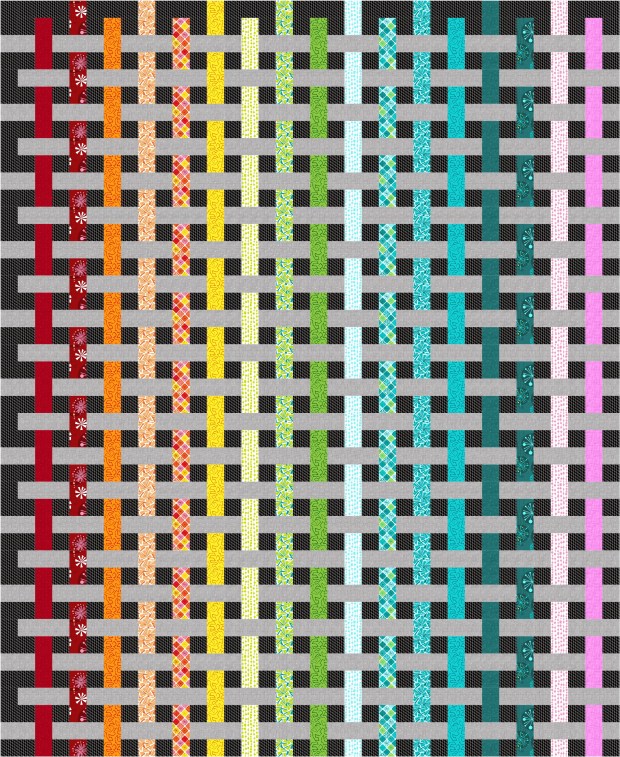
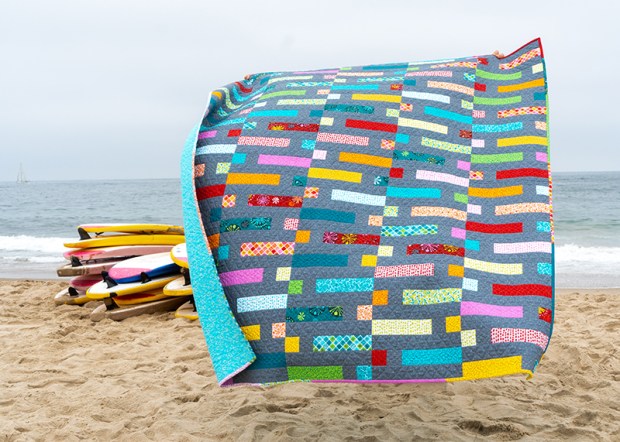
LatticeWork quilt by Christa Watson

LatticeWork by Christa Watson, 74″ x 82″ made from Abstract Garden 5″ Squares + background
Click here to get the LatticeWork quilt kit (while supplies last)

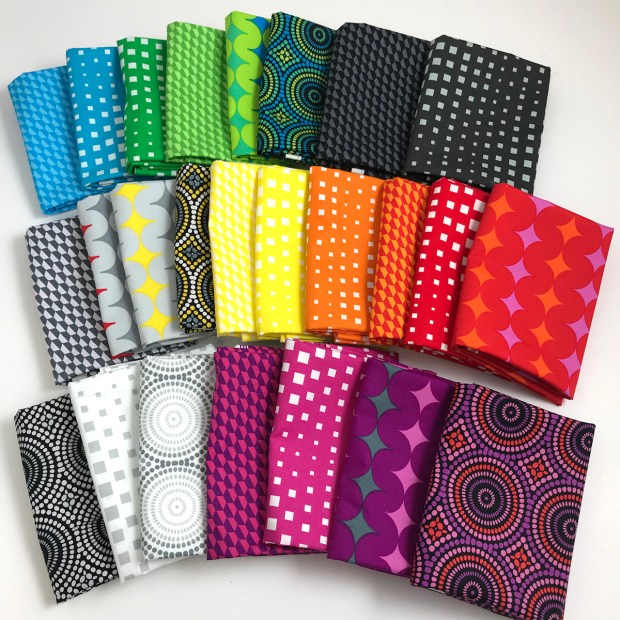
So without further ado, I’d like to introduce you to LatticeWork, made from Charm Squares + contrasting background fabric. I made my version using my Abstract Garden fabric line, but of course it works well for any set of precut squares.

Cutting the Fabric

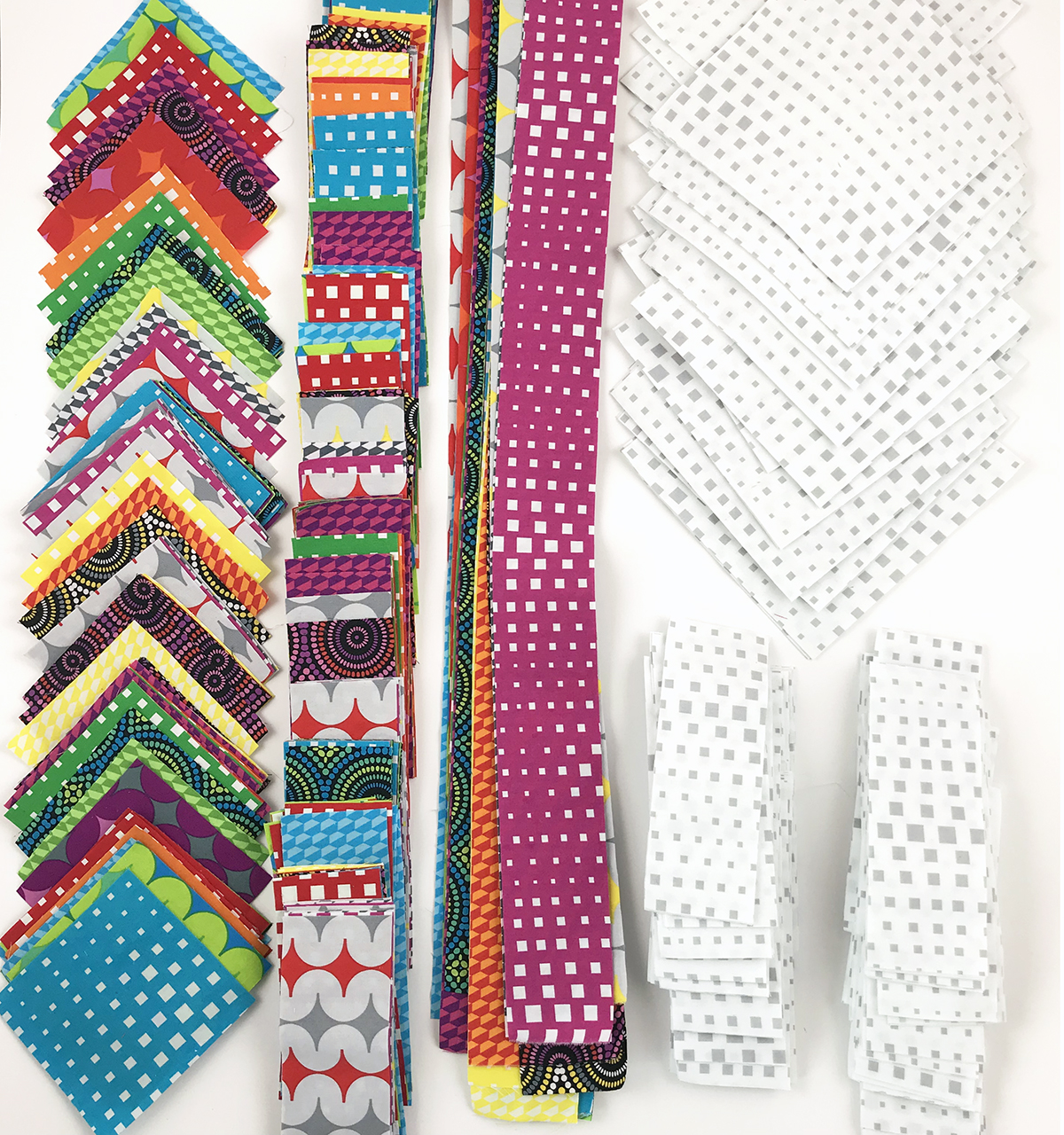
Because this quilt is mostly made from precut squares, there wasn’t much cutting. The pattern comes in 3 sizes and calls for 1, 2, or 4 standard size 5″ charm packs. I made the throw size above, from 4 Abstract Garden 5″ square packs, but you could also use precut 10″ squares and cut them down.

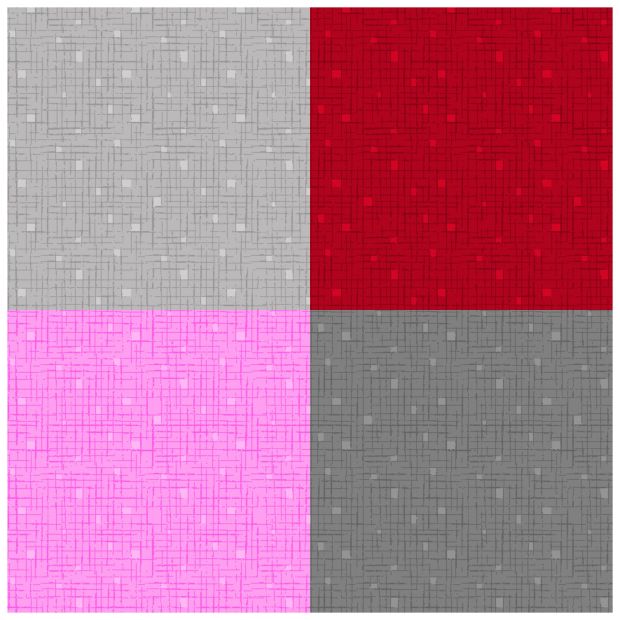
Or how fun would it be to mix and match precut packs, or create a custom bundle from your scrap pile? Anything goes with this quilt. As long as you have good contrast with the other 2 fabrics (black and grey in my version) it will look great!!

latticework cutting

You can make this quilt quickly and easily from my quilt pattern. Click the links below to purchase it in your favorite format:

Sewing the Rows

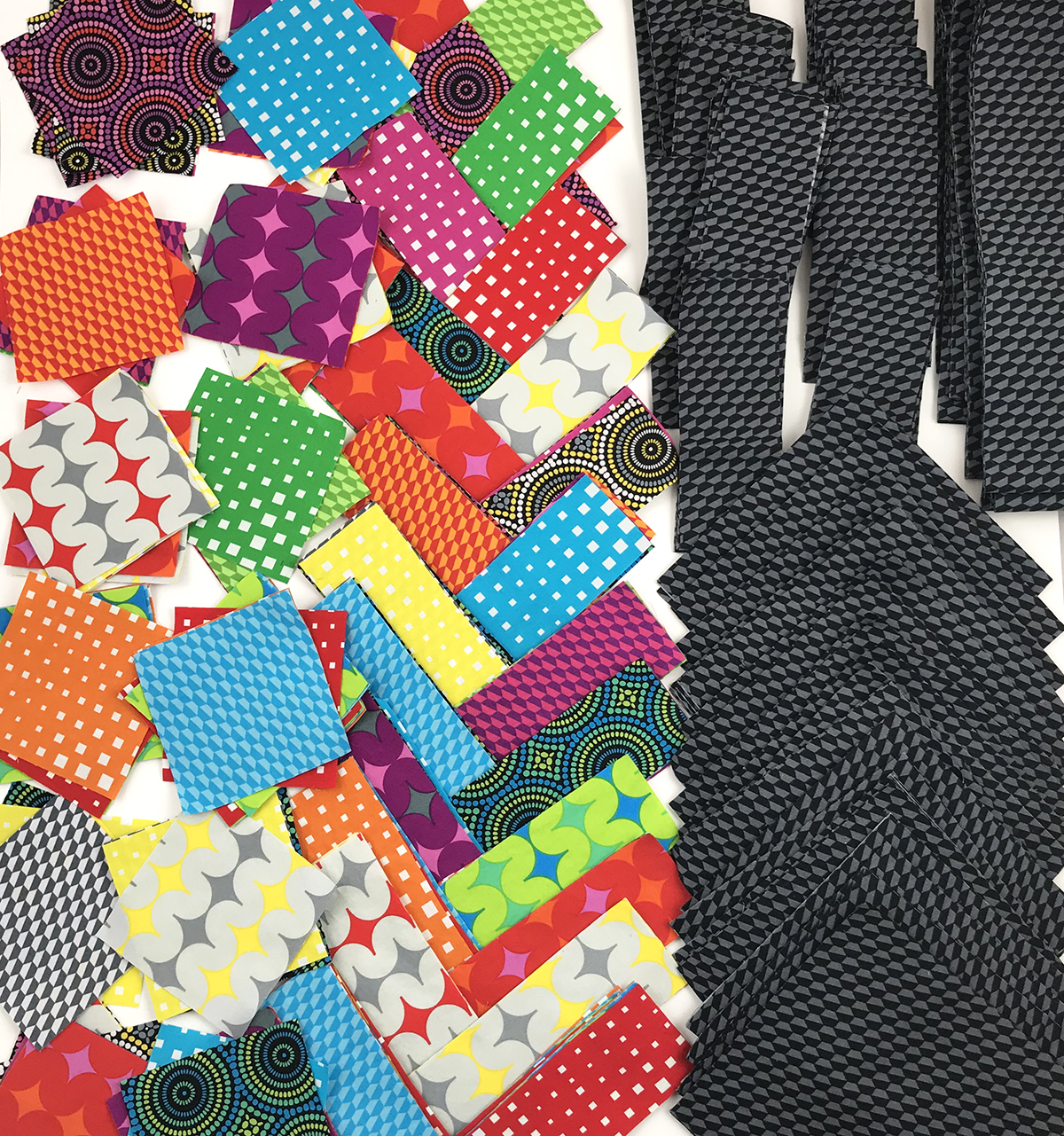
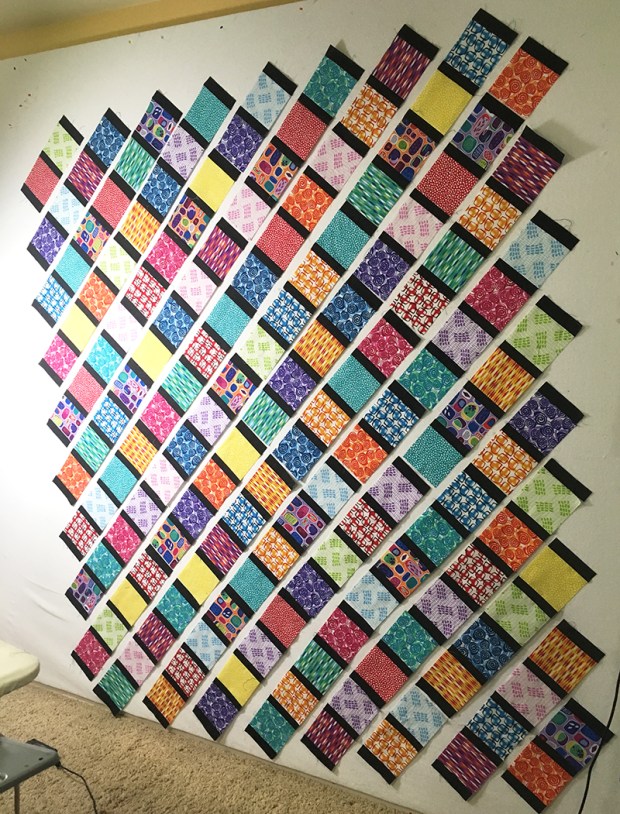
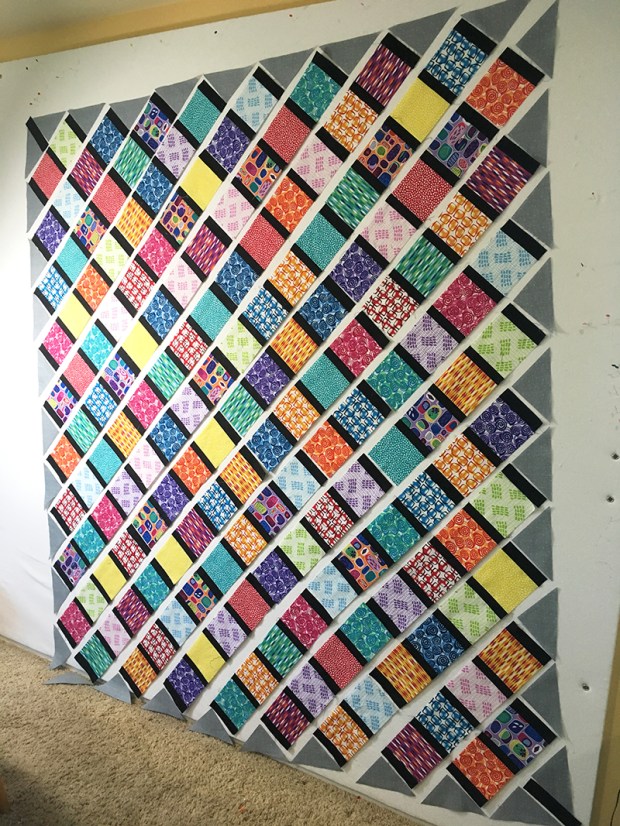
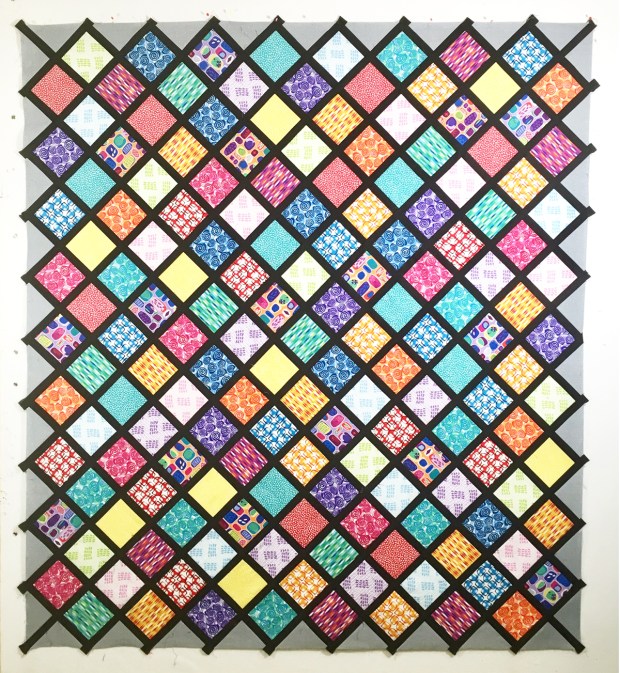
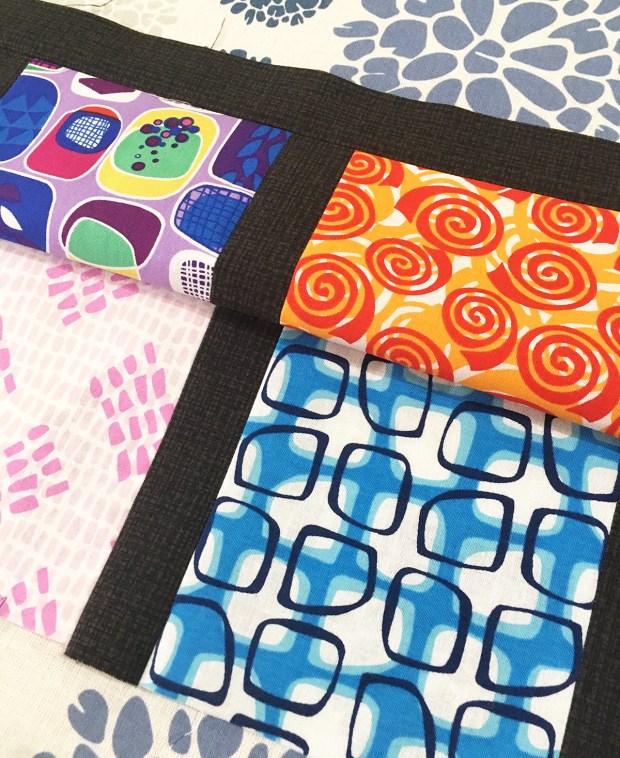
The only tricky part about this quilt is that you sew the rows with the black lattice and then cut off the extra to get nice straight edges. But I have easy to follow diagrams in the pattern so you won’t get lost. It’s very meditative for me to put up the pieces on my design wall and sew them together methodically. Here are a few in process shots of the top going together:

LatticeWork Making Of

My design wall allows me to lay out the entire quilt while sewing!

Whenever I sew scrappy looking quilts, I don’t spend too much time arranging the fabrics. As long as I don’t have 2 of the same fabric next to each other, I’m good to go. Most of my quilts are bright and colorful anyway with at least 20 different fabrics, so I don’t over-think it.

LatticeWork Making Of

Working with setting triangles isn’t tricky once you get the hang of it!

As you can see above, I don’t always lay out my quilts completely straight, but no biggie – it all sews together straight and that’s what matters!

LatticeWork Making Of

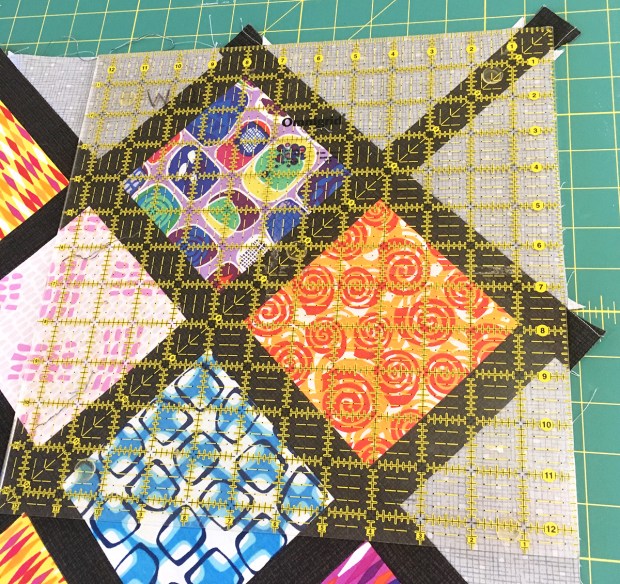
Those extra black tips will get trimmed away before adding the floating border.

Here’s a tip when lining up lots of rows without intersecting seams: fold over each previous row until the sashing lines up. Then pin like crazy to keep it from shifting.

Lining up the rows

Make sure each lattice row lines up before sewing. 

The last step before adding the final floating border is to trim up the corners and sides. Get the biggest acrylic rulers you can to help with this!

I forgot to get a picture of the finished quilt top before I basted it, but in part 2 I’ll share how I machine quilted it using one of my favorite fast and easy walking foot designs. Stay tuned!

Lattice Work Quilt Pattern

Part 2 – Machine Quilting will be available later this week so stay tuned!

Save the Date: Infrastructure Quilt Along Begins September 9

I’m thrilled with the reception that my Color Weave quit along received this spring/summer, and now it’s time to get ready for the next one! If you want to learn how to make an entire quilt from start to finish, click here to join the fun, and I’ll send you a reminder once the next QAL begins.

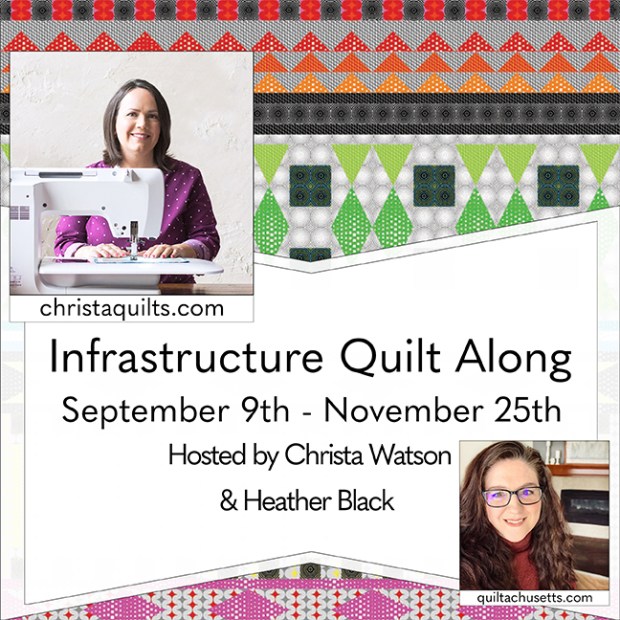
Infrastructure QAL

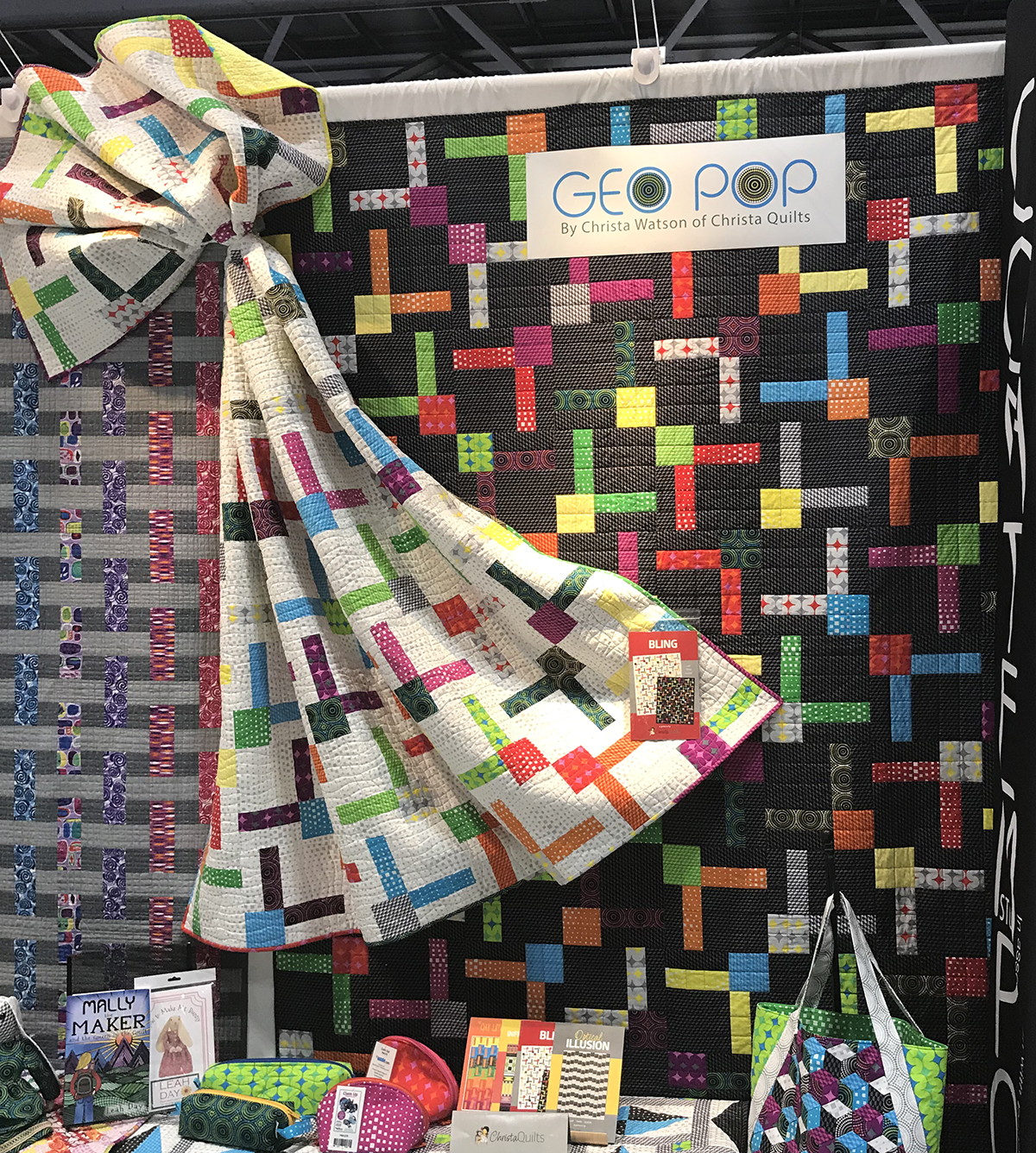
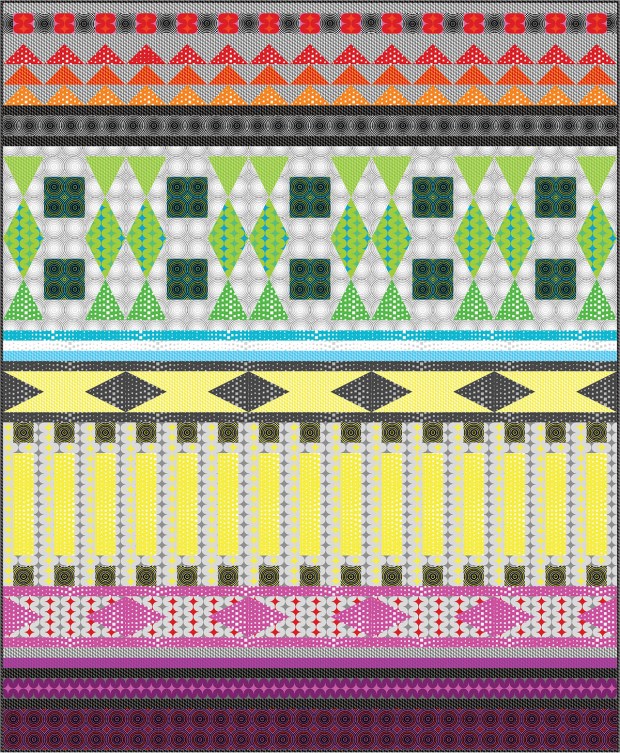
Infrastructure is a Modern Row Quilt designed by my friend Heather Black of Quiltachusetts. I wrote the pattern based on her design and now I’m excited to make it using my brand new Geo Pop fabric which has just started arriving in quilt shops!!

Heather is going to make her version using using Benartex Superior Solids which will look just as fabulous! I’ll be quilting mine on a domestic sewing machine while Heather will quilt hers on a longarm so you’ll learn lots of tips and tricks for doing both.

Infrastructure Quilt

Heather originally designed this pattern in Adobe Photoshop. I was able to redraw in EQ8 software enabling me to break down the design and the write a comprehensive pattern.

Infrastructure Quilt Along Overview

The quilt along will run for a total of 12 weeks: we’ll spend 9 weeks cutting and piecing the rows and assembling the quilt top. Then we will spend 3 weeks basting, quilting and binding. You’ll have plenty of time to follow along will and you’ll actually have a finished quilt by the time we are done! Along the way, you’ll learn how we approach making the quilt and I’m even going to throw in some video tutorials, too. I can’t wait!!

The quilt along itself is completely free; all you need to purchase is a copy of the quilt pattern using one of my links below:

I’m also offering Geo Pop quilt kits while supplies last. Click here to grab yours.

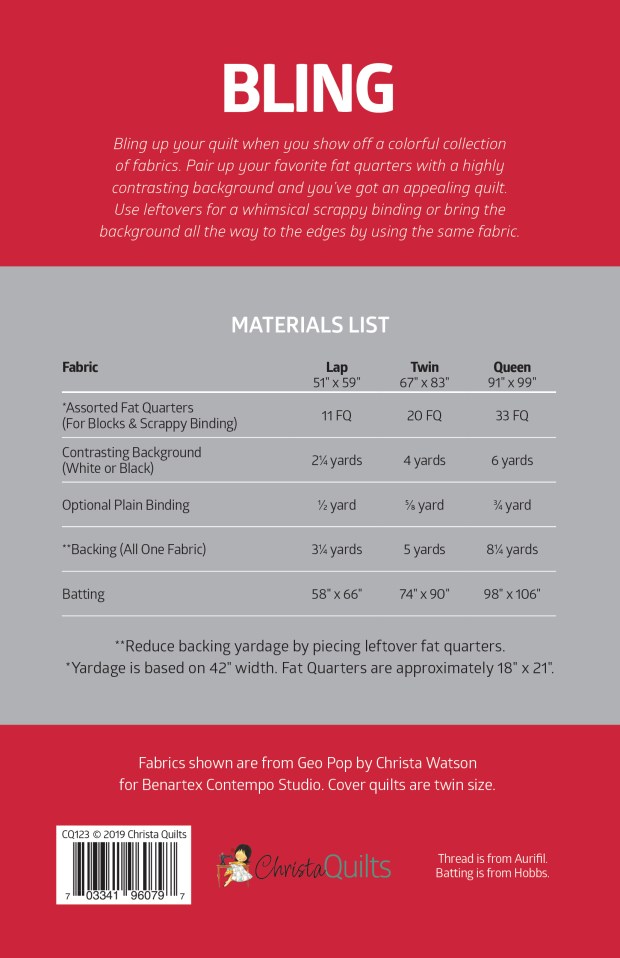
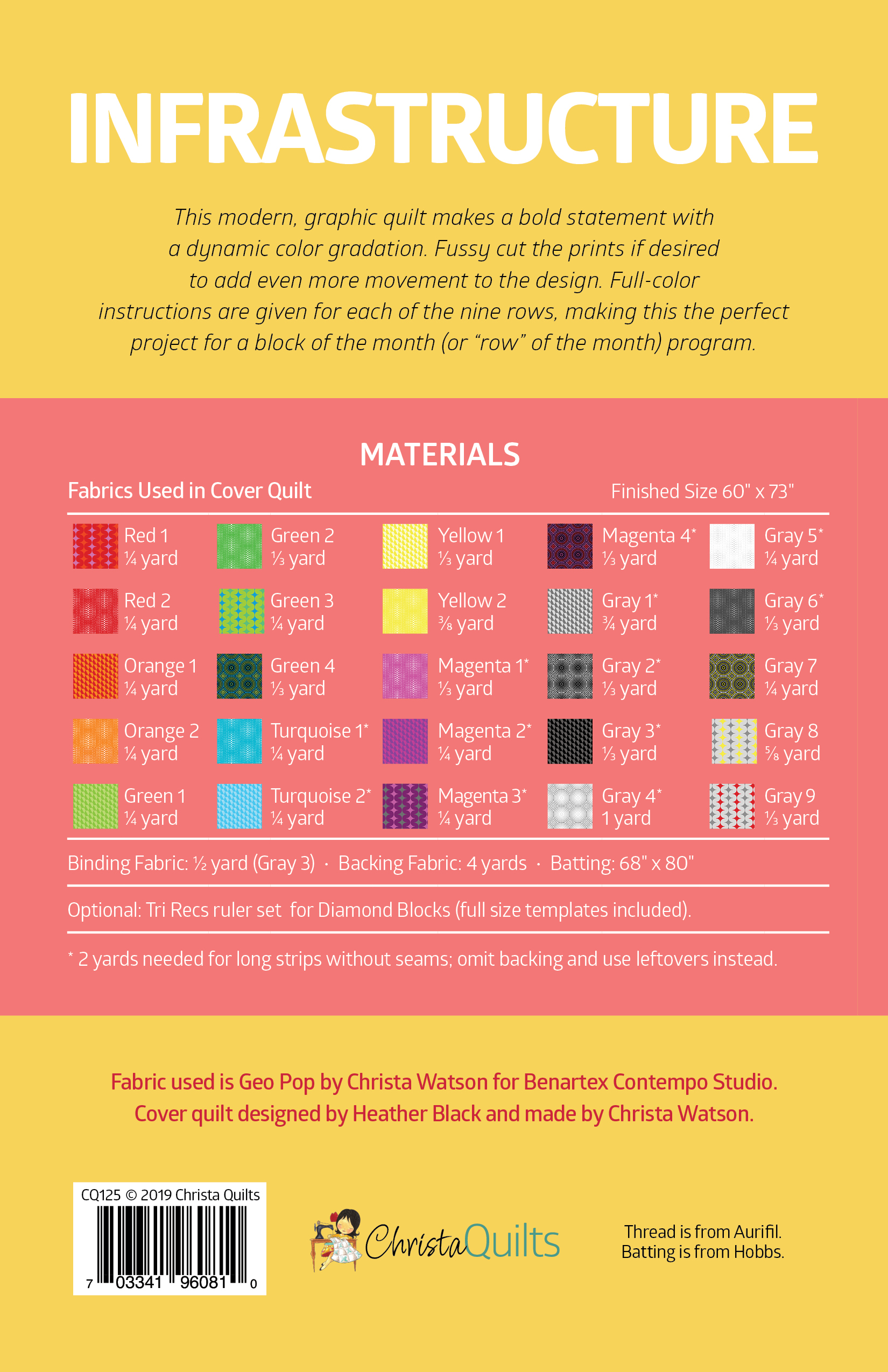
If you’d like to choose your own fabrics, see the materials requirements from the back of the quilt pattern below. Just pick fabrics in similar colors to get the same look as mine. You can click the image to enlarge:

Infrastructure Supply List

There Will Be Prizes!!

Heather will be coordinating weekly giveaways during the quilt along, from a wonderful group of sponsors shown below. Think of it as a great incentive to keep on going throughout the entire event!

Infrastructure Quilt Along Sponsors

I’ve gathered my fabrics and the first thing I’ll do is prewash, starch and press them. Prewashing is a matter of personal preference, but I do it to wash out any chemicals, preshrink the fabric, and get out any excess dye with fabric color catchers. I’ll meet you back here with an update at the end of the month. In the meantime, let me know if you plan to join, and click here to sign up for my quilt along newsletter!

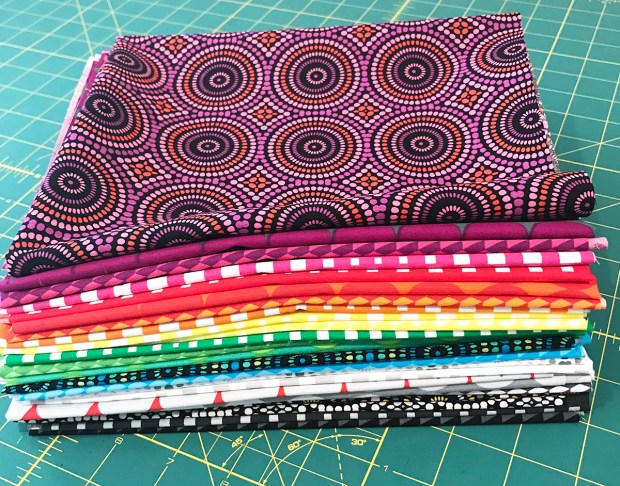
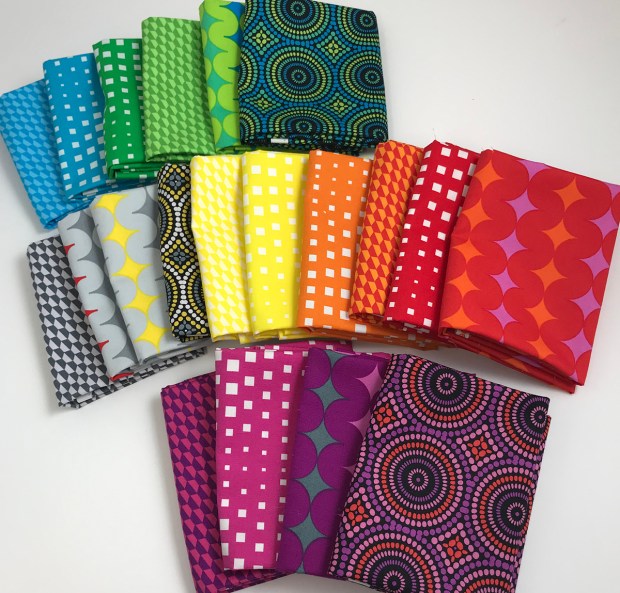
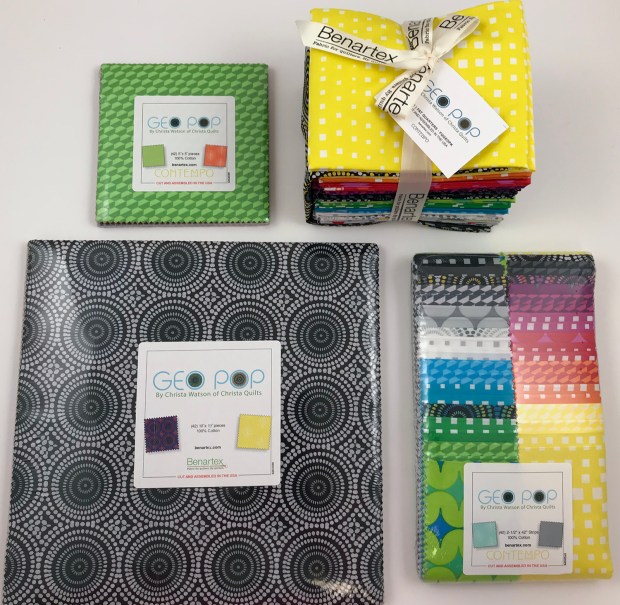
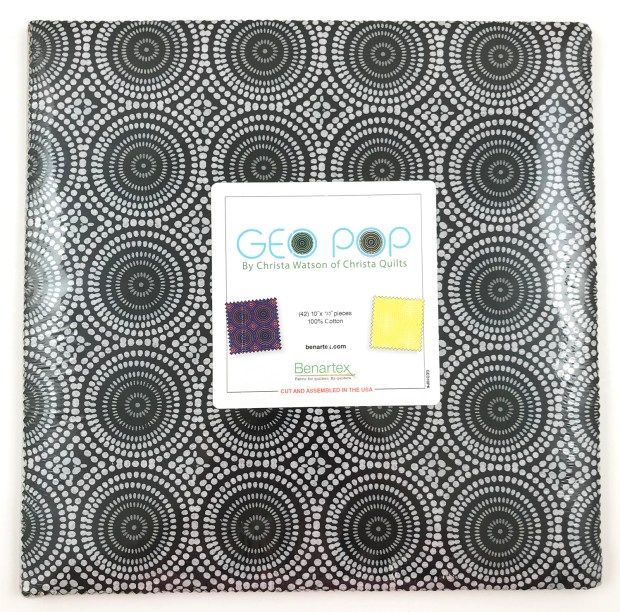
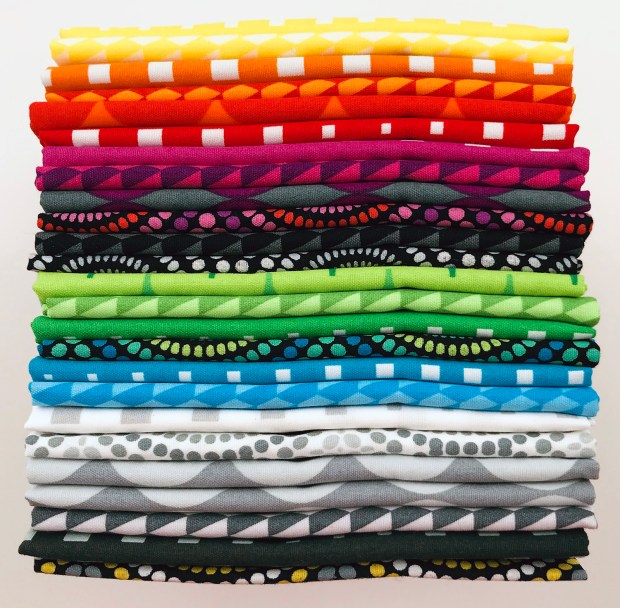
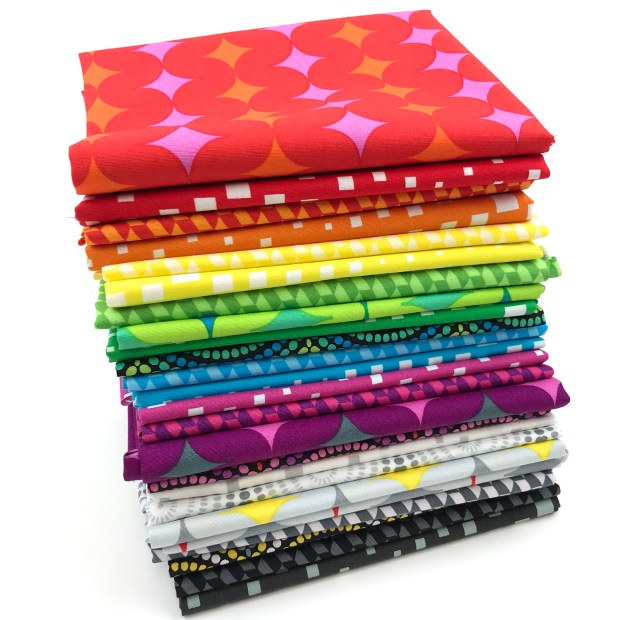
Geo Pop Bundle

Click here to get Geo Pop fabric, bundles and kits.

Blooming Wallflowers Quilt Revisited – See 3 Different Versions

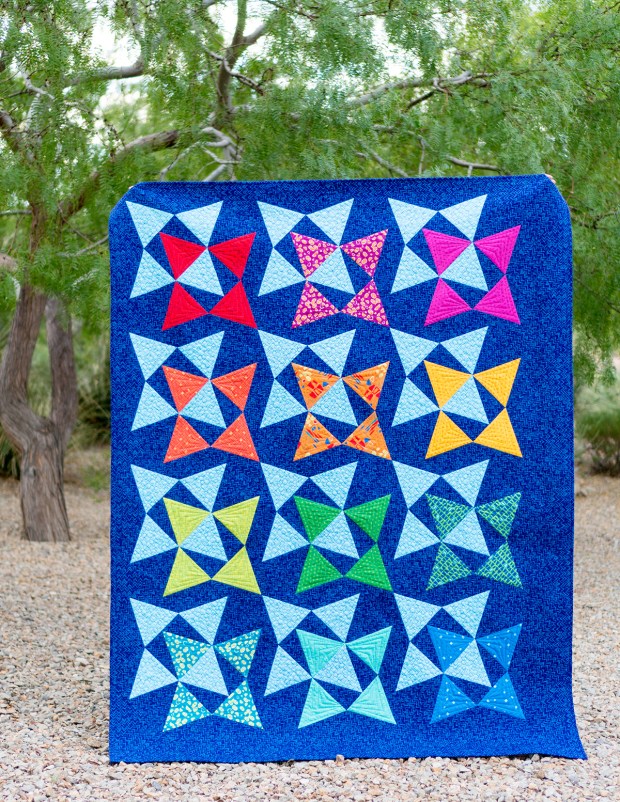
I wanted to do a quick throwback to my Blooming Wallflowers quilt because I’ve made it twice and digitally recolored it a third time, using 3 of my fabric lines. When I design a quilt, I love iterating to see what it will look like in different fabric/color combos!

Blooming Wallflowers in Modern Marks

Blooming Wallflowers Modern Marks

Click here to get the Blooming Wallflowers quilt pattern – PDF version.

Above is the original version, made completely in Modern Marks fabric. I originally made it for a magazine to promote my first fabric line when it came out. I had fun selecting the 12 rainbow prints from the line and pairing them up the light blue accent and dark navy background.

Blooming Wallflowers in Abstract Garden

Blooming Wallflowers quilt

Click here to get the Blooming Wallflowers quilt pattern – print version.

Once the publishing rights reverted back to me,  I decided to self-publish the pattern with a new cover to show case my third line of fabric, Abstract Garden. Again, it was fun to mix and match the prints and arrange them in a pleasing order. I used the navy herringbone print from Modern Marks again because it really made the other prints pop!

Blooming Wallflowers in Geo Pop

Blooming Wallflowers Quilt in Geo Pop

Click here for the free Blooming Wallflowers quilt along.

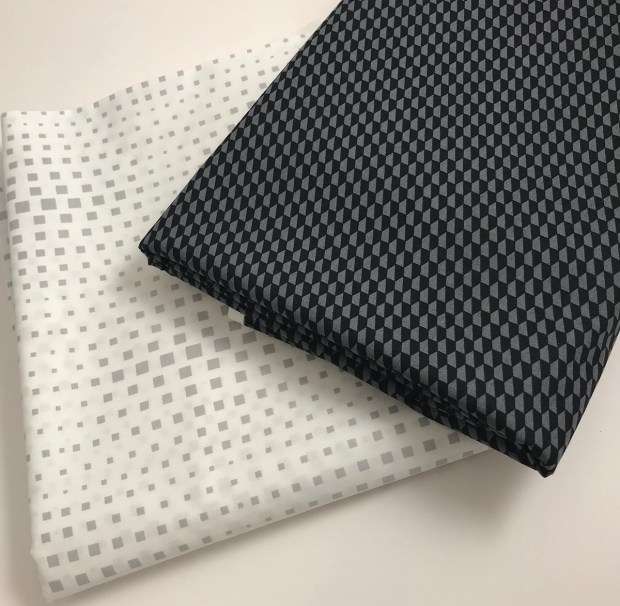
Now that my fourth line of fabric, Geo Pop officially releases next month, I wanted to see what the quilt would look like in the new fabric, with a different colored background. Thanks to Electric Quilt, I can upload jpegs of my fabric swatches and easily recolor it. It was fun to play around with different fabric combinations and I was happily surprised with how good it looks when pairing it with the yellow/gray Diamond Pop print and the charcoal Op Squares print for background. I may have to add this one to my “to make” list!!

What do you think? Which colorway is YOUR favorite?

Get the Supplies!

If you are new to the blog and haven’t seen this quilt before, click the links below for more info about the quilt pattern, fabric, and a recent quilt along to make it:

Color Weave Quilt Along Week 8 – Binding by Machine

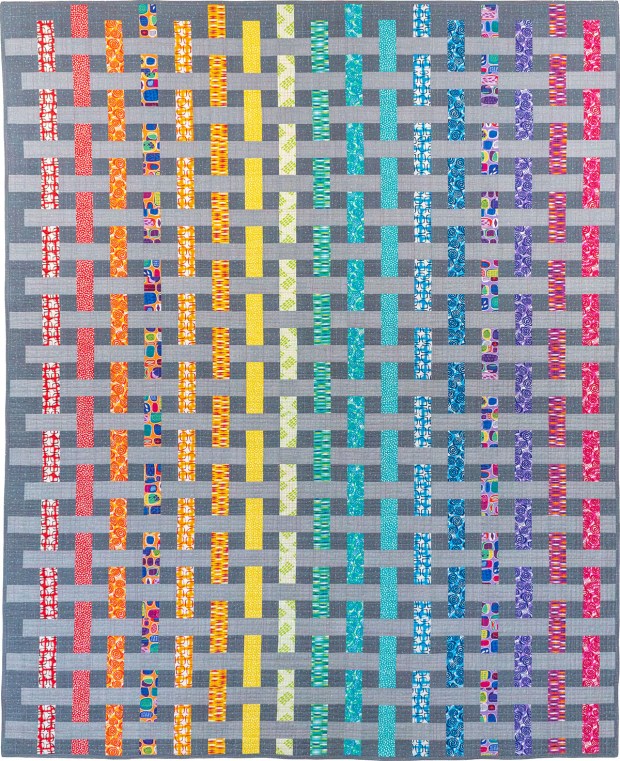
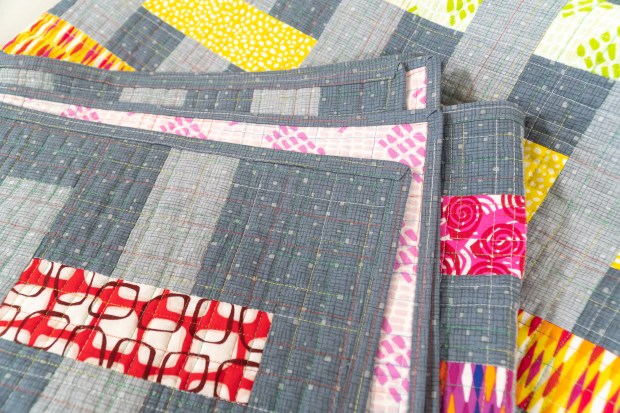
We’ve finally come to the end of our quilt along and I sure have enjoyed seeing everyone’s progress so far! This week we will finish the quilt with machine binding. Now usually, I prefer the clean look of binding by hand. However, I was in a hurry to make this quilt so I decided to make the machine stitched binding an overall part of the design.

Color Weave Quilt by Christa Watson

This tutorial is pretty heavy on the videos because I thought it would be much easier to SHOW you my process for binding and explain what I’m doing each step of the way. The videos don’t have any sound because I’m still getting comfortable with the process, but I’m learning so much along the way (just like quilting right?)! They are pretty short, just about a minute or two each, and very easy to follow along what I’m doing.

Binding Step 1: Square up the quilt

Trim off all sides evenly with a long acrylic corner. I like to use square rulers at the corners to keep things nice and square. I trim the backing and batting even with the quilt top so I can wrap the binding snugly around the edges.

Binding Step 2 – Make Continuous Binding Strips

The pattern gives the number of strips to cut and how wide. I actually like to cut mine a little narrower, at 2″ wide so that they finish an even 1/4″ on both sides of the quilt. To join them end to end, place the strips right sides together and sew from corner to corner. I’m pretty good at eyeballing the middle; if you need more help, you can mark the sewing line ahead of time.

When you open up the strip, you want the top and bottom of the strip to be nice and even. Trim off the excess fabric and press seams open. Trim off one tail of the binding at a 45 degree angle. This will be your starting end. Finally, press the binding in half wrong sides together with a hot, dry iron.

Binding Step 3 – Sew the Binding to the Quilt

Usually, I attach the binding to the FRONT of the quilt and then wrap it around the back to finish by hand. However, when binding by machine, I sew the binding to the BACK of the quilt and wrap to the front, then finish with a decorative stitch.

Attach the binding with 1/4″ seam starting on any side and leaving about 10″ of starting tail loose from the quilt. When you get to the corner, stop 1/4″ away from the edge and sew off the quilt. Fold the binding up so the edges are even, then fold back down on itself to form the corner miter. (Watch this part several times if needed to get the hang of it!)

Continuing sewing the next side in the same manner. When you reach the end of your quilt, leave a gap between the ending and beginning binding tails. Open up the ending tail (with the flat end) and place the beginning tail (with the angle) gently on top. Mark the angled edge on the ending tail and add 1/2″ for seam allowances on both ends. Carefully pin the ends together and sew. Finger press the seam open and clip off the excess fabric. Smooth it back down on the quilt and stitch by machine to close the gap.

Binding Step 4 – Secure the Binding with Decorative Stitches

When machine binding it’s nearly impossible to hide the stitches evenly in the ditch. So I make them a decorative part of the quilt! Fold over the binding to hide your stitching and secure with clips. The corners will form a natural miter when you fold them down. Fold them in opposite directions from the back of the quilt to reduce bulk.

I used the same variegated thread for the binding as I used for the machine quilting so it looked like part of the quilting design. First I stitched one line of stitching all the way around the quilt, right along the edge of the binding to secure it to the quilt. This is similar to topstitching near the seam of a garment. Then I went back and added another line of stitching about 1/4″ away to complete the pattern. I used a straight stitch but you could also try using a decorative stitch for a different look!

Ta Da! This is what it looks like when it’s all done. The quilt is secure and ready to use!

Machine Stitched Binding

I used the same Aurifil variegated thread for machine quilting and binding.

IMPORTANT LINKS

Click here for links to all of the quilt along posts.
Click here to share your progress in my Facebook group.

How You can Support ChristaQuilts

If you’ve enjoyed this quilt along, please consider supporting my efforts by purchasing any of my products using the links below. I sure love what I do and I thank you for your patronage!

Click here to purchase my fabrics by the yard.
Click here to purchase my precuts, bundles and kits.
Click here to purchase my print patterns.
Click here to purchase PDF patterns from my Etsy shop.
Click here to purchase a signed copy of my machine quilting books.
Click here to purchase my Aurifil thread kits.

Catching up with Christa – A Bit of This and That

How’s everyone’s summer going so far? I thought I’d do a catch-all post today, letting you know what’s been going on around here in real time. I feel like I’ve finally got a good work-life balance going that’s allowing me to keep up with consistent online content, too.

Resting, Relaxing, and Getting Healthy!

Last week, my family and I took our annual beach vacation in Hermosa Beach, California. This was the first time in a long time I’ve gone on vacation and not done any work. It was a very nice break and now I’m geared up and ready to for for a busy fall season coming up later this year. I’m currently working on my next fabric and book deadlines, but unlike in previous years, I’m not ignoring the blog or social media.

Hermosa beach vacation

While I was on vacation, I kick-started my determination to get healthy again. I worked out every day and chose healthier food options. Over the past 5 years, I’ve let my healthy habits slip and am excited to get back into shape. I’m not doing anything too crazy – just tracking what I eat and how much I work out. Somehow that magically transforms into small but consistent weekly weight loss! I’ll be posting a few of my adventures on my instagram stories so be sure to follow my @christaquilts instagram account if you’re interested in that.

Gearing up for Travel Season

Although I travel year round about once a month, I’m gearing up for a busy travel season over the next couple of months. In fact, I’m excited to be hanging out with the gang from QUILT of Northwest Arkansas this weekend, and then I’ll be traveling from coast to coast. You can catch me at Dave’s BERNINA in Utah in August, and then a couple of stops in New York in September and October. I’ll also be debuting my next line of fabric at fall quilt market and am excited to be part of the inaugural Threads of Success event at Houston Quilt Market.

Click here to keep up with my current travel schedule and let me know if you’ll be attending one of my events. I look forward to seeing you!

Updated Website Navigation

I have a LOT of content here on my blog, which also functions as my website. I’ve made it easier to find my free patterns, tutorials, quilt alongs, online classes and other content. Simply check out the menus at the top of your screen, and explore all of the content I have to offer. My #1 goal with quilting is to be your cheerleader, so you can have as much fun making quilts as I do!

Upcoming Quilt Along

Here’s a sneak peek of the quilt along my friend Heather Black and I are hosting in September, featuring my Geo Pop fabric line. More details will be coming soon, but save the date. I have a few Infrastructure kits available for a limited time.

Infrastructure QAL

With this upcoming quilt along, I’m hoping to venture more into video. The plan this summer is to film while I’m making the quilt so I can offer a comprehensive tutorial on all aspects of quilt-making from cutting to binding! The quilt along itself is free; all you need to purchase is a copy of the Infrastructure quilt pattern to participate.

Quilting Podcast Series

I was happy to be a returning guest on a relatively new podcast called “Make and Decorate” with Stephanie Socha. She’s currently running a series on how to quilt your quilts and she’s interviewed several well known quilters in the industry. I had a great time sharing some of my favorite tips and tricks. Be sure to check out her website for other inspiring interviews from some of your favorite designers and teachers. I love Stephanie’s voice and her enthusiasm for the craft is very infectious!

Make and Decorate Podcast

Click here to listen to my podcast interview.

Shipping Update – Flat Rate of $5 to the US

Although I love supporting independent quilt shops, I also keep a stock of my fabrics, patterns, books, and threads on hand for those who simply can’t find them at their favorite shop or don’t have a LQS nearby. To make it easier on the wallet for online purchases, I’ve updated my shipping across the board to be a flat $5 per order, no matter how much you buy. Hopefully that gives you incentive to stock up on your favorites without breaking the bank! I ship internationally, too based on the current flat rates for each country.

Geo Pop Fabric

Click here to shop all of my Christa Quilts branded products.

That about wraps it up for this week! I’m trying to consistently post 2-3 times per week and I always appreciate the comments, questions, and feedback I receive. You all make my full-time quilting career so much fun!!!

Color Weave Quilt Along Week 7 – Machine Quilting Random Crosshatch

How is your quilt coming along? Remember, you can work at your own pace, so please don’t every feel like you have to “catch up!” Last week I discussed making a quilting plan and stitching in the ditch to anchor your quilt. This week we will complete the Random Crosshatch quilting.

Random Crosshatch Quilting

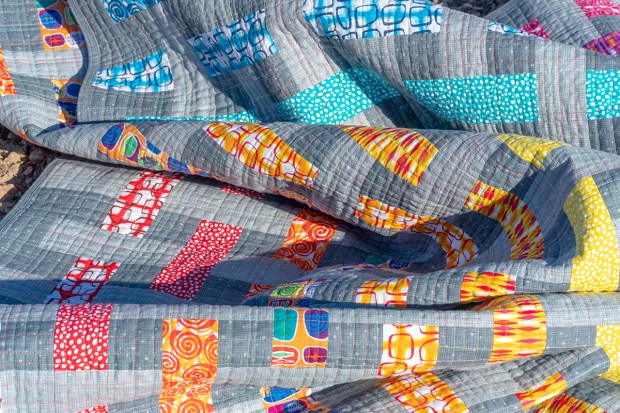
Here’s what it looks like after I’ve stitched in the ditch in both directions and am filling in randomly spaced lines vertically. My Aurifil variegated thread adds lots of texture and I’m not stressing out too much about whether the stitches are perfectly straight or all the same length. It’s more about enjoying the process!

Machine Quilting Random CrosshatchClick here to purchase yardage of the pink “Tracks” fabric from Abstract Garden.
I used the selvage as my label for this quilt!!

Because I quilted so densely, I started with 2 full spools of thread from my Auifil Variegated thread collection – one for the front and one for the backing in variegated colors that blend in with the quilt. Although I used up most of the spool, there’s still enough left that I can use for piecing my next quilt.

Machine Quilting Random crosshatch

I like to avoid marking my quilt as much as possible, so I’m using my  “divide and conquer” process which means I don’t quilt ALL of the lines in one area. Instead, I make several passes across the quilt in both directions, adding more and more lines until I’m happy with the way it looks.

Below are several videos I took of the random crosshatch quilting in progress where I’m adding additional lines of quilting. During an earlier pass across the quilt, I stitched about 1/4″ away from the ditch on both sides of the yellow fabric below. Now I’m using the previously stitched lines as a guide for no-mark quilting. I randomly changed my needle position so that the lines end up various distances apart as I go.

Doing this type of “irregular” quilting is much easier to do and gives a more interesting texture to the quilt. Next, this is what it looks like after I’ve added more passes across the quilt in both directions:

The pieced  texture is emphasized with the random spacing, and the variegated thread makes the whole quilt more exciting! It’s a really fun and forgiving machine quilting design to do. I recommend doing it over several days rather than trying to cram it all into quilting session. Here’s more eye candy quilting in progress:

And finally, here are some more detail shots of the finished quilting:

Quilting Random crosshatch

I love how the variegated thread adds a pop of color and dimension to the quilt!

Quilting Random Crosshatch

If you are ever unsure about your design – just add more quilting!!

Machine Quilting Random Crosshatch

Can you believe this quilt is nearly finished?! Next week, we’ll complete the quilt with fast and easy machine quilting – I can’t wait!

IMPORTANT LINKS

Click here to purchase the Color Weave Quilt Pattern – paper version
Click here to purchase the Color Weave Quilt Pattern – digital download
Click here to purchase the Abstract Garden strip roll
Click here to get my Aurifil thread collections
Click here for links to the previous quilt along posts
Click here to share your progress in my Facebook group

Christa’s Soapbox: Thoughts About Being a QuiltCon Juror 2019

QuiltCon – the modern quilting show and conference hosted by The Modern Quilt Guild – has recently opened quilt submissions for their 2020 show, so I thought now would be an appropriate time to share about what it was like to be on the jury of the 2019 show.

I’ve attended every event since the first one in 2013, have been lucky enough to have at least one quilt in every show, and have taught there 3 times so far (2016, 2017, 2019). In fact, I credit QuiltCon and The MQG with changing the course of my quilting career – for the better! So it was quite an honor and great responsibility when they invited me to be on the jury for the 2019 show, which took place in Nashville in February.

Cute QuiltCon Ribbons

QuiltCon award ribbons from the very first show in 2013

Now as you can imagine, I’m taking a bit of a risk here in even talking about this publicly since I know what a heartbreak it can be when your quilt doesn’t get in. Trust me, I’ve read enough “what were they thinking??” comments on social media to make my stomach turn. And I really do wish I could reach out and give every single person a huge hug for entering your gorgeous, wonderful, fabulous quilts!! It was truly a pleasure to see all 1800+ of them!!

Therefore, I thought it would be helpful and educational to talk about the experience in an open and honest way, with my hope for you to understand more about the process. I’ll be as transparent about it as I can, and would ask you the courtesy of being polite in your comments about this post.

My Quilt, “Charming Chevrons” hung in the very first QuiltCon in 2013!!

What’s a Juried Quilt Show?

First of all, let’s start with the basics. A “juried” show means that in order to display your quilt in the show, you must fill out an artist statement and include a high quality digital image of your finished quilt. A  panel of “jurors” (usually 4-5 people) look at each and every submitted quilt and then vote on which ones they believe should be a part of the show. The number one reason why a show is “juried” is simply because of supply and demand. There are only so many spots to hang quilts, and the number of entries far out weighs the number of spots available.
For example, each year QuiltCon receives approximately 1500-1800 entries and only has room for about 350 quilts. So that means 3 out of 4 quilts simply will not hang in the show due to space constraints. By comparison, a large national show (such as Road to California, Paducah, AQS, etc.) will likely have space to display 600-700 quilts or more, and my guess is that they don’t get anywhere near as many quilt entires. In fact, a friend recently told me that the upcoming International Quilt festival in Houston was able to accept about 75% of the quilts submitted this year. So please keep that in mind as I share more thoughts below.

To be clear, the JURY process and the JUDGING process are done by completely different people. The jury decides which quilts will hang in the show for the  judges to see.

Spiraling out of Control

My quilt, “Spiraling out of Control” hung at QuiltCon in 2015. Some day I’ll make a pattern!!

The QuiltCon Jury Process

Most of what I’m sharing here has been shared publicly so I’m not spilling any well-kept secrets. It’s up to an individual juror to decide whether or not they want to let others know they were part of the jury (after the show has ended of course). For obvious reasons, most people tend to stay silent about it.

Click here to read QuiltCon’s published judging and jurying documents.

In a nutshell, each juror takes a look at each and every single quilt that has been entered and gives it a numerical ranking. No juror knows how any other juror is voting and the final number is based on an average of all scores by all jurors. The juror gets to see two images of the quilt – an overall shot and a detail image. They can also read the artists’ statements if they so choose, but the juror does NOT see the names of who submitted each quilt. In this way, jurying is “blind” and fair.

The quilts that get the highest ranking are then accepted into the show, up until the maximum number of entries.  When there is a tie – usually for the mid-range of scores above the cutoff – the jury meets to discuss those quilts in more detail and decide which ones will be accepted until the total has been met. The MAJORITY of quilts fall into this category. So if yours didn’t make it in, I’m sure it barely missed the cutoff! (So try, try again!!)

The only category that was not juried was the youth category (quilts made by members under the age of 18). According to The MQG FAQ, “in order to encourage the next generation of quilters, in this category at least one quilt is accepted per quilter, should space permit it.” So if you know a child that wants to get involved with the show, I highly recommend encouraging them to enter!

My quilt, “Focal Point” from my first book hung at QuiltCon in 2016.

The Jury Takes Their Job Very Seriously

I can’t tell you the number of times I’ve heard false rumors that the jury has an “agenda” on which type of modern quilt will be accepted (or not). That’s simply not true. I can tell you from my experience that the jury is a well-rounded group of folks with diverse backgrounds, quilting experience, and areas of artistic expertise. However, one thing the jury all has in common is that they make modern quilts and understand the modern aesthetic.

I can only speak to my experience doing this one time, but I can assure you that we were not instructed to favor any type of quilt over any other, we were not told to create a certain look for the show (other than modern) and we were expected to look at the quilts objectively without bias or favoritism. If we felt we couldn’t judge a quilt fairly on its own merits, then we could recuse ourselves from judging that quilt. There was no absolutely no drama when it came to any discussions and the whole experience was completely professional.

The jury IS allowed to enter a quilt into the show, (as are the judges) but they are NOT allowed to be judged- AND the jurying is still blind. So none of the jury knew if they were voting on other members quilts! For full disclosure, I did get ONE quilt juried into this year’s show – my Blooming Wallflowers quilt – but I had entered two more that didn’t get accepted. So yes, I got those “reject” letters, too!!

Diamond in the Rough Quiltcon 2017

My quilt “Diamond in the Rough” hung in QuiltCon 2017 and was in QuiltCon magazine that year.
It will be part of the Aurifil exhibit at this year’s International Quilt Festival in Houston.

Why Quilt Photography Can Make or Break Your Quilt

Unfortunately, there were a number of quilts that weren’t accepted simply due to poor photography. If we can’t tell if it’s finished or not, if we can’t see the quilting, if we can’t see the edges or the binding, it most likely won’t get in. If there are people in the quilt photo blocking the quilt, we can’t see what you are trying to show.

Also, some people try to get a “leg up” on the competition by creating a collage of more than one photo in the same image which usually works to their detriment. If we can’t tell what we are looking at, it most likely goes in the “not accepted” pile. We don’t need to see the back of the quilt unless that’s the side you are entering. Just show the front on a clear flat surface, with nothing distracting in the picture. And don’t “style” the shot. We just want to see the quilt, not a beautiful background or distracting props.

Also, it breaks my heart to see a quilt entry with poor lighting or fuzzy focus. There have been times where I’ve seen a gorgeous quilt photo later on social media (after the entries have been finalized) and I thought, why didn’t they use THAT image for their entry instead of the fuzzy one?? So again: good, clear, well-lit, uncluttered photography is a MUST.

Color Weave Quilt

The original version of Color Weave hung at QuiltCon in 2018.
it was in Modern Quilts Unlimited Magazine which is now sadly out of print!! 

My Personal Thoughts

The biggest take away from my experience on the jury is that it was extremely fair. For me, it was a very touching and heart-warming experience to look at each and every one of the quilts and read ALL of the artists’ statements. Some brought me to tears, others made me my heart sing with joy, and many made me think deeply about their work.

With over 1800 quilts to look at, I didn’t keep track of the hours and hours and HOURS I spent viewing all of the amazing, wonderful quilts. But It was the most uplifting quilting experience I’ve ever had – and if there were enough room, I would have accepted them all. I truly felt it an honor to interact with these quilts in such an intimate way.

One of the coolest things I heard this year was that so many quilters who were rejected previously were able to get something in this year. So you never know until you try. And I’ve seen many quilters who didn’t make it into QuiltCon go on to enter (and win) in other shows.

So I welcome your thoughtful questions and kind comments about the process. Of course I can’t speak to any individual quilts in the show as to why they were or were not accepted. And due to the sheer numbers of of quilts involved, there’s no feasible way to share individual juror feedback on any of the quilts. But what I can do is encourage you to enter future quilt shows.

Blooming Wallflowers by Christa Watson QuiltCon 2019

My one and only quilt that was juried into QuiltCon 2019 – Blooming Wallflowers.

It was so wonderful for my fellow jurors and I to be entrusted with your quilts. We all volunteered our time because we are just as passionate about quilts as you are. So please, if you entered a quilt and it didn’t get in, don’t think badly of the process, of THE MQG, or of your quilt. I can tell you personally that I saw your quilt and LOVED it – and would encourage you to keep making quilts, and PLEASE keep sharing them with the world!

I’m happy to continue this discussion in the comments as long as everyone plays nice. 🙂

Etsy Summer Sale: Buy 3 PDF Patterns – Get 1 Free!

I’ve been selling PDF/digital patterns on Etsy for a few months now and have been very pleased with the results so far. Now it’s time for me to test out the coupon/sale functionality. So for one week only (through 7/22)  I’m offering a super summer sale: buy any 3 PDF patterns and automatically get one free. It applies to all 18 of my patterns in my Etsy shop, with no coupon required!

Christa Quilts Patterns

 Click here to buy 3 get 1 free on all PDF patterns!

The fine print: This applies to instant downloads only purchased through my Etsy shop, not paper patterns purchased on other sites. So stock up on your faves, now!

Color Weave Quilt Along Week 6 – Stitching in the Ditch

Now we’ve reached my favorite part of the quilt-making process – machine quilting!! Quitling will be broken up into 2 parts so that it won’t feel so overwhelming. The quilting design I’ve chosen – random crosshatch, is actually very easy to do, but it can be a bit time-consuming if you like your quilting to be as dense as mine.

Random Crosshatch quilt plan

My favorite designs to quilt are those than can go all the way across the quilt without starting and stopping. That way I don’t have to worry about tying off and burying my threads. The random crosshatch above is basically a series of straight lines quilted across the quilt in both directions with a walking foot. You start and end each line of quilting in the batting, and that will get all trimmed up later once you add the binding.

Thread Choices

I also don’t want to stress too much over thread color. I prefer to use 1-2 colors for the whole quilt, if possible. My thread of choice is Aurifil 50 weight cotton because it comes in any color I need. It’s thin but strong and blends into the quilts I make rather than being the star of the show.

Because this quilt has so much color in it, I chose to use threads from my new Variegated Thread Collection. I used #4650 Leaves for the top of the quilt. Although it will show up on the gray sections, by the time I add lots of texture, it won’t be that noticeable.

Aurifil variegated thread

I like to “audition” my thread choices before I begin quilting.

For the bobbin, I used #3852 Liberty since it reads more pink. For 95% of my quilts, I use the same thread in top and bottom. But every now and then I’ll use two different colors when it makes sense.

The thread will still be visible on both sides, but with so many different colors (in the fabric and thread), these were the best choice. I made a practice piece with leftover scrap fabrics and tested both threads to make sure I’d be happy with the results before I started quilting my quilt.

Aurifil Variegated Thread

 #3852 Liberty and 4650 Leaves can both be found in my Variegated Thread Collection from Aurifil.

Machine Quilting – Stitch in the Ditch

To break the quilting into easier, doable steps, this week we’ll focus on just stitching in the ditch in both directions. This will secure the quilt for further quilting later, and will also evenly distribute the bulk of the quilting across the quilt. You can also decide at any point how lightly or densely you’d like to quilt the rest of the lines.

Here’s a short video clip showing how I deal with the quilt as I stitch in the ditch. I’m using my BERNINA dual feed foot which works the same way as a regular walking foot. I have an open toe so I can see what I’m doing and I reposition the quilt a lot so that my quilting lines are smooth the entire time. Also, pressing my seams open makes it sooo much easier to stay in the ditch!!

Notice in the video below that when I quilt an area without seams, I just eyeball the straight-line I’m stitching. Because it’s never more than 2″ that I have to eyeball, it works pretty well.

First, I started quilting from the right side of the quilt towards the middle. I quilted in the ditch every 2″ since that’s the finished size of my strips. I quilted all of the vertical seams first, then rotated the quilt and quilted all of the horizontal seems to create a quilted grid.

It’s easier to work from the side of the quilt towards the middle, because that’s less bulk to deal with at the beginning. By the time it gets too bulky, you’ll be halfway across the quilt and you can rotate the quilt, continuing from the center to the other side.

Here’s another video of me quilting from a wider angle. I really just scrunch and smoosh the quilt however I can, re-shifting whenever necessary.

Once I “anchor” or stabilize the quilt with ditching in both directions, I go back in and quilt randomly spaced lines, using the edge of my foot as a guideline for spacing. That will be our goal for next week, so I’ll see ya then!

IMPORTANT LINKS

Click here to purchase the Color Weave Quilt Pattern – paper version
Click here to purchase the Color Weave Quilt Pattern – digital download
Click here to purchase the Abstract Garden strip roll
Click here to get my Aurifil thread collections
Click here for links to the previous quilt along posts
Click here to share your progress in my Facebook group

How to Make a Quilting Plan for Your Quilt

Since we are getting ready to quilt our quilts for the Color Weave Quilt Along, I thought it would be helpful to discuss how I make a quilting plan, using examples of some of my previous quilts. Then it will make more sense when I write about machine quilting for the next installment of Color Weave. For those of you NOT doing the quilt along, this info is still helpful for any quilt you make!

Machine Quilting Color Weave

Machine quilting my Color Weave quilt.

I’ve had fun sharing my methods in three machine quilting books I’ve written along with my online classes through Bluprint (formerly Craftsy). Each of these resources includes not only step-by-step patterns for piecing a quilt; each pattern also includes a complete quilting plan with instructions on how to finish your quilt!

Christa Quilts Machine Quilting Books

Today I’ll share a several quilting plans and explain how I break down the quilting process. Then hopefully, you’ll be able to incorporate some of my methods into your own work.  But first, before we even get to that part, you’ll need to get your quilt ready for quilting. Be sure to check out my earlier post from this week about preparing the backing and basting – which works for any quilt!

Hobbs Batting Cotton/Wool

Click here for my pieced backing and spray basting tutorial.

When I’m making a plan, the first question I always ask is, what’s the purpose of the quilt and how much time do I have to finish? For example, If it’s for a baby shower coming up this weekend, I’ll stick with fast and simple quilting, like an allover design. Here’s a simple block quilting plan showcasing one of my go-to modern quilting motifs: boxes. The plan is more of a guideline of how to work my way around the quilt rather than an exact replica of the stitching I’ll do.

Allover Free-Motion Quilting Plan

First, I will draw the design on paper to get a feel for how it will flow across the quilt. Then I’ll quilt it out on a practice block, or even a scrap of fabric and batting to check thread color and tension. Finally, I’ll apply the design to the actual quilt.

To quilt an allover quilting design, pick a favorite free-motion motif and quilt the design randomly from edge to edge, regardless of the pieced design. It’s fast, fun and easy to do, and by the time you reach the end, you’ll be an expert at that design! I quilted the free-motion design shown above, on my quilt “Stepping Stones“, below:

Stepping Stones by Christa Watson

Click here to get the Stepping Stones quilt patten for just $6.95 while supplies last.

To make a plan for an allover design, I always start quilting on the right side of my quilt and work my way towards the middle. When the quilt gets too bulky, I rotate it 180 degrees and then finishing quilting from the middle to the other edge of the quilt. It’s much, much easier to start quilting when there’s no bulk under the machine, and you work your way across the quilt a few inches at a time.

By the time you’ve reached the bulkiest part in the center, it’s time to rotate the quilt, and then it gets less bulky again as you work your way across the other way. As long as you’ve done a good job basting your quilt, there’s no need to start in the center and stress yourself out with all of that bulk to begin with!

Stepping Stones Quilt Pattern by Christa Watson of Christa Quilts

Here’s what the quilting looks like on the actual finished quilt. Remember, I didn’t try to replicate the design exactly, I just meandered my way across the quilt in an organized manner, block by block. Like everything I design, my Stepping Stones quilt pattern includes instructions for both piecing AND quilting.

Allover Walking Foot Quilting Plan

You can also use the edge-to-edge quilting process with walking foot quilting, by using a process  I call “divide and conquer” – or breaking down the quilting design into smaller manageable chunks. I still start on the right-hand side of the quilt work my way across towards the center, rotate, and then continue from the center to the other side. In this example, I’m planning to quilt a wavy line design “near” the ditch rather than “in” the ditch because wavy lines are much faster AND easier to quilt than straight ones!

I’ll quilt my wavy lines in one direction for all of the vertical seam intersections, and the spacing will depend on how wide the blocks are. This first pass across the quilt is called “anchor” quilting and will secure the quilt for additional quilting later on. It also distributes the density of quilting evenly across the quilt.

First, I sketch out my plan on an image of the pieced quilt design. You can print off a digital image of the quilt if it’s something you designed in Electric Quilt (or other design software). You could also make a photocopy of a sketch or pattern cover and blow it up big enough for you to draw on. You could even take a picture of of the finished quilt top and then print it out in black and white on a regular size piece of paper, too.

Once I’ve quilted the first pass across the quilt, I’ll quilt  more wavy lines in between until I’m happy with the final line spacing. When planning a quilt, I won’t necessarily draw in all of the lines, but I’ll sketch enough of them to remind myself of what I’m doing. You can follow the exact same plan above using straight lines, wavy lines, or even decorative stitches on your sewing machine.

Here’s me putting the quilting plan into practice, “scrunching and smooshing” the quilt under the machine as I go. Look closely near the bottom of the image to see how I’m filling in lines of quilting between each of the “anchor” lines.

The quilt shown is called “Modern Puzzle” showcasing jelly rolls of my fabric, but of course it would look fabulous in any fabrics. It’s the perfect pattern to practice your “divide-and-conquer skills!” The best thing about quilting several passes across the quilt is that you can decide to stop at any time, once you are happy with the spacing of your quilted lines.

Custom Quilting Plan

Now, If I want to spend more time quilting a special quilt, I’ll do custom quilting, combining both walking foot quilting and free motion motifs. To divide and conquer the process, I’ll break the quilt down visually into these elements: the ditch, the blocks, and the background. Then I’ll quilt something different in each section.

Here’s an example quilting plan for my free quilt pattern “Beaded Lanterns” – made from one strip roll of my Fandangle fabric line.

Step 1 – Stitch in the ditch between each row of blocks. Here, I’m treating each row of blocks as one unit so I’m basically outlining the shape of the blocks while stitching the vertical ditches. However, I’m NOT stitching the horizontal ditches so that I don’t have to stop and start as much.

Optional: Echo the ditch to further separate the elements of the quilt. This is also called outline quilting or channel quilting and will help provide more contrast between the blocks and the background, separating the quilting designs so they’ll stand out more.

Step 2 – Free-motion quilt “something” in the background. By this, I mean pick ANY free-motion motif you like and quilt it in all the background areas. I happen to really like quilting pebbles in defined areas so I use them a lot. Remember, this isn’t an exact replica of what each stitch motif will look like. It’s just a roadmap that will tell me which design goes where.

Step 3 – Free-motion quilt a different design in all of the blocks. The fun part is figuring out different combinations of designs you like, and there’s no right or wrong answer! Because my background had dense curved pebbles, I chose something more linear and slightly less dense in the blocks to create contrast between the two designs. Because the blocks are made from busy prints, the quilting won’t show up as much so it’s a great place to practice a fun design that doesn’t have to be perfect!

Remember, for each pass across the quilt (ditch, echo, background, blocks) I’m working from the right side of the quilt towards the middle, rotating the quilt, and then working from the middle to the other side of the quilt. I only concentrate on one section of the quilt at a time, and reposition my hands whenever I feel like I’m reaching. By breaking down each step of the quilting plan, the whole process seems much less overwhelming.

Simpler Custom Plan

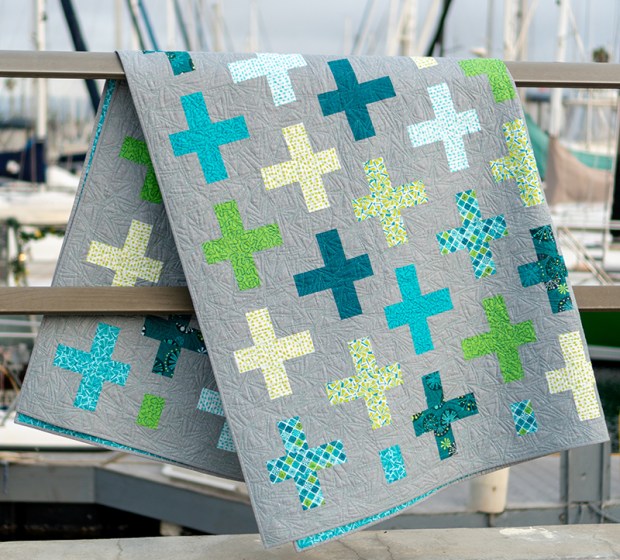
I’ll share one final quilting plan that’s a bit simpler to execute, but still gives a custom look. This is the plan I created and included in my “Positive Direction” quilt pattern. It’s a combination of straight lines and pebbles which emphasize the subtle arrow design made by the color arrangement of the pieced plus blocks.

I quilted all of the straight lines with a walking foot first, and then filled them in with additional straight lines until I was happy with the spacing. Then, in the remaining areas, I filled in the rest with free-motion quilting.

And here’s what the finished quilt looks like below. The quilting adds yummy texture, but doesn’t overwhelm the pieced design. After all, the more quilting you add, the less you see the individual stitches.

Click here to get the Positive Direction quilt patten for just $6.95 while supplies last.

I hope this gets you excited to break down the process, and not be afraid to dive in and quilt your own quilts. If you’d like for me to cheer you on in your machine quilting journey, be sure to join my Quilt Along email list where I’ll share lots of tips and tricks for quilts we can make together! You can also catch me on instagram @christaquilts where I usually show what I’m working on in real time. Happy quilting!