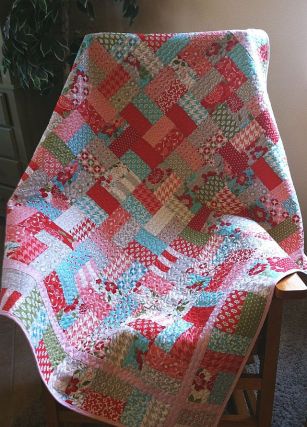
Christa’s Quilt Along 1.4 – Backing and Basting Your Jelly Roll Quilt

Welcome to part 4 of my do-it-yourself quilt along! So far we’ve gathered our supplies, sewn the blocks, and completed our quilt tops. This week we will piece our backings and baste our quilts so that our Jolly Jelly Roll Quilts are ready for machine quilting next week!

Step 1 – Piecing the Backing

Backing DiagramIf you use one fabric entirely for your backing, sew together two lengths of fabric so that your piece is at least 5 inches longer and wider than your quilt.

For a 52″ x 52″ quilt top you would need 3 1/2 yards of fabric for the backing. Cut that into 2 equal pieces, each measuring 63″ long by 42″ wide. Sew those together on the selvedge edges with a half inch seam and you’ll get one piece that is about 63″ x 80″ – plenty of room!

I wrote up a post a few weeks ago on how to make a pieced quilt backing. With more than one fabric. You can read about that by clicking here.

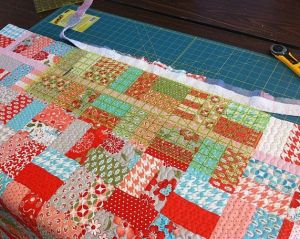
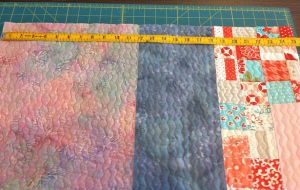
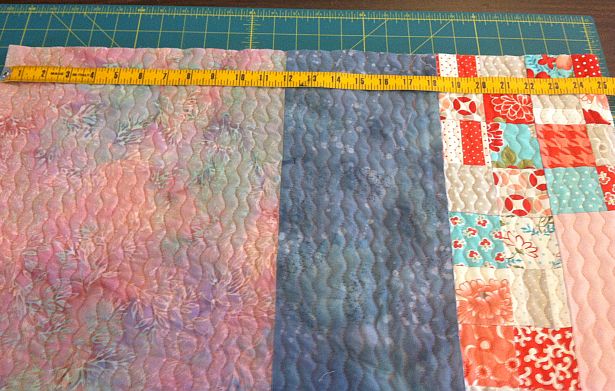
Pieced Quilt BackFor my backing, I chose to use up all of my leftover jelly roll blocks plus some other chunks of fabric, about 3 yards total, to make it a little more artistic.

I sewed two rows of leftover blocks, then filled in with strips of pink and grey fabric from my stash.

The pink on the sides is much wider so a bunch of it will be trimmed off later.

(Don’t mind the wrinkles – I finished it just last night!)

Step 2 – Layering the Quilt

Basting TablesThe most important thing you need for successful basting is plenty of room! I have two 8-foot tables set up in my sewing room at all times. I use them for cutting and basting.

First, you need to secure your backing; this is why you want it to be larger than your quilt top.

I do this by using office clips to secure the backing to the table. I use tape when the quilt backing does not reach the edge.

Clamp Down the BackingTape the EdgesNext, it’s time to spread out the batting. I used Warm-N-Natural cotton batting which does have a right and wrong side. The side with the flakes is the front side and the whiter side is the back side. Layer it right side up.

You can start with your batting folded up in one corner, then unfold the batting one step at a time if you are basting by yourself. Be sure to smooth it down so there are no wrinkles.

Batting 1Batting 2Batting 3You can click each of the pictures for a larger more detailed view.

Finally, it’s time to add the top! I don’t clamp down the top, but I do smooth it out and line it up as much as I can so that it is as straight and square as possible.

Layered QuiltStep 3 – Basting the Quilt

Now it’s just a matter of pinning the layers together so they won’t shift during quilting. My favorite basting tools are Pinmoor pin anchors. They are little  rubber tips that fit on the end of straight pins. You can use any types of pins with them and the pins can jab anywhere into the hard rubber piece. They last forever and are so much easier to use than safety pins.

Pinmoor BastingIt took me about 150 Pinmoors to baste this quilt in under 20 minutes. If you are not ready to buy enough for a whole quilt, start with one package and baste part of your quilt. Baste the rest of your quilt with safety pins. Then, when quilting, take note of how much easier the pins and Pinmoors are to remove and you will be converted!

Here’s a great video you can watch on how to use them, made by the makers of Pinmoors.

Next week  we will machine quilt this baby! That’s the best part of my do-it-yourself quilting tutorial; you are actually going to do it all yourself – no quilting by check here!!

Remember to send me pictures of your completed quilt tops. You can email me directly at Christa@ChristaQuilts.com. It’s “sew” fun to share!


Here is the complete Jolly Jelly Roll Quilt-Along Schedule:

Week 1 – Supply ListJolly Jelly Roll Quilt

Week 2 – Sewing the Blocks

Week 3 – Completing the Top

Week 4 – Backing and Basting

Week 5 – Machine Quilting

Week 6 – Machine Binding to Finish

Sew and Tell Friday – Quilts from Precuts

This week for Sew and Tell Friday, I want to share with you an adorable charm quilt that my mom made, plus a another show-and-tell from our Jolly Jelly Roll do-it-yourself quilt-along.

My mom is a very prolific sewer. She taught me how to sew, and in turn, I introduced her to quilting many years ago. She recently made this adorable quilt top from a Twirl charm pack I gave her. (When you have a mom that sews, fabric always makes a great gift!)

Twirl Charm QuiltMom used a Split 9-Patch pattern variation which just calls for 1 charm pack plus 3/4 yard of border fabric and 1/2  yard of sashing fabric. You basically sew together four nine-patches (using 36 charm squares), cut them into fours, and insert a 1 1/2″ strip of sashing in between each block and around the edges to frame it.  The borders are cut 5 inches wide (4 1/2″ finished), so I think you could use 4 more charms in the border corners and then use a leftover charm on the back for your label! Cute, huh??

Hmm… this may have to be a future tutorial…..

Speaking of quilt  tutorials, Mom is also following along making her Jolly Jelly Roll quilt top, but she hasn’t sent me any pictures, yet (hint, hint, Mom!)… However, a bunch of you have. Here’s a picture from Amy S. who’s using the Summersville jelly roll for her quilt blocks.

Summersville Jelly Roll Quilt BlocksDon’t those look yummy? I love her methodology for how she’s going to sew together the blocks. She’s going to throw the strip pairs into a bag and randomly grab 2 blocks at a time to sew together, as long as they are different fabrics. I love it – it’s going to be scrap-a-licious!

Here’s a link to the supply list if you want to grab a jelly roll and start one of these quilts yourself.  I just barely finished sewing my quilt top yesterday in time to blog about it, so I’ll give everyone plenty of time to finish up their tops before we start to quilt them.

Christa’s Quilt Along 1.3 – Jelly Roll Quilt Top

This week’s do-it-yourself-quilt tutorial will be pretty long. We are finishing our Jelly Roll quilt tops and I’m including lots of steps with photos. You can click on last week’s post here.

Step 1 – Piecing the RowsBlock Pairs

Grab 100 of your sewn blocks and pair them up into sets of 2 like this. Notice the orientation. Sew them all together so that you have 50 block pairs.

Next, sort your pairs into five stacks of ten block pairs each. This will be for 10 rows you will sew.

5 Stacks of 10 Blocks

Sew the top two pairs together and then the bottom 3 pairs together. Of course, you can shuffle them around as desired and assembly line sew all the stacks to make it quicker.

Piecing the RowsJoin these two pieces together to complete a row from each stack. Repeat to make 10 rows of 10 blocks each. They will all look the same and you will flip every other row to create the pattern. Please take this into account if you are using any directional fabrics.

Step 2 – Sewing your “IQ” (Inner Quilt)

Lay out all 10 of your rows horizontally into a pleasing arrangement. Flip every other row to create a horizontal-vertical-horizontal pattern with the blocks.

Pieced Jelly Roll Strip Rows10 Rows of BlocksImplement the 3 P’s for pretty patchwork: Press, Pin, and be Precise!

Pin Your RowsSew the rows of blocks together into groups of two. I put each row up on my design wall to make sure I don’t have the same two fabrics touching. Join rows to complete the IQ.

Join the Rows

Step 3 – Adding The Inner Solid Border & Outer Pieced Border

Sew together 4 more rows of 10 blocks each. Keep the same horizontal-vertical-horizontal pattern going. These strips will be for each of your borders. From your solid fabric, cut 5 – 1.5″ strips. Measure each of your rows and trim 4 of these solid strips to that measurement. Add a strip to each pieced border row on the same side so that they all look the same.

Cut 5 - 1 1/2 Inch StripsAttaching Accent StripsThe rows should measure 40.5″ unfinished. However, my rows grew to 41.5″.

That’s ok as long as they are all consistent!

Sold Strip with Pieced BordersNext, set aside 4 extra pieced blocks for each of the corners. Add a strip of 1.5″ solid to two sides of each block so that it looks like an L. Be sure to sew as shown below to make sure they are positioned carefully. If your blocks measure 4.5″ unfinished, you can trim 4 solid side strips to 4.5″. Trim the other solid side strips to 5.5″.

Adding Corner StripsBorder CornersTwo of each block will be the same.

Now it is time to sew two of your pieced borders to the top and bottom of your quilt. Flip the border strip so that your vertical-horizontal-vertical block pattern continues in the borders.Sew Top and Bottom BordersTo make the rows line up properly, flip the border strip down so you can match up the seams. Use lots of pins to keep everything lined up straight.

Match the SeamsUse lots of Pins

Corner Detail

Add corner blocks to either side of the remaining two pieced borders trips. Again, watch the rotation of your blocks.

You will notice I changed the design slightly from my original drawing.

I like the look of the solid border extending out into the edges of the blocks. I also liked continuing the alternating block pattern into the pieced borders.

Join the side rows to complete the top!

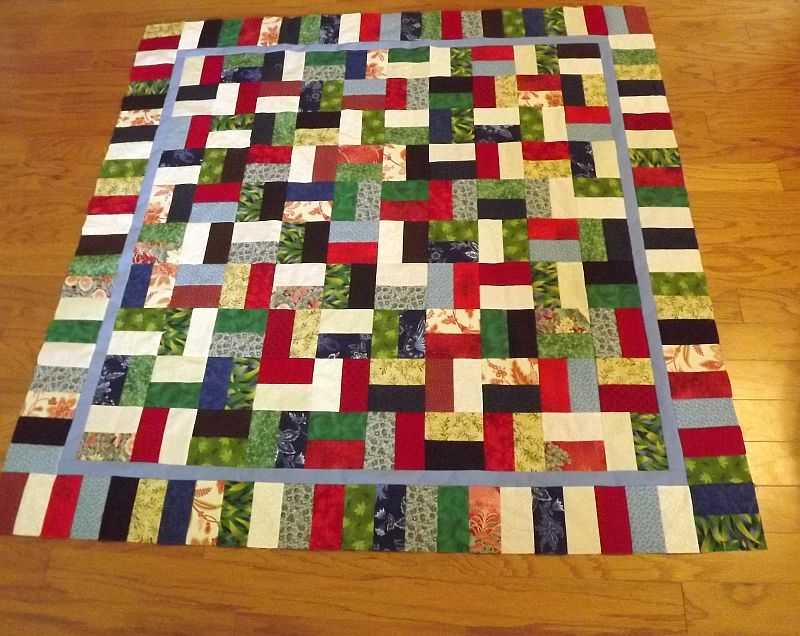
Jolly Jelly Roll Quilt TopCongratulations! You’ve now finished your Jolly Jelly Roll Quilt Top! Please email  pictures of your completed top to christa@christaquilts.com and tell me which Jelly Roll or set of fabrics you used. I’ll share your pictures before next week’s tutorial.

Next week we will prepare the backing and baste so it’s ready to quilt! You’ll need backing fabric (3.5 yards), batting (at least 60″ square), and basting pins. Here is the supply list.

I used one Vintage Modern jelly roll by Bonnie and Camille with 1 yard of Kona Cotton Solids in flesh pink for my quilt top. I will pick out my backing fabric later this week and will use the remaining blocks to add a little interest to the back of my quilt.


Here is the complete Jolly Jelly Roll Quilt-Along Schedule:

Week 1 – Supply ListJolly Jelly Roll Quilt

Week 2 – Sewing the Blocks

Week 3 – Completing the Top

Week 4 – Backing and Basting

Week 5 – Machine Quilting

Week 6 – Machine Binding to Finish

More Jolly Jelly Roll Quilt Blocks

I’ve been having “sew” much fun with our quilt-along and have been impressed with the comments and pictures I’ve been receiving from those that are participating. Unfortunately I don’t have a way to link up with everyone’s blogs who are following along. So I’ve decided to post pictures of everyone’s progress at  least once a week.

If you are sewing along with us, please email me your pictures, no matter how far along you are and I’ll post them here on my blog.  Here’s a link to last week’s tutorial for those of you that are just joining us. It’s never too late!

I just received a wonderful picture from Linda & Martha showing three different jelly roll collections that they and their quilting buddies are doing. They chose Trick or Treat, Christmas Spirit, and Meadow Friends for 3 of their Jolly Jelly Roll quilts.

Jolly Jelly Roll Quilt BlocksLinda and her “strip club”  meet every other month at their local quilt store. Like me, they think it’s so much fun to see what fabric everyone uses and what they look like when done!

Here’s a fantastic picture from Kathie that I just had to add. She’s using Leaf Haven from Benartex for her strips. If I can stop drooling over all these great quilt pictures and actually get to sewing my own, I can finish my top and show you the next step, LOL!

Kathie's Jelly Roll Quilt Blocks


Christa’s Soapbox – Teach Your Kids (and Friends) to Quilt!

This week my boys were out of town at scout camp, so it was just us girls! My daughter and I put the time to good use by starting on her summer quilt project. Last year she made her first quilt, and now she’s ready to make another.

Jenna's Jelly Roll StripsJenna selected Cosmo Cricket’s Chemistry Jelly Roll since pink is her favorite color.

We laid the strips out on her bed to come up with a simple yet striking quilt design. She cut each of the strips in half first and then began sewing them end to end to create long strips of fabric, sort of like a Jelly Roll 1600 quilt but with straight edges instead of mitered ones.

Jenna plans to applique her name and add hearts to the top. It’s going to be “sew” cute!

While we were sewing, my friend Marci decided to pop on by to join the fun. Her boys are also at camp and she needed help to make some modern quilt blocks for a swap she’s doing later this summer. Marci’s a more of a sewist than a quilter, but I’m converting her!Girl's Retreat!Marci is making fun wonky blocks in shades of grey using Kona Cotton Solids.  She cut randomly sized strips and sewed them together, using improvisational piecing wherever she needed to make the blocks big enough. They turned out great!

Kona Solids Neutral GreysModern Grey Blocks

Whew, all this blogging about what other people are doing makes me want to go work on my own projects now!

Christa’s Quilt Along 1.2 – Jolly Jelly Roll Quilt Blocks

Welcome to week 2 of my Jolly Jelly Roll Quilt Tutorial. You can link back to week 1 here for the supply list. This week we will sew up all of our jelly roll strips into blocks.

Step 1 – First, find yourself a nice relaxing sewing spot.  Next, lay out all of your pretty strips (40 total) and cut each of them in half along the fold so that you have a total of 80 half strips, each measuring 2 1/2 inches wide by approximately 21 inches long. This will give you a better variety to work with. Smaller strips are also easier to handle and sew together.

Relaxing Sewing SpotLay out Your StripsI sewed my strips together with my  Singer Feather-weight last week while  on vacation at the beach. It doesn’t get any better than this!

Step 2 – Group your half-strips into pairs. You’ll be using the same fabric twice each time, so try to mix them up so they are all different. Or you can sew them together totally randomly. Lay your whole stack next to your sewing machine, with pairs rights sides together and sew them together along the length. Try to keep a consistent quarter-inch seam allowance while sewing.

Stack of StripsSewn Strip Pairs

Seams Pressed OpenStep 3 – Press your seams open. I find that the strips lie much flatter, and are much easier to stack and cut when the seams are pressed open. As we will find in a couple of weeks, they are also much easier to machine quilt though.

Make sure there is at least 20″ of useable fabric per strip set, not including selvedges.

You can click on any of the pictures shown to see a larger, detailed view.

Step 4 – Square up the end and cut each strip segment into 4 – 4 1/2″ blocks. There is little waste and with careful cutting, you can get a bonus 2 1/2″ piece at the end of each segment. Save those for now and I’ll figure out something fun to do with them later.Cut into 4 1/2" SegmentsStep 5 – Cut all of your strip sets into blocks exactly the same way. You should be able to cut a total of 160 blocks. You only need 145 blocks for the quilt (if I counted correctly!) Save the leftovers in case of mistakes. I will use some of them on the backside of my quilt.

Stacks of Finished BlocksNext week we will finish the quilt top. We will continue on with basting, easy machine quilting, and binding in subsequent weeks. I like to go at an easy pace so everyone can keep up! Feel free to work ahead if you like and email me pictures of your progress. I’ll feature as many of them as I can during my sew and tell on Fridays!

Also, please post any questions you have about this project and I’ll answer them in the comments section of my blog. Thanks for sewing-along!


Here is the complete Jolly Jelly Roll Quilt-Along Schedule:

Week 1 – Supply ListJolly Jelly Roll Quilt

Week 2 – Sewing the Blocks

Week 3 – Completing the Top

Week 4 – Backing and Basting

Week 5 – Machine Quilting

Week 6 – Machine Binding to Finish

Sew and Tell – Breast Cancer Survivor Quilt

This week’s show and tell star has a very special quilt to share. Shirley G. from Texas is a breast cancer survivor and made this quilt as her therapy.

Shirley's Breast Cancer QuiltI’ll let Shirley explain, in her own words:

“I made this quilt from your Loralie Harris Still fabric line. I bought your fabric on line several years ago when I was recuperating from a lumpectomy, chemo, and radiation.

“After I finished my quilt, I loved it so much that a made another one for a young woman that I called my “bosom buddy.”  We met by chance when she sat in the chair beside me and took her own chemo treatments as I took mine every 3 weeks for 6 months. By the Grace of God, we became close friends and remain so today even though I’m old enough to be her mother.

“Many of my family members and friends gave me little mementos as they prayed for me during my treatment. After I finished my quilt, I decided to pin many of the mementos to the quilt. My grandson was attending Texas A&M during my treatment. You will notice in the right hand lower corner his contribution to my quilt!

“I wish the picture was clear enough for you to see the contribution that my surgeon gave me for my quilt. When she surgically removed the chemo port from my arm 2 years following all of my treatment, I asked her if I could have the port. She was so surprised when I told her that I wanted to hang it on my breast cancer survivor quilt!  She had her attending nurse wash the port and line very well and gave it to me. To this very day, it hangs on the top of my quilt.  We all had lots of laughs about that. I later mailed her a picture of the quilt which she proudly showed off to others in her office!”

For those of you that don’t know what a chemotherapy port is, here’s Shirley’s explanation:

“A chemo port is a device that is surgically placed just underneath the skin usually in the bicep area of your arm or in the clavicle area of your neck.  It is usually a one time procedure that is  done before a patient’s chemo treatment begins. It is placed there so that every time a patient has his/her chemo treatment, the oncology nurse can place the chemo drip IV  needle directly into the port instead of the patient having to be stuck with a needle directly in the vein. Also when blood work is required, the oncology lab can  draw blood thru the port thus eliminating yet another needle stick directly in the vein. There is almost no pain when they are able to use the port instead of sticking directly into the vein.  Once a cancer patient’s series of chemo treatments are completely finished (6 months or so), the surgeon and chemo oncologist together will decide when the port will be surgically removed.

“In my case, the port was left in me for almost 2 years after my chemo was finished so that, heaven forbid  my cancer should return, my port would already be in place for reuse. I had a very aggressive form of breast cancer that is called HER 2 positive. After my original 6 months of chemo and 35 days of radiation, I had a drug called Herceptin administered in the port every month for 1 year. Thank God that drug was developed just a year or so before I got my type of cancer for exactly my kind of cancer. God was taking care of me even before I was diagnosed with cancer by letting someone develop the drug that was specifically for HER 2 + cancer.”

Wow Shirley, what a triumph! Shirley’s wish through this quilt and this blog post is to encourage others not to dread cancer treatment. She wants to spread the word that while the big “C” is a scary thing, she  is  living proof that many survivors do kick its butt!!

From the bottom of my heart, Shirley, thanks for sharing your beautiful quilt!

Share Your Project

If you would like to share a project you’ve made with at least one piece of fabric purchased from me, please email christa@christaquilts.com with your high quality photos and what makes your project interesting or special to you. If you are selected as my show and tell star of the week, you’ll get a $5 gift certificate as my way of saying thanks for sharing!

Christa’s Quilt Along 1.1 – The Jolly Jelly Roll Quilt Supply List

Join My Quilt AlonG

New to my blog? Be sure to sign up for my email newsletter to join my next quilt along where I show you how to make a complete quilt from start to finish!

Geo Pop Update!!

This design would look fabulous using one strip roll from any of my fabric lines. I’ve recolored it below using Geo Pop!

Jolly Jellyroll quilt in Geo Pop by Christa Watson

The Jolly Jelly Roll Quilt

Do you love precuts but have no idea what to do with them? Are you tired of quilting by check and want to make your own quilts from start to finish? Do basting and binding a quilt scare you? Then come join me for a quilting adventure and I’ll show you how to finish your own quilts yourself, and hopefully help you build the confidence to do so!

With my Quilt Along series I will post step-by-step tutorials showing you exactly how to make a quilt from beginning to end. My first project is this super simple Jolly Jelly Roll quilt.

Scroll to the end of this post for the schedule. You can also share it on Instagram with the tag #christaquiltsqal.

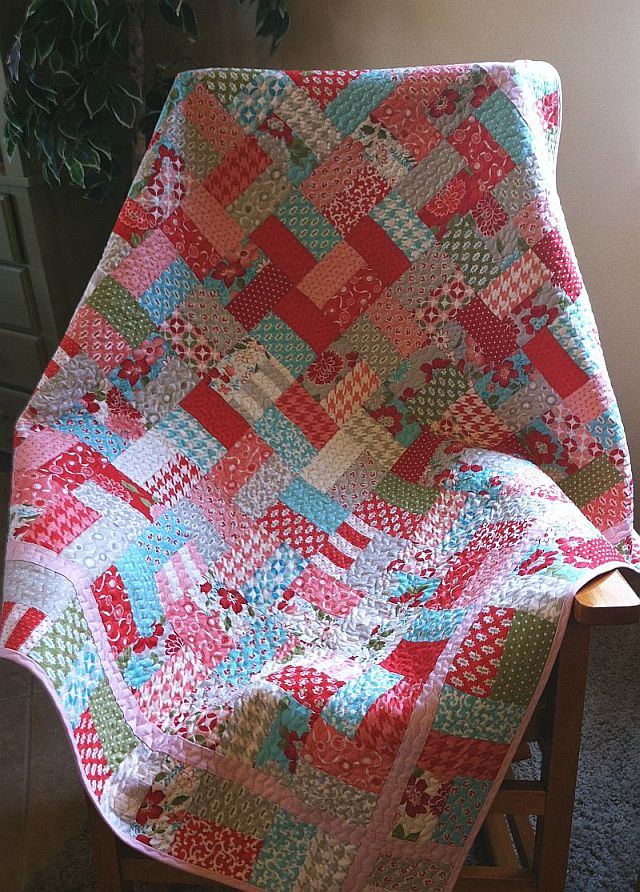
Sugar Sweet Jolly Jelly Roll QuiltI designed this quilt in EQ7 using fabric swatches Bonnie and Camille’s Vintage Modern collection. However, it will work great with any jelly roll!

Vintage Modern Fabric Swatch Vintage Modern Jelly RollLet’s get started! Below, I’ve posted a supply list as well as the quilt’s vital statistics and a few notes.


Suggested Supply List

  • 1 jelly roll, or 40 fabric strips measuring 2 1/2″ x WOF (width of fabric – usually 42″)
  • 1 yard of coordinating solid or tone-on-tone fabric for the inner border and binding
  • 3 1/2 yards of fabric for backing, or a pieced backing measuring approximately 60″ square
  • 60″ x 60″ piece of batting (Warm-N-Natural cotton and Legacy wool are my favorites.)
  • 100% Cotton neutral thread for piecing (I like Superior Threads Masterpiece)
  • 50 weight 100% Cotton or 30-60 wt soft polyester thread for quilting in a blending color
  • Quality sewing needles for piecing and quilting (I use Superior Titanium Needles)
  • General sewing supplies: sewing machine, rotary cutting equipment, pins, seam ripper, etc.
  • Optional: Machingers quilting gloves, basting pins, walking foot

Quilt Vital Statistics

  • Size: Approximately 51″ x 51″
  • Finished Block Size: 4″
  • Number of Blocks in Quilt: 100 (set 10 x 10)
  • Number of Blocks in Border: 45

Go gather up your supplies and follow the links below for some fun sewing!

Additional Notes About This Quilt

1. Fabric selection is easy: just choose a jelly roll that you like and pair it with a nice solid fabric, or a tone-on-tone print that “reads” as solid. This will help break up the busy-ness of the quilt design. The same fabric will also be used for the binding.

2. Do not be afraid to machine quilt this quilt yourself. For this pattern, I will be quilting using a walking foot only and leaving my feed dogs engaged as normal. I will not do any free-motion quilting on this quilt; instead I will show you how much lovely texture can be created with either straight stitching or using a decorative stitch on your sewing machine.

3. I am very generous when figuring out yardage for my quilts. For example, you can probably get away with only 3/4 yard of fabric for the inner border and binding. And, with extremely careful measuring or basting, you may be able to get by with just 3 yards for the backing. However, I always round up just in case of fabric shrinkage or mis-cuts. It’s better to be safe than sorry. Besides, anything leftover is like “free fabric” for your next quilt!


Week 1 – Supply ListJolly Jelly Roll Quilt

Week 2 – Sewing the Blocks

Week 3 – Completing the Top

Week 4 – Backing and Basting

Week 5 – Machine Quilting

Week 6 – Machine Binding to Finish


Sharing is Caring

I’d love to see your version! Please share your work in progress in my facebook group: Quilt With Christa . 🙂
Bungle Jungle Charm Quilt Week 4 – Ditch Quilting

Bungle Jungle QuiltI didn’t make a ton of progress on my Bungle Jungle modern quilt this week, mostly because I was packing up to go on our family vacation and getting all my ducks in a row ahead of time.

(They are quacking nicely now!)

But, I did get all of my stitch in the ditch quilting done so I’m ready for the best part, the free motion quilting next week!

I think my plan will be to quilt a different motif in each charm square, to practice a bunch of free-motion quilting designs.

Stitch in the DitchI want to add tons more quilting. By pressing the Quilt Back with Grid Quiltingseams open, stitching in the ditch in between the charm squares was a breeze. It created a grid over the surface of the quilt which you can see on the back side of the quilt. Click for closeups.

Sewing LineI used an acrylic ruler and a blue washout pen to mark straight lines where needed to complete the grid.

The quilt is now anchored so I can remove the rest of my basting pins and it’s ready for more quilting!

Be sure to join me tomorrow as I launch my new tutorial series: Do It Yourself Quilts!

Favorite Tools #2 – Shout Color Catchers

Shout Color CatchersOn my last soapbox, I blogged about how much I advocate pre-washing fabrics for quilts.

To make this job easier, I love using Shout Color Catchers. You can get them pretty inexpensively at Target or Wal-Mart and they work wonders with quilt fabrics.

They are rectangular sheets of material that almost look like dryer sheets.  You put them in with the fabric during the wash cycle. The extra color that comes off in the water adheres to the sheets, not other fabrics. I’ll use at least 2 per load when washing a bundle of fabric, and will throw in more if I’m washing a large quilt.

After discovering problems with some of my personal stash fabrics running, I used several sheets when washing my sister-in-law’s wedding quilt I recently finished (only 2 years late). I had sewn the blocks so long ago, I couldn’t remember if they had been pre-washed or not. I used 4 color catchers with the quilt and it came out fine. I breathed a huge sigh of relief!

Color CatchersI used this red batik fabric in a small wholecloth quilt I recently made. I wanted to make sure it didn’t run so I washed it twice – with one color catcher each time.

The first color catcher sheet came out orange after the first wash; by the second wash, the excess color was mostly gone so I knew it was now safe to use this fabric!

I’m still experimenting with pre-washing,  using color catchers in every load of cut yardage, and throwing a sheet in with quilts made from fabric that I can’t pre-wash like Moda Precuts.

During my previous post about pre-washing I got a really good comment about using Retayne, a dye fixative, with unwashed precuts. I forgot I even had some! So that will be my next experiment I think…..