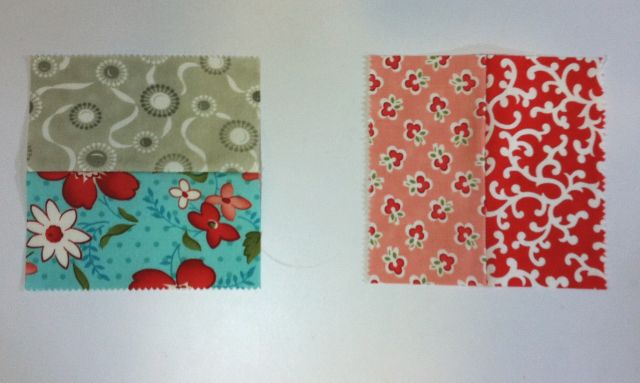
Sew and Tell Friday – Strips and Bricks

It’s so fun to see how everyone’s Jolly Jelly Roll quilts have turned out.  Even though I finished up this tutorial, I will be happy to share pictures of those that have followed along, whether they are finished or not (though I can’t wait to see the quilting on them)!

Also, I put together a Jolly Jelly Roll quilt kit if you’d like to make another one.

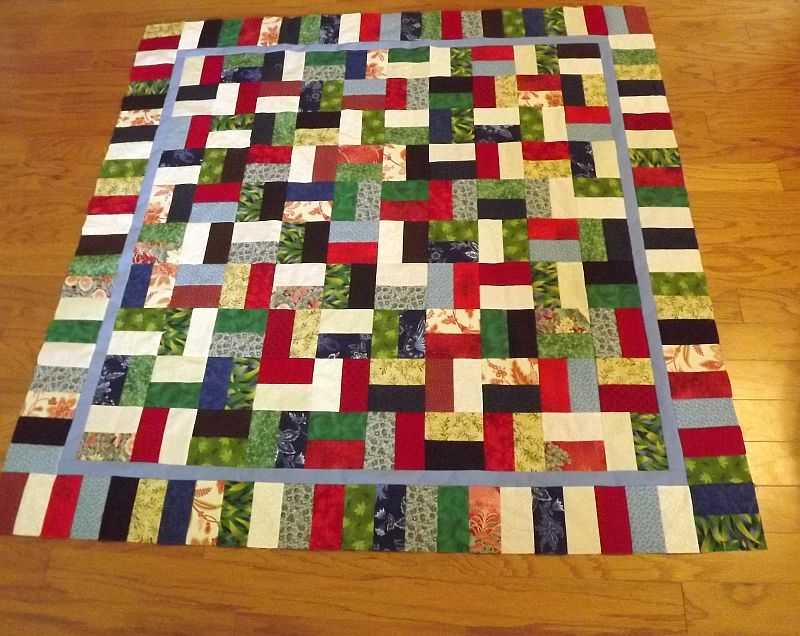
This is Laura F.’s top that she made from her stash. She chose to make her quilt as I had shown in the original pattern drawing, with piano keys borders. She’s toying around with the idea of using oilcloth for the backing as a picnic blanket. I think that would be fantastic!

Laural's Jolly Jelly Roll QuiltI’ve just begun the next quilting tutorial series, called quilt Baby Bricks. I tweaked a design I had done previously, based on a couple of fun quilts I designed and made last year.

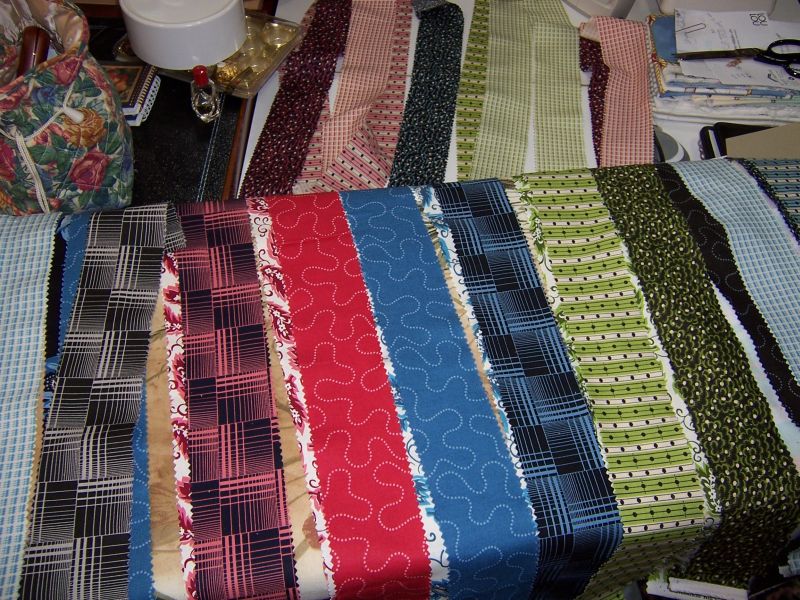
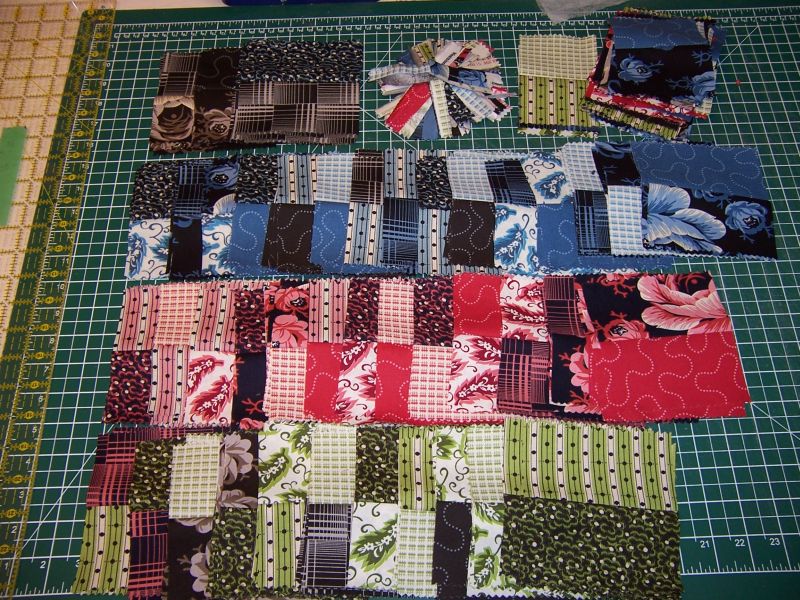
Blue BricksMy tutorial will be very similar to the blue quilt, with the addition of neutral solid strips in between the rows. That will give it a modern touch while providing some negative space.

Kits are available for that one, too.

Green BricksJust for fun, I made a similar quilt in brown and green and added a few monkey appliques.

To do this, I simply ironed some wonder under to the back side of my Funky Monkeys fabric and cut around the shapes. I ironed them to the quilt top and then stitched around them with a straight stitch once the quilt was basted, an appli-quilt technique!

This is the first time I’ve sort of worked in a series. I like the look of the bricks and it was fun to explore a few different possibilities with the design.

Christa’s Quilt Along 1.6 – Machine Binding to Finish

Free Pattern

Be sure to sign up for my email newsletter to get a free quilt pattern!

Jolly Jelly Roll Quilt Wrap Up


Here are all of the previous bog posts, if you are just now joining us:

Week 1 – Supply ListJolly Jelly Roll Quilt
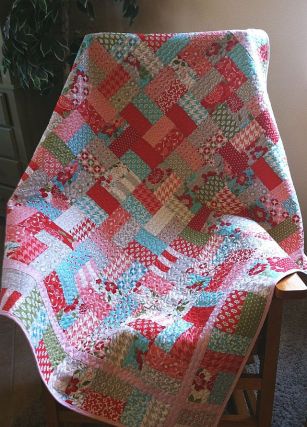
Week 2 – Sewing the Blocks

Week 3 – Completing the Top

Week 4 – Backing and Basting

Week 5 – Machine Quilting

Remember, you can click on any picture to enlarge it. Now, onto the binding!

I use the same techniques to attach the binding to all my quilts, whether finishing by hand or machine.

Step 1 – Square Up the Quilt

Use a large square ruler to trim up all four corners of your quilt. The square will help you achieve a nice straight 90 degree corner. Trim up all four of the sides with a longer ruler.

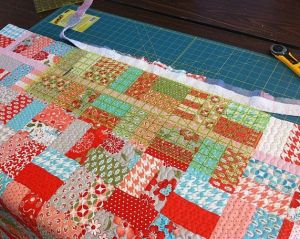
Square Up the Corners

Trim the Sides

Step 2 – Measure the Quilt Perimeter and Cut Enough Binding Strips

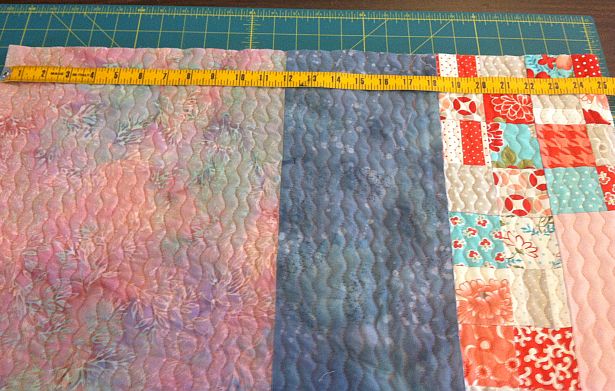
Measure the perimeter of your quilt so you know how many strips to cut.  Lay it out on your cutting mat or use a measuring tape. I folded my quilt in half to make it easier to measure. Divide your perimeter by 40 inches (the useable length of one strip).
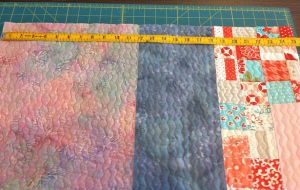
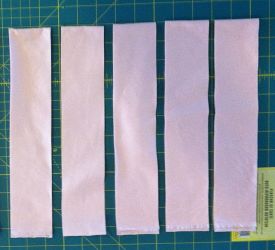
Measure the Quilt PerimeterCut 5 strips 2 1/4 Inches Wide

Round up to the nearest number of strips and cut them 2 1/4″ wide. I cut 5 strips for my quilt.

Step 3 – Make Continuous Binding

This method is called double-fold straight grain binding. Sew all of your strips together to make one continuous piece. Miter the strips by sewing on an angle to distribute the bulk of the seam. If you are using a solid fabric, be sure to sew them all together on the same side!

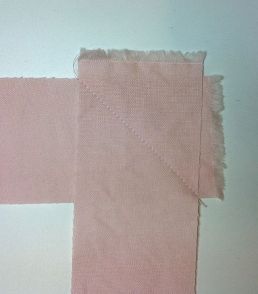
Join Binding StripsSew on an AngleYou can eyeball the seam.

Trim 1/4 inch seams to the right of your sewing line and press open.

With a small square ruler, cut off one end of your binding on a 45 degree angle. Make sure your binding strips have not been folded or pressed yet. Once the end is cut, then press your binding in half along the entire length, with wrong sides touching and right sides out.

Angle the BegninngPress Binding in HalfWatch your seams if using solid fabric!

Step 4 – Attaching the Binding to the Quilt

Begin sewing your binding to the quilt with a walking foot, leaving a tail of about 6-8 inches unsewn. Be sure to start on the side of your quilt, not at a corner and sew the binding to the front of the quilt. The folded side of your strips will be to your left. The open sides will be to your right. Use a quarter inch seam allowance and match your thread to your binding fabric.
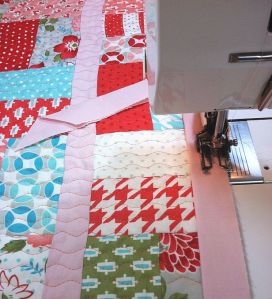
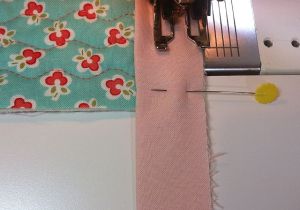
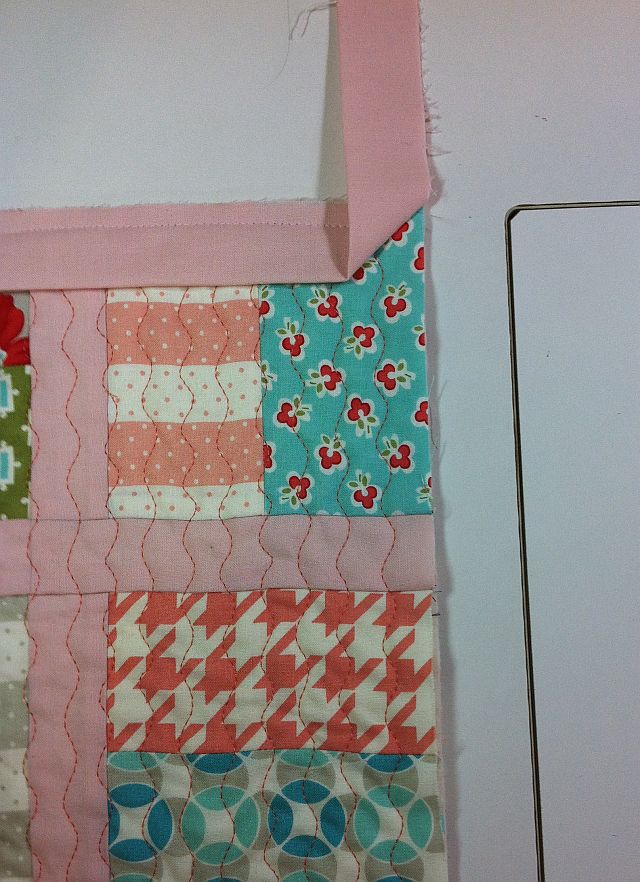
Leave a TailStop 1/4 Inch AwayWhen you reach a corner, stop sewing 1/4 inch away from the end. Mark it with a drawn line or a light pencil mark if needed. Sew off the side.

Rotate the quilt and flip the binding strip up so that it is even with the side of the quilt. Then, flip it back down, forming a “pinch” of fabric at the corner. This will be the fullness that will flip around to the back creating a nice mitered corner on the front.

Sew off the Side at 1/4 InchFlip Binding UpThen Flip DownRepeat this technique for all four corners of the quilt. When you are nearly finished sewing the binding onto the front side, make sure to leave another tail of about 6-8 inches of binding so you can join the beginning and ending binding pieces.
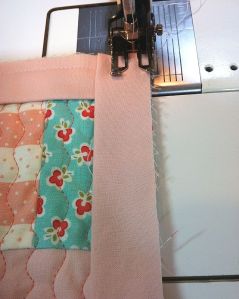
Next Corner

Leave a GapNext, you will trim and join the ends so they fit together exactly.

If you have a lot of excess binding, you can trim some off.

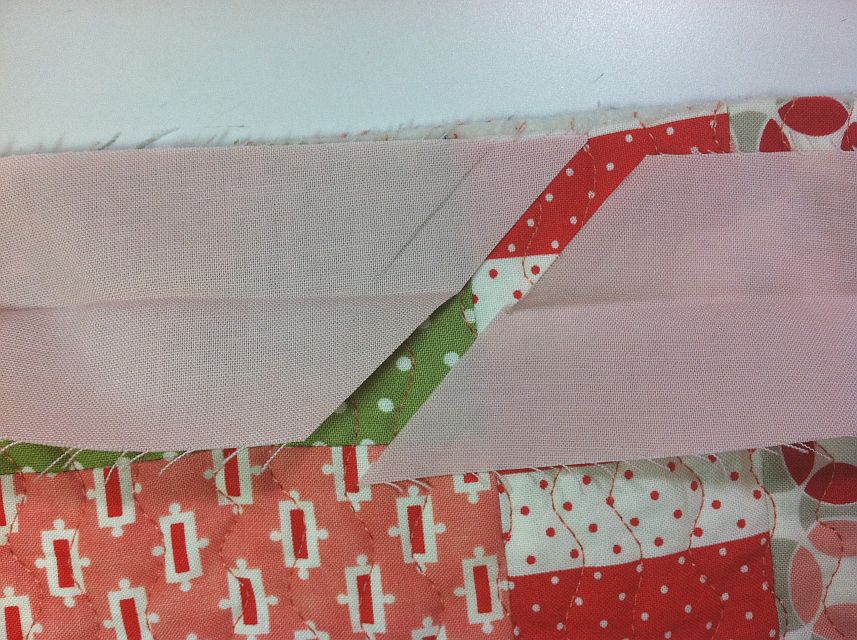
Open up both binding ends and nestle your beginning binding piece (the angled cut end) on top of the ending piece so that it is flat and smooth. Mark an angle on the ending piece where the beginning piece rests on it – should be a 45 degree angle. Cut 1/2 inch away from this marked line. This will take into account the seam allowances for both pieces. Make sure your binding is not twisted and that both angled cuts are parallel to each other.

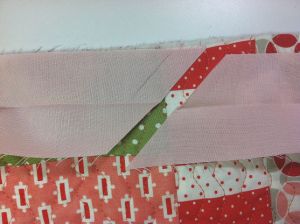
Mark the AngleCut 1/2 Inch Past Marked LineJoin the two ends by offsetting them slightly to create little tiny tips at each end. Where my pin is pointing, sew from the crevice of one triangle tip to the other, with 1/4 inch seam. Trim off the triangle tips, and press the seam open. It should be a perfect fit!

Joining the Beginning and Ending StripsFinishing the Front BindingFinger press the rest of the binding closed and complete your stitching on the front side.

Step 5 – Finishing the Binding with Decorative Machine Stitching

Pinmoors for BindingThe key to a really nice binding, whether finished by hand or machine, is to make sure it lies flat all the way around the quilt and that the corners are secure.

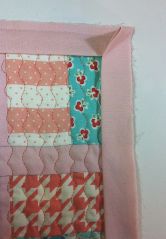
Once the binding is sewn to the front, simply fold it over to the back to stitch.  I like to use pins with Pinmoor anchors for safety to keep everything in place. Fold over the corners to create a nice miter and pin.
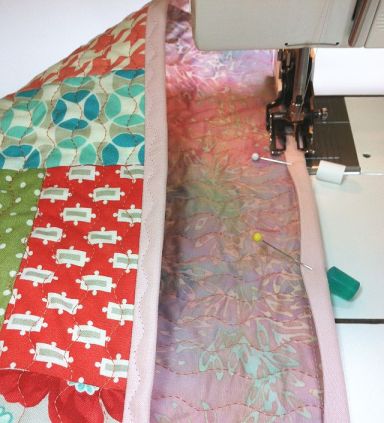
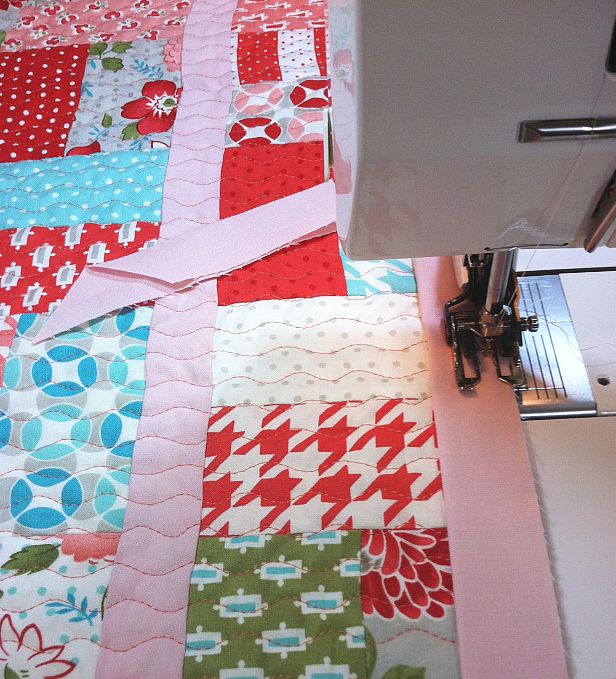
Binding by MachineI used the same decorative serpentine stitch for the binding that I used for the quilting.

You will notice I am actually stitching by machine from the back side of the quilt. This seems to give me the best results and I can control how wide the stitching is so it shows up nicely on the front.

You can see where I’ve already stitched some of the binding.

On the back, be sure to cover the line of straight stitching that was used to sew on the binding  from the front side.

The binding is just as beautiful on the backside as it is on the front. Another finished quilt!

Another Finished Quilt!

Sharing is Caring

I’d love to see your version! Please share your work in progress in my facebook group: Quilt With Christa . 🙂

Sew and Tell Friday – 3 Jelly Roll Quilt Tops

For today’s show and tell we have a triple header! These three beautiful quilt tops come from Linda and Martha, a couple of friends who have been moving right along with my Jolly Jelly Roll do-it-yourself-quilt tutorial.

Linda & Martha's Jelly Roll QuiltsThese two gals love working with jelly rolls “sew” much! Martha sewed the two holiday quilts using Christmas Spirit and Trick or Treat, and Linda is making hers from the girl colorway of Meadow Friends. They will present their show and tell at their next “Strip Club!” Now they just have to quilt and bind their lovely quilts and they can move onto their next projects.

Speaking of finishing, I will present a machine binding tutorial to finish these quilts up next week and will then start another complete quilt project the week after.  I’m toying  around with switching up my blog software so that more of you can share your WIP’s! (Works in progress), so stay tuned for details. Also, be sure to subscribe to my blog if you haven’t done so already, so you can stay abreast of all the latest happenings.

Oh, and if you have any suggestions on what types of quilt projects you’d like me to demonstrate, please leave a comment. The next do-it-yourself-quilt tutorial will either use fat quarters or a layer cake (I’m designing it now). But I’d love to have more ideas, and I plan to offer these free tutorials on an ongoing basis. Eventually, I’ll offer patterns and kits to go along with them, too!

Christa’s Quilt Along 1.5 – Machine Quilting

This week’s post is the one I’ve been waiting for. I think machine quilting is the best part of making a quilt, so I couldn’t wait to get my Vintage Modern jelly roll quilt top finished and basted so I could start the fun! I quilted it using a serpentine stitch with my walking foot.

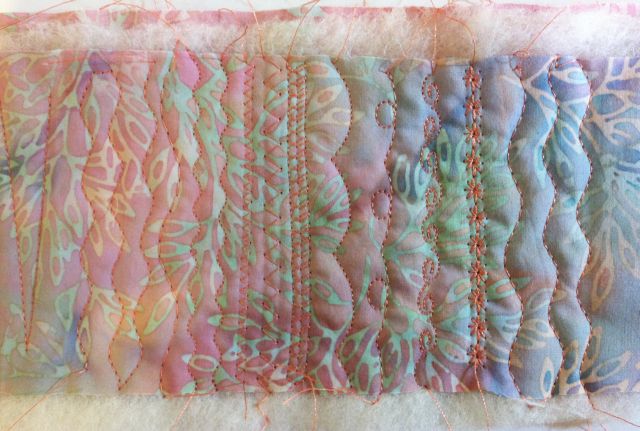
Machine Quilting 2" ApartBefore I started quilting, I tried out a few of my machine’s decorative stitches to see how they would look.  All of these can be done using a walking foot with the feed dogs engaged.

Stitch SamplesI used a 40 weight high-sheen polyester thread with a size 90 needle and used the same thread for both the top and bobbin.

This gives better results than using different colored threads.

Step 1 – Decorative Ditch Quilting

Quilting 4" ApartBe sure your needle plate has a wide enough opening to accommodate your decorative stitch and test it out first so you avoid broken needles.

Quilt along the seam lines in one direction in between your blocks, about 4 inches apart. The first pass took me 30 minutes.

This will secure the quilt and you can remove the pins as you go.

Next, make second pass in between each line of quilting. Now your quilting is about 2 inches apart and the quilt is starting to get some texture! I quilted parallel lines across the quilt. I did not mark any of these lines – I just used the seams as a guide and eyeballed it across the fabric where there was no seam to guide me. This is both liberating and fun!

Quilting Parallel Wavy LinesThis second pass took another 30 minutes so I’m just at 1 hour total quilting time. Not bad! At this point, this is enough quilting to hold your quilt together. However, I want more…

Step 2 – Adding More Quilting

Quilting 1 Inch ApartMy motto is that you can never add too much quilting to a quilt!

So I added another line of quilting in between each of the rows above. This was my 3rd pass and now the quilting lines are about 1 inch apart.

This took only another 30 minutes and I can’t believe how fast this is going!

There is still enough room to add another row of quilting and do a fourth pass, so I decided, what the heck?

The fourth pass took 1 1/2 hours because I had now doubled the amount of quilting on the quilt, but I loved every minute of it!

Half Inch Quilting Lines

I ended up with quilting lines about 1/2 inch apart over the surface of the quilt. Total quilting time was 3 hours and I used up a full 500 yard spool of Superior Highlights thread.

Textured QuiltingSuperior Threads Tri-Lobal Polyster

I love all the texture on the back!

Pieced Backing with Quilting

So next week, we will finish our quilts, can you believe it? We will trim them up and bind to finish. I really can’t wait to see how everyone’s quilting turns out. Be sure to email me pictures of your progress, no matter where you are,  so I can share with everyone else.


Here is the complete Jolly Jelly Roll Quilt-Along Schedule:

Week 1 – Supply ListJolly Jelly Roll Quilt

Week 2 – Sewing the Blocks

Week 3 – Completing the Top

Week 4 – Backing and Basting

Week 5 – Machine Quilting

Week 6 – Machine Binding to Finish

Sew and Tell – Dragonfly Batik Art Quilt

I am so excited to share with you Diane’s beautiful art quilt below. She used green batik fat quarters that she got from me, and quilted with metallic thread to add the textured water and pond ripples to her piece. The dragonfly was begun in a Susan Brubaker Knapp thread sketching class and finished at home. (Some people actually finish their class projects!!) She added glittery glue to give the dragonfly some sparkle and make its wings look iridescent.

Dragonfly QuiltDiane has also been following along making her version of the Jolly Jelly Roll quilt. She finished up her homework for the week and shares her lovely jewel-toned top with us:

Jeweled Jelly Roll QuiltNice job, Diane! For those of you quilting along with my tutorial, be sure to email me pictures of your in-progress diy quilts, too. It’s such fun to see the variety.

And for those of you that want to share your work using fabrics purchased from me, I’ll send you a little thank you if I feature your finished project on my blog. You can email pictures to christa@christaquilts.com. Happy quilting!

Favorite Tools #5 – Batting

Later this week during my do it yourself quilt-along, we are going to be basting our Jolly Jelly Roll quilts so I thought it would be an appropriate time to talk a little bit about batting.

From my experience, the type of batting you choose can really make a difference in creating a well-done quilt. Since all of my quilts are machine quilted, I need to use battings that are easy to quilt through and are not so bulky that they won’t fit under my machine.

So far, my two favorite battings are Warm-N-Natural 100% cotton, and Pellon Legacy Wool. (Unfortunately I don’t carry these in my shop because they are too bulky to ship!)

I like Warm-N-Natural because it’s very flat and relatively inexpensive. I can actually buy it buy the bolt with a discount coupon from Joanne’s for about the same price that I can get it wholesale. It does shrink up a bit, but it gives that nice antique wrinkly look when washed. Here are some machine quilting closeups using Warm-N-Natural.

Little Rascals QuiltingQuilting Warm-N-Natural

These were both densely quilted with an allover free-motion quilting design.

If I want my quilting to really pop, or if I am doing intricate quilting like feathers, wreaths or focus designs, I will use Legacy Wool batting. It’s a little more expensive but it’s very clean and white so it’s a perfect choice for quilts with lots of white backgrounds like in my Bungle Jungle quilt below. It also allows me to achieve a “faux” trapunto look if I densely quilt the background areas. The pictures below show quilts using Legacy Wool.

Quilting Legacy Wool

Faux Trapunto QuiltingThe little hands really pop! Wool has a nice loft but the background squishes down nicely when you quilt the heck out of it!

As far as polyester battings go, I’m not too fond of them as they are usually too lofty for me. I haven’t tried any of the newer blends out there like bamboo or silk yet. One batting that is next on my list to try is Quilter’s Dream Cotton.

If any of you out there have favorite battings that you like, please add your comments!

Sew and Tell – Do it Yourself Quilts Update

Today’s Sew and Tell is a little different. Instead of featuring a finished project made by one of my customers, I’m excited to share with you some finished jelly roll blocks from one of my quilt- along followers. Scroll down to  the end of this post if you want to join the fun!

These pictures come from Diane in Canada and she finished up this week’s homework in a jiffy!  She had an older strip bundle lying around that she put to good use.

Jelly Roll StripsDiane’s fabric is Greenfield Hill by Denise Schmidt for Westminster. Instead of randomly sewing the strips together, she matched up the pretty jewel tones into coordinating pairs.

Jelly Roll Blocks“Sew” far, “sew” good, Diane! I think your use of color will be striking if you sew each row in a different color, “strippy” style, or if you have the colors cascade across the quilt in an orderly fashion (like green, red, blue, black, etc.)

For those of you eager beavers out there like Diane that are ready to move on, I’ll give a sneak peek of what we’ll be working on for next week’s lesson. If you select 100 of your blocks and sew them together into 50 pairs like this you’ll be one step ahead.

Jelly Roll Block Pairs

Next week’s post will include complete directions on how to finish the quilt top, so make sure you grab your one yard of tone on tone or solid coordinate to go with your jelly roll.  I’m going to use Ruby Red Kona Solid to go along with my Vintage Modern jelly roll shown above.

In case you are just joining us, you can click the links below to catch up and follow along with this tutorial in it’s entirety. My main reason for starting this tutorial is to teach you that  yes, you can, make a complete quilt from start to finish, all by yourself!

DIY Quilts #1.1 – The Jolly Jellyroll Quilt Supply List

DIY Quilts #1.2 – Jolly Jelly Roll Quilt Blocks

What Was I Thinking???!!

What was I thinking? I’m trying to have a zen experience with my quilting by breaking up the negative space in my Modern Quilt with lots of different quilting designs. But I think I went a little overboard with all the small scale background fillers!

Negative Space QuiltingI actually do like the texture the quilting is adding to the quilt, but when you see how little of the quilt I’ve actually finished compared to how much is left to quilt, you’ll start to pity me…

The picture below shows about 1/4 of the quilt finished. I’m adding larger scale textures in each of the charm squares and a smaller scale background around each of the hands. I’ve quilted 12 out of 42 charm blocks which represents about 5-6 hours of solid quilting so far.

1/4 of the QuiltI am having fun quilting different designs in the blocks though. I’ve outlined some elephants, practiced my pebbles and grids and even quilted the alphabet on the lined paper fabric! Here are a couple more closeups, just for fun!

Closeup 1

Closeup 2I’m linking this blog post to the Free-Motion Quilting Project and WIP Wednesdays so I can share the insanity!!! This will definitely be a long term project. But if I quilt 1 block a day, I can finish it in under a month!

I used a clean toothbrush dipped in water to erase the blue pen marks once I quilted them.

Toothbrush EraserFor those of you interested in what materials I used, I started with 1 charm pack of Moda’s Bungle Jungle by Tim and Beck, and 2 1/2 yards of White Kona Cotton Solid. I sewed together a layer cake for the backing.

I am doing all the quilting with 60 weight polyester thread  in a light gray.  I chose Superior Threads bottom line in both the top and bobbin. It breaks too easily in the top thread for my taste – but it is very fine and blends beautifully. My batting is wool which gives a nice faux trapunto look to the little hands.

I hope I get more done by next week! I think I’d better go work on my jelly roll quilt now…..

Christa’s Quilt Along 1.1 – The Jolly Jelly Roll Quilt Supply List

Join My Quilt AlonG

New to my blog? Be sure to sign up for my email newsletter to join my next quilt along where I show you how to make a complete quilt from start to finish!

Geo Pop Update!!

This design would look fabulous using one strip roll from any of my fabric lines. I’ve recolored it below using Geo Pop!

Jolly Jellyroll quilt in Geo Pop by Christa Watson

The Jolly Jelly Roll Quilt

Do you love precuts but have no idea what to do with them? Are you tired of quilting by check and want to make your own quilts from start to finish? Do basting and binding a quilt scare you? Then come join me for a quilting adventure and I’ll show you how to finish your own quilts yourself, and hopefully help you build the confidence to do so!

With my Quilt Along series I will post step-by-step tutorials showing you exactly how to make a quilt from beginning to end. My first project is this super simple Jolly Jelly Roll quilt.

Scroll to the end of this post for the schedule. You can also share it on Instagram with the tag #christaquiltsqal.

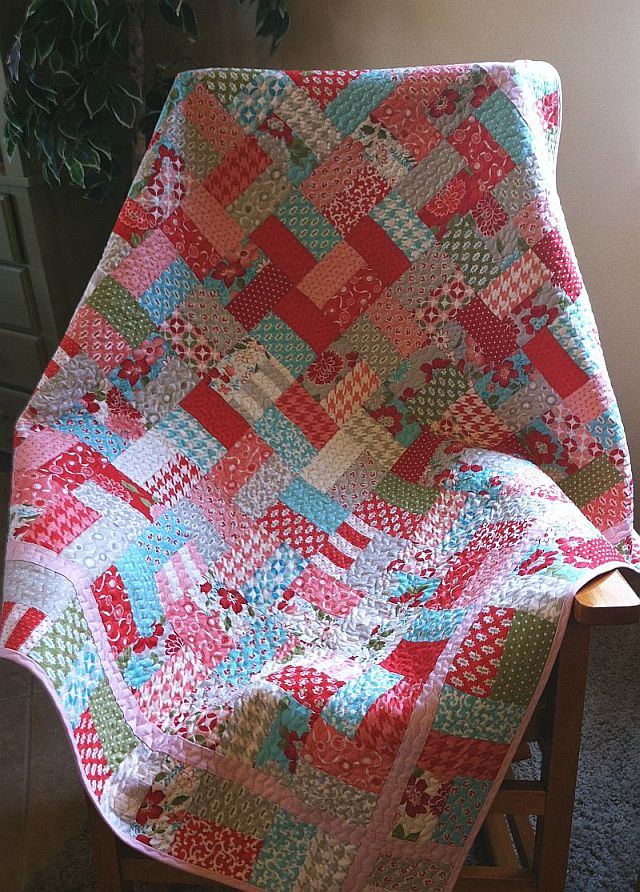
Sugar Sweet Jolly Jelly Roll QuiltI designed this quilt in EQ7 using fabric swatches Bonnie and Camille’s Vintage Modern collection. However, it will work great with any jelly roll!

Vintage Modern Fabric Swatch Vintage Modern Jelly RollLet’s get started! Below, I’ve posted a supply list as well as the quilt’s vital statistics and a few notes.


Suggested Supply List

  • 1 jelly roll, or 40 fabric strips measuring 2 1/2″ x WOF (width of fabric – usually 42″)
  • 1 yard of coordinating solid or tone-on-tone fabric for the inner border and binding
  • 3 1/2 yards of fabric for backing, or a pieced backing measuring approximately 60″ square
  • 60″ x 60″ piece of batting (Warm-N-Natural cotton and Legacy wool are my favorites.)
  • 100% Cotton neutral thread for piecing (I like Superior Threads Masterpiece)
  • 50 weight 100% Cotton or 30-60 wt soft polyester thread for quilting in a blending color
  • Quality sewing needles for piecing and quilting (I use Superior Titanium Needles)
  • General sewing supplies: sewing machine, rotary cutting equipment, pins, seam ripper, etc.
  • Optional: Machingers quilting gloves, basting pins, walking foot

Quilt Vital Statistics

  • Size: Approximately 51″ x 51″
  • Finished Block Size: 4″
  • Number of Blocks in Quilt: 100 (set 10 x 10)
  • Number of Blocks in Border: 45

Go gather up your supplies and follow the links below for some fun sewing!

Additional Notes About This Quilt

1. Fabric selection is easy: just choose a jelly roll that you like and pair it with a nice solid fabric, or a tone-on-tone print that “reads” as solid. This will help break up the busy-ness of the quilt design. The same fabric will also be used for the binding.

2. Do not be afraid to machine quilt this quilt yourself. For this pattern, I will be quilting using a walking foot only and leaving my feed dogs engaged as normal. I will not do any free-motion quilting on this quilt; instead I will show you how much lovely texture can be created with either straight stitching or using a decorative stitch on your sewing machine.

3. I am very generous when figuring out yardage for my quilts. For example, you can probably get away with only 3/4 yard of fabric for the inner border and binding. And, with extremely careful measuring or basting, you may be able to get by with just 3 yards for the backing. However, I always round up just in case of fabric shrinkage or mis-cuts. It’s better to be safe than sorry. Besides, anything leftover is like “free fabric” for your next quilt!


Week 1 – Supply ListJolly Jelly Roll Quilt

Week 2 – Sewing the Blocks

Week 3 – Completing the Top

Week 4 – Backing and Basting

Week 5 – Machine Quilting

Week 6 – Machine Binding to Finish


Sharing is Caring

I’d love to see your version! Please share your work in progress in my facebook group: Quilt With Christa . 🙂

Sew and Tell – Scraps Galore!

Jill F. from Iowa shares her fun and scrappy geometric quilt with us this week:

Jill's Scrappy QuiltJill made this beauty by collecting assorted fat quarters and 1/2 yard cuts she got from me,  plus scraps from her stash. The strips are all 2 1/2 inches wide so it could be assembled from a jelly roll, too!

Here are some quilt vital statistics you may be interested in: the pattern is called Hugs and Kisses by Julie Herman for Jaybird Quilts, and the wonderful brown that pulls all of the scraps together is Moda Bella Solid in Hershey brown.
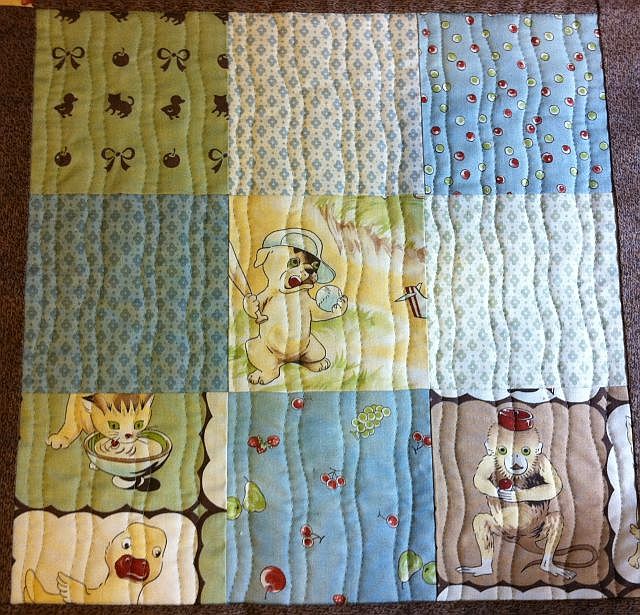
Jill used her Lazy Angle Ruler from Lazy Girl Designs to cut the wedges of assembled strips. Hey, I have that ruler but haven’t made anything from it yet; I guess I’ll give it a try!

Quilting CloseupJill  made this  quilt to go in her four-year old son’s room and is using extra blocks for a coordinating quilt for his little brother. It’s always amazing how many blocks you can get when you start pulling scraps from your stash – they seem to multiply!

She did a great job of making the quilt seam super scrappy, yet pulled-together.

Way to go Jill! How did you know my favorite colors are brown and green? That’s probably what attracted me to your quilt!

Of course I had to include a closeup picture of the gorgeous quilting, done by a friend of Jill’s that’s just getting started with her long-arm business. If this quilt is any indication, Jill’s friend is on the right track!

Share Your Project

If you would like to share a project you’ve made with at least one piece of fabric purchased from me, please email christa@christaquilts.com with your high quality photos and what makes your project interesting or special to you. If you are selected as my show and tell star of the week, you’ll get a $5 gift certificate as my way of saying thanks!