Christa’s Quilt Along 2.4 – Marking and Basting Baby Bricks

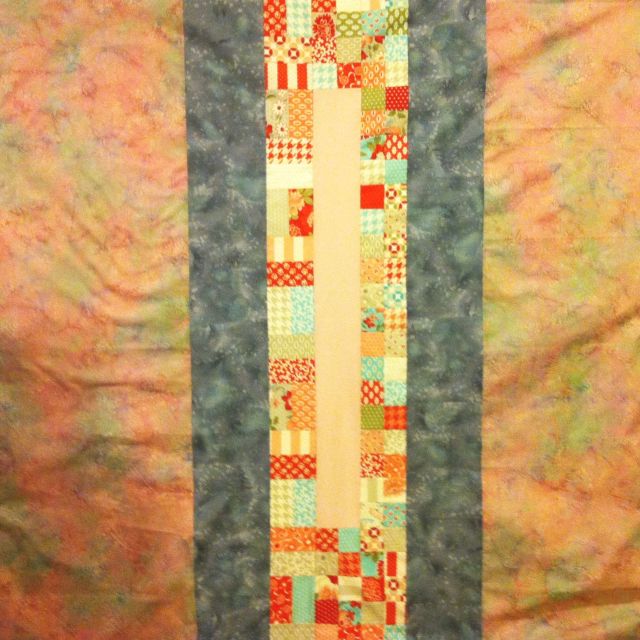
I finished the pretty pink version of Baby Bricks this week to go along with the baby blue top that I will be basting today.  (Kits are available for both colors for a limited time.)

Before I get to the most fun part of making a quilt in my opinion – the machine quilting – I’ve got to get them marked and basted! Today’s demo will be shown on the blue version.
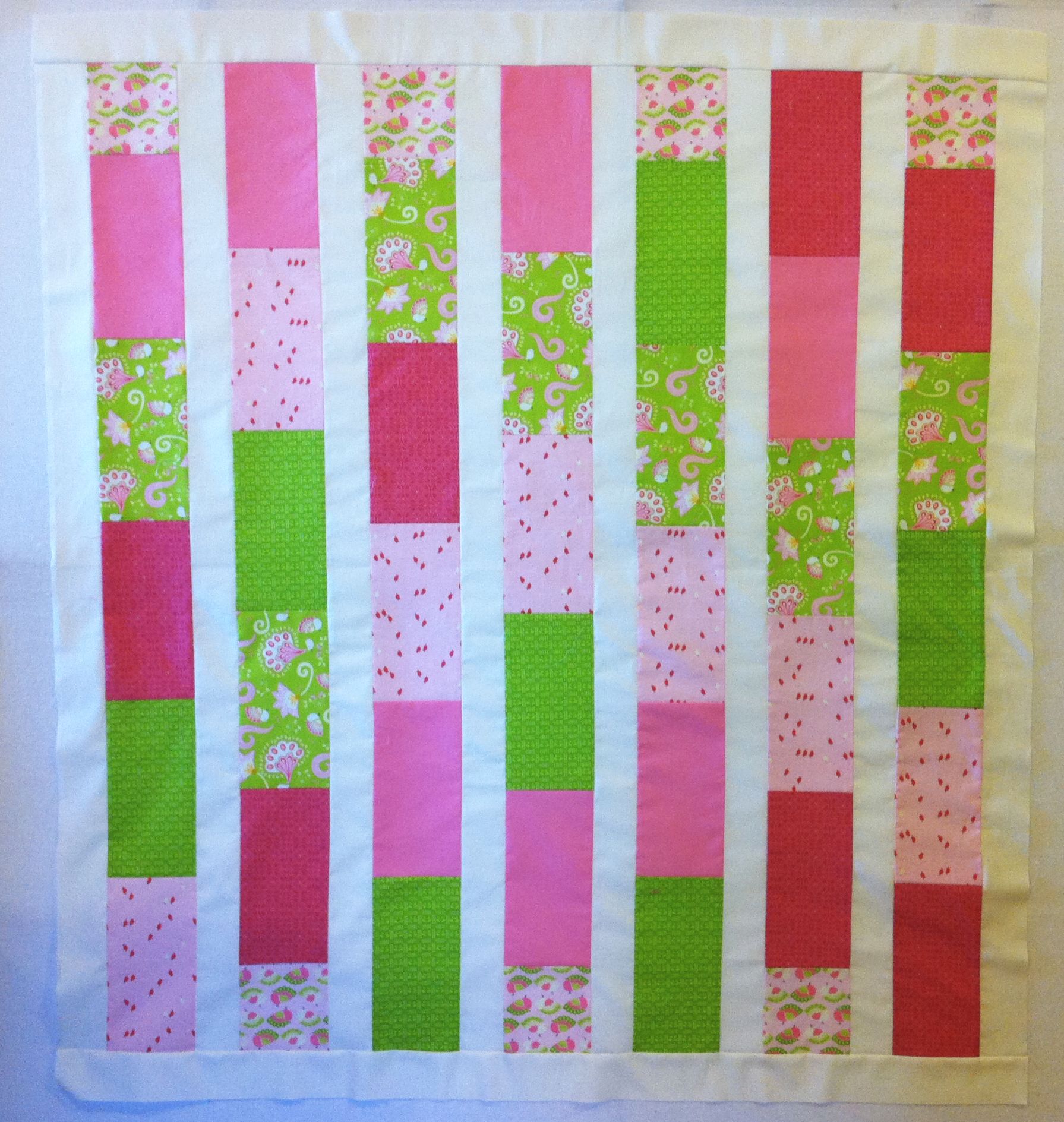
Girl Baby Bricks

Step 1 – Marking Diagonal Lines

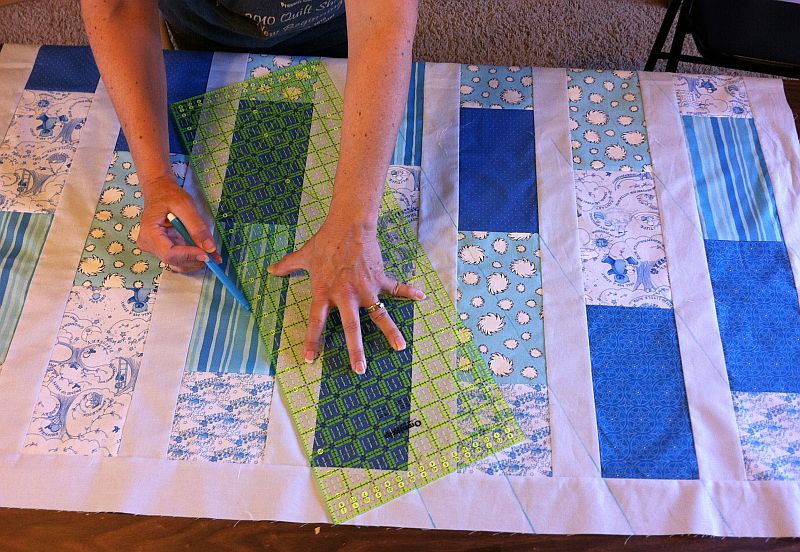
For the boy version of Baby Bricks I am going to quilt straight lines with a walking foot.  I used a water soluble blue marking pen to draw the quilting  lines. (If you are afraid of fabric bleeding or do not want to mark your quilt, you can use low-adhesive painter’s tape instead.)
Straight Lines

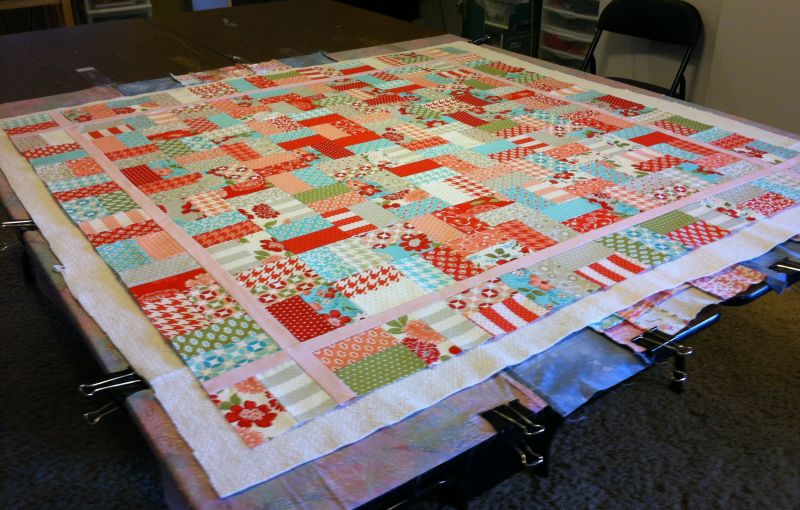
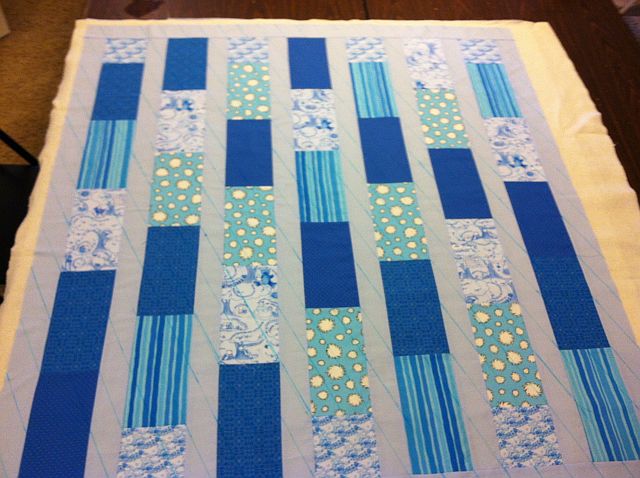
Using my longest ruler, I marked straight lines across the surface of the quilt. I started in one corner and drew a line from corner to corner of a rectangle brick. I extended the line so that it goes across the entire quilt including the borders. I spaced them 3 1/2 inches apart.
Additional Marked Lines

I added an additional line half-way in between so that the spacing of the lines is now 1 3/4″.  It took a total of 45 minutes to completely mark the top. Now the quilt is ready to baste.

Step 2 – Piecing the Backing

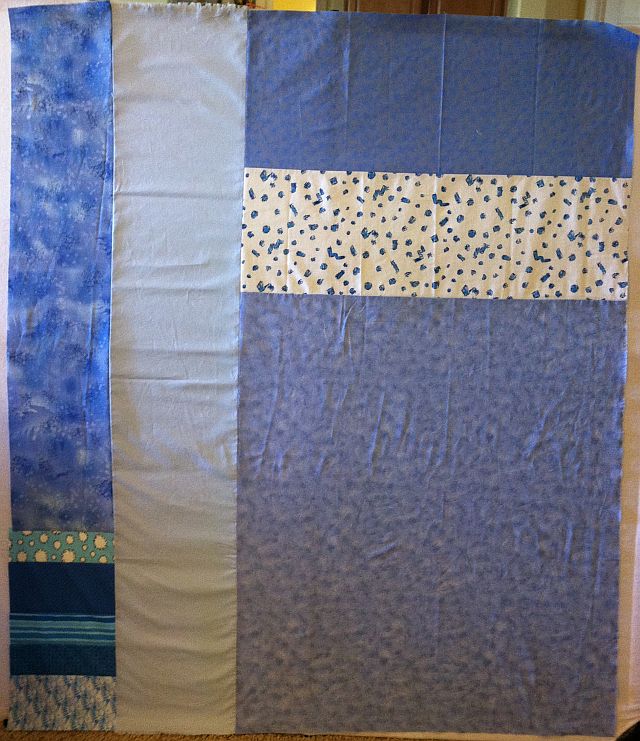
I enjoy pieced backs much more than plain ones. This satisfies my urge to go a little “wonky” with some improvisational piecing on the back. It took about 1/2 hour to sew together.
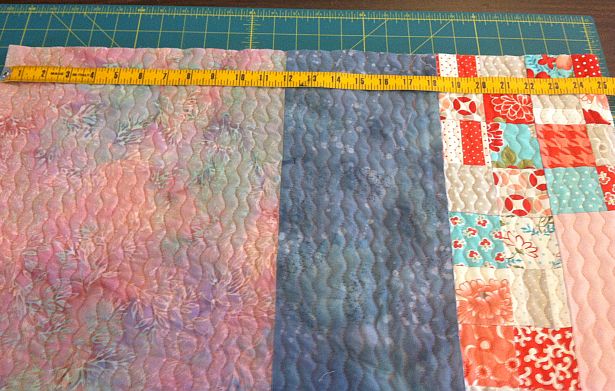
Pieced Backing

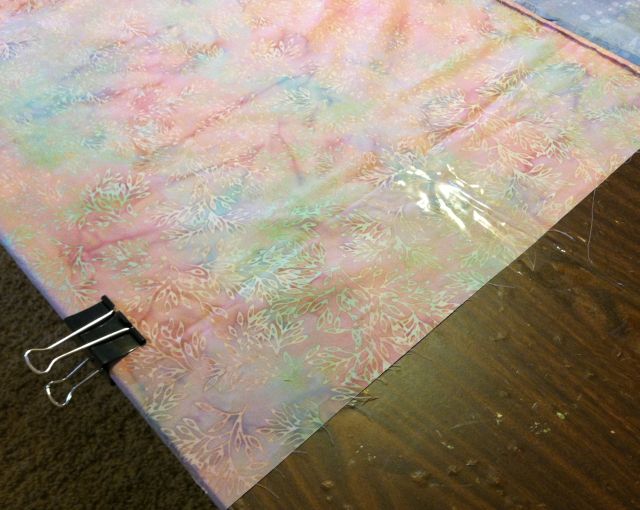
I put the back together sort of like a puzzle, adding chunks of fabric until I had a large enough piece. For this quilt I used up my the rest of my light blue solid, a few leftover bricks, and some pieces from my stash. It took about 2 yards total.

For more detail on sewing a pieced back, refer to my previous tutorial here.

Step 3 – Basting With Pinmoors

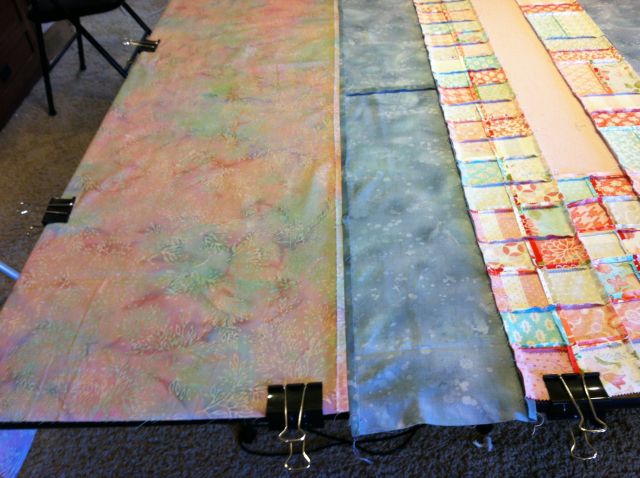
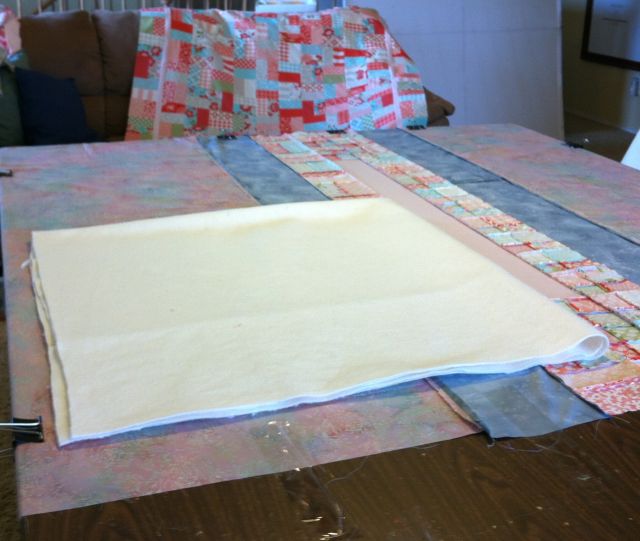
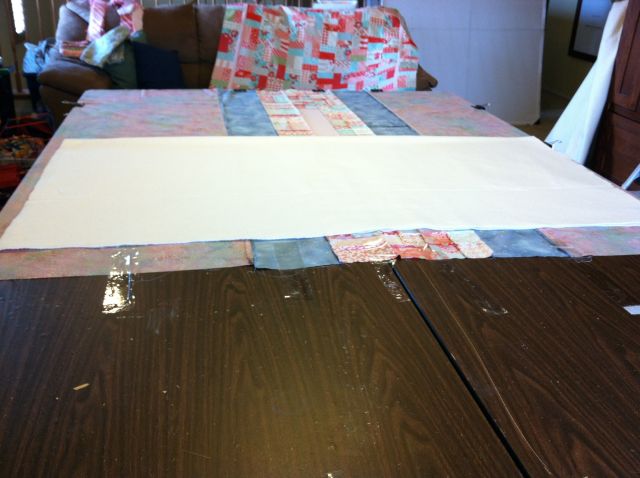
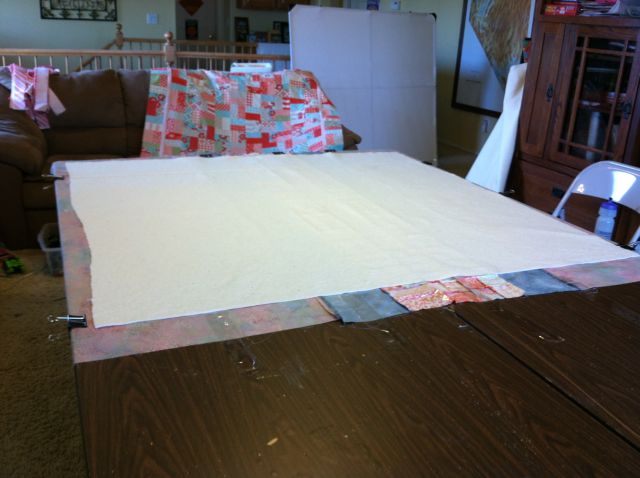
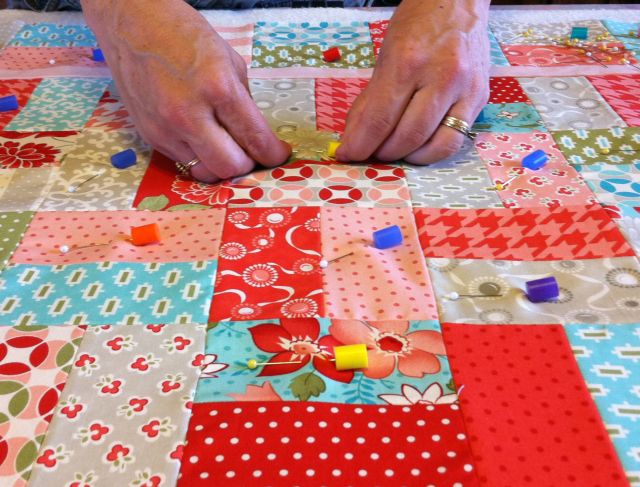
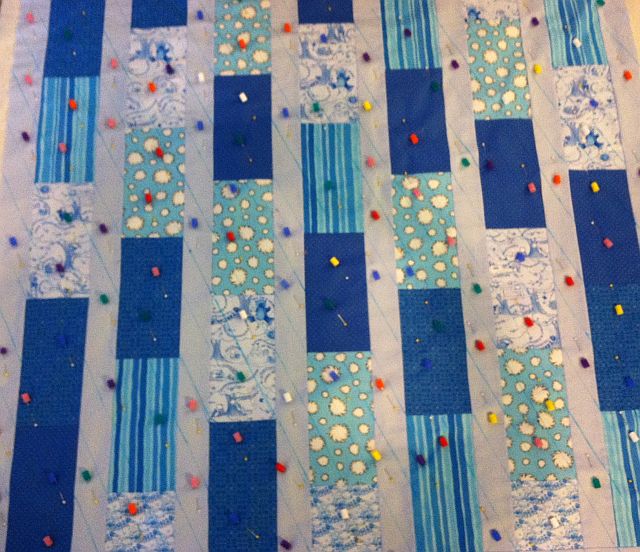
My preferred basting tools are Pinmoors and straight pins. It took about 1 hour and 100 Pinmoors to baste this baby sized quilt. You can read my previous basting tutorial here.
Basted with Pinmoors

I get better results when I use lots of pins and am careful not to pin through any quilting lines. It’s easier to stick the pin in the quilt and cap it with a Pinmoor, than it is to open and close lots of  safety pins. The Pinmoors are easy take out while quilting, but they stay in place until I’m ready to remove them.

I am going to take this quilt with me to my guild’s quilting retreat this weekend. With any luck, I’ll get it finished quickly and can start on the pink one.
Here is the schedule of tutorial posts for my Baby Bricks do-it-yourself quilt along:

Christa’s Quilt Along 2.3 – Sewing Your Baby Bricks Together

This week we will sew together the complete Baby Bricks quilt top. Kits are available if you would like to quilt-along, or scroll down to the end for a link to the supply list.

I am making two quilts at the same time so it’s double the fun! I finished the boy version just before we left on our vacation and it literally took me 2 hours to sew the whole top. We were just in time to catch our flight! (I’ll finish the girl version when I get back!)

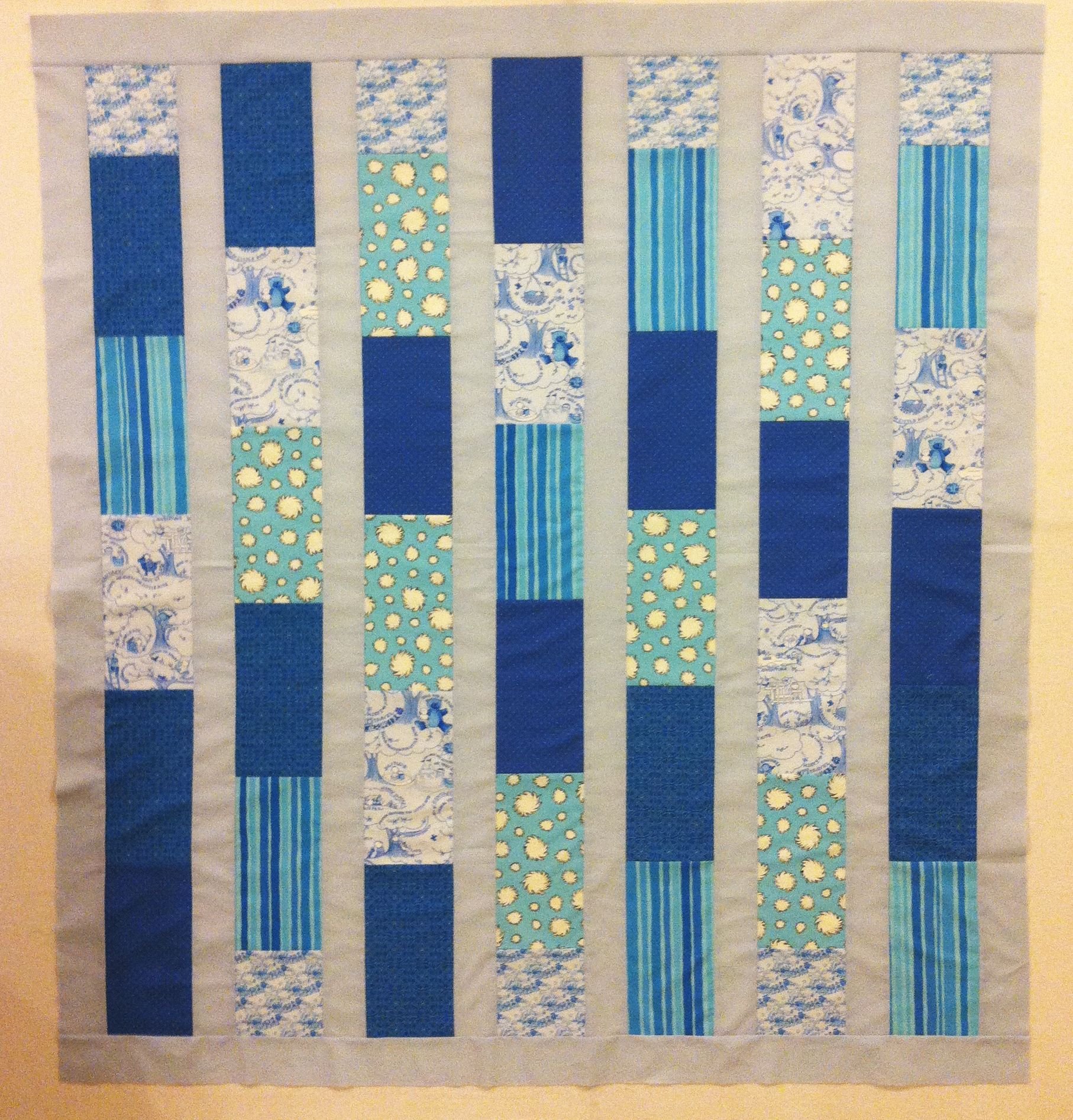
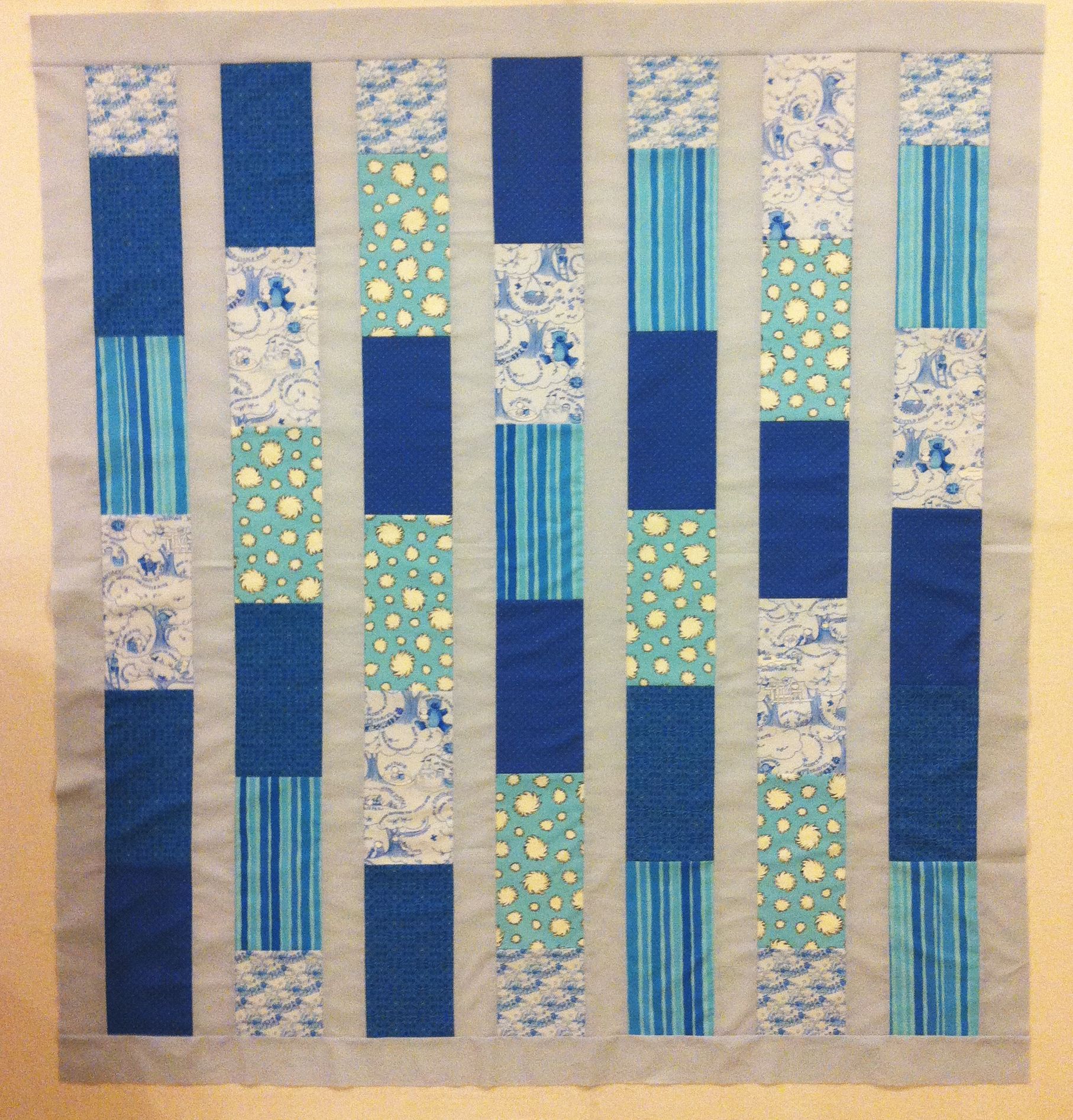
Baby Bricks Quilt Top

Step 1 – Sewing the Rows

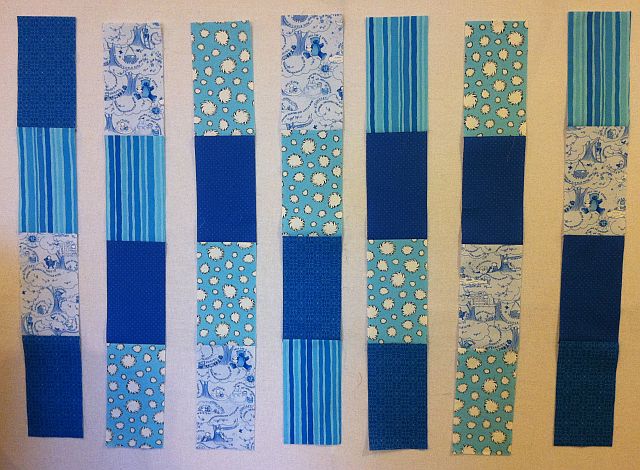
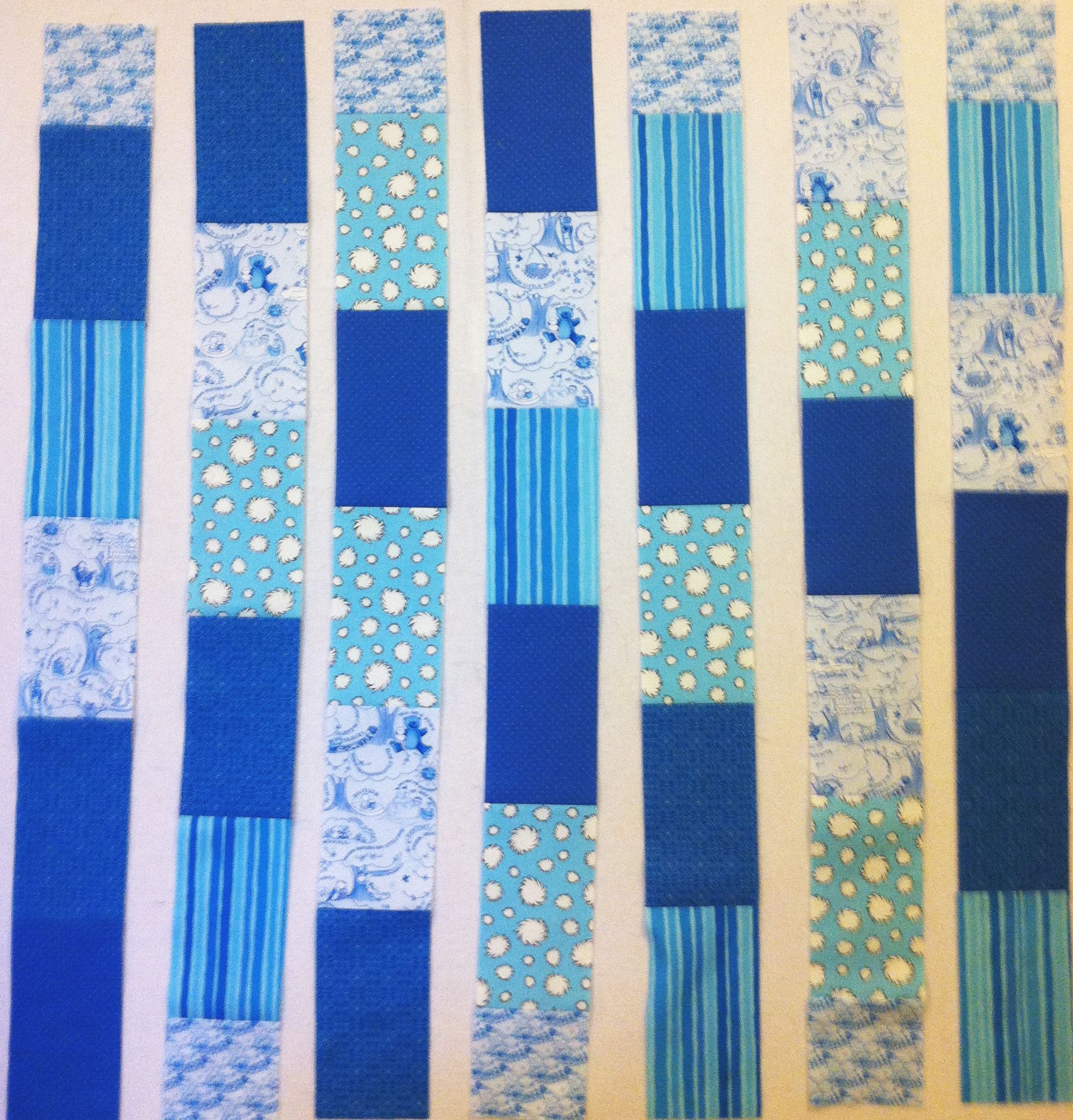
The quilt consists of 7 rows of bricks with alternating 1/2 bricks at either end. There are solid strips in between each of the rows. Watch your fabric placement if you are using directional fabrics. I used cotton thread, size 50 and a new needle, size 80/12 for piecing.

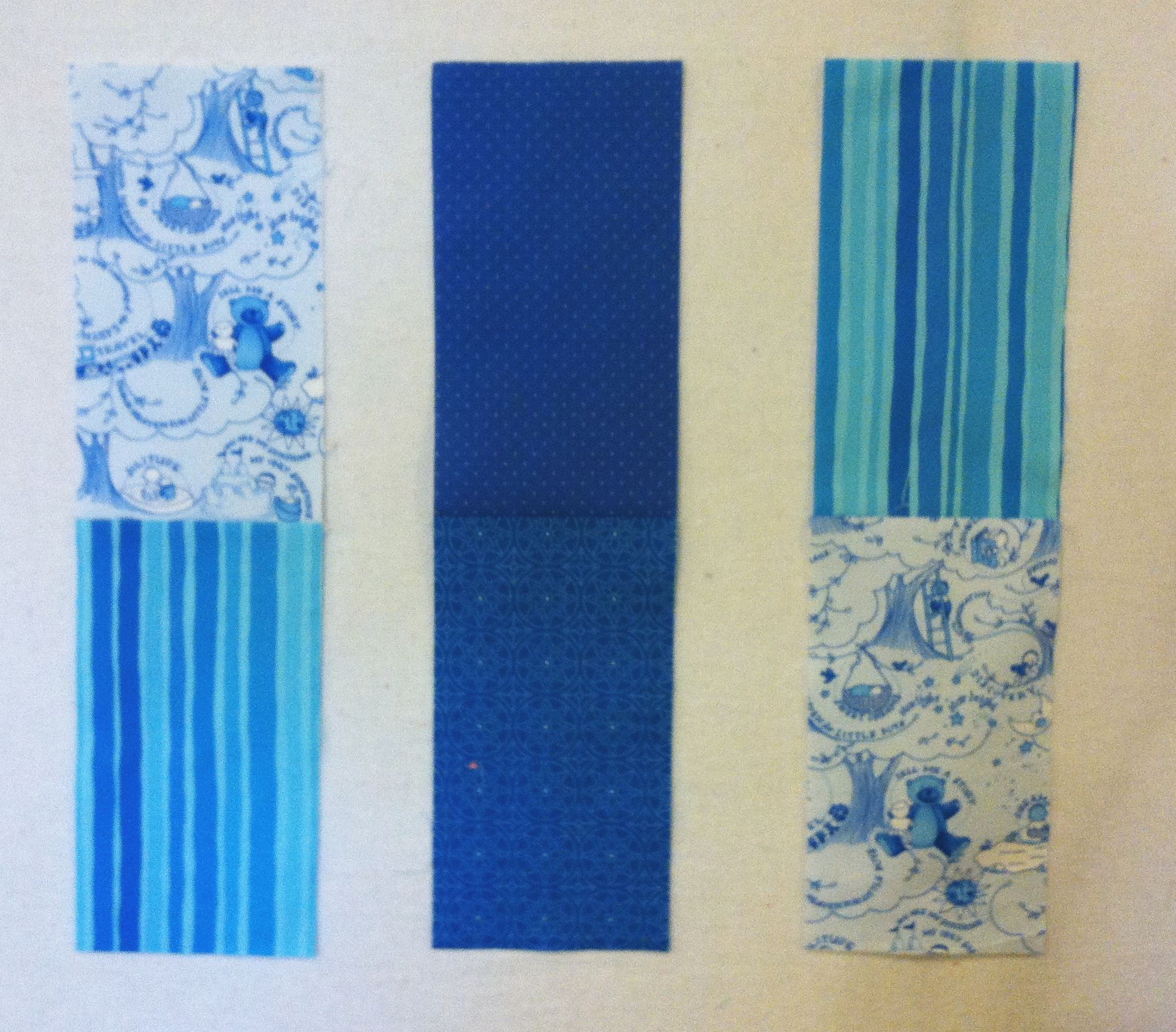
It’s easiest to sew together 14 pairs of two bricks first. I grabbed them at random.

Brick PairsNext, double up your pairs so that you have 7 rows of 4 bricks each.

Sets of 4 BricksAdd 1 full brick and 1/2 brick to the top and bottom of each row, alternating placement. (The half bricks are slightly longer than 1/2 of a brick to account for seam allowances.)

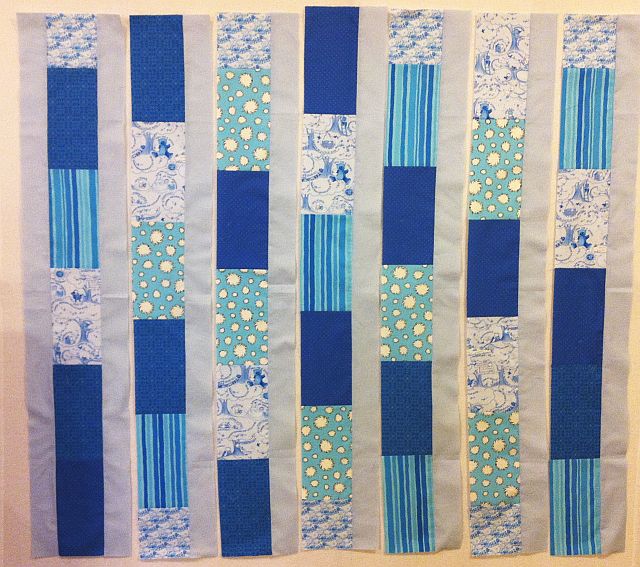
Finished RowsEach row has a total of 6 pieces.

Step 2 – Adding the Background Strips

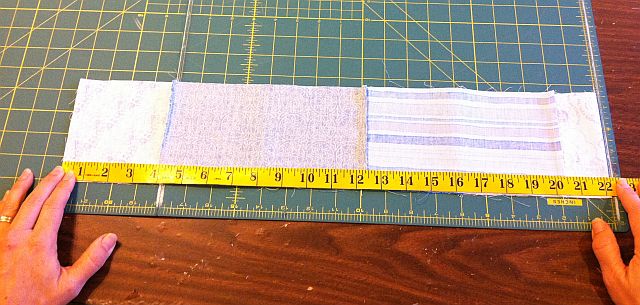
Measure the length of your rows. Mathematically they should measure 44 1/2″ at this point.
Fold a row in half to make it easier to measure. The half-measurement is 22 1/4.”

Measure Each RowTrim up 8 of your background strips to this measurement. Pin one strip to the right side of each row and sew. The first row will have a strip on the left side, too. Because the strips were cut parallel to the selvedge, they will have less give and there is less chance for distortion.

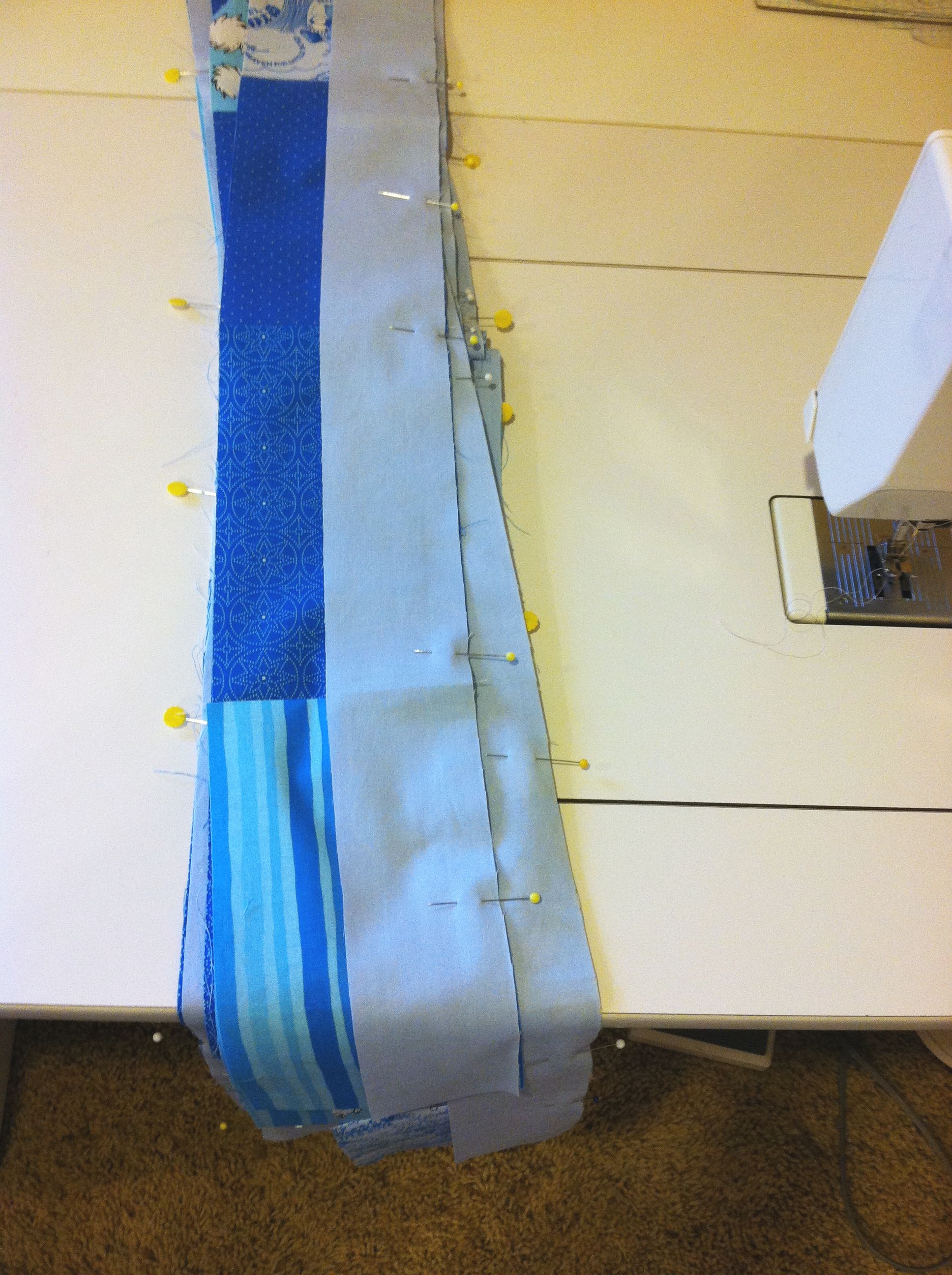
Pin the Background StripsAfter the background strips are sewn on, sew the top into wider rows, joining 2 at a time. This time, sew with the bricks on the top side and the background strips underneath. This will help ease any distortion that occurs when sewing long strips together. Again, pin well.

Bricks and BackgroundOnce all the rows are joined, measure across the width of your quilt.  Finished Quilt Top

Mathematically it should be around 44 1/2″ wide (the same as the length of each row).

Trim your last two background strips this length and join to the top and bottom.

Give it a nice press and your top is done! This quilt will be a nice canvas for some fun geometric machine quilting. I can’t wait to get to that step in 2 weeks.

Be sure to email me pictures of your progress and any questions you have!

The full tutorial schedule is shown below, with links to each completed step as I finish:

Christa’s Quilt Along 2.2 – Cutting the Baby Bricks

I’m so excited to start on a new quilt! Perhaps the best thing I love about creating these tutorials is that it forces me to quilt. I work well with deadlines. 🙂 It was also very fun to put together quilt kits for this project and even more gratifying that they are selling!

This week we will cut out all of the pieces for our Baby Bricks Quilt. Scroll to the end of this post for the complete schedule. For those of you needing a quick refresher on rotary cutting, Alyssa from Pile O’Fabric has an excellent rotary cutting tutorial on her blog.

Before you begin, make sure to read the instructions thoroughly and heed this advice: measure twice, cut once! You need 17″ x 18″ of useable fabric from each fat quarter.

Step 1 – Cutting the Bricks

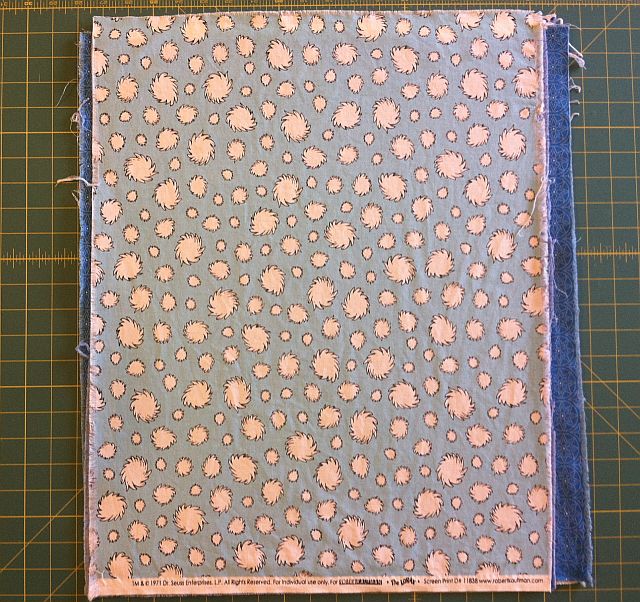
Start with a sharp rotary cutting blade, and stack 5 of your 6 fat quarters together.

Stack of Fat Quarters

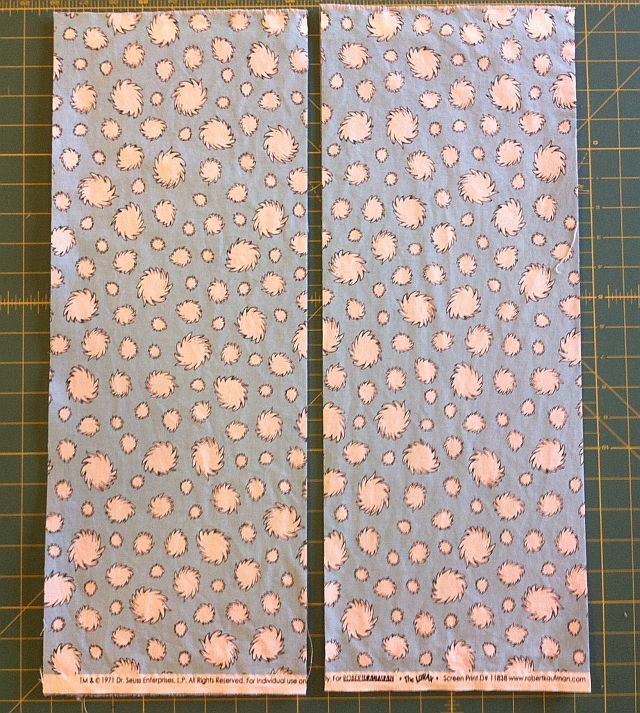
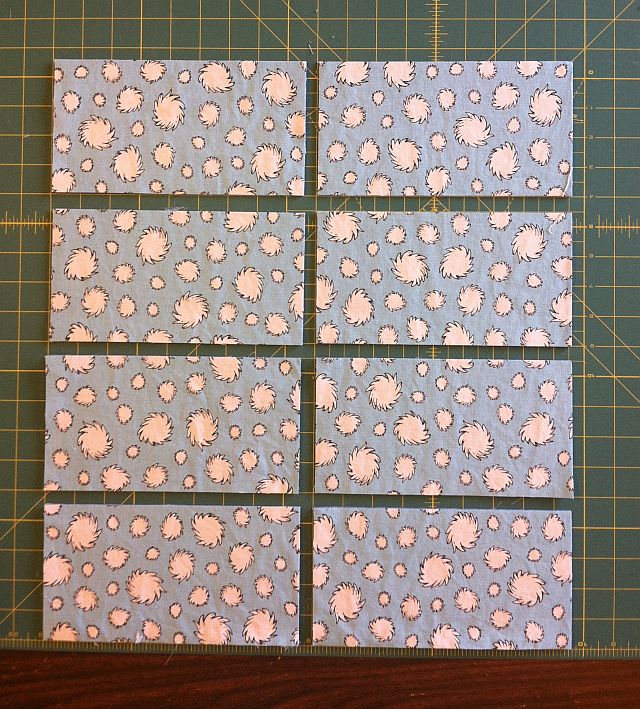
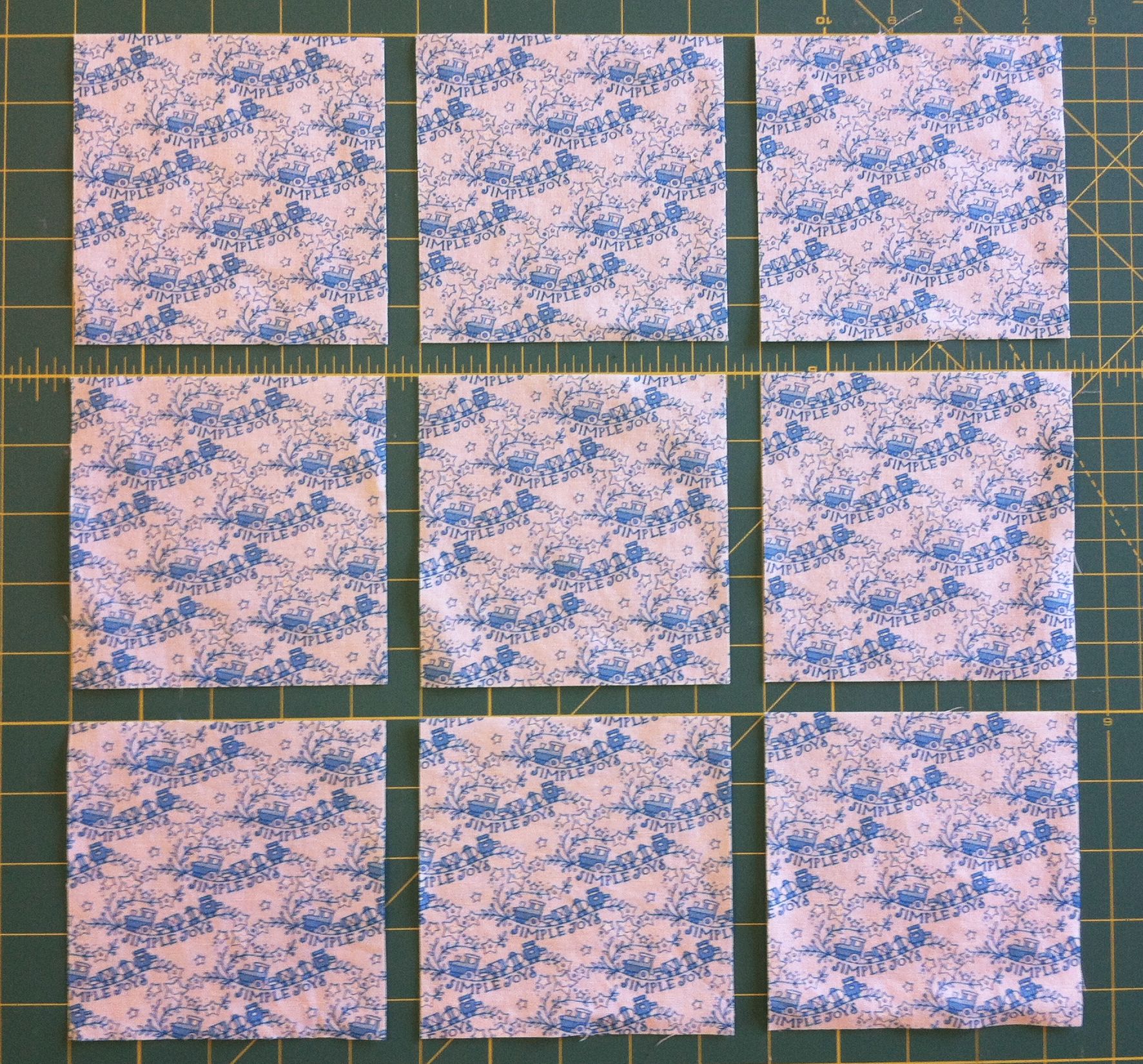
Cut each fat quarter into two 8 1/2″ x 21″ strips. Then subcut them into 4 1/2″ x 8 1/2″ bricks. With careful cutting, you can get 8 bricks per block. Repeat for a total of 40 bricks.

Two 8.5 Inch Strips

8 Bricks Per Fat Quarter

For this quilt, You only need 35 bricks, so 5 of them will be extra.

You can use the leftovers either on the back of the quilt, or use them to make a quilt label, or small throw pillow. Or swap some of them out with your 1/2 bricks shown below for variety.

Step 2 – Cutting the “Half”-Bricks

With your remaining fat quarter, cut out three 4 1/2″ strips. It doesn’t matter which direction this fat quarter is going because you will subcut them into squares.

Cut 3 Strips for Half Bricks

Cut the 3 strips into nine 4 1/2″ squares. These squares are actually a little longer than half of one brick so cut carefully! You only need 7 “half”-bricks, so 2 of these will be extra.

Cut Nine 4.5 Inch Squares

Step 3 – Cutting the Background and Binding Strips

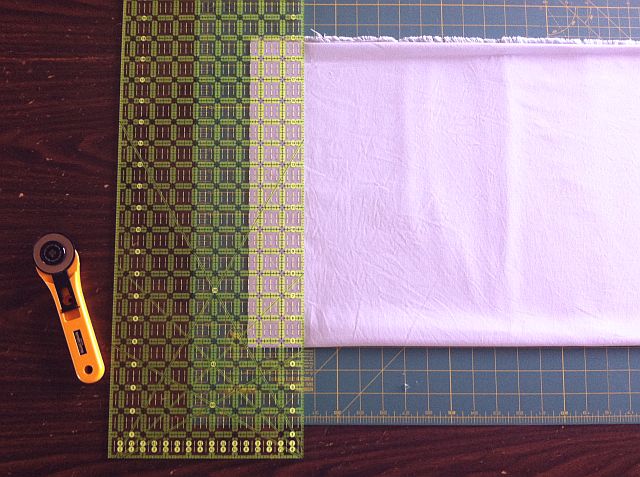
Fold your background fabric “the long way” as I call it, parallel to the selvedge. Fold the fabric into 4 layers and use a longer acrylic ruler for cutting.

Fold Parallel to Selvedge

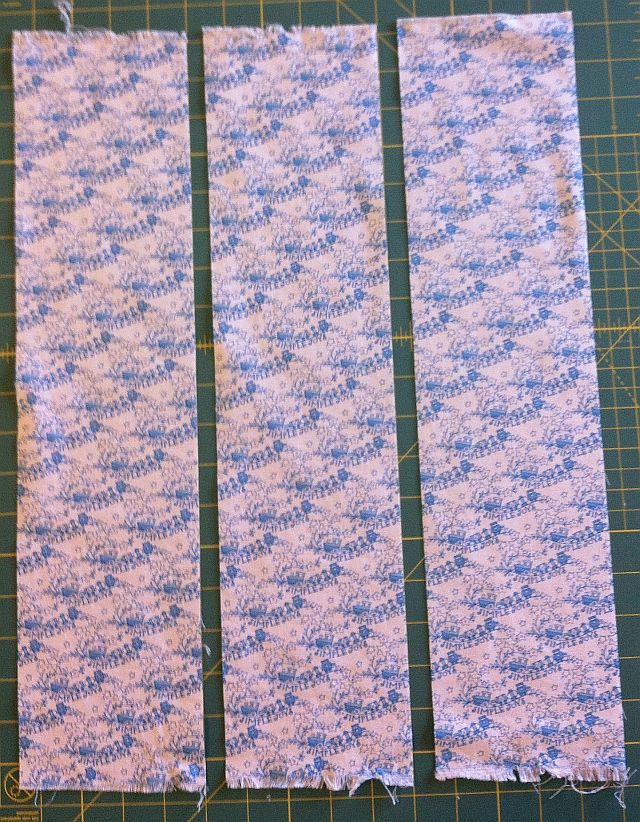
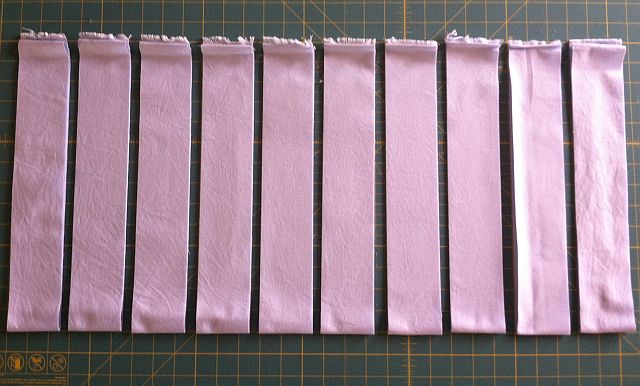
Trim the selvedge and cut ten strips that measure 2 1/2″ wide by the length of the fabric (about 54 inches).  These are for your background strips and your borders.

Cut 10 long strips by 2.5 Inches

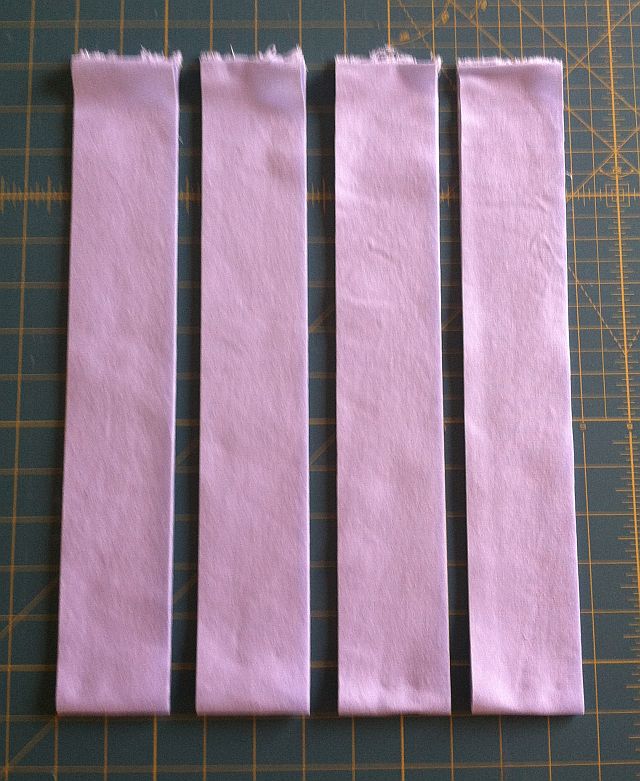
Cut 4 more  strips 2 1/4″ x 54″. These will be your binding strips. Set them aside for now.

Cut 4 Binding Strips 2.25 Inches

That’s it for this week! Wasn’t that easy? It was so easy that I am actually making two quilts at the same time. You can see both my boy version and girl version below.

Boy BricksGirl Bricks

If you have any questions about this tutorial you can post them here on the blog. If you want to share pictures of your quilts in progress from any of my tutorials, just email me at Christa@ChristaQuilts.com. I’ll share pictures and answers next Friday.

Here is the complete tutorial schedule. Each link will be active once I’ve finished that step:

Christa’s Quilt Along 2.1 – Baby Bricks Supply List

Free Quilt Pattern

New to my blog? Be sure to sign up for my email newsletter to get a free pattern!

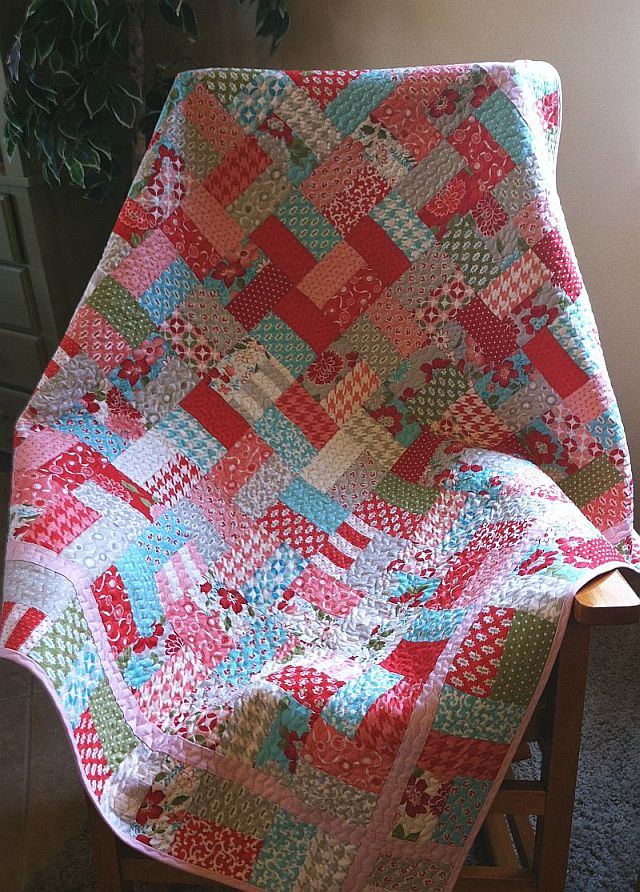
Baby Bricks

Welcome to my second Quilt Along! (Click Here for the first one). What makes my quilt alongs different and exciting? We will make the complete quilt from start to finish including machine quilting. I love to encourage do-it-yourselfers – no quilting by check here. 🙂

We will be making this Modern Baby Bricks Quilt measuring approximately 44″ x 48″.

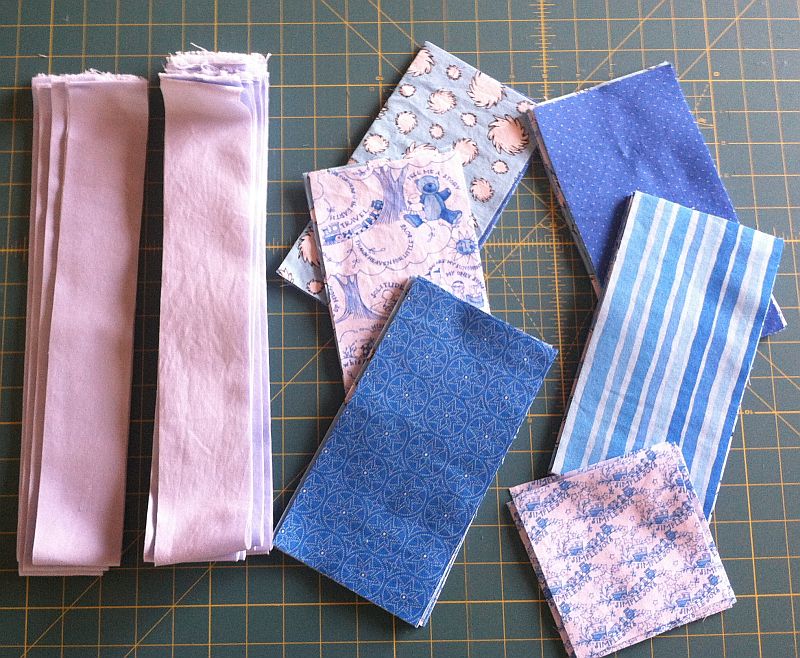
Baby Bricks Boy Blue

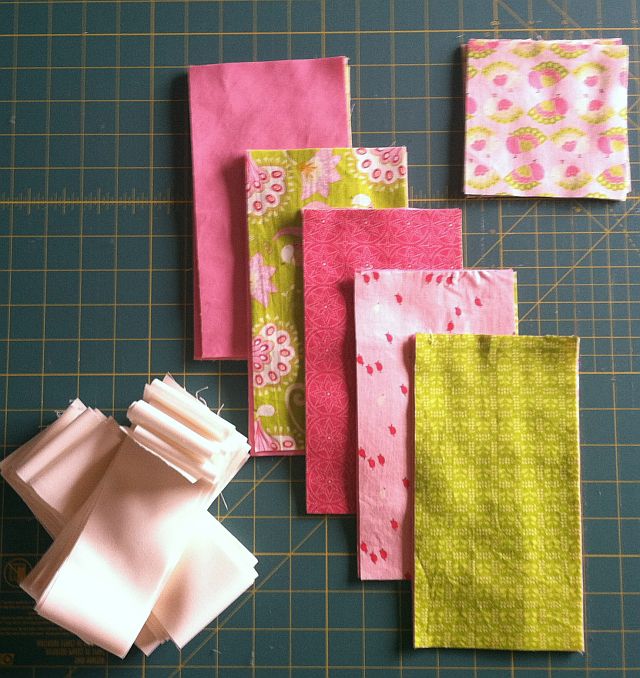
I’m making this quilt in two color options, using the fabrics shown below:

Girl Baby BricksBoy Baby Bricks


These  colorways are Pretty in Pink and Baby Boy Blue and am going to make one of each! Have fun choose your fabrics using the supply list below and quilt along with me!

Sewing Schedule (All links will be active once each step has been completed.)

Supply List

  • 6 Fat Quarters of coordinating fabrics – use a variety of values and scales for interest
  • 1 1/2 yards of neutral background fabric; includes enough for binding
  • 2 yards of fabric for the backing; will be pieced
  • Rotary cutter with a sharp new blade for cutting through multiple layers.
  • General sewing supplies: machine in good working order, rulers, cutting mat, etc.
  • Neutral cotton thread for piecing (sewing the quilt blocks together)
  • Matching cotton or polyester thread for machine quilting
  • Walking foot for straight line quilting
  • Brand new sewing machine needles
  • Piece of batting at least 50″x55″
  • Tape or washable marking pen (test first and be sure to prewash your fabrics!)
  • Optional: Darning foot for free-motion quilting; supreme slider, quilting gloves, for FMQ

Note about washing your fabrics – I always prewash to make sure there are no surprises. If you are using small pieces like fat quarters, either wash them by hand in your sink, or use a mesh bag and machine wash on a gentle or hand-wash cycle. Wash light and dark colors separately until water runs clear and consider using a color catcher sheet with each load.

So take this week to gather your supplies and I’ll meet you back here next week for cutting!

Sharing is Caring

Please share your work in progress in my facebook group: Quilt With Christa . 🙂

Christa’s Quilt Along 1.6 – Machine Binding to Finish

Free Pattern

Be sure to sign up for my email newsletter to get a free quilt pattern!

Jolly Jelly Roll Quilt Wrap Up


Here are all of the previous bog posts, if you are just now joining us:

Week 1 – Supply ListJolly Jelly Roll Quilt

Week 2 – Sewing the Blocks

Week 3 – Completing the Top

Week 4 – Backing and Basting

Week 5 – Machine Quilting

Remember, you can click on any picture to enlarge it. Now, onto the binding!

I use the same techniques to attach the binding to all my quilts, whether finishing by hand or machine.

Step 1 – Square Up the Quilt

Use a large square ruler to trim up all four corners of your quilt. The square will help you achieve a nice straight 90 degree corner. Trim up all four of the sides with a longer ruler.

Square Up the Corners

Trim the Sides

Step 2 – Measure the Quilt Perimeter and Cut Enough Binding Strips

Measure the perimeter of your quilt so you know how many strips to cut.  Lay it out on your cutting mat or use a measuring tape. I folded my quilt in half to make it easier to measure. Divide your perimeter by 40 inches (the useable length of one strip).

Measure the Quilt PerimeterCut 5 strips 2 1/4 Inches Wide

Round up to the nearest number of strips and cut them 2 1/4″ wide. I cut 5 strips for my quilt.

Step 3 – Make Continuous Binding

This method is called double-fold straight grain binding. Sew all of your strips together to make one continuous piece. Miter the strips by sewing on an angle to distribute the bulk of the seam. If you are using a solid fabric, be sure to sew them all together on the same side!

Join Binding StripsSew on an AngleYou can eyeball the seam.

Trim 1/4 inch seams to the right of your sewing line and press open.

With a small square ruler, cut off one end of your binding on a 45 degree angle. Make sure your binding strips have not been folded or pressed yet. Once the end is cut, then press your binding in half along the entire length, with wrong sides touching and right sides out.

Angle the BegninngPress Binding in HalfWatch your seams if using solid fabric!

Step 4 – Attaching the Binding to the Quilt

Begin sewing your binding to the quilt with a walking foot, leaving a tail of about 6-8 inches unsewn. Be sure to start on the side of your quilt, not at a corner and sew the binding to the front of the quilt. The folded side of your strips will be to your left. The open sides will be to your right. Use a quarter inch seam allowance and match your thread to your binding fabric.

Leave a TailStop 1/4 Inch AwayWhen you reach a corner, stop sewing 1/4 inch away from the end. Mark it with a drawn line or a light pencil mark if needed. Sew off the side.

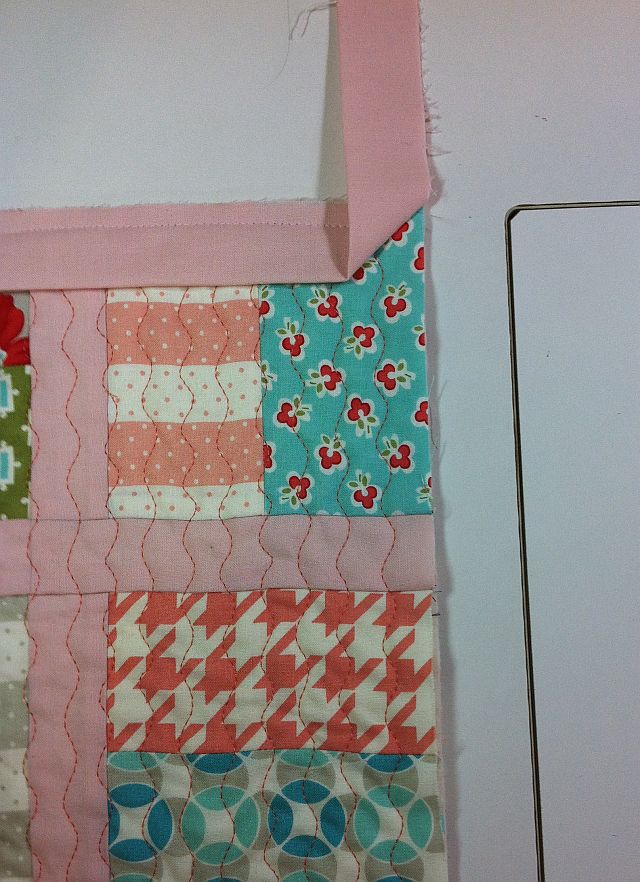
Rotate the quilt and flip the binding strip up so that it is even with the side of the quilt. Then, flip it back down, forming a “pinch” of fabric at the corner. This will be the fullness that will flip around to the back creating a nice mitered corner on the front.

Sew off the Side at 1/4 InchFlip Binding UpThen Flip DownRepeat this technique for all four corners of the quilt. When you are nearly finished sewing the binding onto the front side, make sure to leave another tail of about 6-8 inches of binding so you can join the beginning and ending binding pieces.

Next Corner

Leave a GapNext, you will trim and join the ends so they fit together exactly.

If you have a lot of excess binding, you can trim some off.

Open up both binding ends and nestle your beginning binding piece (the angled cut end) on top of the ending piece so that it is flat and smooth. Mark an angle on the ending piece where the beginning piece rests on it – should be a 45 degree angle. Cut 1/2 inch away from this marked line. This will take into account the seam allowances for both pieces. Make sure your binding is not twisted and that both angled cuts are parallel to each other.

Mark the AngleCut 1/2 Inch Past Marked LineJoin the two ends by offsetting them slightly to create little tiny tips at each end. Where my pin is pointing, sew from the crevice of one triangle tip to the other, with 1/4 inch seam. Trim off the triangle tips, and press the seam open. It should be a perfect fit!

Joining the Beginning and Ending StripsFinishing the Front BindingFinger press the rest of the binding closed and complete your stitching on the front side.

Step 5 – Finishing the Binding with Decorative Machine Stitching

Pinmoors for BindingThe key to a really nice binding, whether finished by hand or machine, is to make sure it lies flat all the way around the quilt and that the corners are secure.

Once the binding is sewn to the front, simply fold it over to the back to stitch.  I like to use pins with Pinmoor anchors for safety to keep everything in place. Fold over the corners to create a nice miter and pin.

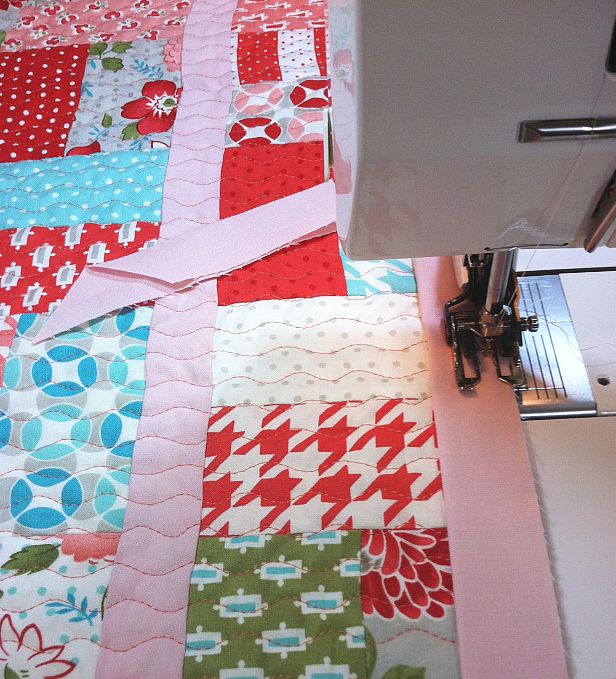
Binding by MachineI used the same decorative serpentine stitch for the binding that I used for the quilting.

You will notice I am actually stitching by machine from the back side of the quilt. This seems to give me the best results and I can control how wide the stitching is so it shows up nicely on the front.

You can see where I’ve already stitched some of the binding.

On the back, be sure to cover the line of straight stitching that was used to sew on the binding  from the front side.

The binding is just as beautiful on the backside as it is on the front. Another finished quilt!

Another Finished Quilt!

Sharing is Caring

I’d love to see your version! Please share your work in progress in my facebook group: Quilt With Christa . 🙂

Christa’s Quilt Along 1.5 – Machine Quilting

This week’s post is the one I’ve been waiting for. I think machine quilting is the best part of making a quilt, so I couldn’t wait to get my Vintage Modern jelly roll quilt top finished and basted so I could start the fun! I quilted it using a serpentine stitch with my walking foot.

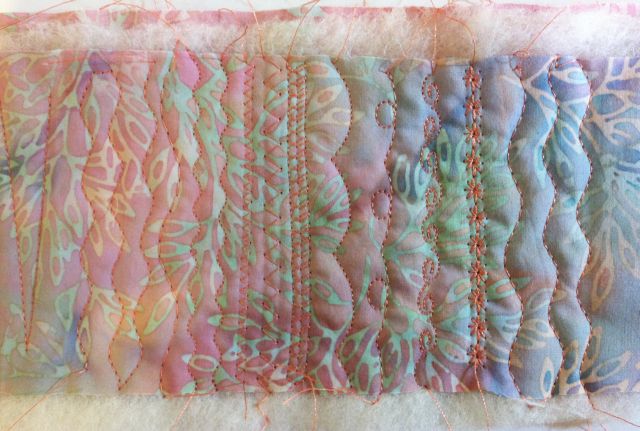
Machine Quilting 2" ApartBefore I started quilting, I tried out a few of my machine’s decorative stitches to see how they would look.  All of these can be done using a walking foot with the feed dogs engaged.

Stitch SamplesI used a 40 weight high-sheen polyester thread with a size 90 needle and used the same thread for both the top and bobbin.

This gives better results than using different colored threads.

Step 1 – Decorative Ditch Quilting

Quilting 4" ApartBe sure your needle plate has a wide enough opening to accommodate your decorative stitch and test it out first so you avoid broken needles.

Quilt along the seam lines in one direction in between your blocks, about 4 inches apart. The first pass took me 30 minutes.

This will secure the quilt and you can remove the pins as you go.

Next, make second pass in between each line of quilting. Now your quilting is about 2 inches apart and the quilt is starting to get some texture! I quilted parallel lines across the quilt. I did not mark any of these lines – I just used the seams as a guide and eyeballed it across the fabric where there was no seam to guide me. This is both liberating and fun!

Quilting Parallel Wavy LinesThis second pass took another 30 minutes so I’m just at 1 hour total quilting time. Not bad! At this point, this is enough quilting to hold your quilt together. However, I want more…

Step 2 – Adding More Quilting

Quilting 1 Inch ApartMy motto is that you can never add too much quilting to a quilt!

So I added another line of quilting in between each of the rows above. This was my 3rd pass and now the quilting lines are about 1 inch apart.

This took only another 30 minutes and I can’t believe how fast this is going!

There is still enough room to add another row of quilting and do a fourth pass, so I decided, what the heck?

The fourth pass took 1 1/2 hours because I had now doubled the amount of quilting on the quilt, but I loved every minute of it!

Half Inch Quilting Lines

I ended up with quilting lines about 1/2 inch apart over the surface of the quilt. Total quilting time was 3 hours and I used up a full 500 yard spool of Superior Highlights thread.

Textured QuiltingSuperior Threads Tri-Lobal Polyster

I love all the texture on the back!

Pieced Backing with Quilting

So next week, we will finish our quilts, can you believe it? We will trim them up and bind to finish. I really can’t wait to see how everyone’s quilting turns out. Be sure to email me pictures of your progress, no matter where you are,  so I can share with everyone else.


Here is the complete Jolly Jelly Roll Quilt-Along Schedule:

Week 1 – Supply ListJolly Jelly Roll Quilt

Week 2 – Sewing the Blocks

Week 3 – Completing the Top

Week 4 – Backing and Basting

Week 5 – Machine Quilting

Week 6 – Machine Binding to Finish

Christa’s Quilt Along 1.4 – Backing and Basting Your Jelly Roll Quilt

Welcome to part 4 of my do-it-yourself quilt along! So far we’ve gathered our supplies, sewn the blocks, and completed our quilt tops. This week we will piece our backings and baste our quilts so that our Jolly Jelly Roll Quilts are ready for machine quilting next week!

Step 1 – Piecing the Backing

Backing DiagramIf you use one fabric entirely for your backing, sew together two lengths of fabric so that your piece is at least 5 inches longer and wider than your quilt.

For a 52″ x 52″ quilt top you would need 3 1/2 yards of fabric for the backing. Cut that into 2 equal pieces, each measuring 63″ long by 42″ wide. Sew those together on the selvedge edges with a half inch seam and you’ll get one piece that is about 63″ x 80″ – plenty of room!

I wrote up a post a few weeks ago on how to make a pieced quilt backing. With more than one fabric. You can read about that by clicking here.

Pieced Quilt BackFor my backing, I chose to use up all of my leftover jelly roll blocks plus some other chunks of fabric, about 3 yards total, to make it a little more artistic.

I sewed two rows of leftover blocks, then filled in with strips of pink and grey fabric from my stash.

The pink on the sides is much wider so a bunch of it will be trimmed off later.

(Don’t mind the wrinkles – I finished it just last night!)

Step 2 – Layering the Quilt

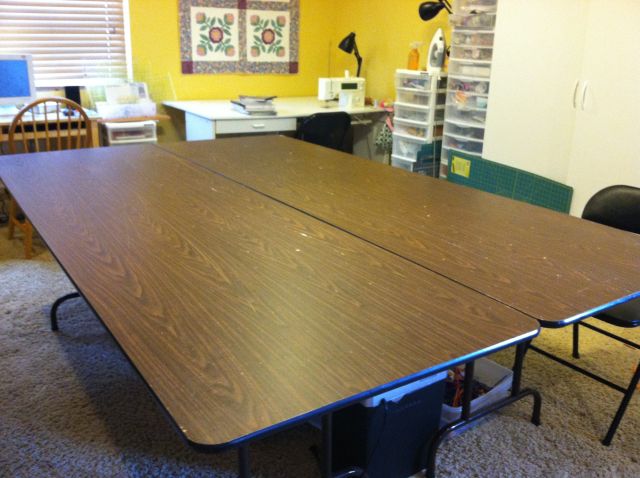
Basting TablesThe most important thing you need for successful basting is plenty of room! I have two 8-foot tables set up in my sewing room at all times. I use them for cutting and basting.

First, you need to secure your backing; this is why you want it to be larger than your quilt top.

I do this by using office clips to secure the backing to the table. I use tape when the quilt backing does not reach the edge.

Clamp Down the BackingTape the EdgesNext, it’s time to spread out the batting. I used Warm-N-Natural cotton batting which does have a right and wrong side. The side with the flakes is the front side and the whiter side is the back side. Layer it right side up.

You can start with your batting folded up in one corner, then unfold the batting one step at a time if you are basting by yourself. Be sure to smooth it down so there are no wrinkles.

Batting 1Batting 2Batting 3You can click each of the pictures for a larger more detailed view.

Finally, it’s time to add the top! I don’t clamp down the top, but I do smooth it out and line it up as much as I can so that it is as straight and square as possible.

Layered QuiltStep 3 – Basting the Quilt

Now it’s just a matter of pinning the layers together so they won’t shift during quilting. My favorite basting tools are Pinmoor pin anchors. They are little  rubber tips that fit on the end of straight pins. You can use any types of pins with them and the pins can jab anywhere into the hard rubber piece. They last forever and are so much easier to use than safety pins.

Pinmoor BastingIt took me about 150 Pinmoors to baste this quilt in under 20 minutes. If you are not ready to buy enough for a whole quilt, start with one package and baste part of your quilt. Baste the rest of your quilt with safety pins. Then, when quilting, take note of how much easier the pins and Pinmoors are to remove and you will be converted!

Here’s a great video you can watch on how to use them, made by the makers of Pinmoors.

Next week  we will machine quilt this baby! That’s the best part of my do-it-yourself quilting tutorial; you are actually going to do it all yourself – no quilting by check here!!

Remember to send me pictures of your completed quilt tops. You can email me directly at Christa@ChristaQuilts.com. It’s “sew” fun to share!


Here is the complete Jolly Jelly Roll Quilt-Along Schedule:

Week 1 – Supply ListJolly Jelly Roll Quilt

Week 2 – Sewing the Blocks

Week 3 – Completing the Top

Week 4 – Backing and Basting

Week 5 – Machine Quilting

Week 6 – Machine Binding to Finish

Sew and Tell Friday – Quilts from Precuts

This week for Sew and Tell Friday, I want to share with you an adorable charm quilt that my mom made, plus a another show-and-tell from our Jolly Jelly Roll do-it-yourself quilt-along.

My mom is a very prolific sewer. She taught me how to sew, and in turn, I introduced her to quilting many years ago. She recently made this adorable quilt top from a Twirl charm pack I gave her. (When you have a mom that sews, fabric always makes a great gift!)

Twirl Charm QuiltMom used a Split 9-Patch pattern variation which just calls for 1 charm pack plus 3/4 yard of border fabric and 1/2  yard of sashing fabric. You basically sew together four nine-patches (using 36 charm squares), cut them into fours, and insert a 1 1/2″ strip of sashing in between each block and around the edges to frame it.  The borders are cut 5 inches wide (4 1/2″ finished), so I think you could use 4 more charms in the border corners and then use a leftover charm on the back for your label! Cute, huh??

Hmm… this may have to be a future tutorial…..

Speaking of quilt  tutorials, Mom is also following along making her Jolly Jelly Roll quilt top, but she hasn’t sent me any pictures, yet (hint, hint, Mom!)… However, a bunch of you have. Here’s a picture from Amy S. who’s using the Summersville jelly roll for her quilt blocks.

Summersville Jelly Roll Quilt BlocksDon’t those look yummy? I love her methodology for how she’s going to sew together the blocks. She’s going to throw the strip pairs into a bag and randomly grab 2 blocks at a time to sew together, as long as they are different fabrics. I love it – it’s going to be scrap-a-licious!

Here’s a link to the supply list if you want to grab a jelly roll and start one of these quilts yourself.  I just barely finished sewing my quilt top yesterday in time to blog about it, so I’ll give everyone plenty of time to finish up their tops before we start to quilt them.

Lil Rascals Charm Pack Quilt Part 2 – Machine Quilting

Last Thursday I posted instructions on how Lil Rascals Charm Pack Quiltto make this cute Li’l Rascals quilt top from just one charm pack and a yard of coordinating fabric.

If you are following along, feel free to post comments or ask questions about the project and I’ll do my best to answer!

This week I am working on machine quilting the 9 patch blocks with a free-motion wavy plaid design. Next Thursday, I’ll blog about marking and quilting the borders and sashing with a stencil.

I was really excited about doing something different with this quilt. I have stippled myself silly over the last 4-5 years and I’m ready to move on to new textures and designs.

Wavy Plaid PracticeI was inspired by Leah Day’s Loose Weave quilting from her  Daisy to Paisley book of free motion fillers. I stitched out a practice sample on scrap fabric, then set to work on my quilt.

The long wiggly lines were easy to quilt without marking. My design is called “Wavy Plaid.”

First, I quilted long slightly wavy lines down the length of each 9-patch block. I used a thin polyester thread that seemed to blend in with most of the fabrics. I wanted the texture to show, not the thread! I quilted 4 sets of double rows per block and kept them sort of even.

Vertical Lines Quilting

Next, I quilted the same type of wavy lines going across the width of the blocks. I did have to rotate my quilt so that I was quilting either up or down the quilt the entire time. When I tried to quilt from side to side, my thread kept breaking.

Wavy Plaid Quilting I love the freedom this design gave me. Nothing had to be perfect and the quilting added lots of gorgeous texture!

Echo LinesTo create the double lines, I quilted an echo outline with my free-motion foot, using the edge as my guide.

I dropped the feed dogs on my machine, used a Supreme Slider underneath the quilt to help it slide around smoothly, and stitched while wearing Machingers Quilting Gloves. The right tools make all the difference!

By the way, in case in case you need it, here are links to my mini-tutorials on pin basting, and sewing a pieced backing.

Circle Stars Workshop Part 1 – Drafting

I’m finally ready to share some pictures with you from Gail Garber’s workshops I took last weekend.  You can see some of Gail’s beautiful quilts with her signature colorful flying geese in my earlier post HERE. She’s one of the most fun quilting instructors I’ve ever had!

Gail Garber WorkshopShe started us off with a private show & tell of her beautiful quilts and we spent a little time introducing ourselves. What a perfect way to start a class – creating camaraderie to boost our morale for the weekend of work ahead! Getting into the nitty-gritty the picture below shows  the types of supplies we needed to create such complicated quilts. It wasn’t too intimidating since she walked us through the procedures step-by-step. You can purchase many of these supplies from Gail Garber’s website HERE.Drafting SuppliesI spent most of the first day designing and drawing with a compass and pencil. Gail used such friendly terms like “make a fish tail” rather than scary math terms like “bisect the angle”. Her approach was fun and certainly doable! Be sure to click the pictures below for closeups.

Drafting the StarGail with CompassDrafting perfect stars was fun once I knew how!

Drafting DesignPaper Pieced PatternOnce we were happy with our design, we made a paper pieced pattern pie!

I managed to get one wedge of my star sewn by the end of the weekend. What a success!

Finished PieceSeveral friends and guild members took this fun class. Shown above: Jean, me, Gail Garber, and Karen. (Jean and Karen both make award-winning quilts that you can see HERE.)