Paper Pieced Quilt Along #7 – Pieced Backing

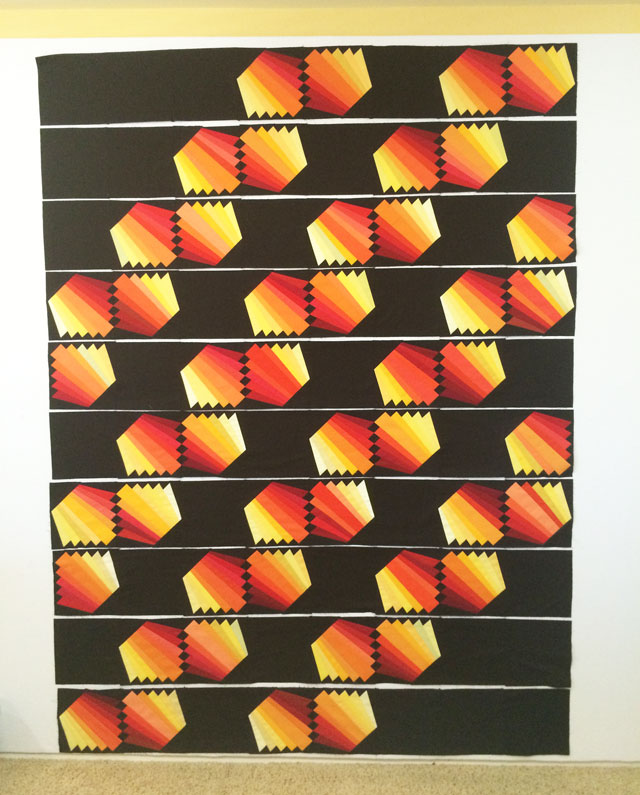
I love a good pieced backing! There’s something about creating a secondary composition on the back that makes me giddy. Of course, you don’t have to make a pieced backing, but what follows are brief instructions for how I made my backing for the Paper Pieced Quilt Along:

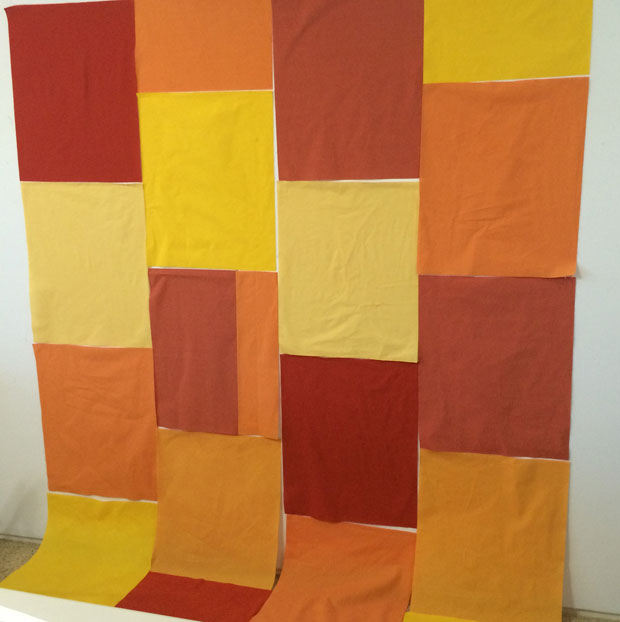
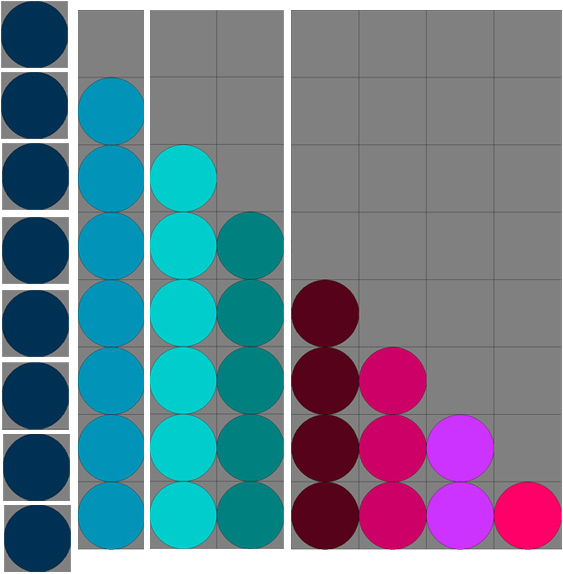
backingdiagramThe backing design is interesting to stand on it’s own as a quilt top, too!

This backing finishes at 68″ x 84″ which is exactly 4″ bigger all around than my quilt top. That’s cutting it close, so if you’d like a bigger backing, just add more rectangles or make them slightly bigger.

Yardage needed – 18 assorted fat quarters (18″ x 22″ each). Note: solids tend to be a slightly wider useable width so they are closer to a true 18″ x 22″. Print fat quarters may result in less useable yardage. To use up scraps, feel free to piece sections together to get the desired rectangle sizes.

Trim 14 of the fat quarters to 17 1/2″ x 21 1/2″. Trim the remaining 4 fat quarters to 17 1/2″ x 11″

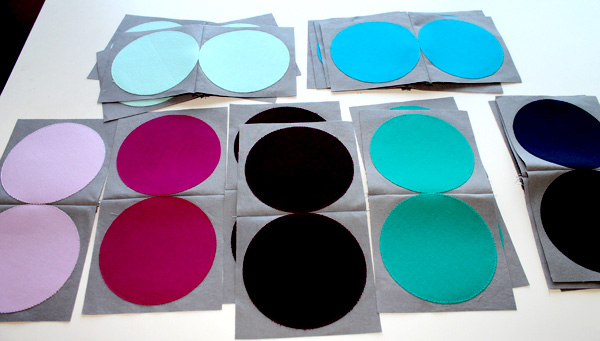
backingsquares

Lay out the rectangles on a design wall or other large surface, into a pleasing color arrangement.

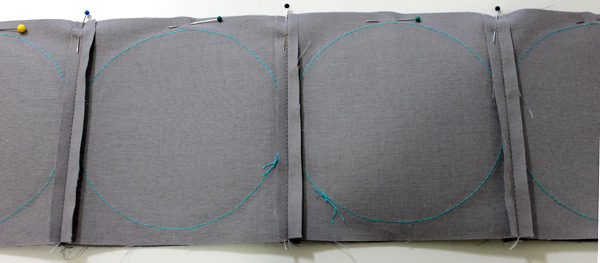
Sew 4 rectangles together on their short ends to make the first and third pieced columns. Sew 3 rectangles and two half-rectangles on either end to make the second and fourth pieced columns. To reduce bulk, press all seams open.

Join the columns to create the pieced backing. Once the quilt is basted, trim off some of the excess fabric and batting around the quilt top.

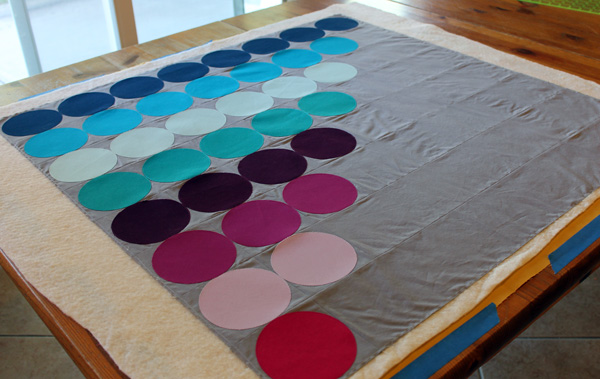
backingpiecedPieced backing after it has been spray basted and trimmed.

It’s ok if the sides don’t look even at this point. Once the quilt has been quilted, it will be squared up.

Once your backing is finished, you are ready to baste your quilt in preparation for machine quilting. Have fun creating your own unique backing!

Click here for all of the Paper Pieced Quilt Along tutorials.


Paper Pieced Quilt Along #6 – Sewing the Top

I have a simple method I employ when sewing nearly all of my quilt tops. I lay out my blocks on a design wall, join them into rows, and sew the rows together to complete the top. For this lesson, I’ll share a few tips on how I make that go more smoothly. (Visit my Paper Pieced QAL page for links to all previous tutorials.)

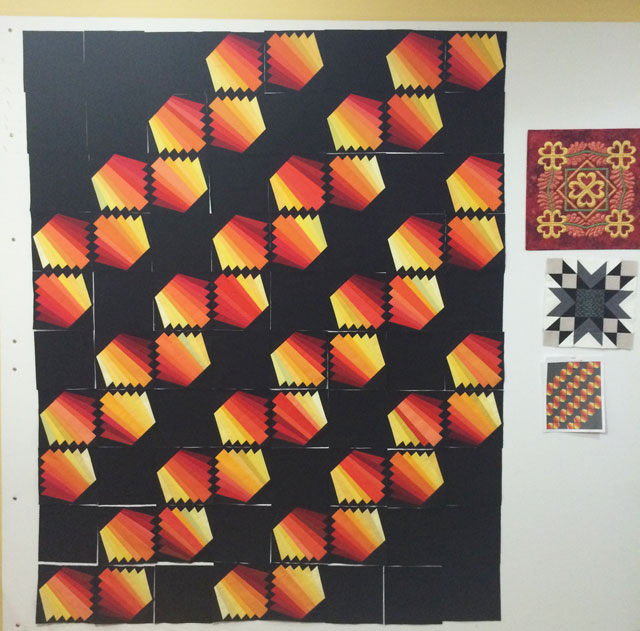
finished_blocks I chose to leave this picture uncropped so that you can see I usually have several things happening on my design wall at the same time.

Step 1

First I throw up the blocks on my design wall. Although I will place the blocks into position, I don’t care too much about the color balance yet. I constantly refer to a picture or printout of my design so I can lay the blocks out in the correct position.

Step 2 (not shown)

After I have laid out all the blocks and background squares, I will play around with the arrangement until it feels right. For this quilt, I had just a few pops of light green and a couple of darker colors purposely out of order to give a little interest. I made sure to balance those out a little when I chose my final layout.

Step 3

sewthexHere’s another thrifty hint: I tend to use up leftover colored cotton bobbins in my piecing.

I take a picture with my camera phone and then begin sewing individual rows, two blocks at a time. As I joined the blocks, I pressed all of the joining seams open. I also pressed each row of blocks open to reduce the bulk.

Tip: use the seam line intersections as a guideline when matching points. For the sides of the block, I sewed just a few thread widths narrow of the intersection between the two seams shown above. When matching up blocks point to point, I pinned generously and sewed through the “x’s” that were formed by intersecting seams.

Step 4

I sewed all of the block rows individually, pressed each open, and put it back into position on the design wall. Then I sewed together two rows, pressed them and put them back on the wall.

block_rowsI made 5 sets of 2 row pairs, then joined those into 2 sections of 4 rows and 6 rows. Finally I joined the rows together to complete the quilt top.

Step 5 – The “Victory Lap”

Once the top is complete, I will secure the perimeter edges by sewing 1/8″ in from the edge of the quilt top, around all 4 sides. Someone jokingly referred to this as the “victory lap” on instagram and I got a kick out of that!

edge_stitchingStay-stitch around the perimeter to secure the edges for basting and quilting.

Now, we are ready to baste! Remember to share your work-in-progress on my Facebook group: Quilt With Christa, or on Instagram #paperpiecedqal.

Copyright and Permission Granted

I am very happy to share my knowledge with you free of charge during this quilt along. However, this information is for your personal use as a loyal reader of my blog. Please do not make copies of any part of this quilt along to distribute it to your friends. If you’d like to tell them about it, simply share my QAL site link with them and encourage them to come on over and join us: ChristasQuiltAlong.com

If you’d like to share links to my site on Facebook or on your own blog, that is great, too!

At the conclusion of the quilt along, I will be happy to edit down all of the content and turn it into a pattern for sale, so that others can use my pattern as a teaching aid in the future. 🙂

Check out the Bee Hive – A Fun, Free Year Long Block of the Month

I love it when my quilty, bloggy friends do cool stuff. Have you visited my friend Alyce from Blossom Heart Quilts? Not only is she a recurring writer for Make Modern Magazine and awesome pattern writer, she’s a generous designer as well.

20150110_beehvie

For all of 2015, she’s put together a fun, free BOM (Block of the Month) program that anyone can follow along with. It’s called The Bee Hive and she’s featuring not just one, but two block tutorials each and every month!

20150110_beehive_block_tictactoe

January’s first block of the month features this awesome tic-tac-toe block!

Here’s how it will work:

The first block of the month will feature a unique 12″ finished block design by Alyce, that when laid out side by side forms a secondary design. Then, the second block of each month will be designed by a host of talented guest designers. Alyce’s blog will be the place to go to keep up with all of the tutorials.

20150110_beehive_tictactoeI love the modern, graphic look of these tic-tac-toe blocks set together!

I will be the guest designer for April and I’ve included the complete schedule below. Just think, if you follow along all year, you’ll have 24 finished blocks! As with any quilt along, you are welcome to work at your own pace and join in anytime. 🙂

The Schedule

January 12 – Tic Tac Toe
January 26 – Kristy from Quiet Play

February 9 – Chainlink
February 23 – Janice from Better Off Thread

March 9 – Houndstooth
March 23 – Jane aka Quiltjane

April 6 – Spinwheel
April 20 – Christa from Christa Quilts

May 4 – Busy
May 18 – Angie from Gnome Angel

June 1 – Bunting
June 15 – Anne from Play Crafts

July 13 – Abacus
July 27 – Jess from Elven Garden Quilts

August 10 – Homebase
August 24 – Joshua from Molli Sparkles

September 7 – In The Middle
September 21 – Jennie from Clover and Violet

October 5 – Magic 8 Ball
October 19 – Diane from From Blank Pages

November 2 – Alpine
November 16 – Melissa from Ms Midge

December 14 – Treasure Hunt
December 28 – Finale

When you do join the fun, Alyce has created a hashtag so you can share your blocks on social media: #thebeehivequilts. I can’t wait to see what everyone makes!

Abacus Show and Tell

Half the fun of hosting a quilt along is seeing all of the different quilts. Here are a few of the awesome variations that you guys shared via instagram (#abacusqal), flickr (christasquiltalong) and email!

For those just joining my blog, click here for all of the Abacus Quilt Along tutorials.

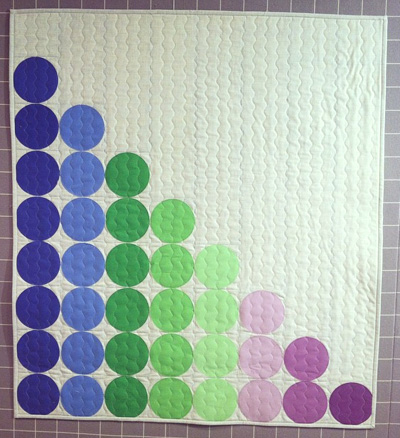
Elizabeth QuiltElizabeth aka Catskill Quilter with her rainbow colored version.

Elizabeth BibsElizabeth even made matching bibs. How cute!

sluslcaySusan C. (slusclay on instagram) chose blue, green, and purple solids for her version. She did a fantastic job on the quilting!

Susan Farm QuilterSusan aka farmquilter chose a darker grey background for her top. I love it!

sconehead1Sconehead1 changed up the bead count and used an awesome background!

sewstitchingcute_1

Sewstitchingcute incorporated Cotton & Steel prints into her pretty piece! She also put the quilt on an angle and quilted more circles in the background. Isn’t that great?

Joanne-P_2Joanne P used batiks and made it her own with an extra bead and borders!

This quilt along was so fun and I can’t wait to do another in the spring!

Christa’s Quilt Along – Abacus Week 6: Binding

Free Quilt Pattern

New to my blog? Be sure to sign up for my email newsletter to get a free pattern!

Binding

I have really come to love hand binding my quilts. There’s nothing better than curling up on the sofa with some mindless TV and hand stitching for awhile. However, for those of you who prefer a quicker finish, be sure to check out my machine binding tutorial.

And now, it’s onto binding! It took me a total of 3 hours to bind Abacus.

TrimmingStep 1 – Trim the Quilt and Prepare the Binding (1/4 hr)

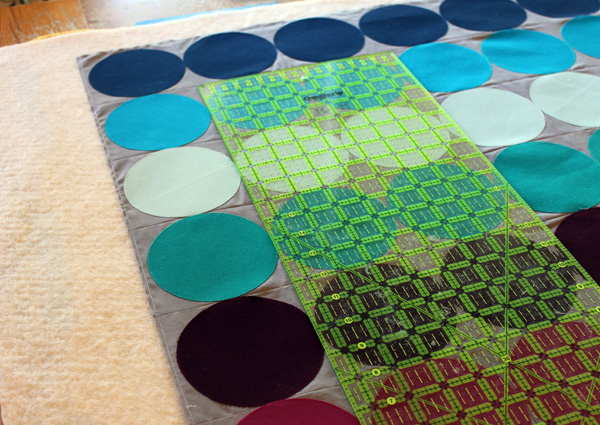
I use a large square ruler to square up the corners flush with the edge of the quilt. I use a longer ruler to trim up the sides. Be sure you have 1/4″ of background left around the edges of your beads so they don’t get covered up by the binding.

I love the look of a freshly trimmed quilt, ready to bind!

quilt-trimmedTo calculate the length of binding needed, take the perimeter and add 10 inches:

32+32+32+32+10 = 138

Divide this number by 40 to get the total number of binding strips needed. 138/40 = 3.45 which I will round up to 4 strips. Cut them 2 1/4″ wide.
Join your strips together by sewing mitered seams. Place them right sides together, perpendicular to each other with a little bit sticking off on both sides. You will be sewing a diagonal seam indicated by the black line below:
binding_1Note: if you are working with solids, take care to know which side you are working with! You can put a pin to indicate which is the front or back side of the strip.

Trim off one end at a 45 degree angle and press the binding, wrong sides together along the length. This is what it the binding strips should look like when trimmed and pressed:

binding_2

Step 2 – Sew the Binding to the Front of the Quilt (1/2 hour)

Start with the trimmed end and stitch with a 1/4″ seam, leaving a tail of about 6″ dangling off the quilt. When you near a corner, make a crease indicating the edge of the quilt underneath. Stop sewing exactly 1/4″ away from the crease and sew off the end at an angle.

binding_3To fold the miter on each corner, lift the strip up and away, parallel to the quilt. Bring it back down upon itself, even with the edge of the quilt, creating some bulk. I call this the “funky fold.”

binding_4Continue sewing from the corner you just folded, all the way around the quilt, mitering each corner as you go.

When you get close to the end of the quilt, leave another tail of about 5″ – 6″.

Join the ends together by opening the beginning tail with the angled edge and placing it on top of the ending tail with the untrimmed edge. Draw a 45 degree line on the untrimmed end. I’ve drawn a black line on the photos below so you can see that more clearly. Cut 1/2″ away from the drawn line. Use a small ruler with a 45 degree angle for an accurate cut.

binding_5

Pin the beginning and ending tails together and sew with a 1/4″ seam, offsetting the edges by 1/4″ (see that little triangle peeking out below). You may have to scrunch the quilt out of the way to make room. Finger press the seam open, fold the binding in half again, and finish sewing the binding to the front of the quilt.

binding_6Step 3 – Pin or Clip the Binding in Place to Sew (1/4 hour)

With an iron, press the binding away from the quilt on the front. This creates a crease making it easier to fold over the binding and sew in place by hand or machine.

binding_7Fold over the edges and hold in place with pins or clips. My favorite are the Clover Wonder Clips in packs of 100. I prefer to clip the whole thing in place so it’s ready to sew, and I place them pretty close together so I can quickly use up a whole bag of clips!

binding_8

Don’t forget to fold the corners in place and secure with a clip. They will automatically create a nice pretty miter on the back – aim to line up the two corner edges so the miter is right in the middle of the corner.

Step 4 – Finish by Hand (2 Hours)

I forgot to take pictures while sewing the binding down by hand. I guess I was enjoying myself too much. Click here for another hand binding tutorial which basically outlines the steps above with hand stitching closeups.

Congratulations on a great finish!

Abacus-Finished-for-Blog

Click here for all of the Abacus Quilt Along Tutorials.

Sharing is Caring

Please share your work in progress in my facebook group: Quilt With Christa . 🙂


Christa’s Quilt Along – Abacus Week 5: Machine Quilting

Welcome to another installment of my Abacus Quilt Along! Today is when the magic happens. It’s time to machine quilt, which I think is the most fun part of the quilt making process. It took me only 1 3/4 hours to machine quilt – so fast and fun! 🙂

I’ve written several blog posts about getting started with machine quilting, including many of my favorite tips and tricks. Click here to read them all!

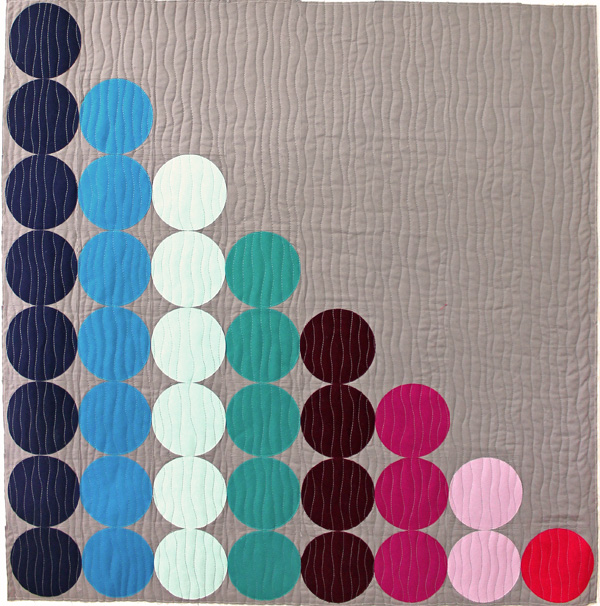
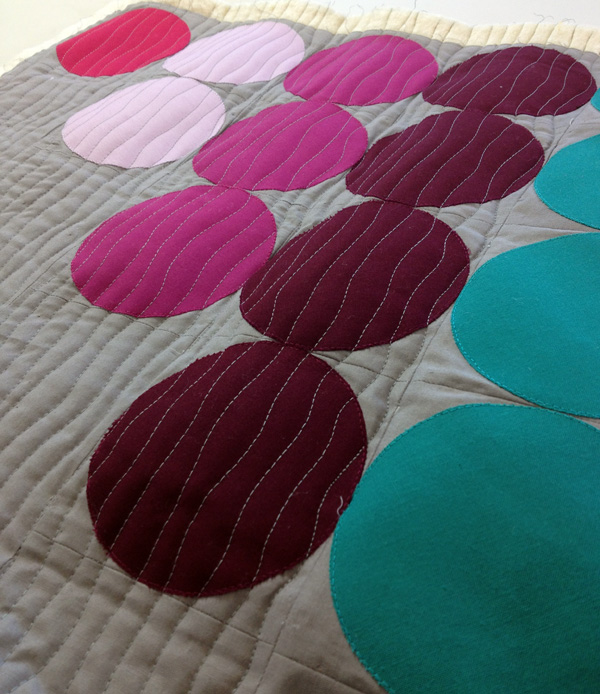
machine-quiltingMachine quilting wavy lines with your walking foot is super simple and fun!

Step 1 – Practice Quilting on a Scrap (1/4 hour)

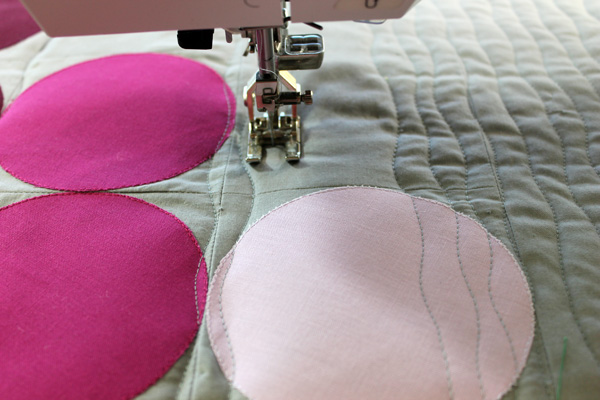
I always, always, try out my quilting idea before I quilt the whole quilt. More often than not, I’m disappointed if I skip this step. What I see in my head may not translate well in fabric, so it always helps to make a small practice piece. It can be as simple as two scraps of fabric with a small piece of batting. Or sometimes I will make up a complete block using the same fabrics and thread as in the quilt.

illustration_3_abacus_quiltingOne of the biggest unknowns when machine quilting is how the quilting thread will look on a wide range of fabrics. I’d rather try it out on a smaller piece to make sure I’m happy. I think the grey Aurifil 50 weight cotton thread and uneven lines of quilting look great on both the light and dark fabrics. So now I’m ready to move onto the real quilt.

Step 2 – Quilt the Anchor Lines, AKA Stitch Near the Ditch! (1/2 hour)

Whenever I begin quilting a piece, no matter how large or small, I always start by quilting a series of anchor lines across the surface of the quilt. This helps stabilize the quilt for more quilting later. For Abacus, I stitched my wavy anchor lines right next to each of the vertical seams, moving the quilt slightly from side to side, letting the lines wobble a bit.

If the quilt is well basted, it doesn’t matter where you start. I usually start quilting in the middle, and move to the right across the quilt, stitching each line from top to bottom. Then I rotate the quilt ninety degrees and finish the other half in the same way.

Anchor-QuiltingRight now it looks like a bit of a mess, but I know from my practice piece that once all the lines are filled in, it’s going to have some incredible texture.

Step 3 – Quilting the Wavy Lines (1 hour)

I quilted wavy lines using my built in even feed. That’s the same thing as using a walking foot. I increased the stitch length slightly and moved the quilt from side to side as the machine stitched, creating the waves.The feed dogs are up as normal and I’m wearing Machingers gloves to give me a better grip on the quilt.

machine_quilt_1Once the anchor lines are quilted, I filled in the spaces between the rows with more wavy lines. I quilted a few lines on the left, then a few lines on the right, all the while aiming for a very organic (messy) looking texture. I let the number of quilted lines vary per row, and used the width of my foot as a rough guideline for spacing.

For those of you who can adjust your presser foot pressure, I set mine all the way down to zero. This really helps eliminate tucks and puckers.

machine_quilting_abacusIn the picture above, I have quilted all the anchor lines and completely filled in the wavy lines on half of the quilt. I rotated the quilt, now I’m ready to finish quilting the other side!

Voila! Quilting finished! Next week I will show you how to square up the quilt and bind it.

abacus_quilting_finishedIf you are enjoying this quilt along, please share your progress on my flicker group or on Instagram #abacusqal.

Remember, I encourage you to work at your own pace. However, if you finish your quilt (or even just the top) by November 10th, I’ll be happy to feature it on my blog in my parade of quilts! 🙂

Click here for all of the Abacus Quilt Along Tutorials.

Christa’s Quilt Along – Abacus Week 4: Basting

Good news: Abacus is now available as a stand alone pattern for just $4.95! Click here to purchase. (You don’t need the pattern for the quilt along, but I know many of you would prefer to print it off and keep by your sewing machine.)

abacus_quilting_finished

Basting is probably everyone’s least favorite part of the quilt-making process, and I think I know why. Recently I helped my friend make a small baby quilt and we basted it on her kitchen floor because she didn’t want to scratch up her table. What an awful process! I would never do that again, LOL!!

spray_basting_5Tables are the best for basting – use one, two, or your kitchen table – just not the floor!

Yes, it takes up a lot of room to baste on a table, and in my friend’s case, you may not want to scratch up your table. I suggest getting some plastic folding tables like those above that can be stashed in a garage or closet. Or keep some large pieces of cardboard to protect your kitchen table if needed. You don’t need a huge table – you can move the quilt around as needed, but please, get up off the floor! 🙂

For today’s basting tutorial, it took me a total of 1 1/4 hours to safety pin baste the three layers. Click here for my tutorial on spray basting (outside or in a well ventilated room – on a table!)

Step 1 – Prepare your batting and Backing Fabric (1/2 hour)

You want to make sure there are about 2-3 extra inches of backing and batting around all 4 sides. My quilt top is 32″ x 32″. Therefore my batting should about least 34″ x 34″ and my backing should be about 36″ x 36″.

table_baste_1Dining Room Table Basting – Checking to see that my backing is bigger than my top.

If using cotton batting, give it a quick press to work out any wrinkles. You want the quilt sandwich to be as flat as possible. Also, starch your backing fabric before you baste to make it extra slippery. This will come in handy when machine quilting.

Step 2 – Pinning the Quilt (3/4 hour)

Lay your backing right side down on a table. Tape down the edges of the quilt with masking tape or painter’s tape. You can also use binder clips if your table isn’t too thick. You want the backing to be secure but not taut. Only tape down the backing, not the other layers.

table_baste_2All 3 layers ready to go for basting! I will smooth out the wrinkles next.

Lay your batting on top of your backing. Get someone to help you if possible, so you can lay it down smoothly. Add your top, right side up. Before pinning, take a few minutes to smooth out the layers with your hands or a long ruler.

table_baste_3Using a ruler to smooth out the wrinkles and align the rows into place.

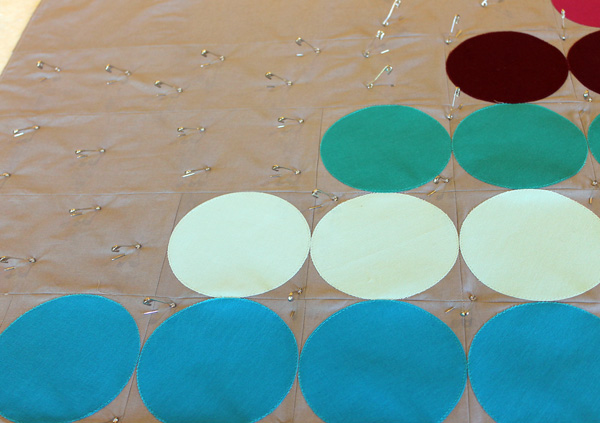
Starting anywhere on your quilt, drop a bunch of safety pins on the top to work with. I recommend using size 1 nickel plated safety pins. I left them open from the last quilt so they are ready to go. The usual recommendation is to pin about 5″ apart. However, I find that I get fewer tucks and wrinkles when I pin closer, about 2″-3″ apart. For this quilt I only pinned in the background sections, not in the circles.

table_baste_4Pin an entire section, then go back and close the pins. This quilt was small enough that I pinned the entire top before closing the pins. A Kwik Klip comes in really handy for this. Click here to see how to use one.

Work you way across the quilt, pinning one section at time. When the quilt is fully pinned, remove the tape and check the backing to make sure you haven’t pinned in any tucks. Then trim off some of the extra batting and backing so there’s less bulk under the machine.

table_baste_5Now you are ready to quilt! There, now,  that wasn’t too bad, was it? Remember, I encourage you to work at your own pace. However, if you finish your quilt (or even just the top) by November 10th, I’ll be happy to feature it on my blog in my parade of quilts! 🙂

Click here for all of the Abacus Quilt Along Tutorials.


Christa’s Quilt Along – Abacus Week 3: Sewing the Top

For today’s Abacus Quilt Along, we will be sewing together our quilt tops! Be sure to click here for links to the rest of the tutorials and supply list. It took me a total of 2 hours to complete this week’s lesson. Feel free to jump in at any time!

 finished-topAbacus quilt top – you can tell it’s real from all the wrinkles! 🙂

Step 1 – Sewing the Rows (3/4 hour)

For ease in construction, lay out all of your machine appliqued and trimmed blocks in order on a design wall or other large flat surface.

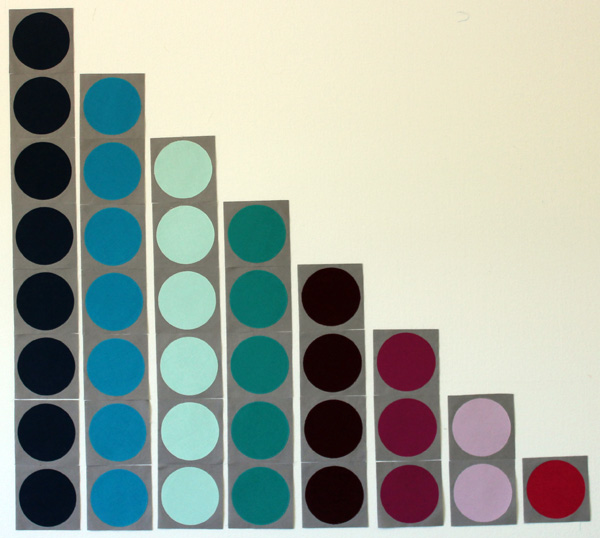
Block-layoutLay out your blocks in order on a design wall or take a picture with your phone!

Sew matching bead blocks together in pairs, chain piecing for faster assembly. Sew all blocks from one color into a row for a total of 8 rows of beads.

Block-pairsBe very accurate when you sew your 1/4″ seams so that you don’t cut off any of the circle. Press your seams open to reduce bulk. This will also help the circles align better.

When placing your blocks right sides together, try to match up the circle positions as closely as you can. You may need to sew more slowly and use pins to ensure accuracy.

Block-pairs-sewnYou want the edges of the circles to just barely touch without catching any of the circle fabric in the seam allowance.

Sew all of the beads together first, then add the background strips to complete each column. The diagram below shows the position and cut length of each background strip.

Background-Strip-NumbersStep 2 – Quilt Top Assembly (1 1/4 Hours)

 Sew together pairs of columns to complete the quilt top. When joining rows, be sure to pin at block intersections. I also pinned in the middle of each block, matching up the two circles in the same position.

Optional: If you want to ensure perfect alignment, you can use a larger machine basting stitch to sew a few stitches only where each of the horizontal pins is below. Once you are happy with the alignment, you can go back and restitch the entire row.

Abacus-Bead-rowsJoin the columns together into pairs, and then into halves to complete the quilt top. Stay stitch 1/8″ around all the edges to secure the seams while quilting. Quilt-Top-AssemblyAbacus Quilt Top Assembly

Just for fun, I designed an alternate solid colorway for Abacus, which I call Parfait.  I think it would look great in prints, too.

Abacus - New Kona ColorsPlay around with different fabric combinations and see what else you can come up with!

I encourage you to share you progress on your own blogs and leave a link in the comments below. If you don’t have a blog, you can always share your pictures on my flickr group, or on instagram (#abacusqal), or via good old-fashioned email! 🙂

Next week we will baste the quilt together. It’s easy peasy and will give everyone a chance to catch up, although you are never behind because the goal is to work at your own pace!

Christa’s Giveaway New Kona Cotton Solid Bundle

How are you all coming on your Abacus Quilt Along? The best part of any group project is seeing how everyone interprets the pattern in their own colors and fabrics. In fact, I have an alternate colorway to share with you today. I call this colorway “Parfait,” using some of the new 2014 Kona Cotton colors with a white background. Isn’t it cheerful?

Abacus - New Kona ColorsAlternate Kona colorway – designed by Christa Watson in EQ7

Thanks to my generous friends at Robert Kaufman, one of you will get to win this lovely bundle! It contains 1 fat quarter of the following colors shown in my sketch above: Heliotrope, Honeysuckle, Grellow, Limelight, Creamsicle, Niagra, Titanium and Nectarine. Plus enough white for the background and binding. Aren’t those fun colors?

Kona New ColorsFabric Bundle of New Colors up for Grabs

Here’s another sketch of what the quilt would look like with the colors in a different arrangement. There’s enough fabric that you can play around and put them in any order you like! Isn’t half the fun of any project picking the fabric placement?

Abacus - Kona's Pick White GridHere’s How to Enter

Kona Cotton solids are definitely one of my favorite fabric to work with. To stock up on some of your favorites, checkout my huge selection of Kona Solid precuts! (And yes, I should have the new color bundles in stock soon!)


Christa’s Quilt Along – Abacus Week 2: Machine Applique

Welcome to week 2 of my Abacus Quilt Along. Today we will learn a super simple machine applique technique than can be applied to any design, not just circles. It took me a total of 4 1/4 hours to complete this week’s lesson. Remember, you can join in at any time and sew on your own schedule.

Step 1 – Fusing the Circles to the Background (1/2 hour)

Remove the paper backings from all 36 of your circles if needed. Place a circle roughly in the middle of each background square and fuse them in place, according to the manufacturer’s instructions.

At this point, the circles don’t have to perfectly centered as we will trim down some of the excess. Just be sure there’s at least 1/4″ of background around the entire circle.

 fused circlesFused circles organized by color – aren’t they pretty?

Step 2 – Machine Applique the Circles (3 hours)

Using a matching thread and a straight stitch, slowly and carefully stitch around the edge of each circle, keeping your thread on top of the bead fabric. Sew very close to the edge without going off of the fabric. Always stop stitching with your needle down for smooth, continuous stitches. If you have a knee-lift for your machine, use it to lift the presser foot every few inches as you turn the circle to sew.

applique-stitchHint: Using an open toe applique foot makes it easier to see what you are doing.

If desired, you may use a decorative stitch instead. Or for a more “industrial” look, go around each circle two or three times. Be sure to start and stop by pulling the bobbin thread up through to the top of the fabric for a clean look.

Practice on a few scraps first to check your stitch length, thread color and tension, and to audition possible machine applique stitches. Note that I did not need to use any stabilizer. The fusible web on the back of the fabrics provided enough stability for this method.

applique-and-quilt-practiceThe sample above was my practice piece for both applique and quilting. I first tried a very thin and narrow zig zag stitch by reducing my length and width. Although I liked the look of the edges, I don’t like how it competed with the lines of quilting. That’s why I decided to go with a cleaner line of stitching around the edges. Try a few things and see what you like!

stitched circlesMatch thread colors to your fabrics to help make the stitching seem to disappear!

When you have finished stitching, pull all of your threads to the back of each quilt block and make a knot by hand. Clip off the excess threads. For efficiency, I did all the applique stitching first and then went back and tied all the knots.

back of bead blockWhat the backs of your bead blocks should look like when stitched.

Step 3 – Trimming the Circles (3/4 hour)

Use a small square ruler to align your circle so that you will be trimming exactly 1/4″ away from the edges on two sides. I have drawn black lines on the picture below showing how you should line up your ruler so that the circle fits within a 4″ x 4″ finished frame. You will be cutting exactly 1/4″ away on all four sides of the black frame shown below.

Line-TrimmingMake the first trim to the right and top of the block, leaving 1/4″ around the two edges.

Trim right side

Flip the block around and line it up so that now you are trimming the other two sides, forming a perfectly trimmed 4 1/2″ block.

circle second trimRepeat for all 36 blocks. The picture below shows a trimmed block next to an untrimmed block for comparison.

trimmed blockHave fun doing your “homework” and feel free to leave comments below or email me with any questions! Don’t forget to share you progress on your own blogs, on my flickr group, or on instagram #abacusqal.

I can’t wait to see how you’re doing!

Be sure to visit my Abacus quilt along page for links to the supply list and all tutorials.