How are your Block Chain quilt blocks coming along? Be sure to share pics of your progress in my ChristaQuilts Facebook group or instagram #blockchainquilt and ask any questions you have. I love to cheer you on!
This week it’s time to finish up those blocks and sew them into a completed quilt top, also knowns as a “flimsy.” Refer to the Block Chain pattern pages 5-7 for the step by step instructions.
The easiest way to arrange your blocks is to use a design wall so you can stand back and play around with the color placement of your blocks. Just don’t overthink it since they will look great no matter what!
If you don’t have a design wall, you can use a design floor, or maybe even a design bed! No matter where you lay them out, be sure to take a picture of them with your camera phone, so you can refer back to the layout again and again as you sew.
I was in a hurry to make this quilt so I don’t have a lot of in-progress pics, but I want to point out a little thing I like to do when sewing the blocks. You can see a closeup of the pattern layout here in this diagram:
Rotate every other block so that the background seams don’t intersect. This will make it faster and easier to sew the rows together. Pin generously for best results and press each row as you go. In fact, I like to sew pairs of blocks, then press them, then sew them into larger pairs. It’s easier to press smaller chunks of blocks so the whole process isn’t so overwhelming.
Sew a Victory Lap!
When the quilt top is complete, you’ll want to “stay-stitch” the edges by sewing all the way around the edges of the quilt (called the perimeter.) Do this about 1/8″ away from the edge so it will get hidden when you put on the binding. If you add borders to your quilt, you can skip this step since the borders will stabilize the edges instead.
LOOKING AHEAD TO NEXT WEEK:
After we are done with the top, it will be time to piece the backing, prep our backing and get ready to baste. This is a quick process so you can take a little extra time to finish your quilt top if needed.
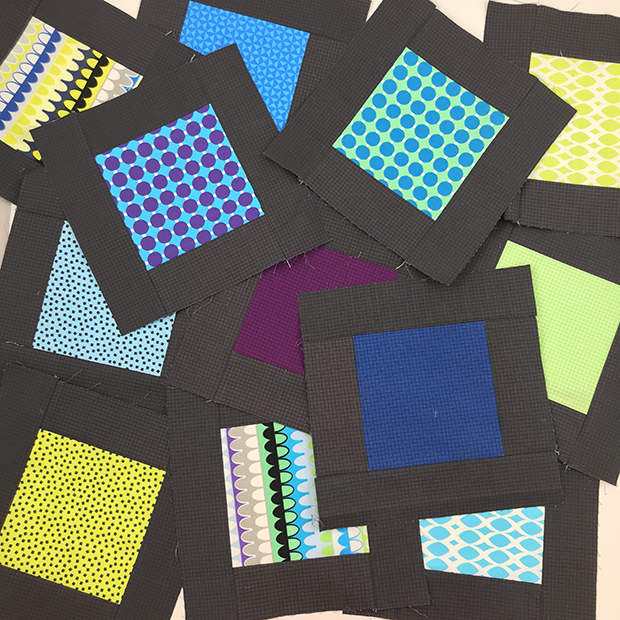
What a week it has been since we began! I know that many of you are home sewing and I hope this Block Chain quilt along is just what you need to make something beautiful when the world is in a bit of chaos! This week we will be sewing our chain blocks using the 5″ charm squares + black accent fabric.
Follow the Block Chain pattern instructions on page 2 to trim down your black strips, and sew the center units shown above.
For the next step, I used the hourglass fabric in gray for my contrasting background because I love the texture, but I think it would look super cool with the black/white print also.
Continue with the pattern instructions on pages 3-5 to sew as many blocks as you need for your size. The contrast around the center squares really makes them pop!
Tip: when sewing all of the complete blocks above, I like to chain piece as much as possible. That means sewing all of the same unit to all of the blocks, one right after the other without clipping threads in between. I prefer to sew with a shorter stitch length (2.5 instead of 3.0) and press my seams open for nice, flat blocks.
Sewing with a shorter stitch length also hides the piecing thread so it doesn’t poke through in between the seams. I used my neutrals thread collection for piecing this quilt because they blend into all of the different colored fabrics.
LOOKING AHEAD TO NEXT WEEK:
Next week we will start sewing our blocks into the quilt top. Just remember, you can work at your own pace, faster or slower as you wish. I’m here to cheer you on each step of the way!
Welcome to the Block Chain quilt along! This week we will be cutting all the fabric needed to make this quilt. It will be super easy because the center of each block features precut squares which are already cut for you (one of the reasons I love working with precuts)!
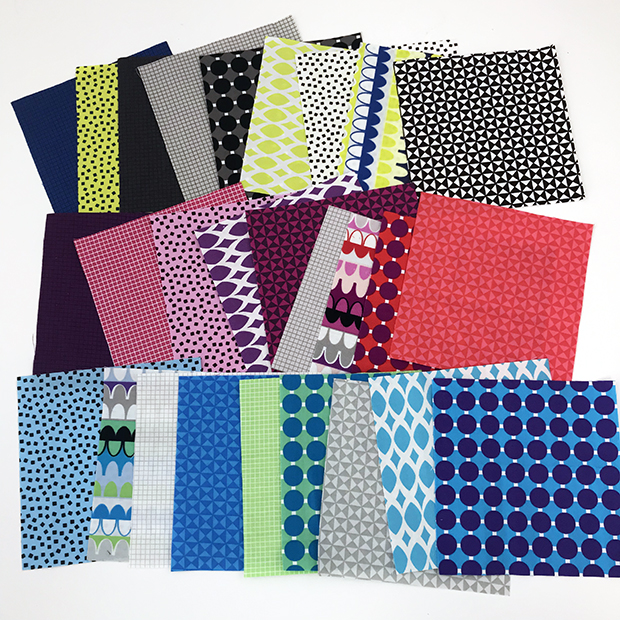
You will need one charm square for each block in your quilt. Because the throw size consists of 36 blocks and my Gridwork charm pack includes 42 squares, I pulled out 6 squares of the black and gray prints. I like the random coloring below with just two of the black/white squares included for interest. Refer to the Block Chain pattern for the number of squares you’ll need for the smaller or larger sizes.
The important thing to remember is that as long as there is contrast between the squares and the surrounding frames (black in my quilt), it will still look good. Here’s another tip: if one of your squares is the same color as your background, it will look like there’s a hole in your block, so avoid that if possible.
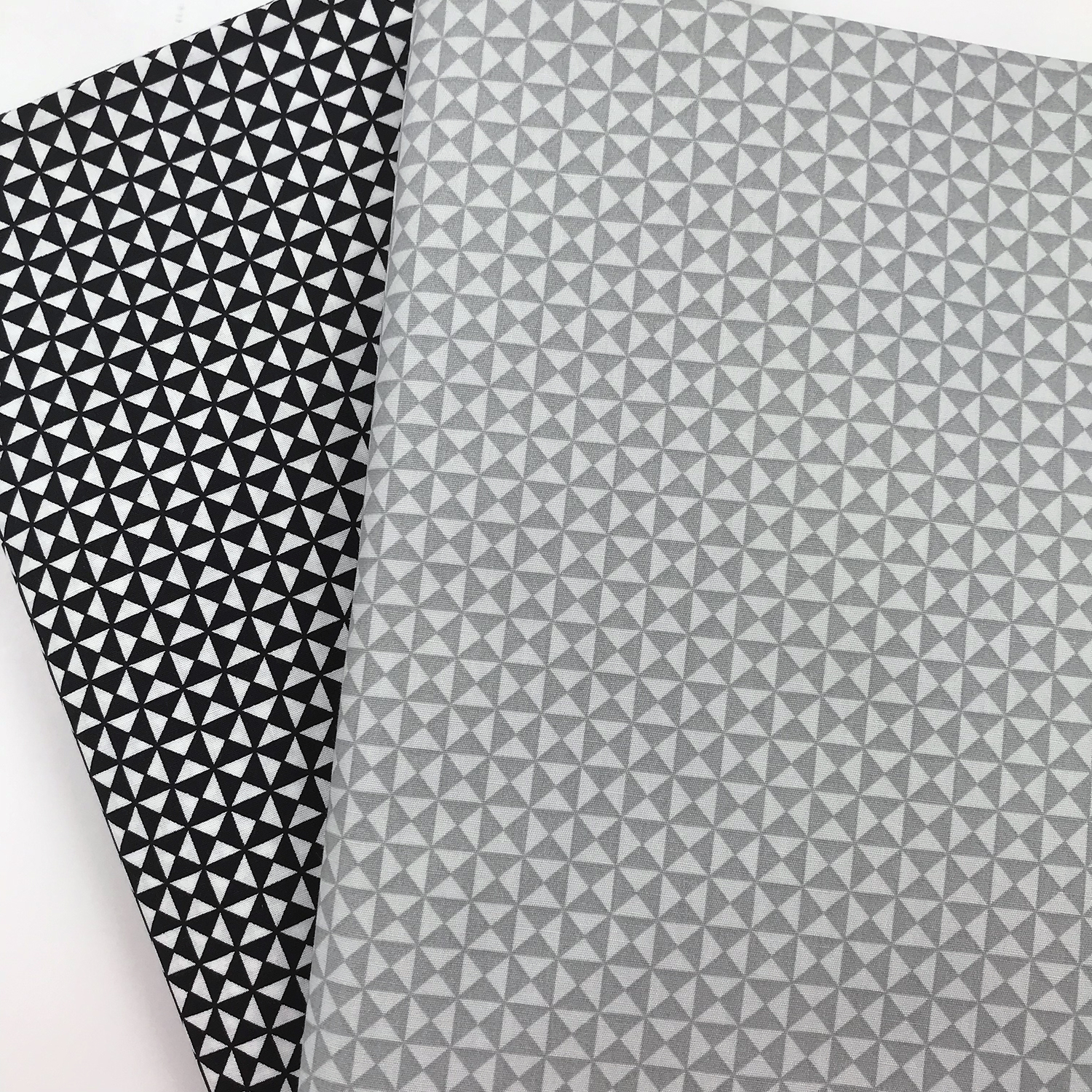
Refer to the Gridwork quilt pattern on page 3 to cut out your accent, background, and binding strips. Here are closeup images of the fabrics that I used:
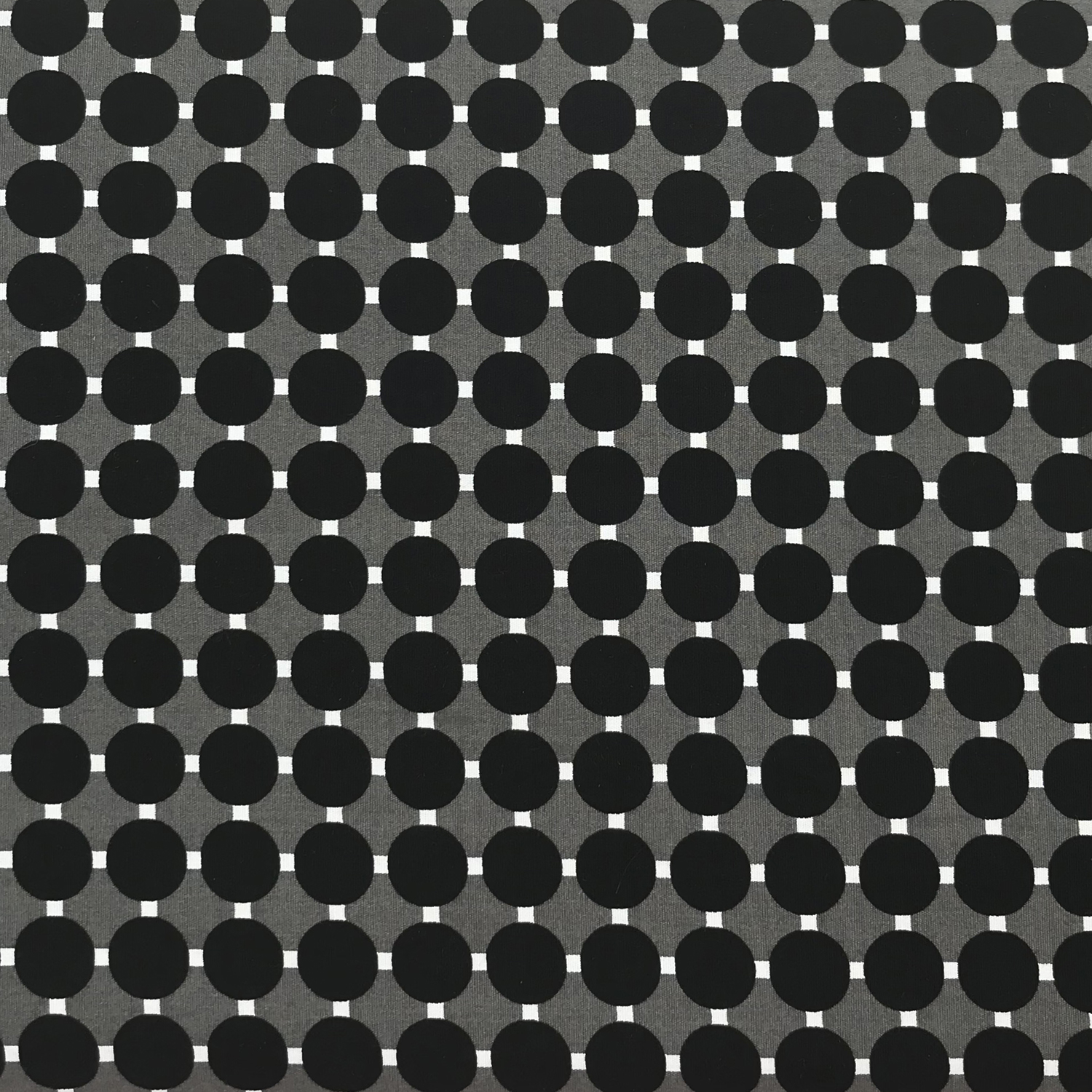
The black is called Square Grid. I included this one in the Gridwork line specifically for this quilt!!
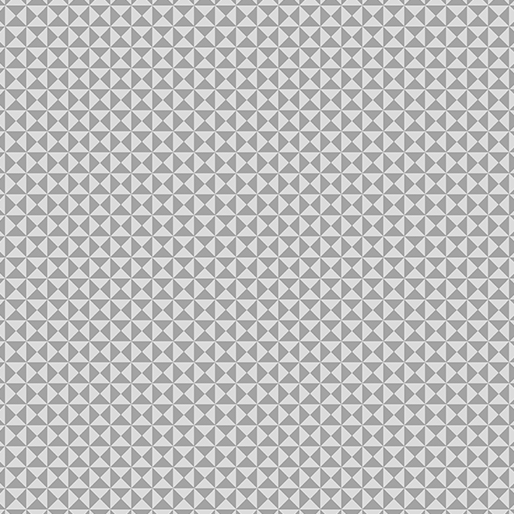
There are several great grays in Gridwork but I really like the look of the gray Hourglass print for the background. It gives the quilt just the right amount of interest and texture!
I especially love using fun geometric bindings for my quilts, so I picked the black Circle Grid print to finish off the edges of the quilt.
Here’s a tip to save for the end: if you want a super narrow binding thats finishes exactly 1/4″ evenly on front and back, cut your strips 2″ and sew the binding on with 1/4″ seam allowance.
Next week we will start sewing all of our cut units into blocks. Just remember, you can work at your own pace, faster or slower as you wish. I’m here to cheer you on each step of the way!
I’m excited to help you make my Block Chain quilt from start to finish over the next six weeks. All you need is a copy of the quilt pattern; cheerleading and moral support are free!!
Block Chain designed and made by Christa Watson
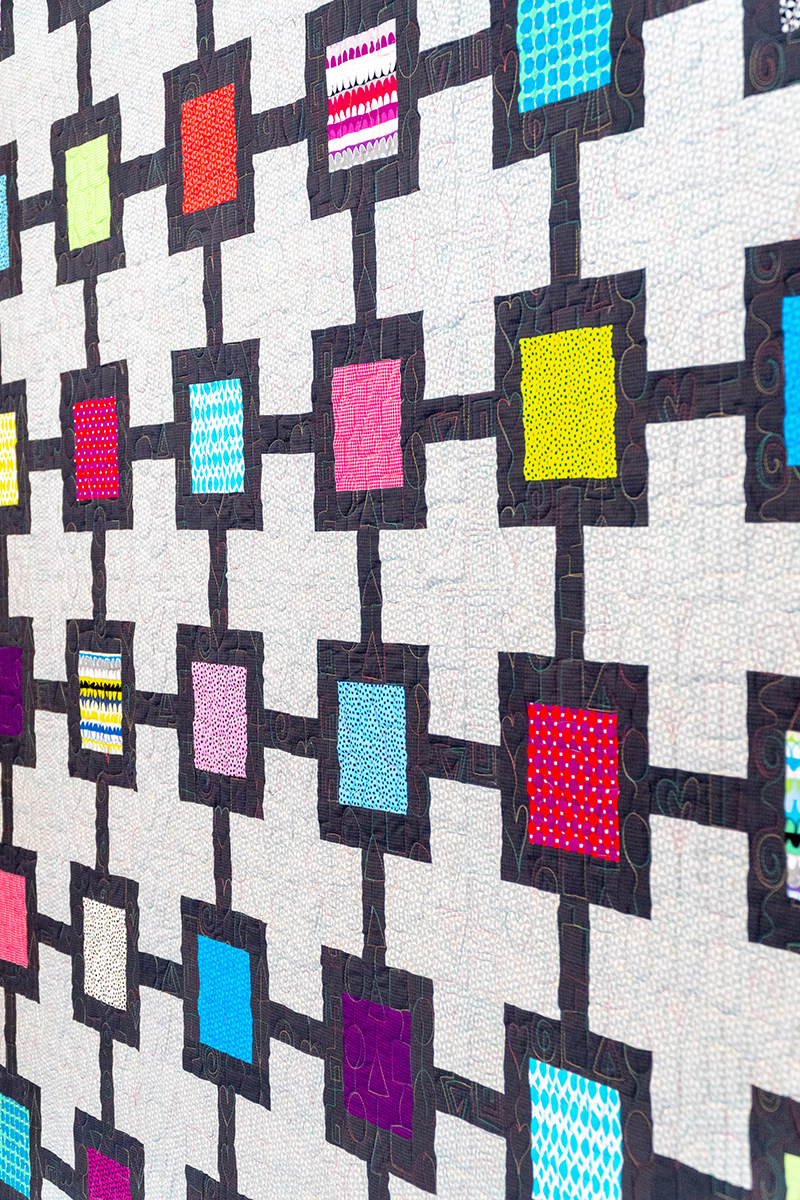
FINISHED SIZE SHOWN IS 69″ X 69″
This colorful modern quilt is a remake of an earlier design I created before precuts became so popular (and before I was a fabric designer). Over the years, I’ve had numerous requests to reconfigure the design so that it can be made from charm packs: 5″ x 5″ squares of a favorite fabric line.
My quilt shown above was made from one Gridwork charm pack, plus contrasting black and gray Gridwork prints. As long as you have good contrast between your charm squares, accent fabric (black) and background (gray), it will look great no matter which colors you choose!
Supplies Needed For Throw Size as shown
Refer to the back of the pattern cover above for additional sizes. Click image above to enlarge. Feel free to substitute fabrics as desired to achieve the same colorful look.
The throw size quilt calls for 36 charm squares. A standard size charm pack includes 40-42 squares, so that gives you some wiggle room to decide which squares you want to include in the quilt. Save the extra squares to make a matching pillow, sew them into the quilt backing, or use them to make a label when you’re finished with the quilt!
So now it’s time to gather your supplies and share pics of which fabrics you’ll use. If you’re an instagram junkie (like me!), please tag me at @christaquilts and use the hashtag #blockchainquilt so I can see what you are doing and cheer you on!
If you’d like to ask questions or need additional help, please participate in my ChristaQuilts Facebook group. It’s a great place to encourage your fellow makers, and get additional ideas for fabric choices, and quilting ideas.
Want to get notified each time a new post goes live? Be sure to enter your email address in the box on the sidebar of this blog. If you are viewing this on your phone or Ipad, scroll aaaaaaaallllllllllllll the way down to the bottom of the page to find the email address box 🙂
I’m excited to announce that I’m March’s featured designer for Cotton Cuts, a fun subscription box that features carefully curated fabric, patterns and more! And I love that the mission of the company is to create jobs by partnering with a local organization that provides dignified employment opportunities to the intellectually challenged and to those with other disabilities.
I’m also excited to announce that one lucky winner will win a classic box featuring my Gridwork fabric + one of my curated PDF patterns. All you have to do to enter is a leave a comment on this post letting me know what is your favorite cut of cotton to play with? Fat Quarters, half yards, full yards, etc.
Cotton cuts allows you to customize your preferences. They offer a variety of boxes and feature a wide range of designers! The larger boxes also include a PDF pattern of your choice from the featured designer, and their smaller boxes are a great way to try out the subscription. Sign up by the 10th of the month to receive your featured designer box by the 20th! Click here to learn more about what they offer.
The giveaway for the classic box will run through Tuesday March 10, 2020. Good luck to everyone who enters!!
I’m so pleased with how many of you have said you love doing my quilt alongs! So this year I’m thrilled to be sharing more quilt alongs than ever before! Now don’t feel like you have to do every single one – but I like to share a variety so that there’s something for everyone. I recently took a vote in my Facebook group and the overwhelming majority wanted to make Block Chain next and I can’t wait!
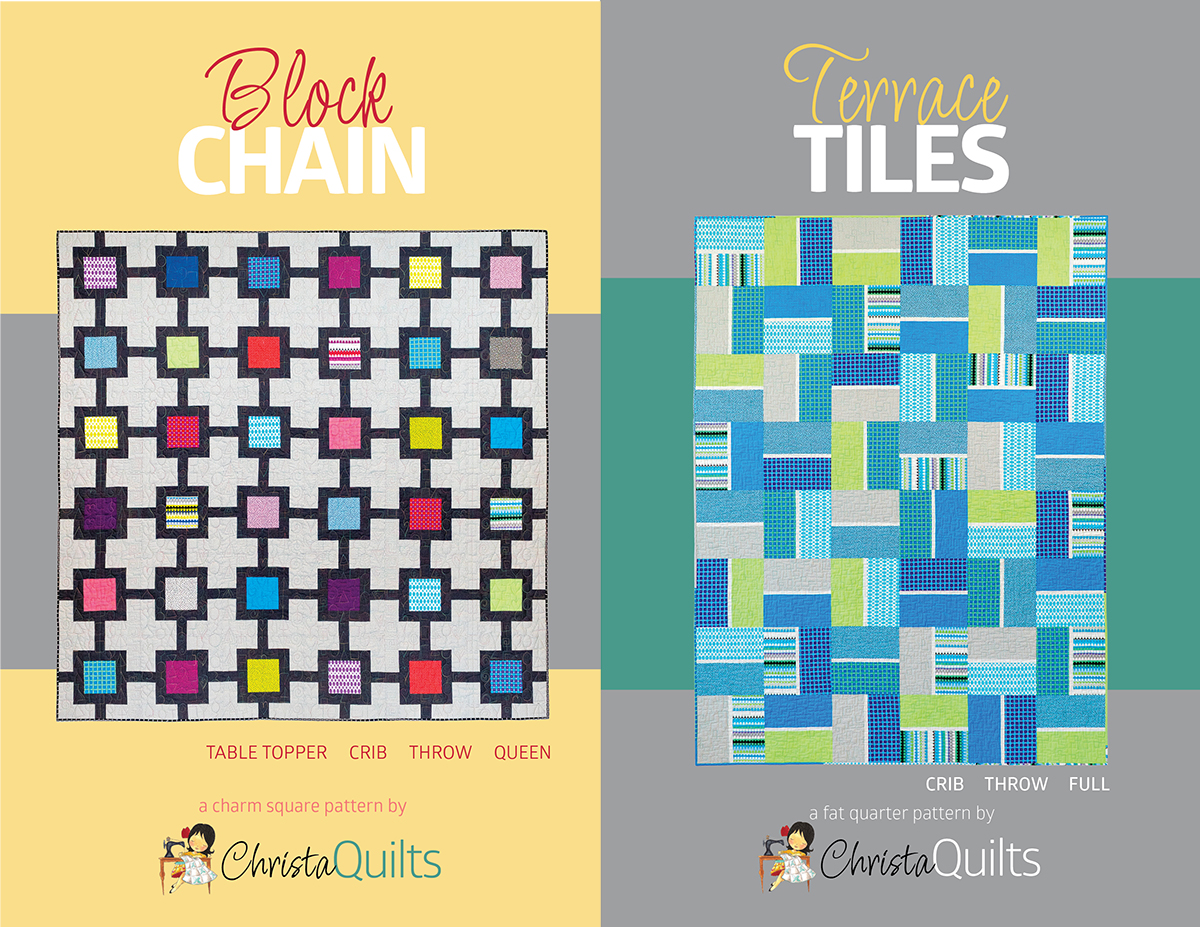
Fabric requirements are super easy this time around: just one charm pack plus 2 contrasting background fabrics (black and gray or other combo). The quilt shown above and on the Block Chain pattern cover is Throw size, but you can make it in any sizes listed on the pattern, or easily adapt it to any size you like. The secret? Just make more blocks or add borders.
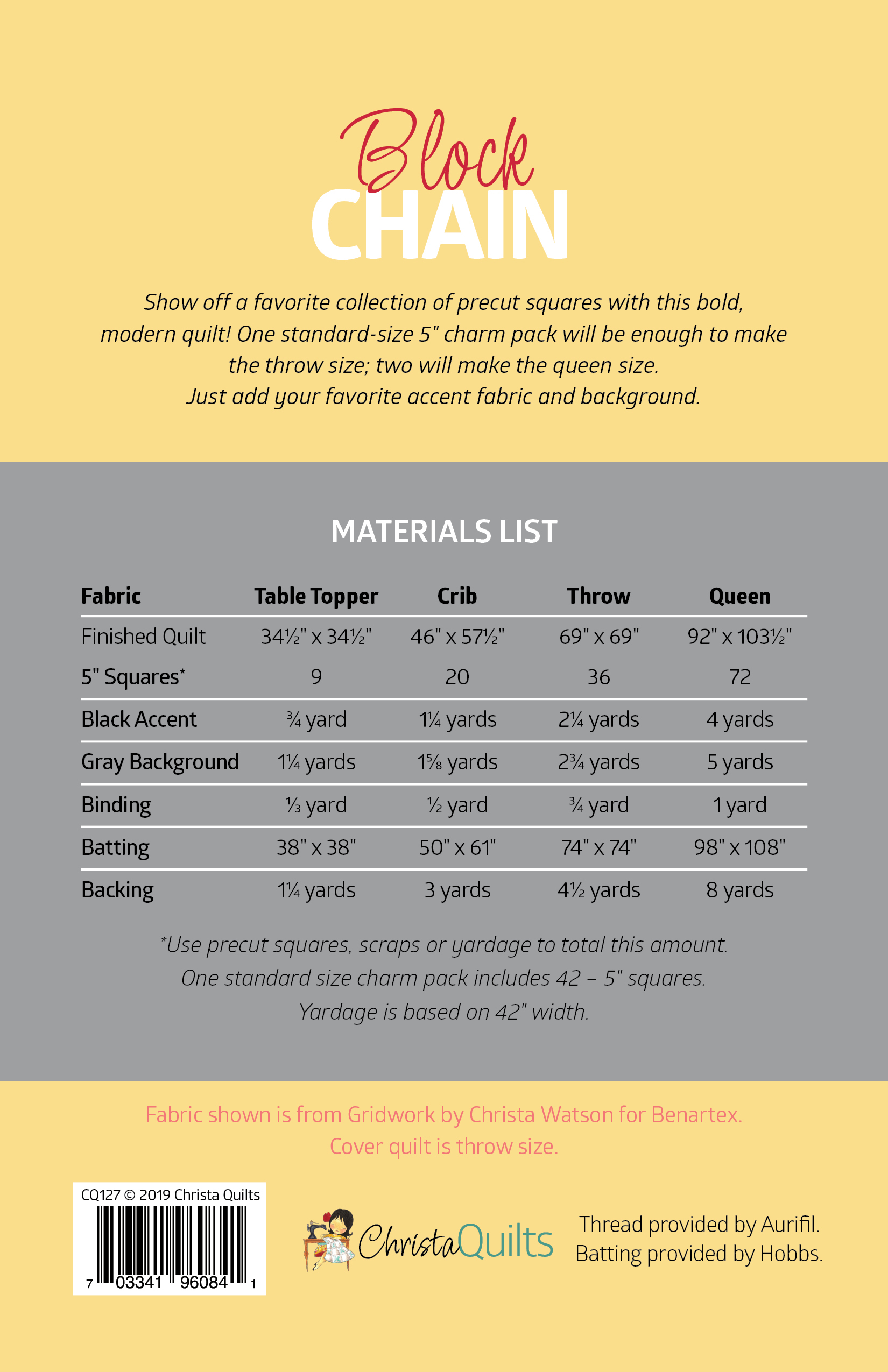
All you need is a copy of my Block Chain quilt pattern to follow along. The quilt along itself is free!! Here’s the materials list sown on the back of the pattern cover – click to enlarge:
The fun will begin March 16 and just like all of my quilt alongs, we will go over every step of the quilt-making process: fabric selection, cutting, piecing, basting, quilting AND binding. If you follow me on the entire journey – you’ll have a fully finished quilt by the end, whoo hoo!!
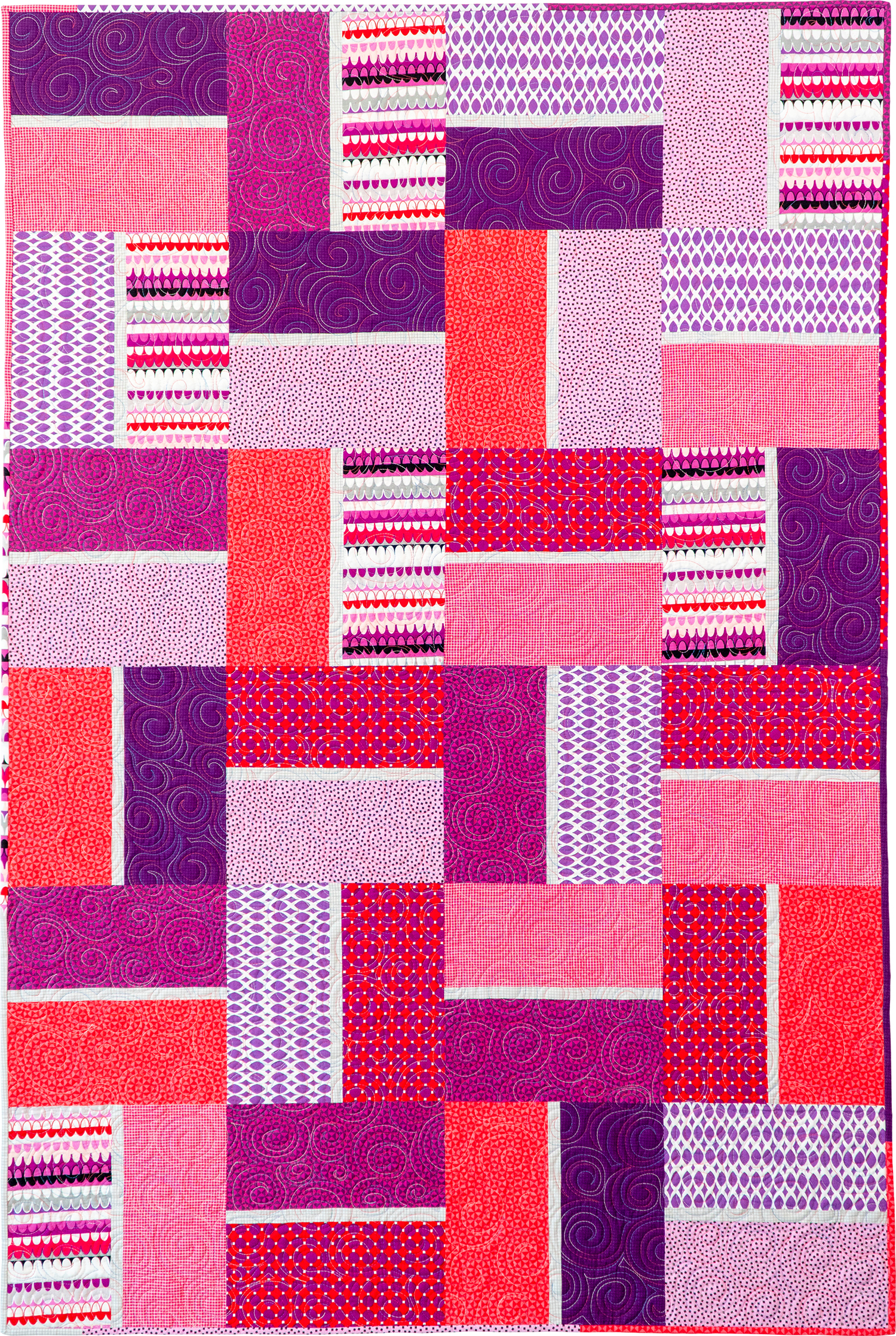
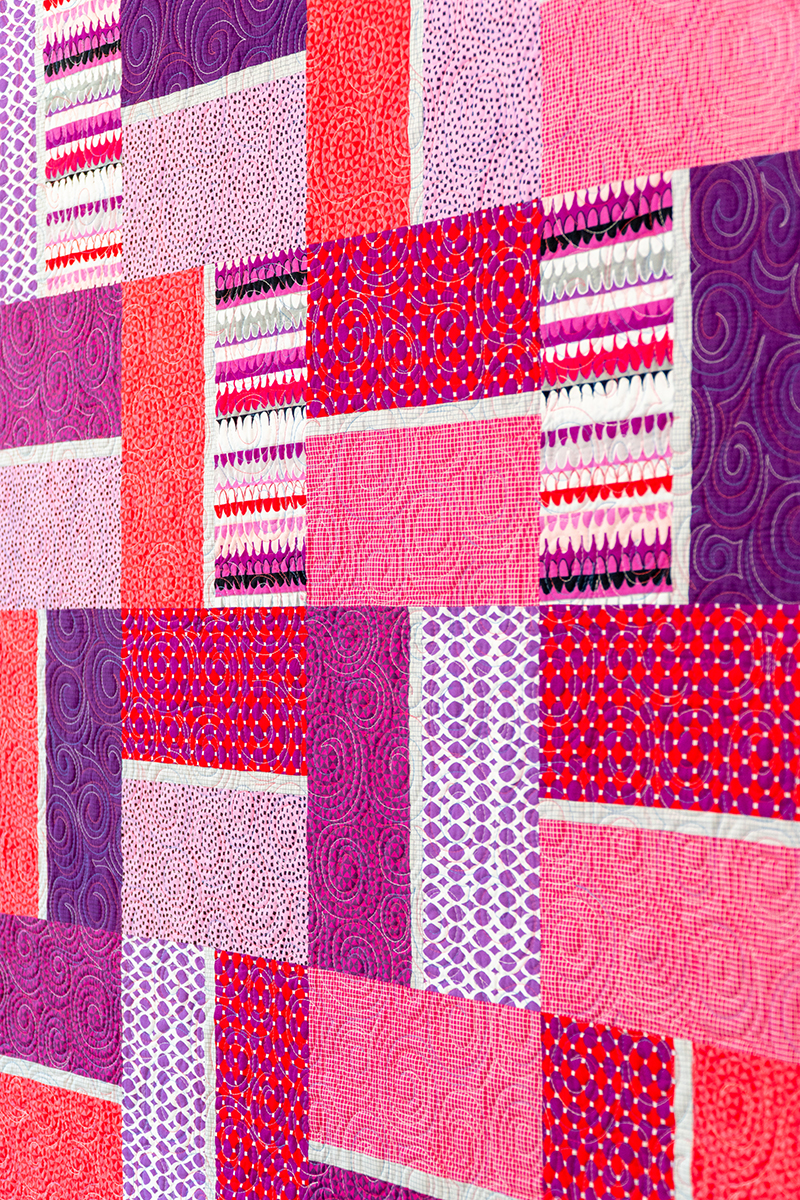
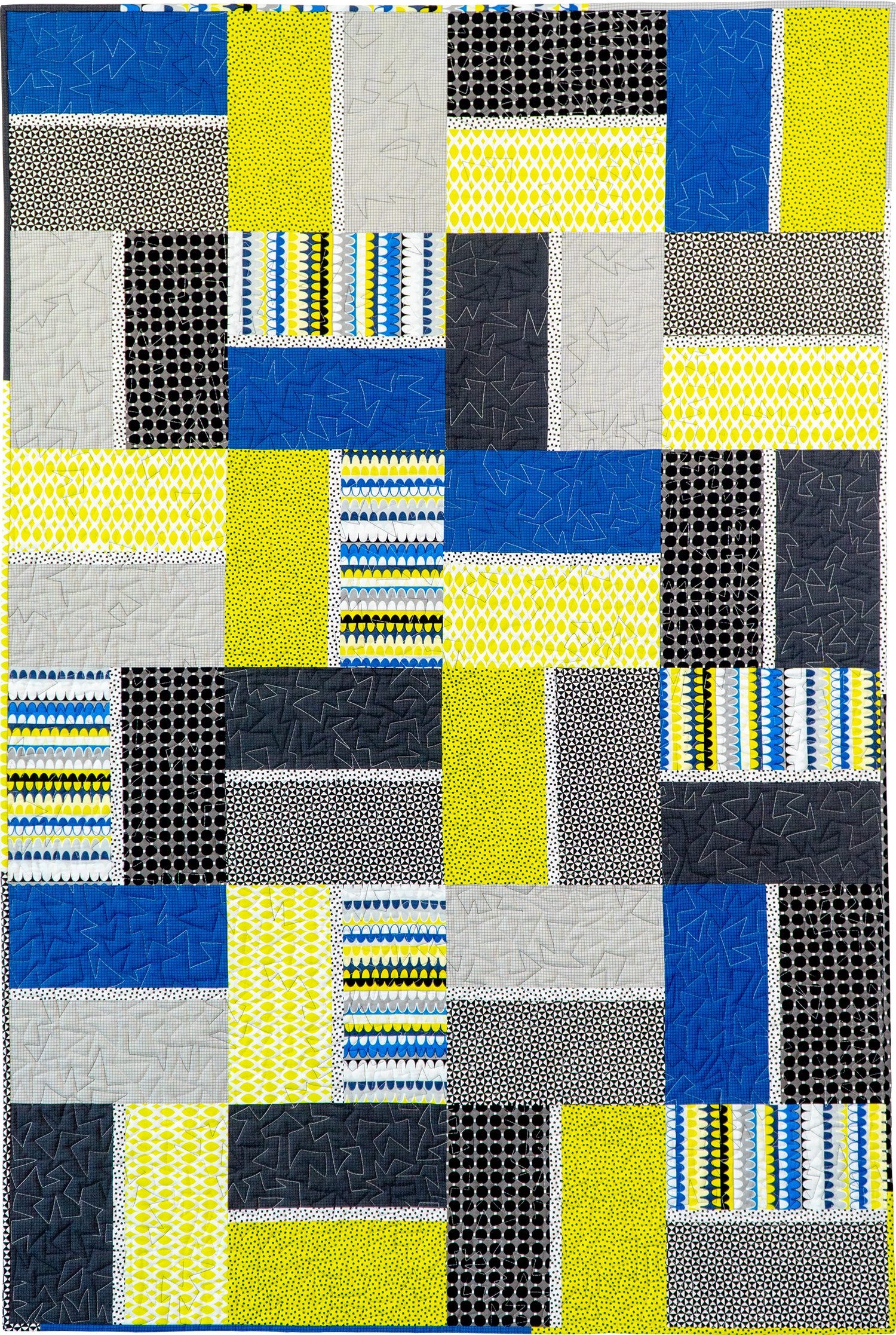
This is the final part of my “making of” series for Terrace Tiles. I hope you’ve enjoyed the journey and are inspired to make your own version! See below for info about these quilts and the previous progress posts.
Terrace Tiles Finished Quilt Stats
Finished sizes: Amethyst and Citron 38″ x 57″; Breeze 57″ x 76″
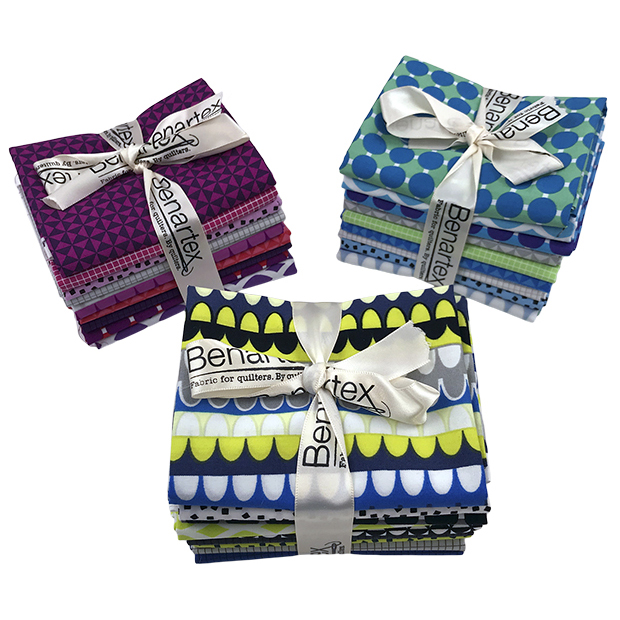
This week, Benartex is promoting my new Gridwork fabric on their social media channels. Along with that, they run a weekly Win-it Wednesday promotion. Today is your chance to win a fat quarter bundle of Gridwork + 2 of my quilt patterns made from it.
To enter, head over to @benartex_fabrics on instagram and leave a comment there. You must follow both Benartex and me @christaquilts on instagram to win. Contest is open until Tuesday, February 18th at 11:59 pm EST. Three winners will be announced on Wednesday, February 19th on the Benartex social media account.
Today I’m excited to share some machine quilting tips and videos for all 3 versions of my Terrace Tiles quilts. My thought is why make one quilt when you can make 3 in almost the same amount of time, right?? LOL!!
Choosing Thread colors
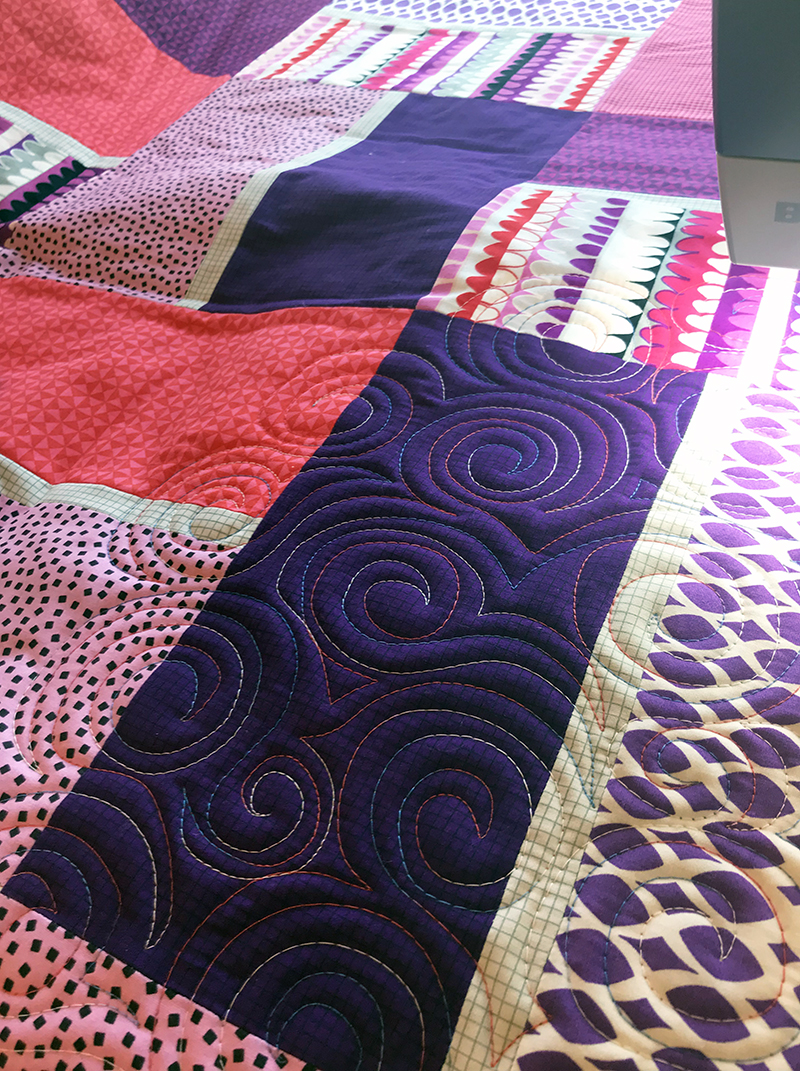
The variegated thread color above is actually a combo of red, white and blue but it looks pink and purple when quilted on the Amethyst quilt!
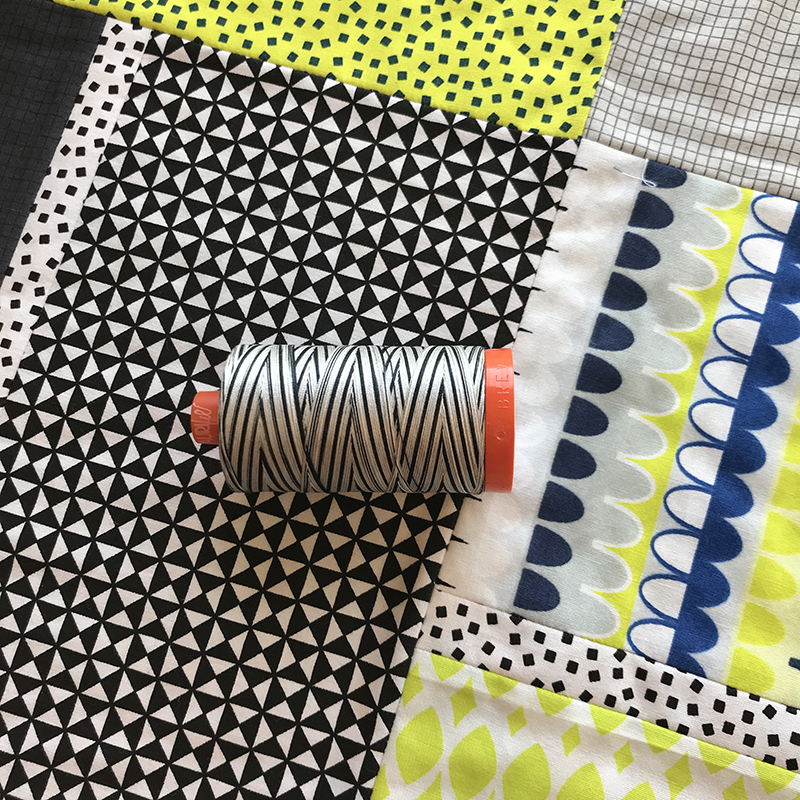
Because these quilts are so bright and colorful, I decided to quilt them using 3 different colors from my Aurifil Variegated Thread Collection. I’ve really been enjoying quilting with them because they add a bit of whimsy and sparkle to my busy quilts! Whenever I pick colors, I audition the thread by placing the spool on top of the fabrics to see how it will blend in.
Variegated thread on the Breeze colorway in progress!
It’s often surprising how well a thread will blend in even if the colors aren’t an exact match to the fabric. I normally use the same color it top and bobbin and don’t worry about whether or not the same colors will line up perfectly – that’s an impossible task. But with the variegated colors, any imperfections are hard to see and that makes for stress free quilting!
The black and white will add an extra dimension to this modern color palette!
Choosing the Quilting Designs
Because I was in a hurry to make these quilts for quilt market last fall, I didn’t have a whole lot of time to finish them. I pride myself on quilting my own quilts because (1) that’s my favorite part and (2) I’m a little bit of a control freak. So I knew I had to choose designs that would look great and wouldn’t take too much time.
Swirls in progress on the Amethyst colorway. Don’t stress about the imperfections!
Also, I wanted these quilts to do double duty. Not only do they showcase my Gridwork fabric and Terrace Tiles quilt pattern, they also are examples of 3 different motifs I teach in my machine quilting workshops: Swirls on the Amethsyt colorway, Boxes on the Breeze colorway, and Jagged Stipple on the Citron colorway.
Boxes on the Breeze colorway is one of my favorite modern machine quilting designs.
The fastest and easiest way to finish a quilt with free motion is to choose one design and quilt it from edge to edge across the quilt regardless of the pieced quilt design. It’s also a forgiving way to hide wonky or irregular seams. Just focus on one block at a time, and before you know it, the whole thing is finished! Another way to speed up the process is to quilt the motifs on a larger scale, because that takes up more space in less time.
Jagged stipple is my modern, angular version of it’s traditional cousin, smooth curving stipple.
Just to give you an idea of how fast these designs are to stitch out, it took me about 3 hours to quit swirls on the baby size Amethyst version, 5 hours to quilt boxes on the throw-sized Breeze version, and 2 hours to quilt jagged stipple on the baby sized Citron version. Although the Citron quilt is the same size as the Amethyst, jagged stipple is a much looser design than swirls, so it was a bit faster.
Scrunching and Smooshing the Quilt
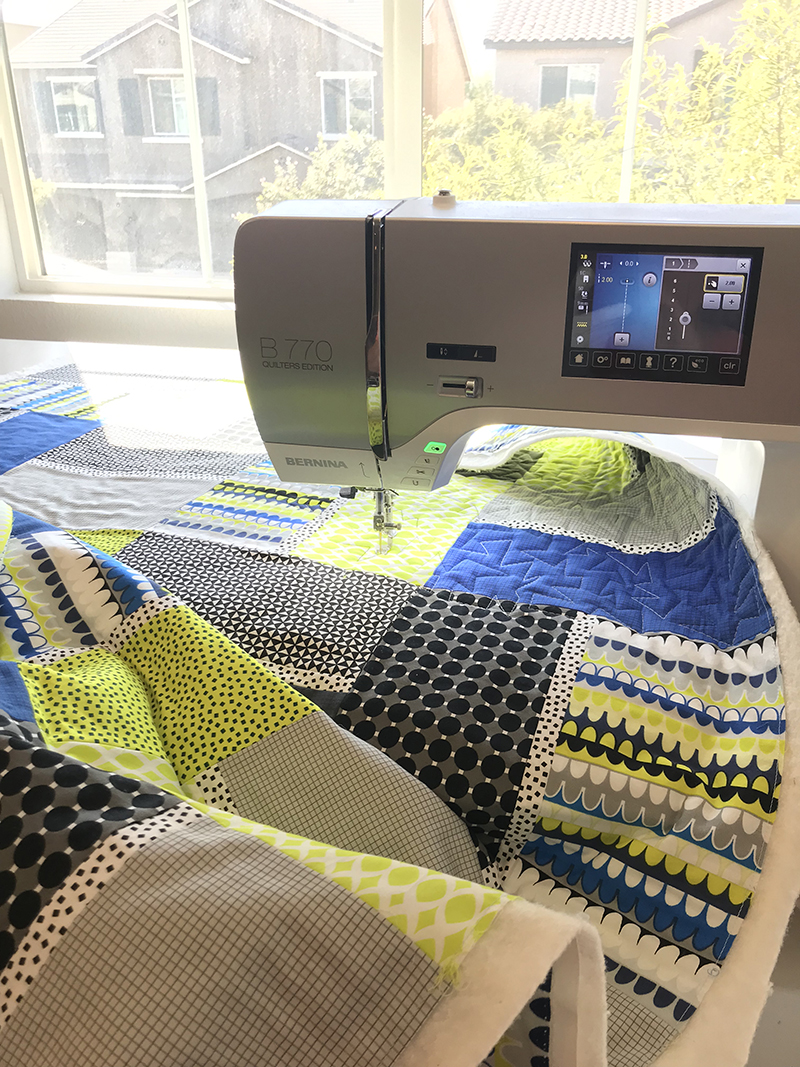
Because I do everything on a sit down machine, it’s important to control the weight and bulk of the quilt. I still have yet to find the perfect quilting table, so this is what my hacked together set up looks like below:
I got this table for a song 20+ years ago and sadly I don’t even remember the brand!
My sewing machine is flush with the bed of the table so it can hold most of the weight. It’s pushed against the wall so the quilt won’t fall off the back of the table. Most of the bulk is to my left, and I’ve placed a TV tray forming an L shape to hold more of the quilt as I scrunch and smoosh it through the machine. I also have a comfortable ergonomic chair that I can roll around easily.
A larger throat space on my machine makes a huge difference when managing the bulk!
On a bright sunny day I like to look out the window which gives me lots of natural light while I’m sewing and quilting! When the quilt falls into my lap, I just scrunch and smoosh it out of the way as needed while I quilt.
I hope this helps you overcome your fear of free motion when choosing and allover textural design like this. The key is to fill in all the spaces, so your eye doesn’t notice any of the imperfections.
See it on Video!
Here’s a YouTube video I made showing me actually fee motion quilting each quilt. The video is just under 8 minutes and it’s packed with tips as I quilt each of the 3 quilts shown above. I’m stitching in real time with the volume on my machine so you can see and hear what it looks like “in real life.” Notice how much I stop and reposition my hands:
Scrappy Binding
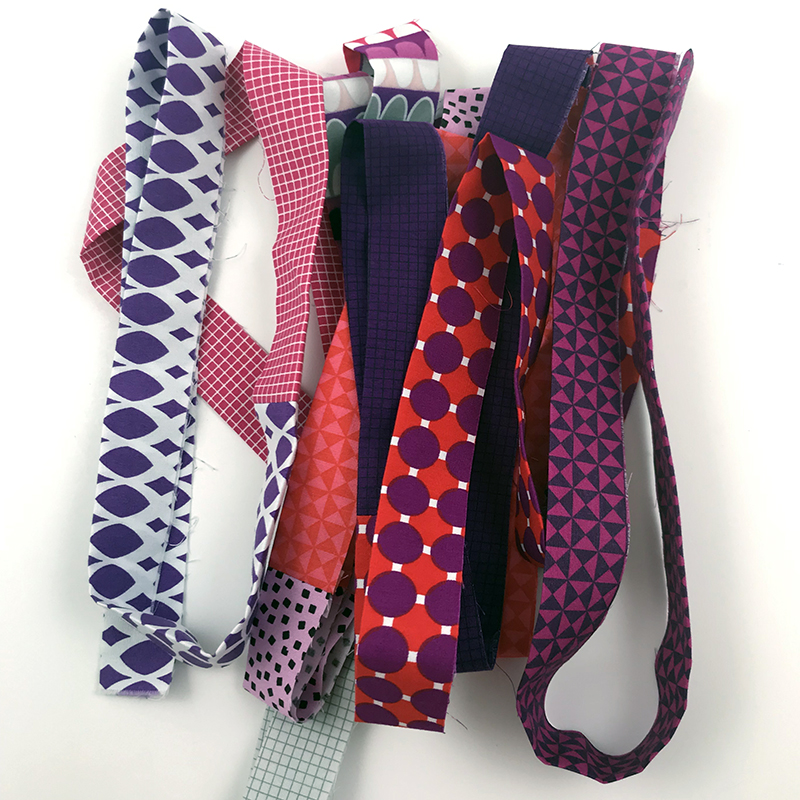
Sew the leftovers together randomly for a fun, scrappy binding!
I love a scrappy binding, especially when making quilts from fat quarters. For Terrace Tiles, you just use up the leftovers and piece them together randomly to carry the colorful chaos all the way to the edges of the quilt.
You can join the ends on an angle or edge to edge!
I prefer to cut my binding strips 2″ wide so they finish nice and narrow and are even on both sides. I press each of the seams open to reduce bulk and make sure the binding is long enough to go around the entire quilt with a few inches extra.
Another great thing about scrappy binding is you can always add more strips!
Although I prefer the look of hand binding, machine binding is a great way to finish fast! Here are my two favorite ways to bind, either by hand or machine:
Remember, if you make your own version of this quilt, please share. You can use #terracetilesquilt on instagram, or you can share your progress in my ChristaQuilts Facebook group. I’d love to see it!!
My Terrace Tiles quilt pattern is quickly becoming a favorite because it is so fast and fun to make!! Last week I shared some tips on piecing the quilt blocks. Now it’s time to finish the quilt tops and get them ready for quilting.
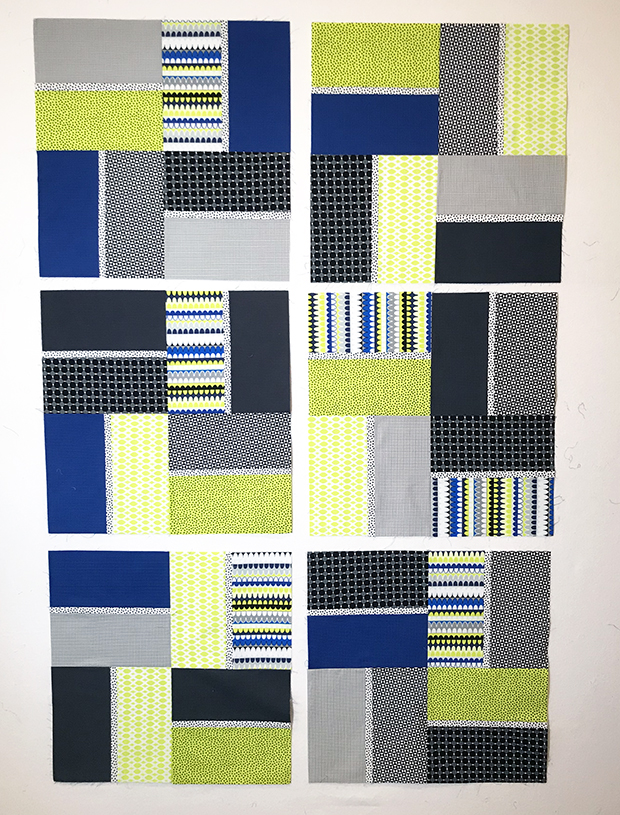
Terrace Tiles in Gridwork Citron Colorway
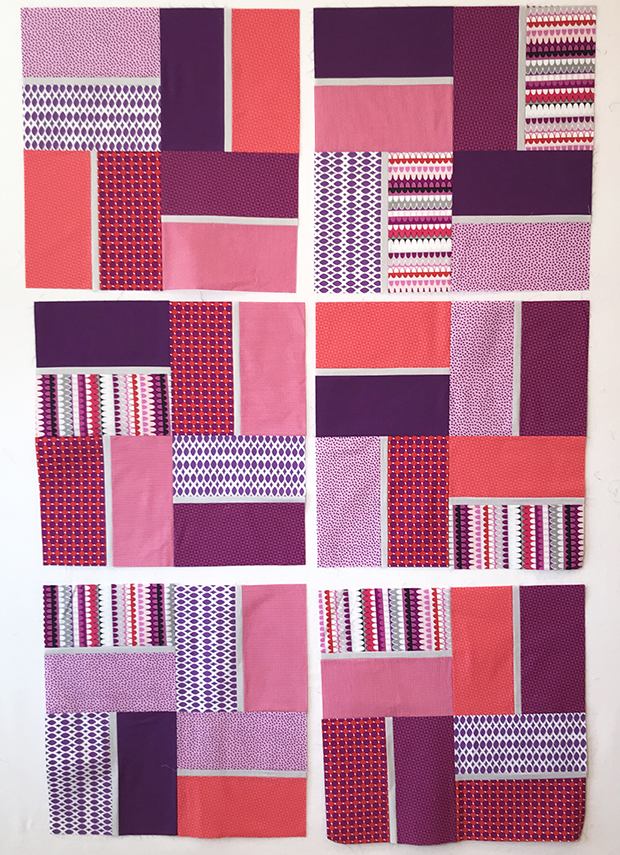
You can either arrange all the blocks on a design wall or other flat space; or you can sew them together into larger sets of 4 blocks like I did to speed up the process. I’m not worrying about block placement at this point. The more random the better!
I’ll take a little bit of time to arrange them in a pleasing order, but I won’t overthink it.
Terrace Tiles in Gridwork Amethyst Colorway
I don’t worry too much if the blocks get a little wrinkly at this point. I’ve used spray starch on the fabric before I cut it which gives the blocks a tendency to wrinkle when handled. But that’s ok – once the top is sewn up and basted they won’t be as flimsy or prone to wrinkling. I also press each seam as I go to keep my blocks as flat as possible.
Terrace Tiles in Gridwork Breeze Colorway
I made the Amethyst and Citron quilts in the smaller crib size. For the Breeze colorway, I wanted to make it in the bigger throw size with more blocks.
Once the blocks are assembled into the quilt top, I take what’s called a “Victory lap:” I sew about 1/8″ around the edges with a longer stitch length to secure the edge seams from splitting open. If the quilt has borders, then you don’t need to worry about that step.
Prepping the Backing
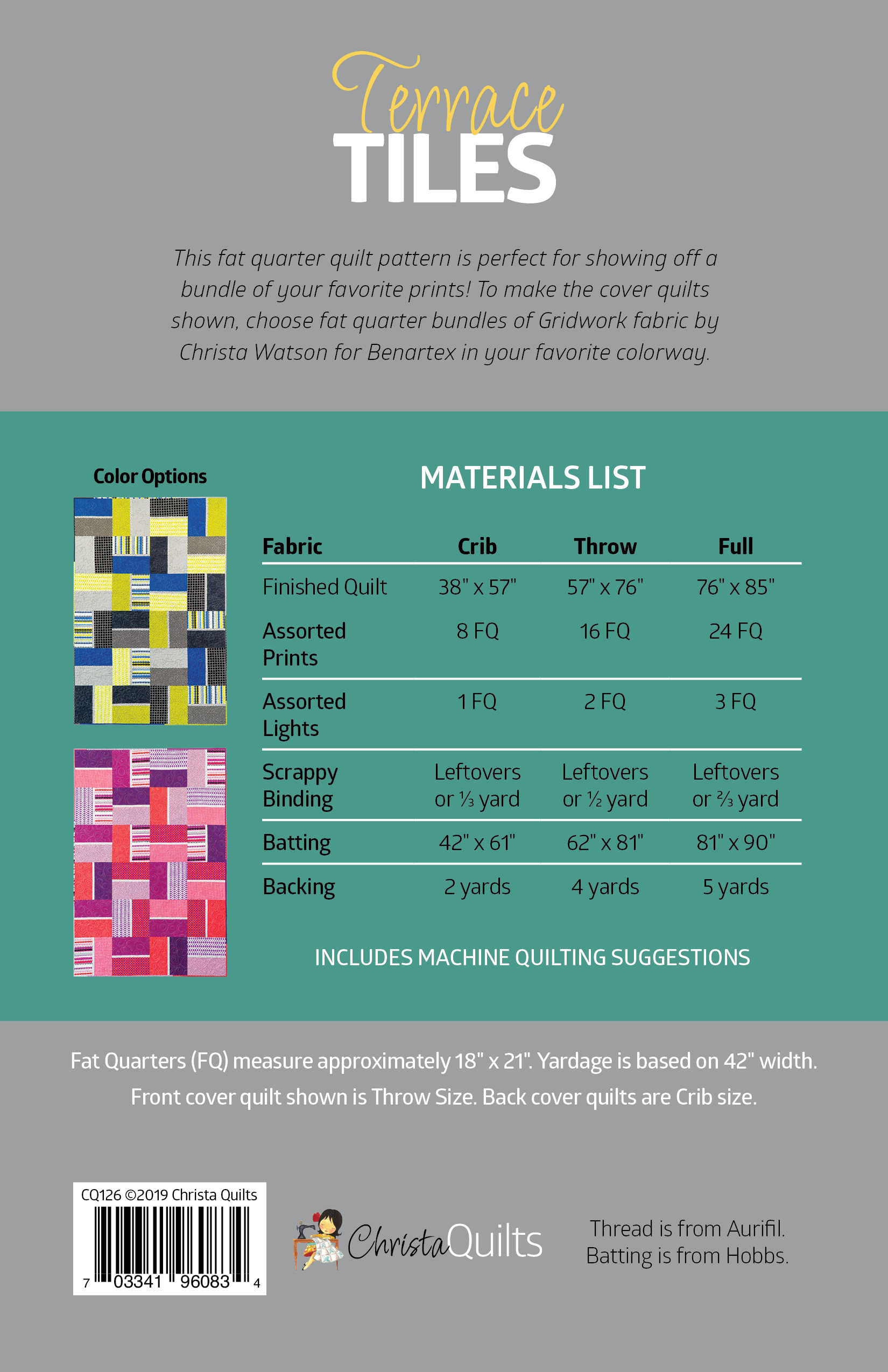
The crib size calls for 2 yards of backing so that you can piece part of it if needed. However, you can get away with less fabric if you measure and baste carefully. As long as the backing is a couple of inches bigger than the quilt top on all sides, you’ll be ok. Below the backing just barely covers the finished quilt top on the left and right, but it’s still enough, thank goodness!
I’ll make sure to pull up the backing from the floor so that it covers the entire quilt top; then I’ll trim off the extra fabric, and press it with starch before I baste.
I also like to take a picture of the batting with the quilt I so I can remember which one I used.
Basting the Quilt
I like to set up a table in my back yard and apply 505 basting spray to the wrong side of the top and backing. It’s much easier to spray the top and backing separately and it uses less spray than spraying the batting instead. Below I’m basting the throw sized quilt so it requires a larger backing.
After spraying outside, I bring the top and backing inside and assemble them on my design wall, one layer at a time.
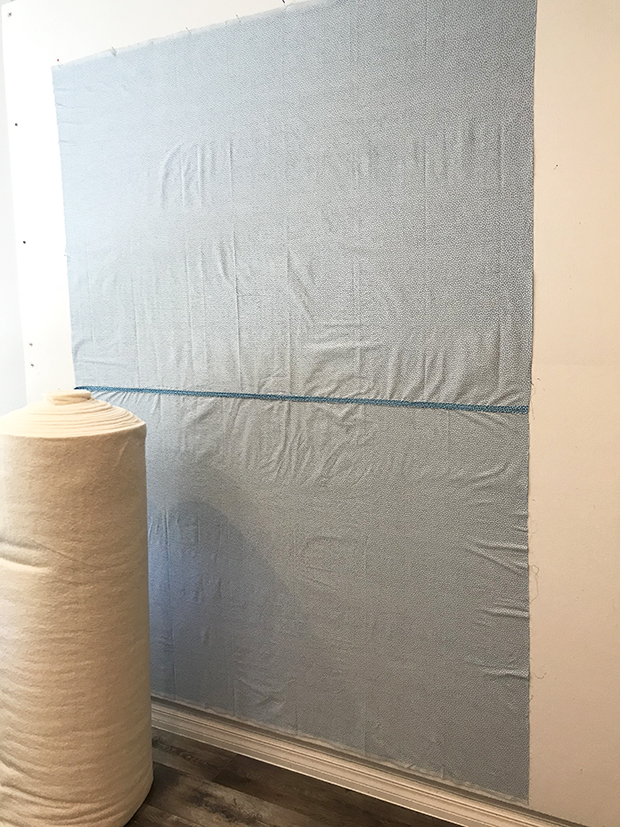
Below, you can see how I pieced the backing for the throw size in the Breeze Colorway: two 2-yard pieces of the blue Hourglass fabric with a horizontal seam in the middle. Don’t worry too much about the small wrinkles – those will get ironed out at the end once the layers are assembled.
I prefer to work with Hobbs batting on a roll so I’ll roll out just enough batting to cover the top plus a few inches, then cut if off the roll and trim off the extra after it’s all basted. I smooth out one layer at a time on my design wall: backing, then batting, then quilt top.
A long acrylic ruler is handy to smooth out each layer. I use a separate one just for basting, since it tends to get sticky from the basting spray.
Above is the Amethyst quilt after basting. I’ll trim off the extra batting and backing fabric so that there’s only about 1″ sticking out on all sides for quilting. That way the excess won’t accidentally get tucked under itself while quilting!!
The final step (not shown) is to iron the front and back of the basted quilt with a hot dry iron. This presses out any wrinkles and helps set the glue so things don’t shift while quilting.
Next week I’ll share some pics and videos the machine quilting I did for each quilt, so stay tuned!























 Christa Quilts