The Pillow Collective – Amy Ellis’ Think Big Edition

Amy Ellis has just released her 4th (yes 4th!) book with Martingale. ๐Ÿ™‚ It’s called Think Big and to celebrate she’s hosting the Pillow Collective – Think Big Edition.

Check out last year’s Pillow Collective here.

Think Big logoFor the blog hop, 15 different bloggers (including me) got a chance to read the book and make a pillow from one of the designs. Let me tell you right now, I have not made a quilted pillow since the early ’90s (I resist 3-D sewing) but boy did I have fun with this one.

I chose Amy’sย  Downtown block and tweaked it a little by using solids for all of the rectangle pieces to create an interesting abstract design. I really like the look of it and definitely need to work more modern design into my decor!

finished_pillow2

For the quilting design, I went to town stitching a whole bunch of random straight lines, using painter’s tape to help establish a straight angle. I quilted on either side of the tape, then used the edge of my presser foot as a guide to add additional random parallel lines.

quilting_lines

The best tip I picked up from Amy’s book was how to finish the pillow. There are excellent step-by-step instructions on how to assemble the pillow front and back together, creating an opening in which to stuff a pillow form.

pillow_bindingFrom the book I also learned that you can bind a pillow the same way you would for a regular quilt. I love the pop of color it adds! Now I’m not scared of pillows anymore and may just make another!

finished_pillow

The pillow is currently sitting pretty in a corner of my very yellow dining room! If I get bored of using it as a pillow, it also makes a cute mini. ๐Ÿ™‚

abstract_mini

Think Bigย includes a beautiful assortment of ten 18″ finished blocks, each with projects in five different sizes! I love how graphic and modern they are, and I’m sure you will, too!

think big cover

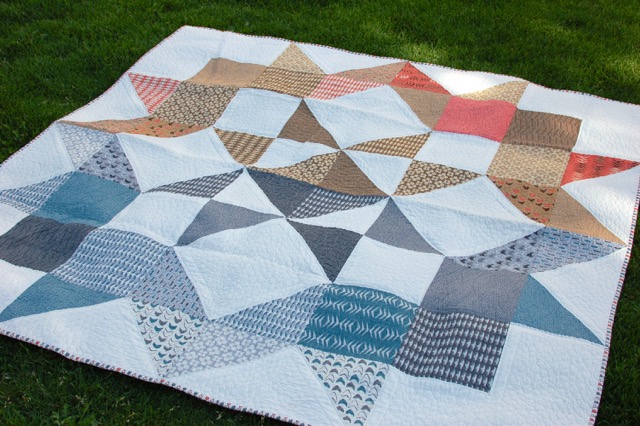
Because Amy is so sweet as well as extremely generous, she’s also hosting a giveaway of several fabric bundles and a quilt featuring her Modern Neutrals fabric line!! To enter, simply pin a pillow to pinterest (say that 5 times fast) using the hashtags #ThinkBigBook and ย #PillowCollective. Click here for Amy’s Pillow Collective Pin Board.
giveaway2

Today is the last day of the blog hop, so be sure to check out all of the previous stops to see all of the other beautiful pillows. I’ve linked to each blogger’s pillow post below:

Now, who’s in the mood to make a pillow?
My Quilt Finishes 2012 – 2014

I recently organized my finished quilts page, showcasing the quilts I’ve made from 2012-2014. The year 2012 was a turning point for me because that’s when I discovered modern quilting and decided I wanted to be a “quilt professional.” Although my quilts aren’t all strictly modern, it’s fun to see them all on one page. I finished 7 quilts each in 2012 and 2013 and then really ramped things up with 19 finishes in 2014!!

I just tell myself that I’m making up for lost time during that period in my life where “Christa didn’t quilt!” ๐Ÿ™‚ You can click on each of the pictures for more detailed information about that quilt. Most of them include pattern information, tutorials, or inspirational in-process pics. Enjoy the show!

2014 Finishes

cwatson_Optical_Illusion_1800

Optical Illusion

Abacus-Finished-for-Blog

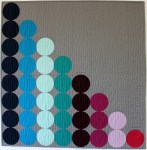
Abacus

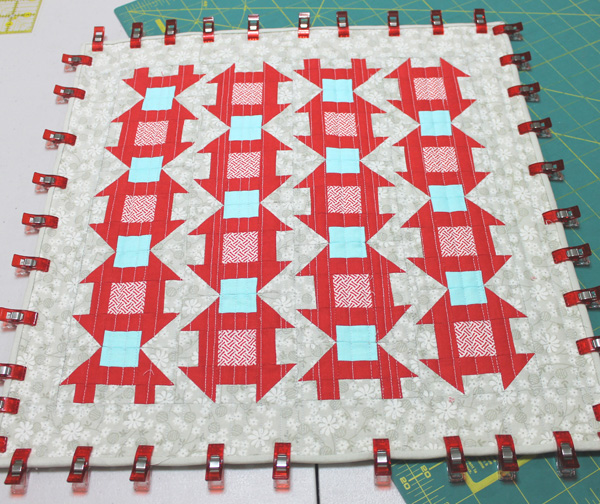
Mini Churn Dash

Mini Churn Dash

Modern Logs

Modern Logs

Herringbone

Herringbone

Modern Quilt

Spiraling out of Control

Modern X

Modern X

12 quilts for my book in 2015!

12 quilts for my book in 2015!


2013 Finishes

Modern Trees

Modern Trees

Colorful Chevrons

Colorful Chevrons

String of Pearls

String of Pearls


Roses for Katelyn

Roses for Katelyn

Hugs 'n Kisses

Hugs ‘n Kisses

Sea of Squares

Sea of Squares

Love by Christa

Love Table Runner


2012 Finishes (The Year I Discovered Modern Quilting)

Charming Chevrons

Charming Chevrons

Girl Baby Bricks

Baby Bricks in Pink

Blue Baby Bricks

Baby Bricks in Blue

Finished Quilt

Busy Hands

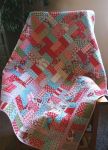
Jolly Jelly Roll Quilt

Jolly Jelly Roll Quilt

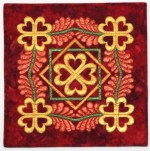
Hearts and Feathers Wholecloth

Hearts and Feathers Wholecloth

Log Cabin Wreath, Pieced and Quilted by Christa Wason 18" x 18"

Log Cabin Mini Wreath

Make a Modern Mini Quilt with My Mini Churn Dash Pattern

I’ve jumped on the mini quilt bandwagon with one of my latest finishes, Mini Churn Dash. I actually made it over the summer, but I’m able to share it with you now that it’s been published in the latest issue of The Quilting Quarterly by the National Quilting Association.

Mini-QADI was actually able to use this mini for two features in the magazine – the pattern on how to make the mini quilt, and my regular recurring column, Quilt As Desired.

Mini_patternI used a few fabrics from Bonnie & Camille’s Miss Kate line, generously provided to me by Moda Fabrics. I had so much fun making this mini!

I wanted to keep both the quilting and the binding in scale so I reduced my quilting stitch length and I finished it with 1/8″ binding rather than the standard 1/4″. It really wasn’t that hard to do. I used single-fold binding strips that were only 1 1/4″ wide and sewed with 1/8″ seams.

mini_bindingI love using Wonder Clips for binding my quilts. The more clips, the better!

In case you missed the magazine issue, you can purchase the individual pattern here.

I’ve been enjoying seeing quilts made with churn dash blocks and am so glad I was able to combine two trending ideas, mini’s and churn dashes into one quilt. If you are inspired to make your own Mini Churn Dash, I’d love to see it! You can share a picture with my via email, on my flickr page, or on Instagram with the hashtag “minichurndash.”

Optical Illusion – The Finish

I was able to finish Optical Illusion just in time to submit it to QuiltCon (the all-modern quilt show and conference). Then I got the exciting news that it was selected for judging along with two of my other entries, Abacus and Spiraling Out of Control. There were over 1300 entries submitted this year which totally blew away the amount of entries received the first time around. What an awesome show it’s going to be!

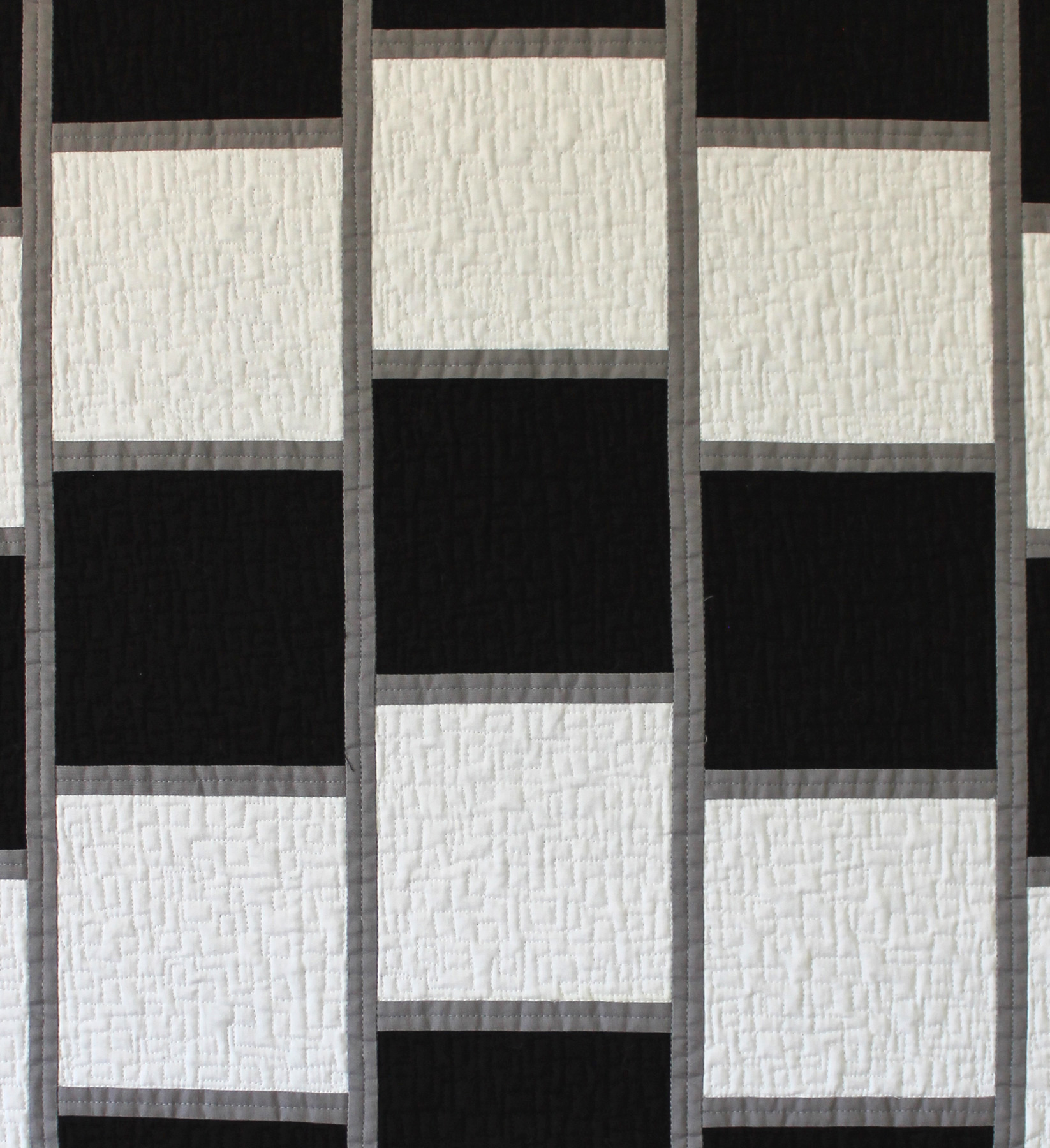
cwatson_Optical_Illusion_1800Optical Illusion, designed, pieced and quilted by Christa Watson

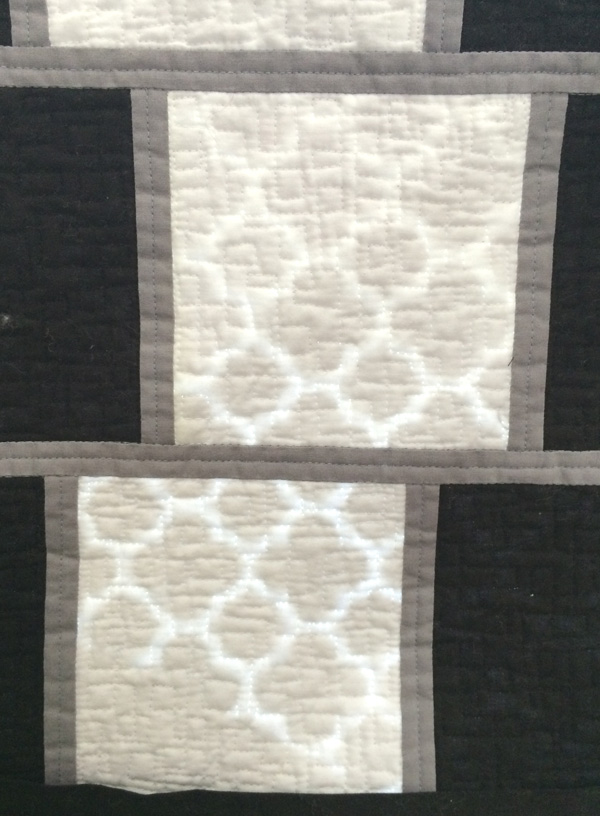
Here’s a detail shot where you can see the quilting a little better:

cwatson_opticalillusion_detI had a lot of fun sharing this one on Instagram, because when my followers scrolled the reduced sized picture up and down, they could get the lines to move. What a fun trick! See if you can get it to move when you scroll this blog post up and down – it’s an interactive quilt!

Another “optical illusion” for this quilt was totally unintentional but added a fun surprise: when you hold it up to the light, you can see the geometric backing fabric shining through the white squares, creating a “stained-glass” effect. Cool huh?

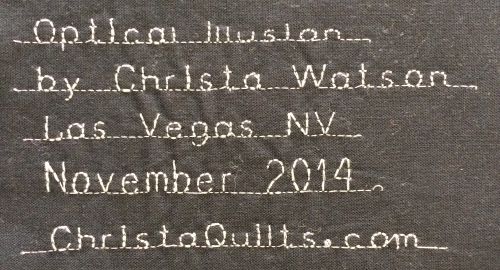
stained-glassThis quilt is as fun to play with as it was to make! Since I finished ahead of schedule, I took a little time to make a not-so-fancy but utilitarian label for it, using the embroidery stitches on my machine. (It’s a Bernina 710 – since I know you are going to ask!)

labelI know several of you have asked for a pattern for it, so that’s in the works. I probably won’t release it though until after QuiltCon, to give me plenty of time to get it ready (and to see how it does during the judging process, LOL!!)

Now, it’s onto the next quilt….

Sneak Fabric Peek of Some New Projects

I’m excited to get a jump start on some quilts I’m hoping to finish next year. I wanted to play around with precuts and scraps and I can’t tell you how refreshing it is to sew with so many colorful pieces of fabric!

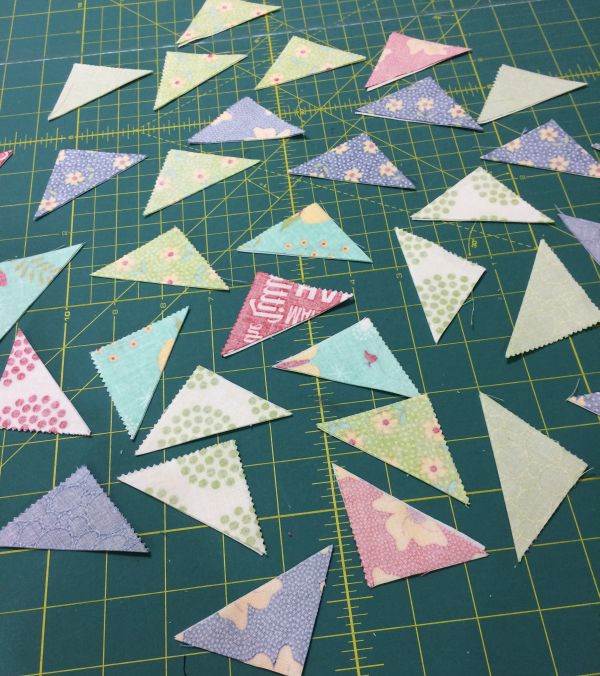
Pat SloanTriangle TipsI’m currently making a quilt using Pat Sloan‘s latest fabric line The Sweet Life which will be in shops (including ours) around February of next year. These are some leftover triangle trimmings from the quilt blocks. I decided they are so fun and colorful that I think I’ll make a bonus project from all of the leftovers. Got any suggestions?

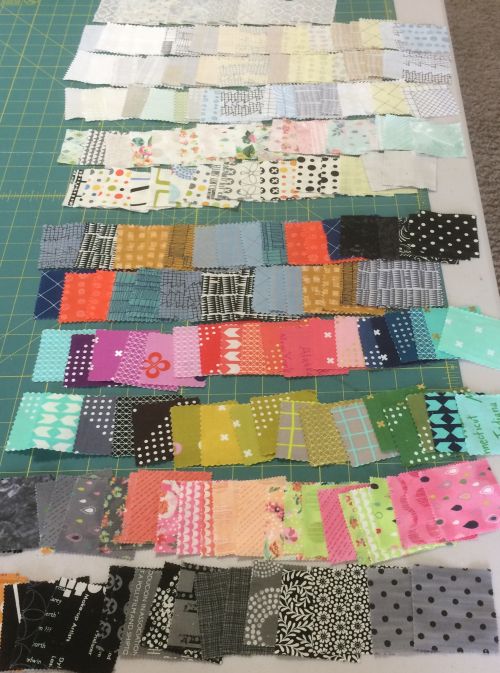
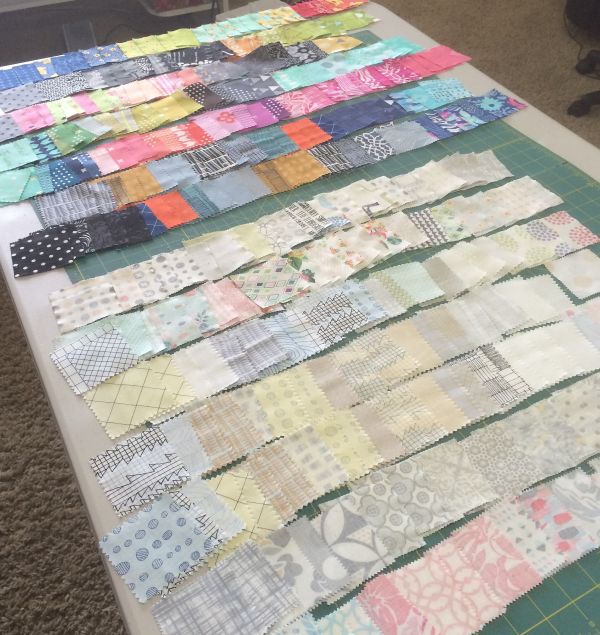
Scrappy Charms_1I also started cracking open some mini charm packs and regular charm packs that I have accumulated over the last couple of months (and this is after attending quilt market and giving most of it away already!!)

Not quite sure what I wanted to do with them, I first sorted them into piles of lights and darks because I knew I wanted high contrast. I was able to flip over quite a few of the medium prints and they turned into pretty low-volume pieces on the back. I just love versatile fabric, don’t you?

scrappy_charms_2I just love the contrast between bright prints and more muted low-volume designs!

I’ve now got the perfect idea in mind – it’s based on a traditional quilt I made years and years ago that I’m going to tweak into a more modern design. I’ve been having a blast sewing together all of these little squares and playing with all these luscious colors and prints!

Work in Progress – Optical Illusion Quilting Update

I’m plowing my way through the quilting on Optical Illusion this week. I hope to get it finished in time to enter it into QuiltCon. No pressure, right? (One of the things I love about entering quilt shows is that they light a fire under me to actually get things done.)

quilting_overviewDon’t you always match your clothing to your quilts when you sew?
I first created a small practice piece so that I could try out a couple of quilting variations with the same fabric, thread and batting as in the real quilt. I’d rather trouble shoot issues now, and know what I’m in for before starting the big quilt.

practice_pieceSmaller practice piece, sewn to scale using the same materials as the big quilt.

One tweak that I made to my spray basting method was to omit dragging my big tables downstairs and outside. I realized I could just lay a large sheet out on the patio and spray the layers of my quilt on the sheet, then take them back indoors for final assembly.

bastingI prefer to spray baste the top and backing separately, rather than the batting.

I tried out several different stitch textures before opting to go with Boxes, the squarish stipple design on the upper left hand of the picture below. After some practice, I realized that the design is really the star of this quilt, so I didn’t want to over-do it on the quilting.

texture_practiceThese textures were quilted on my practice piece so I could see how they looked “in the cloth” before picking a final design.

I realized that I prefer to add texture to my quilts with the quilting, so that I can enhance the piecing rather than overwhelm it. I quilted all of the black areas first in a matching thread, starting and stopping the quilting in each black box.ย  It was a lot of tying off, to bury my thread tails. But it really didn’t take that long, since I did a few rows each night while watching TV.

black_boxesI really like the texture of the boxes. I’m quilting the same motif right now in the white squares and I really like the effect. I chose Quilter’s Dream Orient batting which is super soft and I like the feel of it. However, the batting beards which means there is a lot of white fuzz showing through on the black fabric, so I’m constantly cleaning it off with a lint roller. (I’m still figuring out which battings I like best.)

I should have it all quilted soon and I plan to enjoy the holiday weekend hand stitching the binding on while visiting with the extended family.

Here’s wishing you a Happy Turkey Day!

Work in Progress – Optical Illusion Quilt

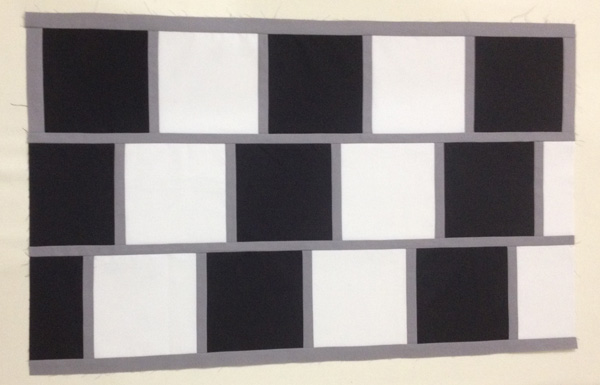
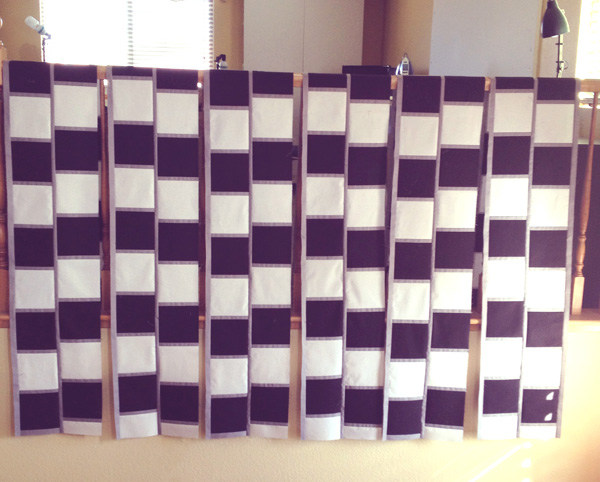
I’m making really good progress on my Optical Illusion quilt I designed several months back. It’s based on the optical illusion called “Cafe Walls” but with a vertical setting rather than a horizontal setting.

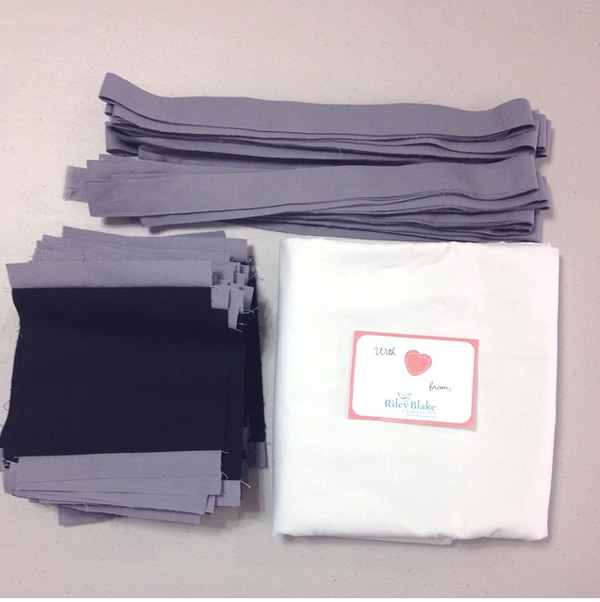
fabricI’m using Riley Blake solids in black, white and grey and decided to cut all of the long skinny strips parallel to the selvedge so they would stretch as little as possible.

RowsI used my railing in my sewing area to keep all of the rows lined up in order. That’s probably the trickiest part!

topI like the illusion it creates when you stare at it for too long! Now I have to decide if I want to make it any wider, and how I’m going to quilt it. That’s half the fun!


Christa’s Quilt Along – Abacus Week 6: Binding

Free Quilt Pattern

New to my blog? Be sure to sign up for my email newsletter to get a free pattern!
Binding

I have really come to love hand binding my quilts. There’s nothing better than curling up on the sofa with some mindless TV and hand stitching for awhile. However, for those of you who prefer a quicker finish, be sure to check out my machine binding tutorial.

And now, it’s onto binding! It took me a total of 3 hours to bind Abacus.

TrimmingStep 1 – Trim the Quilt and Prepare the Binding (1/4 hr)

I use a large square ruler to square up the corners flush with the edge of the quilt. I use a longer ruler to trim up the sides. Be sure you have 1/4″ of background left around the edges of your beads so they don’t get covered up by the binding.

I love the look of a freshly trimmed quilt, ready to bind!

quilt-trimmedTo calculate the length of binding needed, take the perimeter and add 10 inches:

32+32+32+32+10 = 138

Divide this number by 40 to get the total number of binding strips needed. 138/40 = 3.45 which I will round up to 4 strips. Cut them 2 1/4″ wide.

Join your strips together by sewing mitered seams. Place them right sides together, perpendicular to each other with a little bit sticking off on both sides. You will be sewing a diagonal seam indicated by the black line below:

binding_1Note: if you are working with solids, take care to know which side you are working with! You can put a pin to indicate which is the front or back side of the strip.

Trim off one end at a 45 degree angle and press the binding, wrong sides together along the length. This is what it the binding strips should look like when trimmed and pressed:

binding_2

Step 2 – Sew the Binding to the Front of the Quilt (1/2 hour)

Start with the trimmed end and stitch with a 1/4″ seam, leaving a tail of about 6″ dangling off the quilt. When you near a corner, make a crease indicating the edge of the quilt underneath. Stop sewing exactly 1/4″ away from the crease and sew off the end at an angle.

binding_3To fold the miter on each corner, lift the strip up and away, parallel to the quilt. Bring it back down upon itself, even with the edge of the quilt, creating some bulk. I call this the “funky fold.”

binding_4Continue sewing from the corner you just folded, all the way around the quilt, mitering each corner as you go.

When you get close to the end of the quilt, leave another tail of about 5″ – 6″.

Join the ends together by opening the beginning tail with the angled edge and placing it on top of the ending tail with the untrimmed edge. Draw a 45 degree line on the untrimmed end. I’ve drawn a black line on the photos below so you can see that more clearly. Cut 1/2″ away from the drawn line. Use a small ruler with a 45 degree angle for an accurate cut.

binding_5

Pin the beginning and ending tails together and sew with a 1/4″ seam, offsetting the edges by 1/4″ (see that little triangle peeking out below). You may have to scrunch the quilt out of the way to make room. Finger press the seam open, fold the binding in half again, and finish sewing the binding to the front of the quilt.

binding_6Step 3 – Pin or Clip the Binding in Place to Sew (1/4 hour)

With an iron, press the binding away from the quilt on the front. This creates a crease making it easier to fold over the binding and sew in place by hand or machine.

binding_7Fold over the edges and hold in place with pins or clips. My favorite are the Clover Wonder Clips in packs of 100. I prefer to clip the whole thing in place so it’s ready to sew, and I place them pretty close together so I can quickly use up a whole bag of clips!

binding_8

Don’t forget to fold the corners in place and secure with a clip. They will automatically create a nice pretty miter on the back – aim to line up the two corner edges so the miter is right in the middle of the corner.

Step 4 – Finish by Hand (2 Hours)

I forgot to take pictures while sewing the binding down by hand. I guess I was enjoying myself too much. Click here for another hand binding tutorial which basically outlines the steps above with hand stitching closeups.

Congratulations on a great finish!

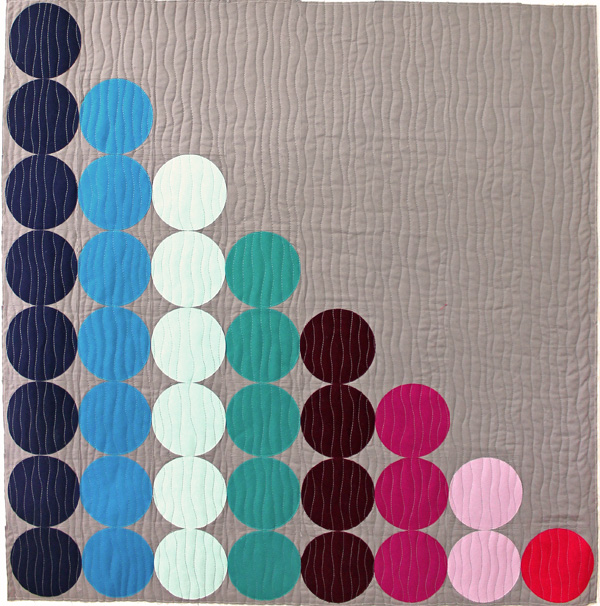
Abacus-Finished-for-Blog

Click here for all of the Abacus Quilt Along Tutorials.

Sharing is Caring

Please share your work in progress in my facebook group: Quilt With Christa . ๐Ÿ™‚


Christa’s Quilt Along – Abacus Week 5: Machine Quilting

Welcome to another installment of my Abacus Quilt Along! Today is when the magic happens. It’s time to machine quilt, which I think is the most fun part of the quilt making process. It took me only 1 3/4 hours to machine quilt – so fast and fun! ๐Ÿ™‚

I’ve written several blog posts about getting started with machine quilting, including many of my favorite tips and tricks. Click here to read them all!

machine-quiltingMachine quilting wavy lines with your walking foot is super simple and fun!

Step 1 – Practice Quilting on a Scrap (1/4 hour)

I always, always, try out my quilting idea before I quilt the whole quilt. More often than not, I’m disappointed if I skip this step. What I see in my head may not translate well in fabric, so it always helps to make a small practice piece. It can be as simple as two scraps of fabric with a small piece of batting. Or sometimes I will make up a complete block using the same fabrics and thread as in the quilt.

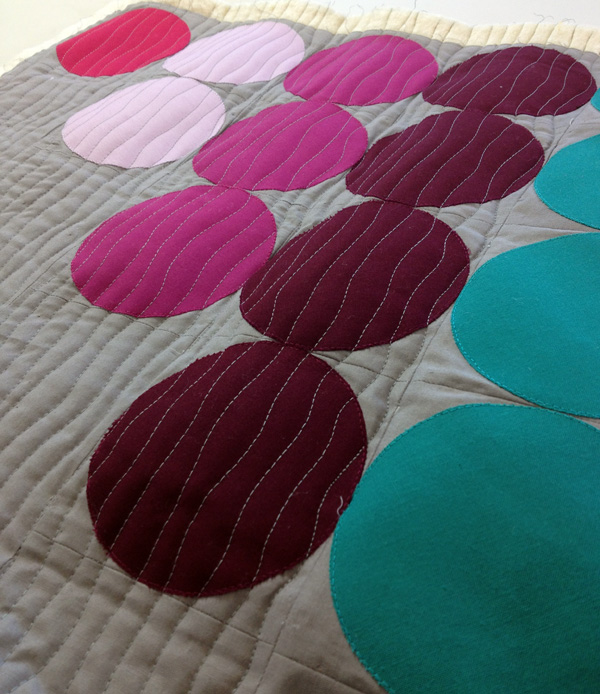
illustration_3_abacus_quiltingOne of the biggest unknowns when machine quilting is how the quilting thread will look on a wide range of fabrics. I’d rather try it out on a smaller piece to make sure I’m happy. I think the grey Aurifil 50 weight cotton thread and uneven lines of quilting look great on both the light and dark fabrics. So now I’m ready to move onto the real quilt.

Step 2 – Quilt the Anchor Lines, AKA Stitch Near the Ditch! (1/2 hour)

Whenever I begin quilting a piece, no matter how large or small, I always start by quilting a series of anchor lines across the surface of the quilt. This helps stabilize the quilt for more quilting later. For Abacus, I stitched my wavy anchor lines right next to each of the vertical seams, moving the quilt slightly from side to side, letting the lines wobble a bit.

If the quilt is well basted, it doesn’t matter where you start. I usually start quilting in the middle, and move to the right across the quilt, stitching each line from top to bottom. Then I rotate the quilt ninety degrees and finish the other half in the same way.

Anchor-QuiltingRight now it looks like a bit of a mess, but I know from my practice piece that once all the lines are filled in, it’s going to have some incredible texture.

Step 3 – Quilting the Wavy Lines (1 hour)

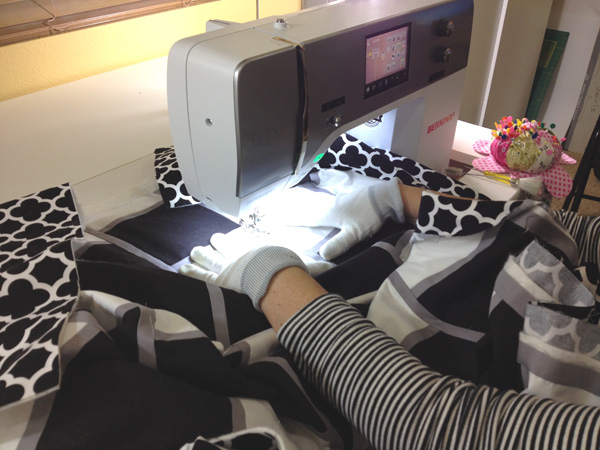
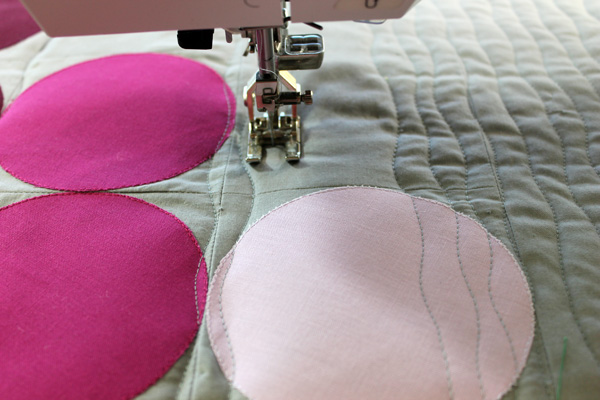
I quilted wavy lines using my built in even feed. That’s the same thing as using a walking foot. I increased the stitch length slightly and moved the quilt from side to side as the machine stitched, creating the waves.The feed dogs are up as normal and I’m wearing Machingers gloves to give me a better grip on the quilt.

machine_quilt_1Once the anchor lines are quilted, I filled in the spaces between the rows with more wavy lines. I quilted a few lines on the left, then a few lines on the right, all the while aiming for a very organic (messy) looking texture. I let the number of quilted lines vary per row, and used the width of my foot as a rough guideline for spacing.

For those of you who can adjust your presser foot pressure, I set mine all the way down to zero. This really helps eliminate tucks and puckers.

machine_quilting_abacusIn the picture above, I have quilted all the anchor lines and completely filled in the wavy lines on half of the quilt. I rotated the quilt, now I’m ready to finish quilting the other side!

Voila! Quilting finished! Next week I will show you how to square up the quilt and bind it.

abacus_quilting_finishedIf you are enjoying this quilt along, please share your progress on my flicker group or on Instagram #abacusqal.

Remember, I encourage you to work at your own pace. However, if you finish your quilt (or even just the top) by November 10th, Iโ€™ll be happy to feature it on my blog in my parade of quilts! ๐Ÿ™‚

Click here for all of the Abacus Quilt Along Tutorials.

Christa’s Quilt Along – Abacus Week 4: Basting

Good news: Abacus is now available as a stand alone pattern for just $4.95! Click here to purchase. (You don’t need the pattern for the quilt along, but I know many of you would prefer to print it off and keep by your sewing machine.)

abacus_quilting_finished

Basting is probably everyone’s least favorite part of the quilt-making process, and I think I know why. Recently I helped my friend make a small baby quilt and we basted it on her kitchen floor because she didn’t want to scratch up her table. What an awful process! I would never do that again, LOL!!

spray_basting_5Tables are the best for basting – use one, two, or your kitchen table – just not the floor!

Yes, it takes up a lot of room to baste on a table, and in my friend’s case, you may not want to scratch up your table. I suggest getting some plastic folding tables like those above that can be stashed in a garage or closet. Or keep some large pieces of cardboard to protect your kitchen table if needed. You don’t need a huge table – you can move the quilt around as needed, but please, get up off the floor! ๐Ÿ™‚

For today’s basting tutorial, it took me a total of 1 1/4 hours to safety pin baste the three layers. Click here for my tutorial on spray basting (outside or in a well ventilated room – on a table!)

Step 1 – Prepare your batting and Backing Fabric (1/2 hour)

You want to make sure there are about 2-3 extra inches of backing and batting around all 4 sides. My quilt top is 32″ x 32″. Therefore my batting should about least 34″ x 34″ and my backing should be about 36″ x 36″.

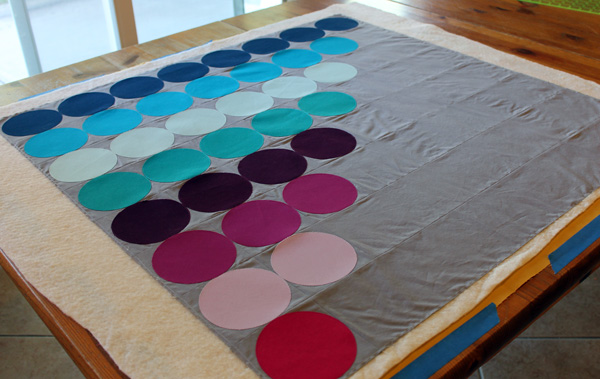
table_baste_1Dining Room Table Basting – Checking to see that my backing is bigger than my top.

If using cotton batting, give it a quick press to work out any wrinkles. You want the quilt sandwich to be as flat as possible. Also, starch your backing fabric before you baste to make it extra slippery. This will come in handy when machine quilting.

Step 2 – Pinning the Quilt (3/4 hour)

Lay your backing right side down on a table. Tape down the edges of the quilt with masking tape or painter’s tape. You can also use binder clips if your table isn’t too thick. You want the backing to be secure but not taut. Only tape down the backing, not the other layers.

table_baste_2All 3 layers ready to go for basting! I will smooth out the wrinkles next.

Lay your batting on top of your backing. Get someone to help you if possible, so you can lay it down smoothly. Add your top, right side up. Before pinning, take a few minutes to smooth out the layers with your hands or a long ruler.

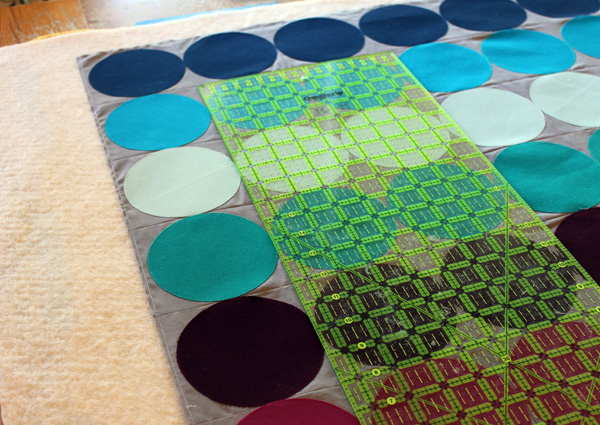
table_baste_3Using a ruler to smooth out the wrinkles and align the rows into place.

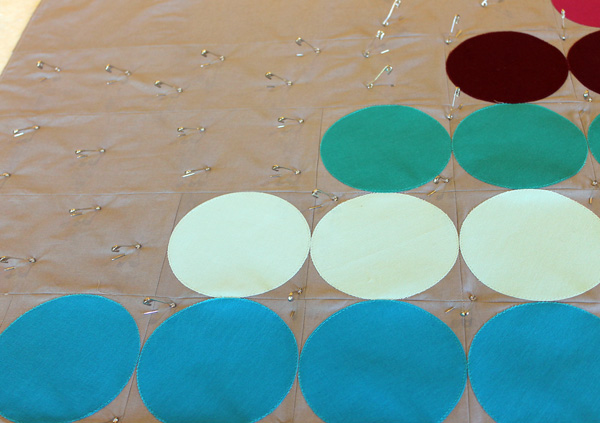
Starting anywhere on your quilt, drop a bunch of safety pins on the top to work with. I recommend using size 1 nickel plated safety pins. I left them open from the last quilt so they are ready to go. The usual recommendation is to pin about 5″ apart. However, I find that I get fewer tucks and wrinkles when I pin closer, about 2″-3″ apart. For this quilt I only pinned in the background sections, not in the circles.

table_baste_4Pin an entire section, then go back and close the pins. This quilt was small enough that I pinned the entire top before closing the pins. A Kwik Klip comes in really handy for this. Click here to see how to use one.

Work you way across the quilt, pinning one section at time. When the quilt is fully pinned, remove the tape and check the backing to make sure you haven’t pinned in any tucks. Then trim off some of the extra batting and backing so there’s less bulk under the machine.

table_baste_5Now you are ready to quilt! There, now,ย  that wasn’t too bad, was it? Remember, I encourage you to work at your own pace. However, if you finish your quilt (or even just the top) by November 10th, I’ll be happy to feature it on my blog in my parade of quilts! ๐Ÿ™‚

Click here for all of the Abacus Quilt Along Tutorials.